
Key takeaways
- Australia built a world-class accumulation system but has yet to develop a decumulation system to match.
- The underlying problem holding back retiree lifestyles is the confidence-to-spend gap, not the size of balances.
- Structured retirement defaults and scaled financial advice are converging on the same problem, but the industry has not resolved where product design ends and advice begins.
- Longevity risk is the reason retirees underspend, but the industry has not found a way to protect against it that is affordable, scalable, and acceptable to members.
- Super funds’ ability to become the trusted centre of the retirement ecosystem is constrained by capital, expertise, and legacy architecture.

Australia's superannuation system holds around $4.5 trillion in retirement savings and is widely regarded as one of the best accumulation frameworks in the world. Helping members spend those savings, however, remains the system’s next great challenge.
Across 11 interviews with senior executives at funds managing more than $1 trillion in assets on behalf of more than 10 million members, one finding is unanimous: the system faces a structural transition challenge as it shifts from accumulation to retirement income delivery.
The industry agrees on the diagnosis – retirees underspend out of fear, not necessity, leaving large balances intact – yet disagrees on the solution.
Whether structured retirement defaults or scaled financial advice should lead the response remains unresolved, with fund positions ranging from opt-out pathways to outright rejection of defaults.
Longevity risk sits beneath the confidence problem, but the products designed to address it remain too expensive, too complex, or too unfamiliar for most members.
And the operational infrastructure that must underpin a mature retirement system – payments, cybersecurity, registry platforms – is stretched by a pace of growth that has outrun the industry's capacity to build.
Not everyone shares the same confidence in the system's future. At least one contributor cautioned that everyday Australians — particularly younger workers — may be less supportive of compulsory superannuation than the industry realises, and that the industry must continue to earn and strengthen the broad political and community support that the superannuation system relies on. The sections that follow examine how the industry intends to close the gap: through retirement defaults, scaled advice and guidance, longevity protection, and the infrastructure required to deliver it.
From saving to spending
Australia has spent decades building a retirement savings system that is the envy of the world. The challenge now is that the tools and services needed to help members spend those savings are still being developed.
The system is structurally misaligned. It was designed to accumulate, and it does that well. But the shift from saving to spending demands a fundamentally different set of products, services, and institutional capabilities that the industry is still assembling.
"We need to acknowledge that today we've built a world-class accumulation system, but we're yet to build a world-class decumulation system," UniSuper Chief Advice Officer Andrew Gregory says.
"The shift will not be about how much money have I accumulated; it's actually how confidently can I live in retirement."
Retirement exposure (selected super funds)
Member accounts, assets and pension payments in retirement phase, at 30 June 2025
| Fund | Retirement | Retirement | % of Assets in | Pension Payments |
State Super | 64.0 | 38,000 | 100% | 5,750 |
Australian Retirement Trust | 108.5 | 53,939 | 16.2% | 3,899 |
AustralianSuper | 125.8 | 56,657 | 14.6% | 3,789 |
Aware Super | 133.8 | 48,042 | 21.2% | 3,312 |
UniSuper | 59.2 | 35,133 | 24.3% | 3,287 |
HESTA | 30.3 | 9,256 | 9.6% | 728 |
CBUS | 24.1 | 9,042 | 8.9% | 700 |
* % of assets in retirement for APRA-regulated funds reflects assets in pension (tax-free) phase as a proportion of total net assets (Conexus Institute, State of Super 2026, based on APRA FY2025 data). State Super figure reflects total Pooled Fund net assets; as a closed defined benefit fund the entire fund is in decumulation.
** State Super pension members include 52,100 SSS, 6,713 PSS and 5,193 SASS pension members at 30 June 2025.
Aware Super CIO Simon Warner frames the same challenge through the lens of what members experience. The accumulation phase, he highlights, is "almost perfectly designed to align to good outcomes" – an individual account structure that gives members transparency, control, and the benefits of scale.
But in retirement, members want the opposite: the certainty that defined benefit schemes once provided, without the risks that came with them.
“We need to acknowledge that today we've built a world-class accumulation system, but we're yet to build a world-class decumulation system.”

Andrew Gregory
Chief Advice Officer, UniSuper
Many retirees pay unnecessary extra tax by keeping their assets in accumulation mode, despite being eligible to move their savings into tax-free retirement products. But the deeper problem is that retirees who do transition into pension accounts still struggle to spend. Research consistently shows that many Australians die with larger super balances than they had at the point of retirement1.
The retirement system is complex, relying on the interaction between superannuation, the Age Pension, and housing. CBUS Chief Strategy Officer Bernie Dean says most of the fund’s blue-collar members retire with $150,000-$200,000 yet too few take the obvious path to maximise their retirement lifestyle.
"There's probably still about a third of our members in that 55 to 60, and 65 year-old cohort that aren't aware that we actually have really good, robust long term performance on our income streams,” Dean says.
AustralianSuper Head of Retirement Jacki Ellis says their vision is to provide personalised guidance to every member in the pursuit of helping them live well in retirement, integrating the different pillars of the retirement system – super, the Age Pension, housing – at a household level. She admits that achieving this vision is ambitious.
"We tend to overestimate the amount of change you can generate in a year and grossly underestimate the amount of change that you'll see in a decade," AustralianSuper’s Ellis says.
What the system owes its members
Few questions in Australian superannuation provoke sharper disagreement than whether funds should default retiring members into income stream products – and if so, how forcefully.
The accumulation phase is relatively simple. Most Australians are automatically placed in low-cost default MySuper products that offer a broadly similar experience across funds. There is no such mandated retirement-phase default product given the unique nature of retirees' wants and needs.
"We can't do retirement well if we take a one-size-fits-all approach," says AustralianSuper’s Ellis.
The interviews for this report reveal a genuine spectrum of positions on retirement defaults, shaped heavily by the demographics and engagement levels of each fund's membership.
At one end, HESTA advocates for an opt-out retirement pathway transition, where a member is automatically shifted unless they actively choose otherwise. The fund's position is driven by a membership where inaction is the real risk: 80 per cent of members are women working in health and community services, and 86 per cent sit in the fund's MySuper option. Both a gender super gap and an undervalued sector pay gap leave them with lower retirement balances, so every dollar counts.
“HESTA's latest research shows between 2017 and 2025, eligible Australians missed out on a staggering $13.5 billion in retirement income simply because they weren't transitioned into retirement phase products when they became eligible,” says Shannon O'Shea, General Manager, Retirement at HESTA2.
O’Shea further adds, “Our position isn’t about treating members as a homogenous group. We’ve invested heavily in sophisticated member segmentation modelling, drawing on enriched qualitative and quantitative data, as well as our deep connection with the Health and Community Services sector, which gives us genuine insight into our members’ preferences and needs. Our insight tells us the majority of our members have relatively simple advice needs, and for them, inaction is the real risk. An opt-out pathway is how we make sure good member insight leads to good outcomes.”
At the other end of the spectrum, UniSuper takes a different view on the concept of defaults, arguing that the complexity hidden behind superficially similar member profiles – including different debt levels, government entitlements and family structures – makes defaults inappropriate for its more affluent membership.
“Between 2017 and 2025, eligible Australians missed out on a staggering $13.5 billion in retirement income simply because they weren't transitioned into retirement phase products when they became eligible”

Shannon O’Shea
General Manager, Retirement, HESTA
“Our view is that defaults should be active decision-making and that every member is different and every set of circumstances are different,” says Andrew Gregory, Chief Advice Officer at UniSuper.
State Super CEO John Livanas, whose closed defined benefit membership is in the retirement phase, is sceptical of any approach that seeks to impose a one-size-fits-all solution.
“People’s family circumstances are all very different. Their requirements might each be different. Their sensitivity to risk and their financial needs are likely to be different,” Livanas says.
He argues that the very architecture of the superannuation system, and the visible, personal relationship members have with their money, makes a prescriptive approach counterproductive.
“Every month, members can see their money on their statement. It is real and it is theirs to access. So why tell them what to do with it? Let them make their own decisions. If we break that relationship, they may start to lose faith in the system altogether.”
The dominant middle ground
Between HESTA's opt-out and UniSuper's rejection sits the position held by the largest cluster of funds interviewed: opt-in cohort-based defaults, where funds present tailored suggestions based on what they already know about a member. AustralianSuper, Australian Retirement Trust (ART) and J.P. Morgan Asset Management all, to varying degrees, occupy this ground.
"Our position is that we're very much in favour of opt-in cohort-based defaults for retirement, paired with easy and freely available guidance and advice, embedded in really great and easy service and transactions," AustralianSuper’s Ellis says.
ART was among the first funds to publicly call for some form of nudge or soft default. Brnic Van Wyk, Principal, Retirement Solutions at ART, frames it as complementary to advice.
" We're not suggesting that soft defaults replace any form of existing or future digital or human advice, rather they complement it."
“We’re not suggesting that soft defaults replace any form of existing or future digital or human advice, rather they complement it.”

Brnic Van Wyk
Principal, Retirement Solutions, Australian Retirement Trust
What ART is calling for, Van Wyk says, is the ability to take a modest but meaningful step: "We want to be able to use what we do know about somebody to provide them with a suggestion on that basis. And that's an enormous step forward, but a baby step away from integrating data with the ATO and all these other ambitious things that people are talking about."
Vanguard Australia Chief of Personal Investor, Renae Smith, also opts for a middle ground.
"Retirement defaults will continue to play an important role, particularly softer, opt-in approaches that guide members without limiting choice. Entry into retirement should remain an active decision rather than driven by hard assignment models."
From a global perspective, J.P. Morgan Asset Management's Daniel Oldroyd describes a model already emerging in the United States where guaranteed-income options are embedded within accumulation vehicles as an opt-in feature.
"It says, if you would like to turn some portion of this into guaranteed income, you can do that. If you do not, it looks and feels like the accumulation vehicle."
Oldroyd also cautions against judging retirement defaults by immediate uptake.
"Utilisation shouldn't be dismissed as a success metric. Adoption of these solutions is a long game – you don't launch and immediately see 100% of members signing up day one. However, the picture looks very different after five years.”
A recurring theme across the interviews is that the opt-in/opt-out debate should not be framed as a binary choice between advice and structured retirement pathways.
Defaults function as anchors – starting points that make the advice conversation more productive rather than redundant. And for members who will never access advice at all, a well-designed opt-in default is the difference between remaining in accumulation by inertia and beginning to draw a retirement income.
Advice, guidance, and the missing middle
All participants in this year’s Future of Super report agreed that financial advice has a clear role to play. But defining where that line is, and how advice is best delivered, remains unclear.
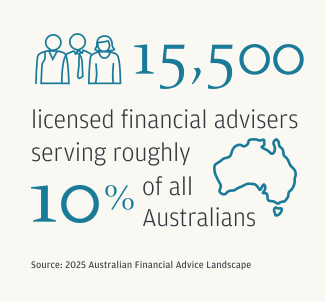
There are only about 15,500 licensed financial advisers serving roughly 10 per cent of all Australians, with cost the main barrier stopping people from seeking advice3. The number has almost halved since 20184.
The result is millions of Australians with growing super balances are making sub-optimal decisions that lead to poorer retirement lifestyles.
For example, around 700,000 Australians over the age of 65 keep their super in accumulation phase rather than moving it to an account-based pension, where investment earnings are taxed at zero. The result is they pay about $650 more in tax per year, according to the SMC5.
It is a pattern driven by inertia and complexity, not by choice.
“Principally advice should be part of core retirement infrastructure,” UniSuper’s Gregory says. “It’s not a luxury service that only the wealthy can access or that everyone else can only aspire to. It should be something that is simply part of being an Australian.”
Every fund interviewed for this report expressed the same conclusion: advice alone cannot solve the retirement challenge. The industry consensus is that bespoke financial advice, while valuable, is not sufficiently scalable for the populations that need it most.
Gregory estimates 3.5 million Australians will navigate a retirement decision in the next decade, and that 9.1 million sit in a “missing middle” category – people with a simple advice need who are not being well served by the financial services sector.
“Financial advice alone can’t be the answer for every member’s retirement journey, the math just doesn’t work. There aren’t enough advisers, and high-touch advice is expensive to scale. We value advice, and so do our members. But the real answer is a mix: digital tools that meet people where they are, guidance that’s easy to access, and human support when the big decisions come up,” HESTA’s O’Shea says.
The digital promise
At CBUS, where the membership is predominantly male, blue-collar, and younger, the challenge takes a different form. Dean says most CBUS members retire with relatively low balances and don't have complex financial needs.
Yet rather than converting to an income stream which is combined with the Age Pension, too many members set up individualised self-managed super funds in an effort to achieve outsized returns quickly.
"The level of faith that people put into customised, personalised products is frightening, but it's rational because they want to feel things are tailored and not generic," Dean says. "However, even when members gain access to these exclusive options, they often find they don’t actually use them.”
Better communication and engagement is part of the solution, as is digital advice – scalable, low-cost guidance delivered through online tools that can reach members who would never see a financial planner.
UniSuper’s digital financial adviser, launched in 2025, provides a hybrid experience where members can start a journey about their investment choice and move from idea to execution in seven minutes. Gregory reports a 45 per cent completion rate among members who begin a digital advice journey – a promising result for “a very immature service.”
AustralianSuper has partnered with digital advice provider Ignition Advice and plans to roll out digital advice options to its 3.6 million members, with digital advice journeys targeted for availability this financial year, Ellis says.
“I’m very confident that we’ll be able to do a lot more in five years’ time than we imagine today because of the technological innovation that’s happening everywhere,” Ellis says.
But question marks remain about the technical limits of embedding digital advice in super platforms today.
“If you take the covers off most of the digital advice providers in market, at least in Australia, they’re either glorified calculators or they are pointing you towards a PDF statement of advice or they’re requiring you still to self-navigate implementation decisions,” UniSuper’s Gregory says. “Most of our advice processes are leading to a dead end or a friction, and it’s not actually making it as simple as it needs to be.”
State Super’s Livanas goes further and suggests a wide range of people won’t be comfortable with digital advice.
“At this stage, many people are not comfortable relying alone on a digital solution for advice. The next generation may be different.”
Longevity and the product puzzle
Pooled longevity protection can lift spending confidence and smooth income – yet demand remains low, because members give up flexibility and control, and the products are often complex.
The possibility of outliving retirement savings, or longevity risk, is a powerful force shaping retiree behaviour. Most people die with the bulk of the wealth they had at retirement intact, with one super fund reporting that members who died left 90 per cent of the balance they had at retirement6.
It is the reason millions of Australians who have enough money to live comfortably in retirement choose not to spend it. It is also the problem the industry has been trying to solve, with limited success.
The dominant product in Australia's retirement phase, the account-based pension, places the entire burden of managing that risk on the individual.
Members must choose their own investment mix, set their own drawdown rate, and make their own judgment about how long their money needs to last. The result, across nearly every interview conducted for this report, is a system that produces decision paralysis.
"Many retirees are underspending, not because of the lack of assets that they have, but because of the lack of confidence in what their income will be and whether that will last," says Giacomo Tarantolo, Head of Retirement Solutions at Acenda Life.
He points to CoreData Retirement Income research that found nine in 10 Australians believe the Age Pension alone will not be enough, while two-thirds say income certainty is one of their top two priorities in retirement. Yet very few understand what guaranteed income products are or how they work.
The account-based pension provides retirees with flexibility, but it also exposes them to sequencing risk – the danger that poor investment returns in the early years of retirement will permanently reduce the longevity of their savings.
CoreData Retirement Income research that found nine in 10 Australians believe the Age Pension alone will not be enough, while two-thirds say income certainty is one of their top two priorities in retirement.
“If markets perform really well at the start of their retirement, they're probably never going to run out of money," Tarantolo says. "But if markets perform poorly in those early years of retirement, their money could run out 10-15 years earlier than anticipated.”
CBUS’s Chief Strategy Officer Bernie Dean adds a dimension to the longevity challenge that most industry commentary overlooks: healthcare.
“Many CBUS members who are now 65 or 70 and living in Victoria will benefit from earlier and better cancer diagnostics, improved care, and overall better health outcomes," Dean adds. "And while that's great for our members, it also means their $150,000 in super will need to last longer.”
Income layering: the reframe
Acenda Life’s Tarantolo argues the longevity debate has historically been framed as a product choice: account-based pension or annuity.
But he contends it should be reframed as income construction – assembling multiple sources of retirement income to serve different spending needs. The Age Pension, topped up with a guaranteed income layer, covers essential spending (housing, food, utilities, healthcare) – with most retirees receiving more Age Pension over time – while the account-based pension layer funds discretionary spending (travel, dining, hobbies).
"If I can use guaranteed income that's linked to inflation to cover my essential spend, and then whatever's left over I can use to have my discretionary spend, it flips it from a product choice to an income construction choice," Acenda Life’s Tarantolo says.
Katherine Santiago, Head of Quantitative Research, Multi-Asset Solutions at J.P Morgan Asset Management has analysed a decade of Chase bank transaction data to reveal how retirees actually spend.
"Some of their spending is very consistent and stable and could very much benefit from guaranteed income,” Santiago says. "Some of their spending is very volatile and lumpy throughout retirement and would really be difficult to cover with an annuity alone. Having that kind of proportionality – some of it guaranteed and some of it fully flexible – really mirrors how people actually spend."
UniSuper’s Gregory says retirees pass through distinct spending phases: "your go-go years, your slow-go years, and then your no-go years." The income-layering approach is designed to accommodate that reality: higher discretionary spending in early retirement, tapering over time, with guaranteed income providing a floor throughout.
Longevity product take-up
Annuities have long been unpopular, partly because of product complexity and a lack of flexibility. But their ability to facilitate consumption smoothing has prompted several other countries to at least partially mandate their use.
ART is the only fund among those interviewed that already offers two retirement products: an account-based pension and a lifetime income product. ART's experience provides the closest thing the Australian market has to real-world evidence on whether members will voluntarily adopt longevity protection.
The "no bells and whistles” product is simple. A member commits capital, receives a starting income rate roughly 50 per cent higher than the minimum drawdown rate, and the income lasts for life regardless of how long the member lives. If the member dies, the capital is returned to the estate.
"We also have a complex product,” ART’s Van Wyk says. “It's called our account-based pension, where you have to decide where to invest your money. You have to rebalance that yourself. You're going to switch those assets. You're going to tell us how much to draw. You're going to manage your longevity."
Van Wyk says retirement needs to be simpler and gives a housing analogy to suggest good solutions are better than perfect.
"I looked through the window at my neighbour's house. If he gives me all his information, I can prove that the house he bought is not optimal. It could have been closer to the school, he could have had an extra bathroom, he could have had a bigger backyard. But he's happy with it. And it's good enough for him. And I think retirement should be the same."
The affordability constraint
Not every fund's membership is positioned to benefit from longevity products today – an issue HESTA is grappling with.
“Affordable products that suit lower balance members don’t really exist today, however we certainly have to plan for the future membership, as our fund is predominantly women, and women live longer, a lifetime guaranteed income will become more critical and hopefully affordable,” HESTA’s O'Shea says.
AustralianSuper’s Ellis confirms the fund is partnering with life insurer TAL to develop a retirement income solution. "We have commenced the build this financial year and see this as a really great step forward in our retirement offering for members," Ellis says.
But she is candid about the scale of the distribution challenge. "As much as it's no simple thing to bring a whole new product to market, the actual challenge is getting meaningful take up in these products. Without that, you're not really making a difference."
Across the system, adoption remains marginal. SMC research shows only 6 per cent of retirees currently use a lifetime income product, despite two-thirds of pre-retirees being aware of them7.
Retirement infrastructure: Payments, trust, and the technology reckoning
Retirement systems are built on trust: save for tomorrow and that delayed gratification will be rewarded.
But polling from Industry Super Australia shows that between 52 and 55 per cent of Australians would support relaxing super's preservation and compulsion rules – and that young men aged 25 to 45 are particularly vulnerable to the appeal of unregulated alternatives, according to CBUS’s Dean.
“My vision for the super system and for retirement in the next couple of years is that the system exists as it is today in five years. I think that anybody that has banked that is at risk of hubris."
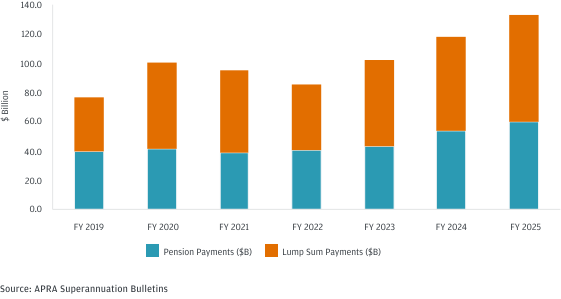
The stakes are rising as the weight of capital flowing across Australia’s pension payment rails becomes a steady torrent. State Super CEO John Livanas is acutely aware of the risks associated with a payment failure.
“We pay 68,000 pensions every fortnight – that’s around $3 billion a year,” he says. “If those payments are delayed by even a few days, it becomes a serious issue. Imagine being a pensioner, having saved all your working life to create a pension which you rely on for your day to day living. Imagine then, that one Monday there’s not enough money in your bank account to go buy groceries.
“That’s why we invest a huge amount of time and effort to ensure payments are made on time.”
Those rails across the industry are already creaking thanks to several cyber incidents and other IT service failures in recent years.
Annual super fund benefit payments ($bn)
TBD
The scale of the problem
Super funds are increasingly becoming technology businesses.
"The role of technology is huge,” Aware Super’s Warner says. “It’s about interfacing with the member base in a way that is really flexible and meets them where they are, delivering them help in the way that they need it.”
A coordinated cyber-attack on Australian super funds in April 2025 using previously leaked usernames and passwords found on the dark web specifically targeted pension drawdown accounts. It is part of a global push to target the elderly and cashed-up retirees.
“As the superannuation system matures and shifts from accumulation to managing retirement income at scale, the risk of fraud and scams is only increasing,” Vanguard Australia’s Smith says. “With more sophisticated threats like deepfakes and advanced cyber‑scams, protecting members has never been more critical.”
Expectations are high among the public.
"You become a payment provider when you're a retirement provider,” AustralianSuper’s Ellis says. “Most Australians' expectations around payments are set through their interactions with banks, and superannuation funds are a long way from that seamless experience today."
“You become a payment provider when you're a retirement provider.”

Jacki Ellis
Head of Retirement, AustralianSuper
APRA’s CPS 230 – which went live on July 1, 2025 – was designed to strengthen financial institutions’ operational resiliency although surprisingly, only banks were called out to explicitly treat payments as a mandatory critical operation8. Super funds’ critical operations encompass investment management and fund administration – pension payment continuity is implicitly nested within fund administration.
ART’s Van Wyk says legacy technology, payments infrastructure, and cyber vulnerability are interconnected risks, which he ranks among his biggest concerns for the retirement system.
“Increasingly, our boardroom is becoming a technology business.”
Technology spend must increase
Super funds recognise the challenge and are investing, but legacy systems represent a significant hurdle and upgrades or replacements often cause long offline periods.
While it is hard to gauge the precise level of expenditure on IT, 60 APRA-regulated super funds spent $900 million on IT services in 2024-25, according to fund-level expenditure data9. But by way of comparison, CBA boosted its annual investment spend by $300 million to $2.3 billion in 2024-25, while also hiring 2,000 IT engineers10.
However, CBUS’s Dean points out that banks have had a massive head start on the relatively young super industry, which has grown faster than expected.
"Banks have had sometimes four and five times the number of decades to mature their systems and liquidity management and their experience of consumer behaviour than what we have."
The structure of industry funds in particular means they don’t have the capital to invest heavily in technology the way banks do. The broader industry also remains under significant fee pressure, including from regulators.
Nonetheless, AustralianSuper’s Ellis says significant investment will need to be made.
"I think there'll need to be quite an investment and innovation in registry systems and platforms, not just product suites and the advice and guidance of platforms over the next decade to be able to set ourselves up for the system we need to become for the future."
ART’s Van Wyk says funds may also strike more strategic partnerships to enable retirement payments. APRA's Prudential Practice Guide SPG 280 (Payment Standards) only requires funds to pay benefits within three business days11.
"Superannuation funds need to be able to get money to members as seamlessly as a bank does. There should be a way where we can integrate with the bank so that if a member asks us for money, we put it straight into their bank account instantaneously."
The industry-wide focus on costs has already reshaped portfolios, encouraging greater internalisation of funds management and equity flows into low-cost passive vehicles.
Aware Super’s Warner says striking that overall balance remains difficult.
"The holy grail of any business is to deliver complexity with simplicity, and that's our challenge. How do you deliver a great individual experience for each of our 1.3 million members, while also achieving elegance and simplicity on the operations side so it delivers maximum benefit in terms of scale, and therefore price."
Conclusion
The super fund that emerges from these interviews is not the one most Australians would recognise today. It is not a savings account with a login and a yearly statement. It is something closer to the institution that a bank once was – the place you go when you need to make sense of your financial life.
Defaults only work if the fund knows enough about its members to construct meaningful starting points. Advice only scales if it is embedded in the retirement experience, not bolted on as a separate service. Longevity products only gain traction when they are woven into an integrated income solution rather than sold as standalone alternatives. And none of it functions without payments infrastructure that can meet the service expectations Australians already have.
The executives interviewed for this report describe a fund that operates as the central organising point for retirement – the hub through which products, advice, guidance, and payments converge. How exactly the fund orchestrates an ecosystem that includes insurers, the Age Pension, aged care, and specialist partners, will determine what the industry must build and what it can borrow.
The stakes extend beyond individual retirement outcomes.
Australia's compulsory superannuation system has become more than an economic mechanism – it functions as a social stabiliser, a structure that has helped prevent the extremes of retirement inequality visible in other developed economies.
That role is not guaranteed. Community confidence in compulsion and preservation is lower than the industry assumes, particularly among younger Australians, and the political consensus that has sustained the system across multiple parliaments cannot be taken for granted.
The industry's response to that fragility will determine whether the super fund becomes the retirement hub its leaders describe – or whether the gap between accumulation excellence and decumulation adequacy persists for another decade.
Contributors
Andrew Gregory
Chief Advice Officer, UniSuper

Bernie Dean
Chief Strategy Officer, CBUS
Brnic Van Wyk
Principal, Retirement Solutions, Australian Retirement Trust

Daniel Oldroyd
Portfolio Manager and Head of Target Date Strategies, J.P. Morgan Asset Management

Giacomo Tarantolo
Head of Retirement Solutions, Acenda Life
Jacki Ellis
Head of Retirement, AustralianSuper

John Livanas
CEO, State Super

Katherine Santiago
Head of Quantitative Research, Multi-Asset Solutions, J.P. Morgan Asset Management

Renae Smith
Chief of Personal Investor, Vanguard Australia
Shannon O’Shea
General Manager, Retirement, HESTA

Simon Warner
Chief Investment Officer, Aware Super
References
Retirement Income Review - Final Report | Treasury.gov.au. (2026, July 09). Retrieved from https://treasury.gov.au/publication/p2020-100554
Make the move: guiding members to tax-free retirement. Retrieved from https://www.hesta.com.au/campaigns/make-the-move-guiding-members-to-tax-free-retirement
Adviser Ratings – 2025 Australian Financial Advice Landscape report: advice penetration at 10.4%; Investment Trends – 11.8 million Australians with unmet financial advice needs; 41% cite high costs as the main barrier
ASIC Financial Advisers Register; FAAA — adviser numbers approximately 15,558 as at March 2025, down from approximately 28,000 in late 2018; FAAA warned a further ~1,000 adviser reduction expected from 1 January 2026 when FASEA education transitional period ended
Super Members Council. (2026, July 09). Retrieved from https://smcaustralia.com/media/busting-a-myth-australians-not-underspending-their-super
Retirement Income Review - Final Report | Treasury.gov.au. (2026, July 08). Retrieved from https://treasury.gov.au/publication/p2020-100554
SMC, The Retirement Revolution: Super's coming of age, August 2025 https://smcaustralia.com/reports/retirement-revolution-supers-coming-of-age/
CPS 230 Operational Risk Management | APRA. (2026, June 29). Retrieved from https://www.apra.gov.au/standards/cps-230
Annual fund-level superannuation statistics | APRA. (2026, June 29). Retrieved from https://www.apra.gov.au/news-and-publications/annual-fund-level-superannuation-statistics
Commonwealth Bank’s 2025 results: investing long term. (2026, June 29). Retrieved from https://rogermontgomery.com/commonwealth-banks-2025-results-investing-long-term
SPG 280 Payment Standards | APRA. (2026, June 29). Retrieved from https://www.apra.gov.au/practice-guides/spg-280
Related insights
-

Securities Services
How data, AI and digital transformation
November 27, 2024
-

Securities Services
-

Securities Services
The Future of Superannuation: A Shared Perspective
March 14, 2022