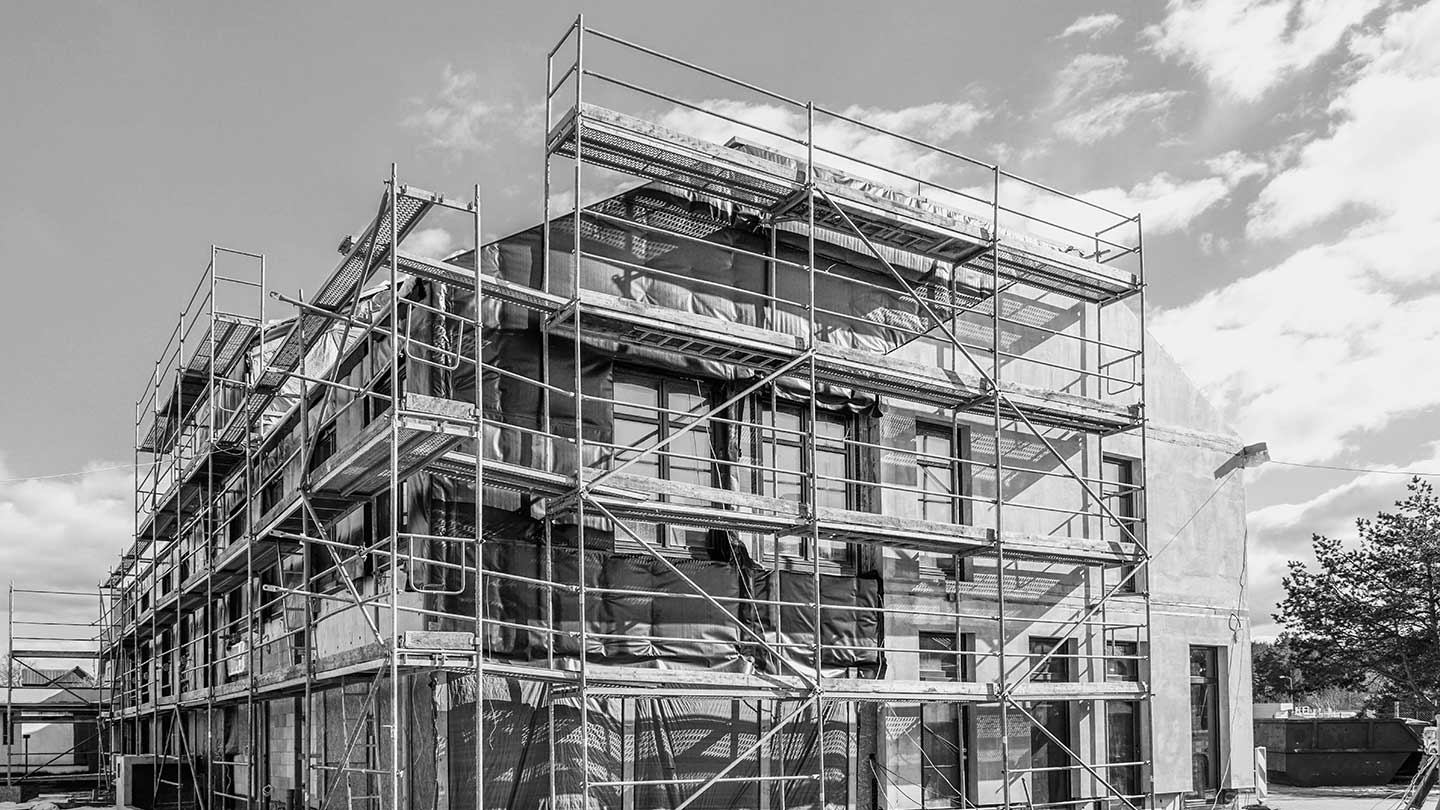
Historic buildings are part of what make neighborhoods unique, and preserving these buildings can spur economic activity as developers create jobs to revitalize aging properties.
Through the Historic Tax Credit (HTC) program, federal tax law provides an income tax credit to developers, who own historic buildings that undergo substantial rehabilitations into income-producing uses, such as housing.
“The Historic Tax Credit program is important to the firm, and most of our investments of tax credit for historic preservation are in areas that are changing, developing or undergoing some renaissance,” says Tim Karp, Head of Historic Tax Credit Equity at JPMorgan Chase.
Learn how to navigate the process for obtaining historic rehabilitation tax credits at the federal and state levels.
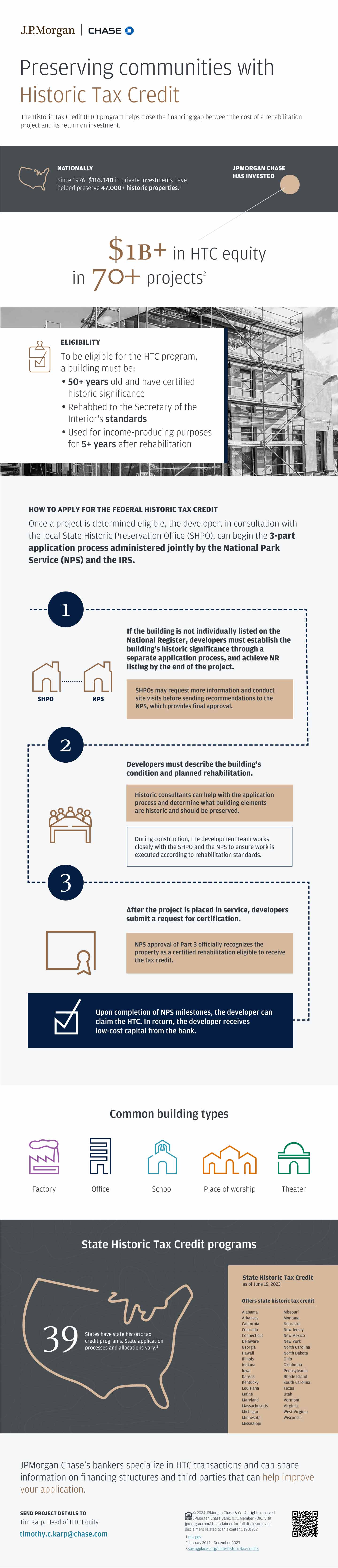
Preserving communities with Historic Tax Credit
The Historic Tax Credit (HTC) program helps close the financing gap between the cost of a rehabilitation project and its return on investment.
Graphic: a map icon of the United States
NATIONALLY
Since 1976, $116.34B in private investments have helped preserve 47,000+ historic properties. Source: nps.gov
JPMORGAN CHASE HAS INVESTED
Graphic: A white line extends from a beige circle to statistics
$1B+ in HTC equity in 70+ projects from January 2014 to December 2023
Graphic: A clipboard icon with a check mark on it, along with text, is placed over the image of a building under renovation with scaffolding along the exterior.
ELIGIBILITY
To be eligible for the HTC program, a building must be:
• 50+ years old and have certified historic significance
• Rehabbed to the Secretary of the Interior’s standards
• Used for income-producing purposes for 5+ years after rehabilitation
HOW TO APPLY FOR THE FEDERAL HISTORIC TAX CREDIT
Once a project is determined eligible, the developer, in consultation with the local State Historic Preservation Office (SHPO), can begin the 3-part application process administered jointly by the National Park Service (NPS) and the IRS.
Graphic: A dotted line connects each part of the process of applying for the federal Historic Tax Credit. For Part 1, the number 1 appears inside a navy blue circle above two building icons, one labeled SHPO and one labeled NPS, with a dotted line connecting them.
If the building is not individually listed on the National Register, developers must establish the building’s historic significance through a separate application process, and achieve NR listing by the end of the project.
SHPOs may request more information and conduct site visits before sending recommendations to the NPS, which provides final approval.
Graphic: For Part 2, the number 2 appears inside a navy blue circle above an icon of a group of people gathered around a table.
Developers must describe the building’s condition and planned rehabilitation.
Historic consultants can help with the application process and determine what building elements are historic and should be preserved.
During construction, the development team works closely with the SHPO and the NPS to ensure work is executed according to rehabilitation standards.
Graphic: For Part 3, the number 3 appears inside a navy blue circle above a certificate icon.
After the project is placed in service, developers submit a request for certification.
NPS approval of Part 3 officially recognizes the property as a certified rehabilitation eligible to receive the tax credit.
Graphic: An icon of a box with a check mark on it
Upon completion of NPS milestones, the developer can claim the HTC. In return, the developer receives low-cost capital from the bank.
Common building types
Graphic: Icon of a building with a smokestack
Factory
Graphic: Icon of a multi-story building
Office
Graphic: Icon of a building with a bell
School
Graphic: Icon of a building with three entrances
Place of worship
Graphic: Icon of a building with a dome
Theater
State Historic Tax Credit programs
Graphic: An outline of the United States with text inside
39 states have state historic tax credit programs. State application processes and allocations vary. Source: savingplaces.org/state-historic-tax-credits
State Historic Tax Credit
as of June 15, 2023
Offers state historic tax credit
Alabama
Arkansas
California
Colorado
Connecticut
Delaware
Georgia
Hawaii
Illinois
Indiana
Iowa
Kansas
Kentucky
Louisiana
Maine
Maryland
Massachusetts
Michigan
Minnesota
Mississippi
Missouri
Montana
Nebraska
New Jersey
New Mexico
New York
North Carolina
North Dakota
Ohio
Oklahoma
Pennsylvania
Rhode Island
South Carolina
Texas
Utah
Vermont
Virginia
West Virginia
Wisconsin
JPMorgan Chase’s bankers specialize in HTC transactions and can share information on financing structures and third parties that can help improve your application.
SEND PROJECT DETAILS TO
Tim Karp, Head of HTC Equity
timothy.c.karp@chase.com
Graphic: Equal Housing Opportunity logo.
© 2024 JPMorgan Chase & Co. All rights reserved. JPMorgan Chase Bank, N.A. Member FDIC. Visit jpmorgan.com/cb-disclaimer for full disclosures and disclaimers related to this content. 1901932