3 min read
Increased construction has put pressure on San Diego multifamily performance. But while the market’s vacancy rate reached its highest level since 2010 in the first quarter of 2026—4.8%—it remains tighter than the national average of 6.8%, according to Moody’s.
“San Diego has been very resilient in how it reacts to downturns. It’s a very livable area that’s attractive to a lot of people and has historically experienced relatively low vacancies and stable rents,” said Lynnette Antosh, Senior Regional Sales Manager at Chase.
Vacancies are projected to rise to 5.1% in 2026 as the market gains nearly 5,900 new units, according to Moody’s. Average effective rents are expected to rise 1.2% after a 2% decline in 2025.
The forecasted construction would result in 6.3% inventory growth since 2023.
“Limited population growth—constrained by strict immigration policies—and a softening job market are expected to hinder demand further,” said Lu Chen, Senior Economist at Moody’s.
But the construction pipeline is expected to slow in the years ahead. Its impact has also been uneven.
“The imbalance between supply and demand was most pronounced in the Downtown submarket, where pandemic-driven hybrid work patterns have slowed the rebound in rental demand,” Chen said.
Workforce housing remains in demand
San Diego’s overall vacancy rate is low, but the rate at Class B and C properties is even lower: 3.3% in the first quarter of 2026, compared with 6.4% at Class A properties, according to Moody’s.
“The tight supply at workforce and affordable housing properties shows they tend to see very durable demand from renters,” said Matthew Krasinski, Senior Regional Sales Manager with Chase.
Class B and C properties also recorded a 1.9% decline in average asking rent in 2025, compared with a 2.7% decline at Class A properties, according to Moody’s.
Between supply pressure and rising renovation costs, some multifamily owners are focusing on limiting turnover.
“We’re seeing customers would rather work with their current renter to keep them in place,” Antosh said.
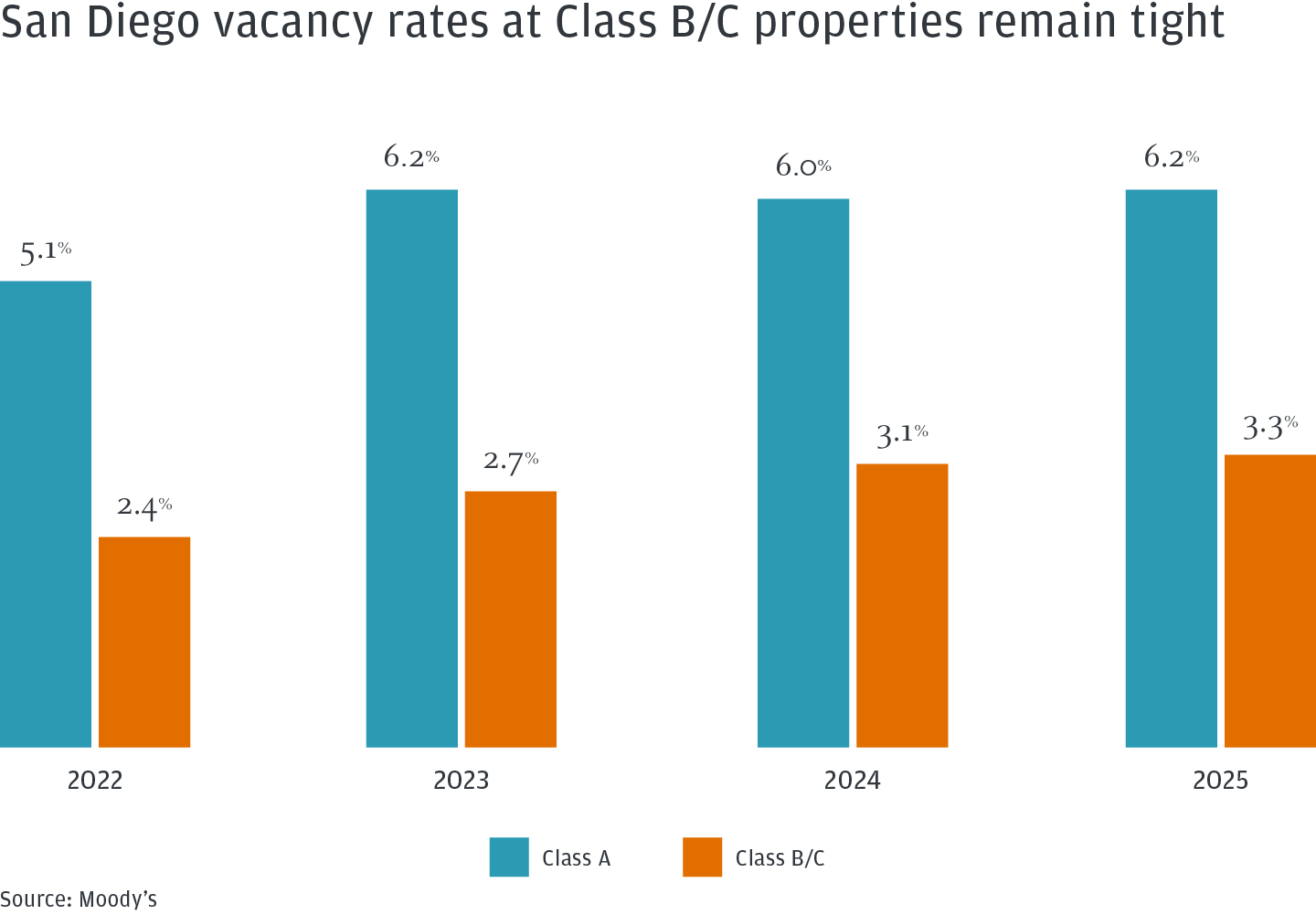
A grouped bar chart shows San Diego vacancy rates for Class A and Class B/C properties from 2022 through 2025. Each year has two bars: teal for Class A and orange for Class B/C. In 2022, Class A is 5.1% and Class B/C is 2.4%. In 2023, Class A increases to 6.2% while Class B/C rises to 2.7%. In 2024, Class A slightly declines to 6.0% and Class B/C increases to 3.1%. In 2025, Class A returns to 6.2% and Class B/C increases further to 3.3%. Across all years, Class B/C vacancy rates remain significantly lower than Class A, though the gap narrows slightly as B/C rates trend upward. Source indicated as Moody’s
Interest rate uncertainty
The Federal Reserve has held interest rates steady since the start of 2026 as it balances its two goals: stable prices and maximum employment. Cap rates have risen slightly in response to the elevated interest rate environment, which has created buying opportunities.
“The difference between where cap rates are and where customers think they’ll be is getting smaller, which has spurred more activity,” Krasinski said.
Amid uncertainty about rates’ paths, some multifamily owners are looking for flexibility when seeking an apartment loan or refinancing. For some, that means riding out the variable-rate portion of a loan rather than refinancing. For others, it means choosing a shorter three- to five-year loan term.
“We’re seeing customers closely watch the volatility in the rate environment, maybe more so than they have in the past,” Krasinski said.
Manage rising costs and protect payments
With operating costs on the rise, consider creating a liquidity management plan. Even cash reserves required for operations can earn interest. Choosing fast, frictionless payment methods to collect revenue faster and establishing longer payment terms with vendors can improve cash positioning.
“When you’re working with experts who specialize in commercial real estate and have solutions tailored to owner-operators, you can deploy capital more effectively,” Antosh said.
Already have a liquidity management plan? It’s smart to review your plan as your business and market conditions evolve to make sure it’s still meeting your needs.
Your payments and liquidity team can also help you protect your business by using fraud protection tools and keeping up with commercial real estate cybersecurity best practices.
“When you’re working with experts who specialize in commercial real estate and have solutions tailored to owner-operators, you can deploy capital more effectively.”
Lynnette Antosh
Senior Regional Sales Manager with Chase
Adding units with ADUs
Multifamily investors with underutilized space on their properties may be able to generate additional cash flow with an accessory dwelling unit (ADU).
“That’s particularly true in places like San Diego, where land is scarce and there isn’t a lot of development relative to the size of the market and demand for housing,” Krasinski said.
An ADU—also known as a granny flat, in-law suite or garage apartment—is typically a new detached unit built on a property or a converted garage. There are regulations to navigate, and the upfront investment can be significant, but it can be an opportunity to create cash flow at an existing property.
Whether you’re ready for financing or looking to streamline your operations, reach out to our San Diego lending, payments and liquidity team.
JPMorgan Chase Bank, N.A. Member FDIC. Visit jpmorgan.com/commercial-banking/legal-disclaimer for disclosures and disclaimers related to this content.