6 min read
New York City’s housing crisis isn’t limited to its lowest-income residents—moderate-income families often earn too much to qualify for affordable housing programs, yet make too little to afford market-rate apartments.
The Mitchell-Lama program was designed to bridge this gap, offering middle-income New Yorkers access to stable, affordable housing.
Find out more about the Mitchell-Lama program, why many buildings need reinvestment and how J.P. Morgan is helping clients finance the renovation of these properties and keep them affordable for low- and moderate-income New Yorkers.
What is the Mitchell-Lama program?
Signed into law in 1955, the Mitchell-Lama program is a New York state affordable housing initiative designed to create more reasonably-priced homes for middle-income New Yorkers.
“Through this program, the state helped fill a housing supply gap by offering incentives to developers to construct apartment buildings and limited‑equity co-ops, including low-cost financing and tax breaks, and providing oversight to ensure units remained affordable. This framework enabled the creation of thousands of units for middle-income households,” said Sharmi Sobhan, Head of Community Development Real Estate, East Region. “In return, apartment rents and co-op prices in those buildings were kept below market rate.”
The program spans roughly 100,000 housing units across the state. Mitchell-Lama properties count actress and rapper Queen Latifah among their former residents, as well as actor Timothée Chalamet, Supreme Court Justice Sonia Sotomayor and comedian Larry David.
Modern challenges for a historic program
While it serves as a critical lifeline for thousands of New Yorkers, rising operating and insurance costs challenge the Mitchell-Lama program’s long-term sustainability.
Mitchell-Lama properties frequently suffer from a lack of funding for capital improvements. Properties are also unable to meaningfully increase rents, as property incomes haven’t kept pace with building operating costs and many residents are on fixed incomes. Because they can’t keep up with rising expenses, many buildings have fallen into disrepair.
Additionally, many developments can opt to buy out of the program and convert units to market rate, reducing the overall affordable housing stock.
“As a result, New York City and state are looking at preserving existing legacy units and preventing buildings from becoming market-rate. They also focus on funding urgent capital repairs,” Sobhan said.
How J.P. Morgan helps finance Mitchell-Lama renovations
The firm is working to help more people access affordable housing through its American Dream Initiative pairing capital, advocacy and fostering partnerships to accelerate local impact at scale. For Mitchell-Lama rehabilitations, that means the J.P. Morgan Community Development Banking team is uniquely equipped to assist based on:
- The depth and breadth of our financial toolbox and balance sheet: Rehabbing and refinancing Mitchell Lama properties requires a layered capital stack. J.P. Morgan offers debt, equity, bridge financing or permanent senior debt, such as Fannie Mae or Freddie Mac financing. “Our goal is to keep these legacy units affordable while modernizing the housing stock to keep properties safe and affordable for families over the long term,” Sobhan said.
- Close collaboration with city and state entities: We work closely with New York City Department of Housing Preservation and Development (HPD), New York State Homes and Community Renewal (HCR) and New York City Housing Development Corporation (HDC) to address financing challenges alongside developers and owners.
- The ability to leverage our nationwide experience with complex transactions: “We’re not only using our vast financial toolbox, but also leveraging our experience on other complex projects, such as NYCHA PACT deals, and sharing those insights with our clients,” Sobhan said. That includes actively sharing learnings formally—through advocacy and policy papers—and informally—by connecting clients who’ve worked on similar transactions.
Historic Tax Credit’s role in financing Mitchell-Lama rehabs
“State and federal Historic Tax Credit (HTC) equity can be integral in getting the capital stack filled for Mitchell-Lama projects,” said Melissa McCormack, executive director, Historic Tax Credit equity at J.P. Morgan.
Due to their levels of disrepair, renovating Mitchell-Lama properties can be expensive and require a large, varied capital stack to ensure long term sustainability. “Historic Tax Credit equity provides low-cost equity to the project through the generation of tax credit, while preserving historic elements of the buildings’ design,” McCormack said.
Linden Plaza
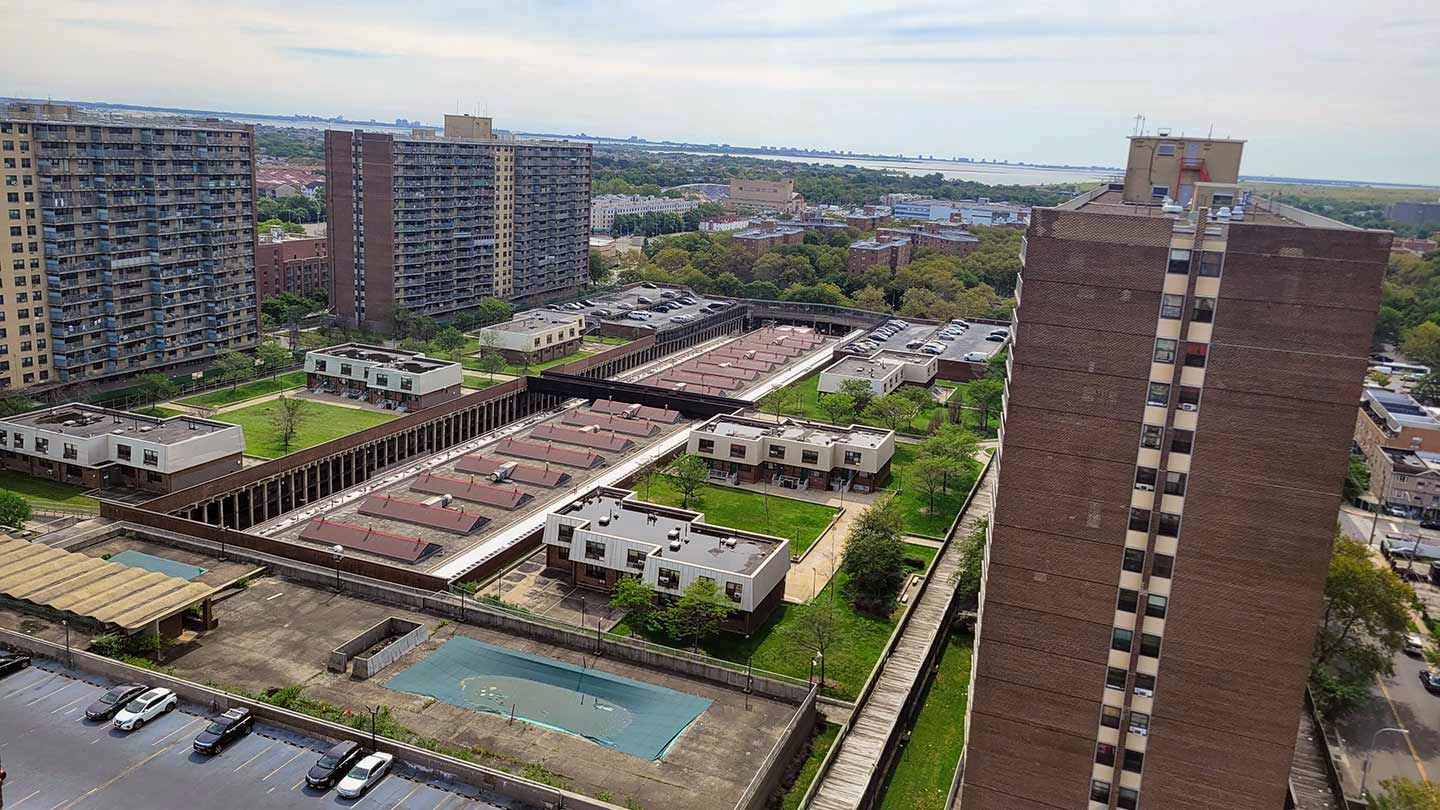
Aerial daytime view of Linden Plaza featuring several tall brick apartment towers surrounding a central complex of low-rise buildings with flat roofs, green courtyards and a parking lot
Built in the early 1970s, Linden Plaza is a 1,527-unit Mitchell-Lama property spanning three city blocks in Brooklyn.
- Historic significance: “The property exemplifies vernacular architecture, local housing development efforts during this period, and stands as one of the first developments to utilize City air rights,” McCormack said. Additionally, “the building’s design features a historic cantilevered structure directly above the Pitkin rail yard, demonstrating impressive structural engineering and maximizing available space.”
- Improvements: “The complex suffered from deferred maintenance and aging infrastructure,” said Joshua Weisstuch of Camber Property Group. “The physical issues spiraled into substandard environmental and living conditions for the residents that threatened the future of this important affordable asset.” For example, significant repairs were required for the underside of the plaza and the columns supporting the deck. The property also underwent essential repairs to its building envelope, including repointing brickwork and installing new windows. Restoration efforts focused on preserving interior historical elements, such as the distinct entranceways, original lobbies and hallways on each floor, and selecting period-appropriate flooring and paint colors for common areas to honor the building’s original aesthetic.
- Financing: J.P. Morgan provided a $155 million standby letter of credit supporting bonds issued by NYC HDC and $120 million in state and federal HTC equity, plus a $49 million HTC bridge loan. The project also included HUD project-based Section 8 vouchers administered by NYCHA and Freddie Mac permanent financing, among other sources. “J.P. Morgan understands the stakes for complicated projects such as Linden and works with developers like us to make sure projects are properly completed and residents receive a quality product,” Weisstuch said.
Fulton Park Plaza
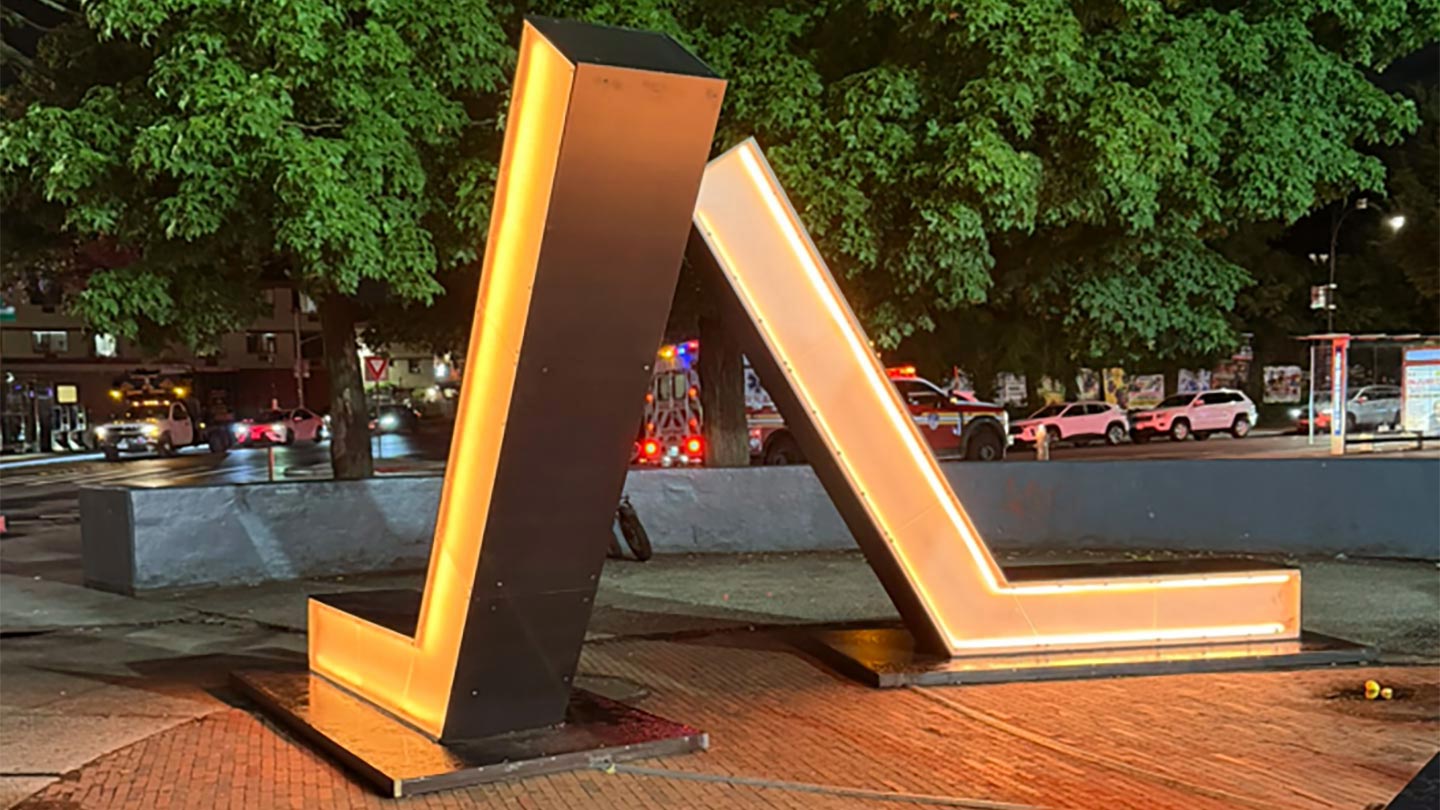
Evening view of Fulton Park Plaza featuring a glowing temporary art installation celebrating Black history—illuminated panels and sculptural elements cast warm light on the plaza
Located in Bedford-Stuyvesant, Fulton Park Plaza includes set asides to serve families earning at or below 50%, 80% and 90% of the Area Median Income (AMI).
- Historic significance: Fulton Park Plaza was originally developed by Jackie Robinson and his wife, Rachel Robinson. “The property also serves as an important community hub,” said Tim Henzy, the principal and owner of Smith & Henzy, the property developer. “Its non-residential tenants include an Early Head Start program, a supermarket, a walk-in health clinic and three food establishments. The Utica Avenue subway station is also located directly on-site.”
- Improvements: The property hadn’t undergone significant renovations since it was built between 1972 and 1974, so significant upgrades were necessary. “Our comprehensive rehabilitation touches virtually every aspect of the property,” Henzy said. That included exterior improvements, such as new entry doors, renovation of interior courtyards and playgrounds, and roof replacement and installation of solar arrays. The project also included new building systems, including installation of high-efficiency electric heat pumps in every apartment and full ventilation of the hallways for the first time, plus updated unit bathrooms, kitchens and common areas.
- Financing: J.P. Morgan provided a $58.6 million direct pay letter of credit supporting bonds from the New York State Housing Finance Agency and a $53.2 million tax credit investment, including state Low-Income Housing Tax Credit equity and state and federal HTC equity. Subsidies rounded out the financing. “Complex transactions like Fulton Park Plaza require significant institutional knowledge, and J.P. Morgan was able to bring that experience to the table and share it with our team throughout the process,” Henzy said. For example, the firm recommended investigating the property's historical significance, an important step that helped the developer include historic tax credit equity as part of the overall capital stack.
Across Community Development Banking, we can help you navigate Mitchell-Lama rehabs and other complex projects with innovative financing and industry expertise. Connect with a banker to learn more.
JPMorgan Chase Bank, N.A. Member FDIC. Visit jpmorgan.com/commercial-banking/legal-disclaimer for disclosures and disclaimers related to this content.