
8 min read
Key takeaways
- Bank reconciliation is a core control that helps businesses align their books with the bank’s records and explain any differences.
- Timing differences are often routine, while discrepancies without clear explanations may indicate issues.
- Reconciliation frequency depends on an account's risk and payment volume, both of which can shift as a business grows.
Bank reconciliation is a foundational financial control—the check that confirms your view of your cash matches what actually happened, rather than what you assume happened. The more accounts, entities and payment channels you run, the more critical strong reconciliation processes are to avoiding errors, detecting fraud attempts and being confident in your cash position.
Tommaso Todesca, senior treasury management officer at J.P. Morgan, explains what separates routine discrepancies from genuine red flags—and how reconciliation frequency should scale with a business's risk, not just its size.
What is bank reconciliation?
Bank reconciliation is the process of comparing your company’s internal financial records against your bank’s to confirm they reflect the same information. Also called bank account reconciliation or bank and book reconciliation, this process compares the bank balance (what your bank’s records show) with the book balance (what your records show). That’s more than matching your cash ledger or general ledger against a bank statement. It can include previous-day reporting, real-time transaction feeds or anything the bank produces that shows what happened with your cash.
If you can account for any discrepancies between what your books show and what the bank shows, your reconciliation process is working.
What is a bank reconciliation statement?
A bank reconciliation statement documents the comparison between what your bank records show and what your books show for a given period.
The bank sees cleared activity—transactions that have settled. Your books see intended activity, whether or not it’s cleared yet. The statement lays out where the two match and where they don’t, and ideally why.
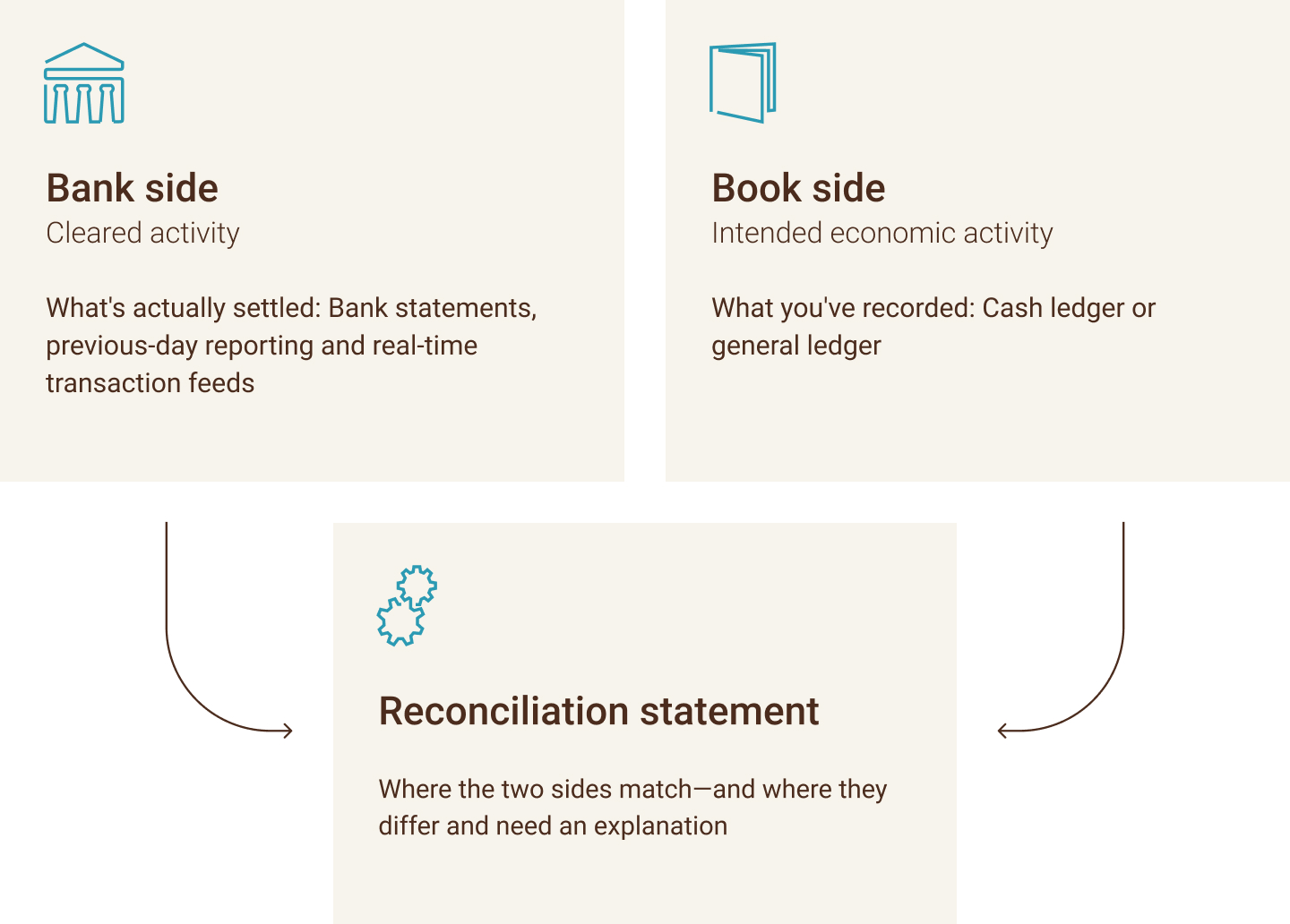
Diagram showing the bank account reconciliation process: The "bank side," or cleared activity is shown on bank statements, previous-day reporting and real-time transaction feeds. The "book side," or intended economic activity, is shown on the cash ledger or general ledger. Both feed into a reconciliation statement, which shows where the two sides match and where they differ and need an explanation.
Why bank reconciliation matters for businesses
As your account structure, payment volume and systems grow more complex, your reconciliation process should scale with them. The process that sufficed when activity was simpler can lose leaders the visibility, control and confidence they need as the business expands.
Reconciliation confirms your books are balanced, checking every movement of cash against what happened. That verification process makes reconciliation one of the first places fraud surfaces, and one of the clearest ways to confirm your cash position before you build decisions on it.
Discrepancies can come from many places, including timing differences, unaccounted-for fees, missing entries or something more serious. Some misalignments are routine and can be handled accordingly. Others should raise red flags. Reconciling regularly can help you spot discrepancies before small unexplained items turn into larger, harder-to-fix problems.
6 steps for reconciling a business bank account
Whether your business reconciles transactions manually or incorporates automation, the process typically includes six steps:
- Gather your bank and book information. The process typically begins with collecting bank statements or other bank-generated data, along with cash or general ledger records, and the prior period’s reconciliation statement.
- Match transactions line by line. As transaction volume grows, this step often requires more structure—whether that means clearer matching rules, more consistent data or automation for routine items.
- Identify what doesn't match. Outstanding checks, deposits in transit and unrecorded bank fees or interest are common sources of discrepancies. Items that carry forward from one period to the next are worth tracking consistently, so unresolved differences don’t become part of the normal close process.
- Classify the differences. Sort gaps you’ve found into defined categories, such as timing differences, bank errors, book errors or unexplained items. Timing differences typically resolve themselves, but errors and unexplained items may need a closer look.
- Make corrections. A system for identifying recurring issues—such as documenting what was found, what was corrected and the reasons for each correction—can inform process improvements over time.
- Review and sign-off. This is where reconciliation becomes a control, not just a correction. A clear review and approval process helps create accountability, especially during tight close cycles.
Common reconciliation discrepancies
Staying alert to items without a clear story or explanation can help catch problems before they grow. Common red flags include:
| Red flag | Why it matters |
|---|---|
| Repeat debits to unfamiliar payees or accounts | May indicate an unauthorized or fraudulent payee has been added to your system |
| Changes to payment beneficiaries with no corresponding change in vendor records | A common sign of business email compromise or invoice fraud—the vendor didn’t request the change |
| Duplicate payments to the same vendor on the same or nearly the same date | Often a processing error, but can also signal a compromised approval workflow |
| Transactions outside normal business hours | Can indicate unauthorized access—harder to catch for businesses operating internationally across time zones |
Bad actors sometimes start with small, barely noticeable debits and increase the amounts over time, since minor discrepancies are less likely to draw attention. The longer it goes undetected, the harder it can be to recover lost funds.
“Ignoring these patterns can be a bit like ignoring your own health,” Todesca said. “Small issues that can be brushed under the rug at first can compound quickly. If you can spot it early, it can be a quick and easy fix. Catch it late, and it gets a lot harder to unwind.”
How often should you reconcile?
The frequency depends on your business’s priorities. “You may have mission-critical accounts that you choose to reconcile more frequently, and secondary accounts that you reconcile less often,” Todesca said. “You don’t necessarily need to have one rule for the entire financial account structure.”
Several factors can influence your business’s ideal reconciliation cycle:
| Factor | Why it pushes toward more frequent reconciliation |
|---|---|
| Payment volume | Higher volume makes discrepancies easier to miss the longer you wait between checks |
| Fraud risk | Shorter cycles help companies with greater exposure to cybersecurity threats or payment fraud catch red flags early |
| Industry | Businesses in regulated industries, such as defense contracting, may be required to reconcile more often |
| Stakes | Operating accounts essential to funding day-to-day transactions benefit from more regular reconciliation |
Best practices for efficient bank reconciliation
Efficiency gains come down to process and data quality, regardless of whether you reconcile manually or with automation. The businesses that do this well tend to share four habits:
-

Consistent cutoff rules
Bank information and books align on the same schedule. -

Standardized transaction naming and coding
Nobody's left guessing what a code means or interpreting it differently from month to month. -

Clear ownership
Everyone knows who's responsible for what. -

Ongoing process improvement
Reconciliation keeps up with growing sales and payment volume.
More frequent reconciliation, more automation and more documentation all add value—but each comes with a cost in time, resources or complexity. The right balance depends on account risk, transaction volume and how much oversight a business needs at each stage of growth.
“Think of a muscle car body running on a hatchback engine,” Todesca said. “The look and the performance don’t match, and eventually that gap shows up in how well it runs.”
Signs a business may benefit from more formal controls can include:
- Are transaction volumes increasing?
- Are more accounts, entities or payment channels involved?
- Are unresolved items carrying forward?
- Is there only one person who understands the spreadsheet?
- Are teams spending more time explaining discrepancies than resolving them?
The more of these that sound familiar, the more the business’s reconciliation cadence, ownership, documentation and automation may need to adjust to reflect the business’s growing complexity. Automation can help reduce manual work, from transferring bank data to rules-based transaction matching, but how much of the process businesses handle manually typically depends on risk and volume.
What to look for in a banking relationship
A bank that supports efficient, accurate reconciliation makes it easy to access transaction data and understand the purpose of each payment. That might mean connecting your bank directly to the systems you use to run your business, rather than downloading and uploading files by hand—or customizing how and when you receive bank statement data.
Real-time visibility is one of the biggest differentiators. Viewing your cash position throughout the day instead of waiting until the end of the day or week can help you resolve discrepancies faster.
J.P. Morgan offers solutions to support increased automation, regardless of what your current reconciliation process looks like. Cash management platforms like Connect and J.P. Morgan Access can automatically sync bank data with many ERP or accounting systems, either on a scheduled basis or in real time. Integrated receivables solutions, meanwhile, provide additional remittance detail to support automated transaction matching.
AI is increasingly part of this picture too. Businesses that use it effectively don’t replace human judgment with AI. Instead, they use AI to support that judgment, building processes where technology handles the routine so teams can focus on the exceptions.
“Think of it like a master painter working with his apprentices,” Todesca said. “The AI paints the routine parts of the canvas, and the controller or treasurer steps in only to correct the exceptions—the unusual strokes or areas that need expert judgment.”
We're here to help
Whether you’re modernizing a process that’s grown with your business, working through a discrepancy or deciding how often to reconcile which accounts, J.P. Morgan bankers and treasury specialists can help you build an approach that scales with you.
JPMorgan Chase Bank, N.A. Member FDIC. Visit jpmorgan.com/commercial-banking/legal-disclaimer for disclosures and disclaimers related to this content.