
5 min read
Key takeaways
- ERP integration eliminates manual data entry between financial systems, providing real-time cash visibility and faster payment processing
- Common challenges include legacy system compatibility, data migration complexity and operational coordination during implementation
- Integration methods range from simple point-to-point connections to enterprise-grade API and host-to-host solutions
Enterprise Resource Planning (ERP) systems and Treasury Management Systems (TMS) form the backbone of modern finance operations. But if your systems aren’t talking to each other, you’re likely dealing with manual data entry, delayed reporting and cash visibility gaps that slow down critical business decisions. Integrating these platforms eliminates these friction points—automating workflows, centralizing cash management and enabling real-time financial insights.
What is ERP and ERP integration?
ERP systems centralize core business functions—finance, human resources, supply chain and procurement—into a single platform. For most finance teams, the ERP handles general ledger, budgeting and financial reporting.
ERP integration connects your ERP with specialized financial systems like treasury management systems (TMS), accounts payable automation, customer relationship management (CRM), supply chain management (SCM) and banking platforms. The goal isn’t just connectivity—it’s eliminating the daily frustrations of duplicate data entry, reconciliation errors and delayed cash reporting that happen when systems operate in isolation. When done right, integration creates automated workflows where payment approvals in your ERP trigger immediate processing in your banking systems, and cash positions update across all platforms in real time.
Systems commonly integrated with ERP
Your ERP likely needs to connect with several specialized systems to handle complex financial operations:
- Treasury Management Systems (TMS): Cash positioning, payments and liquidity forecasting
- Accounts Payable/Receivable Automation: Invoice processing, payment approvals and reconciliation
- Banking and payment platforms: Direct connectivity for settlement and reconciliation
- Virtual card and embedded payment solutions: Generate automated virtual cards for supplier payments directly from AP workflows
- Customer Relationship Management (CRM): Customer data and financial insights
- Supply Chain Management (SCM): Inventory, procurement and logistics
- Human Resource Management (HRM): Payroll, benefits and workforce analytics
Each system handles specialized functions, but without integration, your team ends up manually transferring data between platforms—creating delays, errors and gaps in financial reporting. Integration ensures these systems share data automatically, so payment approvals in your ERP immediately update cash positions in your TMS.
Integrating processes and workflows with ERP
Successful ERP integration requires redesigning workflows to take advantage of connected systems. This typically involves:
- Payment processing workflows: Purchase orders approved in your ERP automatically trigger payment initiation in your banking platform
- Cash management workflows: Daily cash positions from multiple bank accounts feed directly into your ERP’s financial reporting
- Reconciliation workflows: Bank transactions automatically match against ERP records, flagging exceptions for review
These integrated workflows reduce the manual handoffs that create delays and errors in financial operations. They also provide the audit trails and controls that compliance teams require.
Discover how J.P. Morgan’s comprehensive payment solutions can optimize your treasury operations.
Benefits of ERP integration
ERP integration delivers measurable improvements to financial operations:
- Faster processing times: Payment cycles that previously took three to five business days may be reduced to same-day or next-day settlement
- Reduced errors: Automated data transfer eliminates transcription mistakes, while embedded payment solutions like virtual cards reduce fraud risk by generating unique card numbers for each supplier payment
- Real-time cash visibility: Finance teams can see current cash positions across all accounts without waiting for end-of-day bank reports or manual reconciliation
- Improved compliance: Integrated systems create complete audit trails and automated controls that satisfy regulatory requirements
- Better forecasting: With real-time data flowing between systems, cash flow operations become more accurate and can be updated continuously rather than weekly or monthly
Challenges and risks of ERP integration

ERP integration requires careful planning to address common implementation challenges:
- Legacy system compatibility: Your existing ERP may lack modern Application Programming Interfaces (APIs), requiring custom development or middleware solutions
- Data migration complexity: Moving years of financial data between systems without losing transaction history or creating duplicates requires careful planning and testing
- Operational coordination: Integration testing and cutover periods need to be scheduled around critical processes like payroll and vendor payments
- Change management: Finance teams need training on new workflows, and temporary productivity dips are normal during a transition period
- Implementation investment: Integration projects typically require three to six months and dedicated IT resources, but ROI often materializes within the first year
- Security considerations: New system connections require additional monitoring and protection protocols
Working with experienced integration providers helps navigate these complexities. Look for solution providers who have successfully integrated your specific ERP platform and can demonstrate proven approaches for data migration and testing.
ERP integration methods
Businesses can choose from several integration approaches:
| Method | What it means | Business impact | When to use |
|---|---|---|---|
| Point-to-point | Direct connection between systems—your ERP talks directly to your banking platform | Fast setup, lower initial cost | Smaller companies with 2-3 systems |
| Middleware | Central hub that manages all system connections | Easier to add new systems later | Growing companies planning to add more applications |
| API-based | Real-time data sharing using modern web standards | Instant updates across all systems | Companies needing real-time cash visibility |
| Host-to-host (H2H) | Secure file transfers between your systems and the bank | Bank-grade security and reliability | Large companies with high transaction volumes |
The right integration method depends on your goals and future plans. If you expect to add new business systems over time, middleware or API-based approaches offer greater flexibility. If security and reliability for high-volume payments are your top priorities, host-to-host integration is often preferred. Work with your banking and technology teams to map out integration dependencies and budget for both initial setup and long-term support
ERP integration: From fragmented systems to unified control
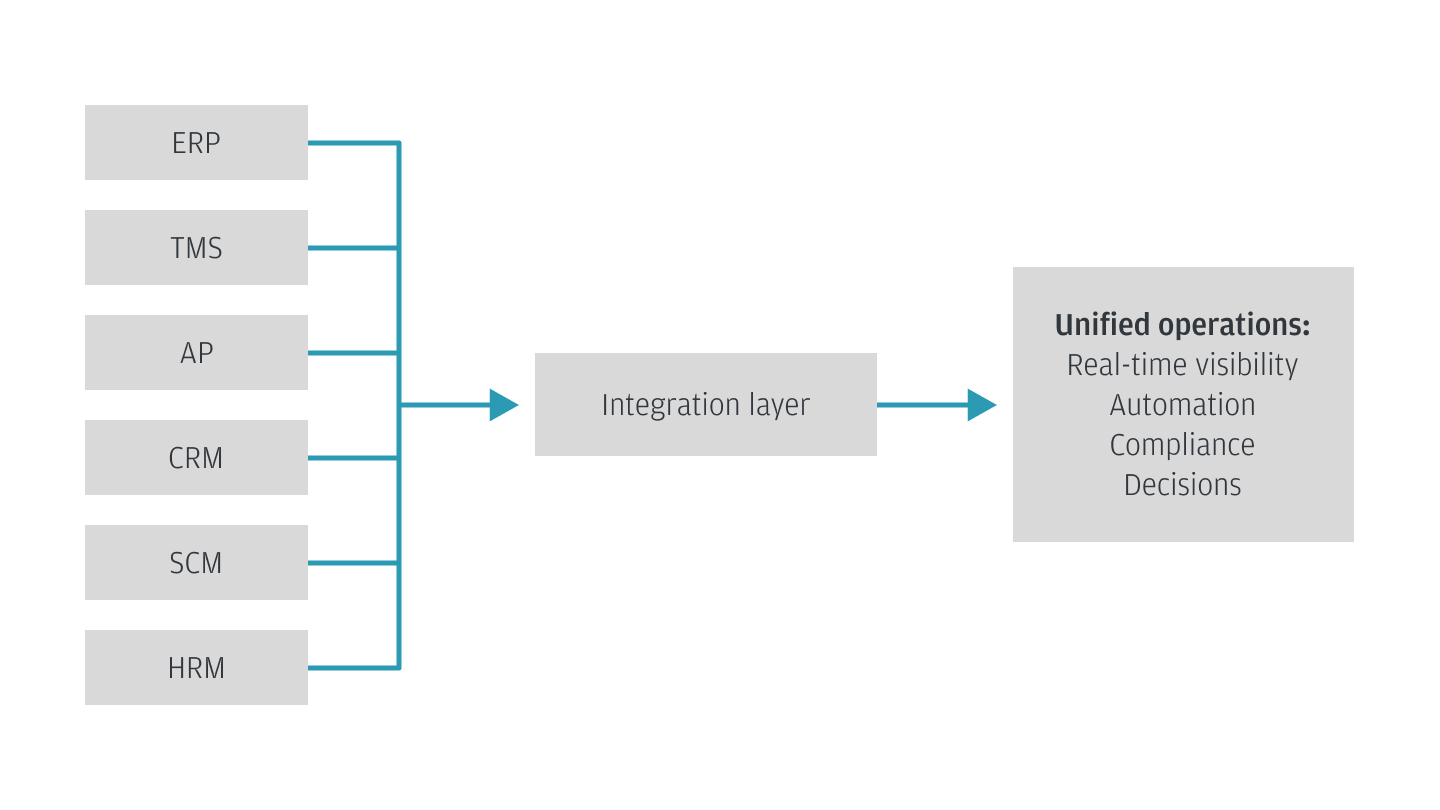
Flow diagram showing how six business systems—ERP, TMS, AP, CRM, SCM, and HRM—connect through a central integration layer to enable unified operations. The integration layer consolidates data from all six systems and delivers four key capabilities: real-time visibility, automation, compliance, and improved decisions.
Integrating your ERP with treasury, payments and core business systems unlocks real-time visibility, automates key financial workflows and streamlines reporting for faster, more confident decisions.
How ERP integration can improve data accuracy and decision-making
Integrating your ERP and treasury systems means your company’s cash, payments, receivables and financial data are current, complete and reliable—instead of living in siloed spreadsheets or out-of-date reports. That means fewer errors, less manual reconciliation and faster response when business needs change.
J.P. Morgan supports this with a suite of integration solutions:
- Payments Partner Network: Access a broad ecosystem of payment and treasury tools to extend your ERP’s reach
- Embedded solutions and direct APIs: Get real-time updates directly into your ERP, so teams always work with current information
- Virtual card solutions: Generate virtual cards automatically from your ERP’s AP workflows, enabling secure, trackable payments without exposing your primary account numbers
- Host-to-host connectivity: Bank-level security and reliability for high-volume payment and reporting flows
- Integration with leading platforms: Compatible with major ERP and treasury systems, so implementation aligns with your current tech stack
We’re here to help
J.P. Morgan offers expertise and technology to help you integrate your ERP and treasury management systems, driving efficiency and visibility in your financial operations. Contact us to get started.
JPMorgan Chase Bank, N.A. Member FDIC. Visit jpmorgan.com/commercial-banking/legal-disclaimer for disclosures and disclaimers related to this content.