Key takeaways
- Public sector treasury modernization means updating how government organizations collect, manage and disburse funds—reducing manual processing while giving constituents and businesses more payment choices
- A connected treasury integrates ERP and payment systems so data and reconciliation flow automatically, improving cash visibility and reporting consistency
- Payment needs vary by organization—the right banking partner brings public sector experience, integrated treasury and payment capabilities and strong implementation and risk management support
Public sector finance leaders are being asked to balance competing priorities. They must deliver modern, accessible experiences to constituents while maintaining the transparency, accountability and stewardship expected of public institutions.
At the same time, treasury operations are becoming more complex. Residents and businesses increasingly expect convenient payment options and faster access to services—but their preferences vary from paper checks to fully digital experiences.
Against this backdrop, treasury teams must navigate budget pressures, staffing constraints, evolving regulations and aging technology platforms. Many organizations are re-evaluating how they collect, manage and disburse funds—and whether current operations are positioned to support future needs.
How money moves through the organization
Effective treasury strategies start with understanding how money moves through the organization and how constituents prefer to engage. Every public sector organization operates differently: a municipality collecting property taxes has different requirements than a public utility, transportation authority, school district or state and local government agency managing large-scale payment programs such as benefits payments, tax refunds and vendor payments.
Key considerations include:
- How constituents make payments and receive funds across channels—from paper checks to ACH, direct deposit and real-time payments
- Volume and variety of financial transactions
- Reconciliation and reporting requirements—including automated payment reconciliation
- Integration with existing financial systems, such as ERP and general ledger
Rather than focusing on individual products or technologies, many finance leaders are taking a broader view of how treasury operations can support organizational goals while improving the constituent experience—by simplifying payment acceptance, reducing manual work, accelerating cash application and strengthening reporting and controls.
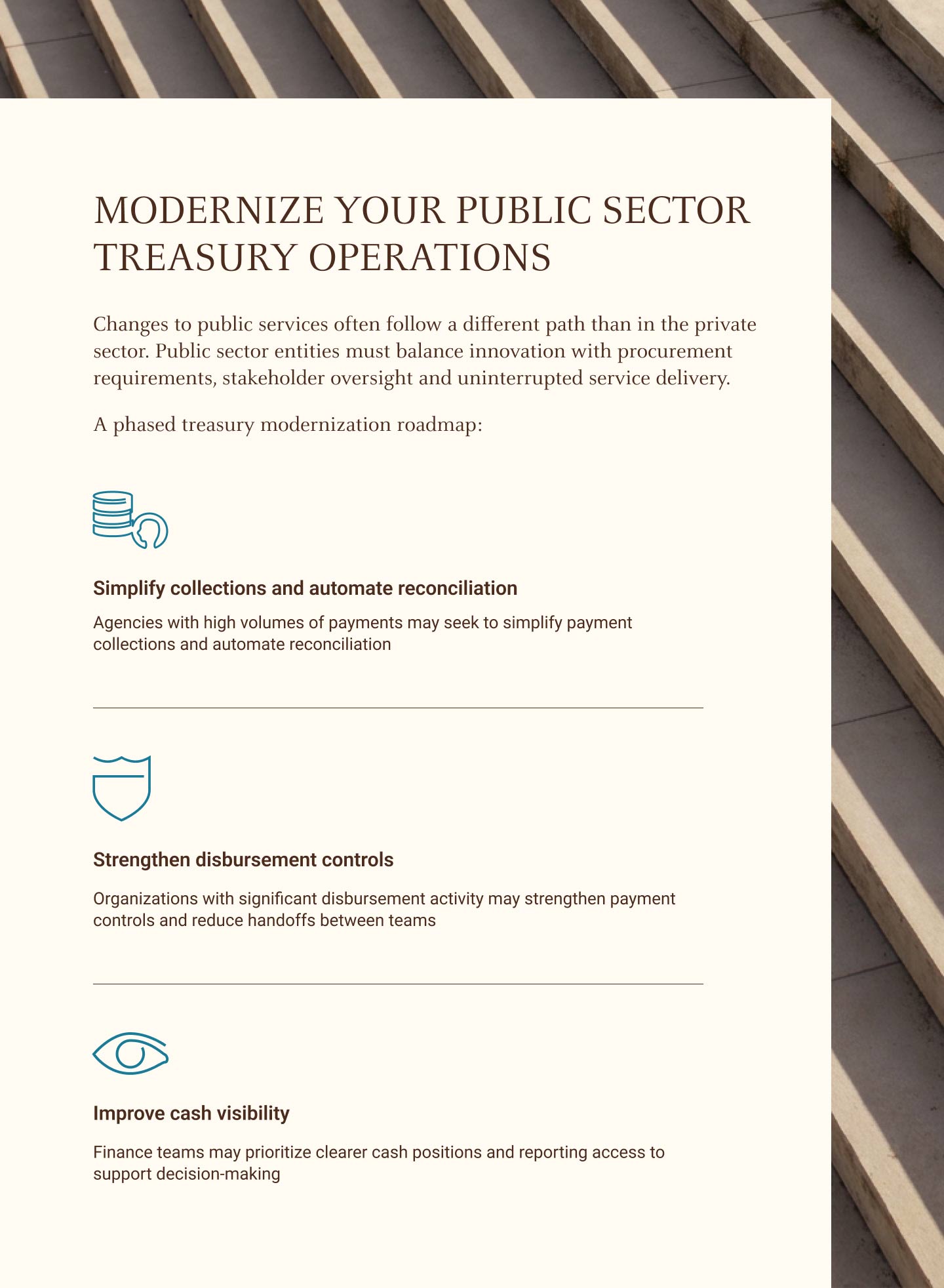
Treasury modernization
Treasury modernization is a journey, not an event. The objective is to create modern treasury operations that strengthen controls, improve cash visibility, reduce manual effort and support reliable public services.
text needed
The value of a connected treasury approach
A connected treasury is the integration of ERP and treasury systems so data and payment workflows flow automatically—reducing manual entry and errors while enabling automated processing and reconciliation.
Historically, collections, payments, reporting and liquidity management have often been managed through separate processes or systems. As transaction volumes grow and constituents engage across more channels—including electronic payments, virtual cards and real-time payments—these disconnected processes can make it difficult to maintain a complete view of financial activity. Public sector organizations that connect these activities can:
- Improve cash-position insight and reporting consistency
- Streamline reconciliation, cash forecasting and reporting processes
- Support payment digitization and service improvements
- Create a more consistent constituent and resident experience
For example, a municipality collecting taxes and fees through multiple channels may seek to centralize reporting and automate portions of the cash application. A state agency managing large payment programs may prioritize deeper payments insight and stronger operational controls. While the specific objectives vary, the goal is the same: more efficient and resilient financial operations.
What public sector organizations should look for in a banking partner
When evaluating treasury and cash management providers, public sector organizations should prioritize banking relationships that offer scalable capabilities aligned to their needs.
Important considerations include:
- Experience serving public sector organizations
- Support for modernization and digitization initiatives
- Integrated treasury, reporting and payment capabilities
- Strong implementation, service and risk management support
Choosing the right banking partner is about more than solving today's challenges. It means supporting long-term objectives with an organization that understands the realities of public sector operations—from procurement requirements to payment integrity and fraud prevention.
Preparing for the future of government treasury modernization
Public sector organizations are looking for ways to improve the constituent experience while strengthening cash visibility and operational effectiveness. These objectives can be achieved by building on an operating model that reduces manual processing, strengthens reporting and controls, and supports accountable decision-making while maintaining uninterrupted service delivery.
Organizations that take a strategic approach to treasury management may be better positioned to navigate change while continuing to serve their communities.
To learn more, connect with a J.P. Morgan representative or explore our Treasury Solutions.
Related insights

Treasury
Scaling receivables for growth: Automating cash application
Aug 28, 2026
Find out how automating cash application can strengthen efficiency and sharpen visibility as your business grows.
Read more
Treasury
Scaling receivables for growth: A strategic framework
Aug 21, 2026
Collections grow more complex as you scale. Learn how to protect working capital, sharpen cash visibility and keep pace while increasing efficiency.
Read more