In Cantonese, “On Lok” means happy, peaceful abode or home. The name carries both aspiration and promise, and, for more than five decades, the San Francisco nonprofit it describes has worked to make that promise real for thousands of older adults across the Bay Area.
In 1971, a group of community members in San Francisco’s Chinatown North Beach neighborhood asked a deceptively simple question: Why should a person spend the final years of their life in a nursing home, far from the streets they walked, the food they loved and the language they spoke? Their answer: They shouldn’t. And that’s how On Lok was founded.
For too many Americans, aging with dignity remains harder than it should be: Healthcare is fragmented, costs are rising and families navigate a maze of providers and social services. On Lok was built to meet that need.
Supporting On Lok’s mission
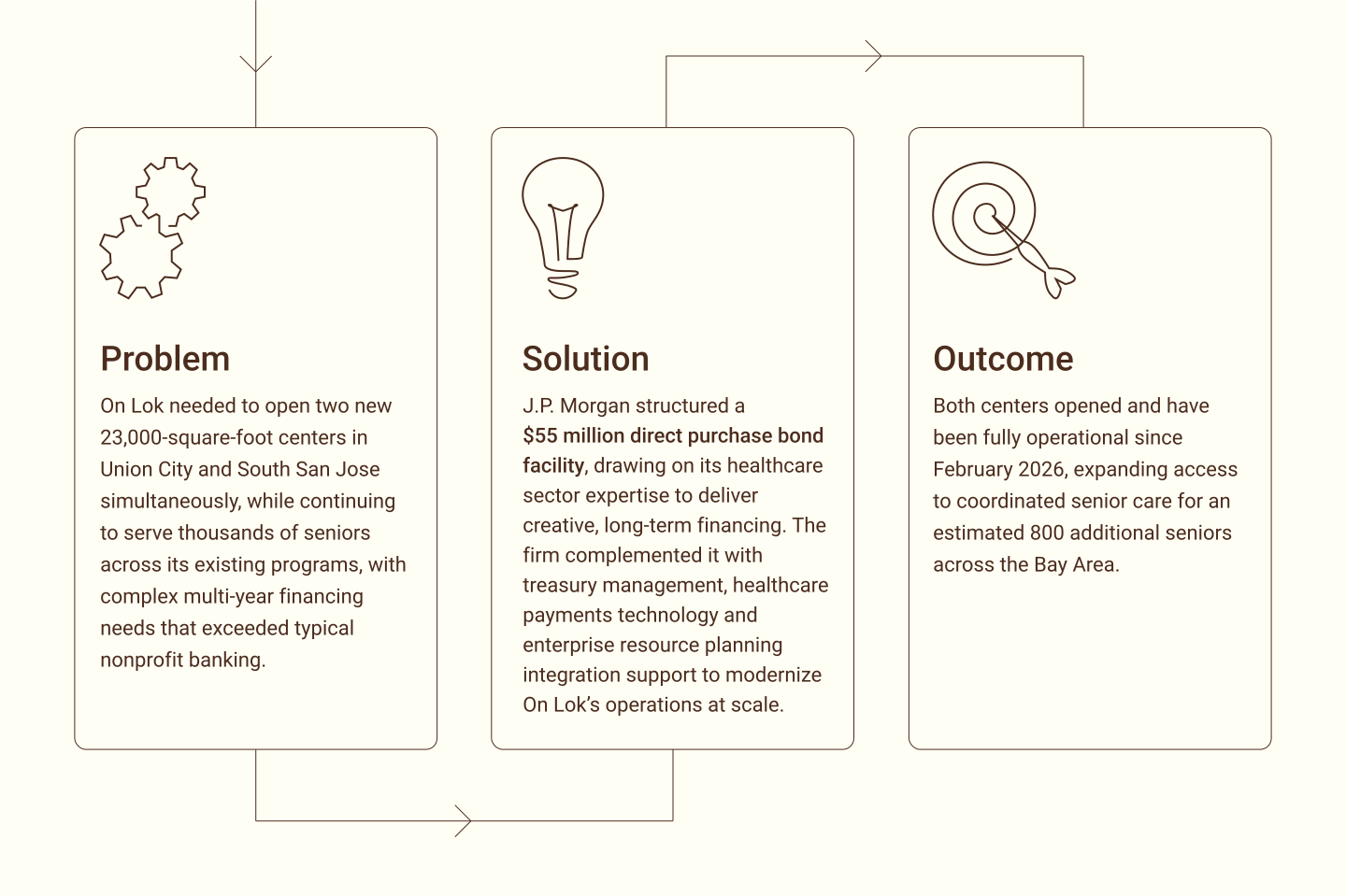
Problem: On Lok needed to open two new 23,000-square-foot centers in Union City and South San Jose simultaneously, while continuing to serve thousands of seniors across its existing programs, with complex multi-year financing needs that exceeded typical nonprofit banking.
Solution: J.P. Morgan structured a $55 million direct purchase bond facility, drawing on its healthcare sector expertise to deliver creative, long-term financing. The firm complemented it with treasury management, healthcare payments technology and enterprise resource planning integration support to modernize On Lok’s operations at scale.
Outcome: Both centers opened and have been fully operational since February 2026, expanding access to coordinated senior care for an estimated 800 additional seniors across the Bay Area.
From neighborhood to a national model
“It’s been 55 years now that On Lok has been part of this community,” said CEO Grace Li, who’s been with the organization for 25 years. “It came to be when members of our community recognized that the seniors in the Chinatown North Beach community really needed a way to receive care that was going to keep them close to their communities.”
What emerged was the Program of All-Inclusive Care for the Elderly—known as PACE—a coordinated, community-based alternative to nursing home placement that integrates medical care, social services, nutrition, transportation and daily activities under one roof. As On Lok proved the model locally, its leaders wanted to test whether it could work beyond San Francisco. They took the concept to the federal government as a demonstration and established a unique way to finance the program through Medicare and Medicaid to deliver the full range of services seniors need to stay in their communities.
With grant support, On Lok worked with six organizations in six states to teach the approach and show it could deliver quality care beyond a single city or population. That proof helped pave the way for a permanent funding framework within Medicare regulations.
Today, PACE operates in 33 states and the District of Columbia, serving more than 100,000 people. With approximately $286 million in annual revenue and more than 1,200 employees, On Lok is also a significant economic anchor in the San Francisco Bay Area, contracting with local vendors and generating the institutional stability that keeps neighborhoods viable.
“Organizations don’t shape policy and change payment reform by accident,” Li said. “Being a local nonprofit where people see our vans and know who On Lok is—they just know.”
“People can still make their own choices. It’s not easy to age and On Lok has been thinking about what our community members need as they age for 55 years.”

Grace Li
CEO, On Lok
Helping people age on their own terms
On Lok’s services span a continuum of aging: active seniors come to senior centers for exercise, art, computer labs and communal meals; those with more complex needs receive care management and help navigating insurance and housing; and for seniors whose chronic conditions make daily life genuinely difficult, the PACE program provides fully integrated medical and social support that keeps them in the community rather than in institutional care.
“On Lok’s mission is the voice of aging,” said Nicole Torres, COO and a 24-year member of the organization. Torres began her career as a nurse—starting in pediatrics at Lucile Packard at Stanford—before shifting into older-adult care and joining On Lok as a home care nurse. “We are serving people who are yearning to age as they want to age. We are also serving communities that need us, who are vulnerable, who are unheard.”
Marie, a pianist and PACE participant at the On Lok 30th Street Center, came to On Lok after breaking her femur during the pandemic. Today she plays piano for fellow participants several times a week. “I kept hoping I could play music for people again. The dream came true,” Marie said. She is also grateful for the healthcare support: “It’s a lifesaver for me.”
Jeffrey, a 66-year-old former cable linesman and self-taught artist at the On Lok PACE South San Jose Center, has had his drawings celebrated by staff and shared with other participants. “The medical support here is impressive,” he said. “I thought I was at the end of my rope. It makes me feel like I’m still somebody. On Lok takes good care of me.”
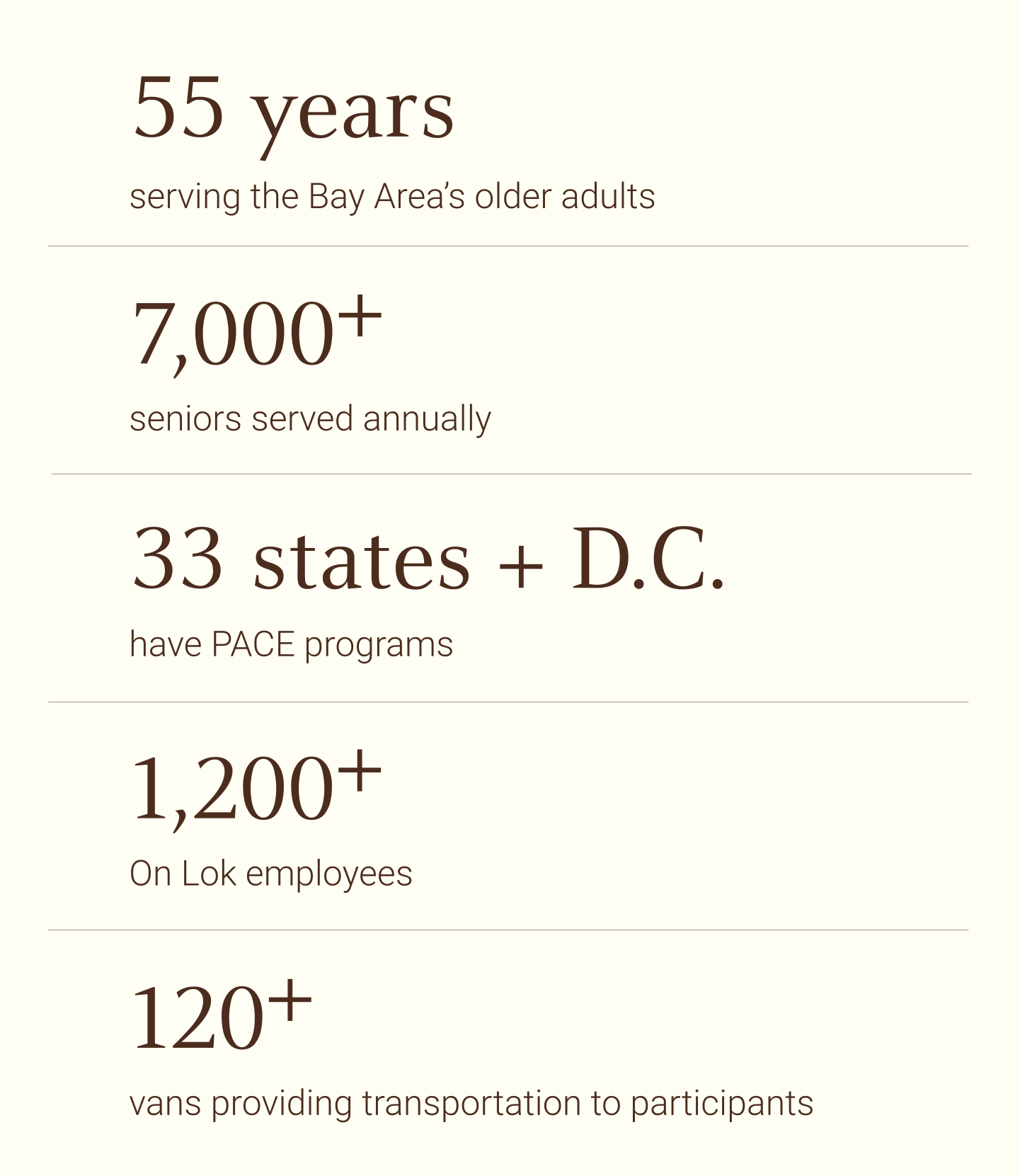
55 years serving the Bay Area’s older adults
7,000+ seniors served annually
33 states + D.C. have PACE programs
1,200+ On Lok employees
120+ vans providing transportation to participants
A local institution, a national impact
On Lok’s reach is deeply local: It employs physicians, nurses, social workers, therapists, drivers and nutritionists, and contracts with local small businesses and community providers. Its impact extends far beyond its walls, strengthening families, caregivers and the community institutions that make neighborhoods work.
That’s the lens JPMorganChase applies through the American Dream Initiative: scaling proven local solutions by mobilizing capital, know-how and practical policy support alongside local organizations. The initiative was designed, in part, to finance local healthcare infrastructure that expands opportunity. For aging Americans, that opportunity means staying in your neighborhood, maintaining independence and receiving high-quality care without being uprooted from everything you know.
“The work we do addresses healthcare, medical care and social supports for that senior and its impact goes beyond the senior,” Torres said. “It helps their community, the immediate caregivers, the friends, the daughters, the husband, the wife and then it helps the greater neighborhood.”
Connect with our team to learn how J.P. Morgan can support your mission-driven organization in strengthening operations, accessing capital and scaling community impact.
A bold expansion—and the capital to make it possible
On Lok made what Torres calls “a bold move”: opening two brand-new PACE centers simultaneously, one in Union City and one in South San Jose, each spanning approximately 23,000 square feet with a full primary care clinic and adult day health center, while continuing to operate all existing programs at capacity.
“J.P. Morgan is the expert at banking and financial services. On Lok is not. We had to recognize who are experts in helping organizations think about how to scale.”
Nicole Torres
COO, On Lok
J.P. Morgan provided a $55 million direct purchase bond facility to finance the acquisition and development of both sites, a transaction requiring careful multi-year planning and deep sector-specific expertise. “For this particular financing opportunity, we turned to J.P. Morgan and talked with them about ways that they could help support us,” Li said.
“J.P. Morgan helped us with a huge historic endeavor,” Torres said. “After two years plus of blood, sweat and tears, those buildings are fully built out and we’ve been operational since February.”
For Stu Bessieres, Relationship Executive at J.P. Morgan, the milestone is personal. “On Lok is a critical organization of San Francisco that represents our true San Franciscan identity. J.P. Morgan was integral in providing the capital necessary for On Lok to expand in both their Union City and South San Jose locations. I saw the buses driving around growing up. Now I get to truly be a part of its success.”
Beyond the transaction
J.P. Morgan is supporting On Lok’s migration to an enterprise resource planning (ERP) platform, transitioning reconciliation and payment origination from manual to fully automated processes. The migration is expected to be completed by the end of 2026.
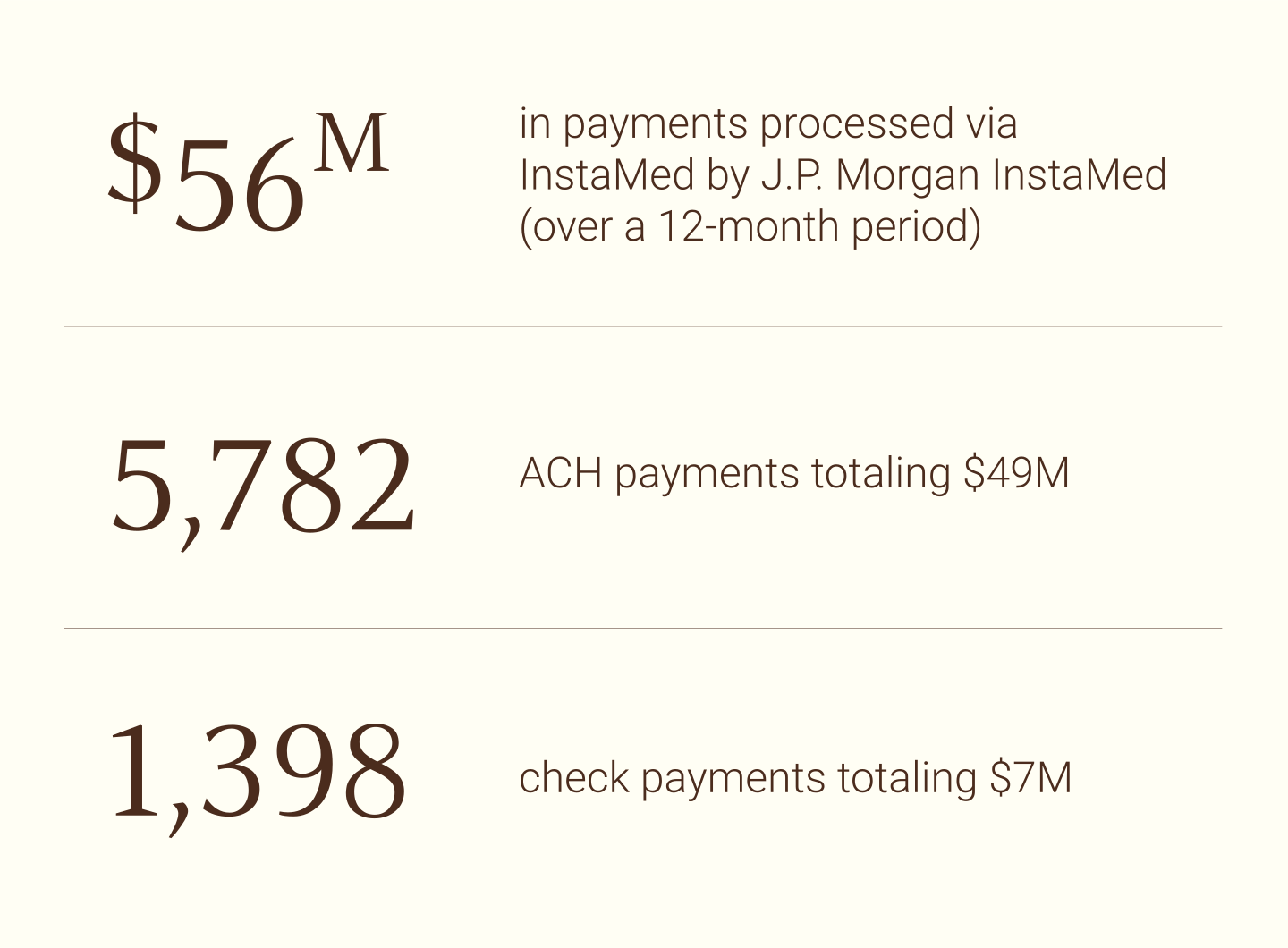
$56M in payments processed via InstaMed by J.P. Morgan InstaMed (over a 12-month period)
5,782 ACH payments totaling $49M
1,398 check payments totaling $7M
The relationship extends into sector connectivity: J.P. Morgan has brought On Lok into its annual Healthcare Conference, nonprofit roundtables and webinars. Employees also volunteer directly at On Lok, playing bingo with participants and tending the center’s garden.
The next 55 years
On Lok’s story is, at its core, a story about generations. The organization is now serving the children and grandchildren of the first seniors it cared for in 1971. That generational continuity is both a measure of past success and a mandate for what comes next.
“We’re already serving generations of families,” Li said. “There are grandkids who always would come and know On Lok because they visited their grandparent here or their parent here.”
Torres looks ahead with clarity. “The next 55 years look bright. Tenfold the lives that we’re serving now. Double, tripling our workforce. Continuing to build our relationships and synergies with community organizations and institutions like J.P. Morgan.”
The two new centers in Union City and South San Jose are not endpoints. They are, as Torres frames it, a signal that a longstanding nonprofit can keep growing, innovating and making room for more people to age with dignity and connection.
“The opportunity to have the support of J.P. Morgan, our community partners, the staff that come to work every day to do this mission-driven work—we’re just grateful,” Li said.
How J.P. Morgan supports mission-driven healthcare organizations
The J.P. Morgan Healthcare, Higher Education and Nonprofit Banking teams bring deep sector expertise to organizations like On Lok—combining primary banking, treasury solutions, capital markets access, healthcare payments technology and strategic insights to support mission-driven institutions as they grow and serve more people.
Connect with our team to explore how J.P. Morgan can support your organization’s mission.
JPMorgan Chase Bank, N.A. Member FDIC. Visit jpmorgan.com/commercial-banking/legal-disclaimer for disclosures and disclaimers related to this content.