
Key takeaways
- European venture capital deal flow is surging, reaching €68.4 billion in the first nine months of 2026 — a 31% year-on-year increase if current pacing continues.
- Deal capital is concentrating around AI infrastructure investments, with tailwinds for companies native to Europe as sovereign AI becomes a strategic focus.
- The IPO market remains closely watched as “private-for-longer” persists, while M&A and secondaries are providing necessary liquidity.
European venture capital deal flow has seen an increase this year, reaching €68.4 billion across 7,311 deals in the first nine months of 2026, with €24.6 billion invested in the third quarter alone. At the current investment rate, PitchBook estimates full-year 2026 deal value would represent a 31% year-on-year increase.1
That said, capital is entering a more selective and intensive phase. Larger private rounds, evolving financing needs and a continued private-for-longer environment are changing how companies fund growth, while access to customers, strategic partners and international markets is becoming increasingly important. Here’s a look at the trends shaping European VC in the age of AI.
AI remains a focus for dealmaking, with the move toward sovereignty serving as a tailwind
AI-centric companies currently account for 66% of European VC deal value, up from 41% in 2025.³ Interestingly, investors are showing support for funding the infrastructure required to make AI models usable at scale, including compute, orchestration and chips.
Additionally, AI companies headquartered in Europe are enjoying a particular tailwind. “AI is the defining theme, but the broader story is how the focus has turned to ‘sovereign’ AI as European governments and corporates view local compute infrastructure, data and AI models as strategic priorities,” said Alex McCracken, co-head of EMEA Venture Capital Coverage at J.P. Morgan.
Funding rounds are also happening faster and at higher valuations. Seed and Series A rounds for AI and deep technologies like quantum computing have reached record sizes, and are often pre-empted, widening the divide between perceived category leaders and the rest of the market.
The increase in deal sizes reflects sector needs. Defense, robotics, autonomy and deep tech are all areas typically more capital-intensive than legacy software. More than $7.4 billion was deployed into European defense deals in the first three quarters of 2026, compared with $1.5 billion in the same period of 2025.
AI investing is entering a more discerning phase. While exposure to the theme itself has attracted significant capital, investors are increasingly differentiating between companies based on sustainable competitive advantages, unit economics and their ability to translate technological innovation into durable revenues. The next phase will be as much about identifying the winners as identifying the right sectors.
That capital concentration is contributing to funding bottlenecks, increasing the cost of entry and raising the stakes of investment. “Venture investors can’t afford to miss out of potential AI category leaders in this environment,” McCracken said. “With more capital into fewer companies, investors need greater conviction around whether a business can build a durable competitive advantage and generate huge potential upside to justify that level of investment.”
Still, McCracken described the capital-intensive trend as one that requires long-term relationship building. “As capital concentrates, access itself becomes a moat: access to customers, to partners, and to the right capital at the right stage. There’s an opportunity for us to be in the room earlier, helping shape the sequencing,” he said.
Liquidity is evolving as companies stay private for longer
Despite increased investment, companies face a difficult path to exit. High private-market valuations and substantial capital requirements are narrowing the pool of potential acquirers and complicating the route to liquidity, all while megacap IPO deals dominate headlines.
“Public markets are showing encouraging signs of renewed activity, including beyond the largest transactions.,” said Silvia Biscaldi, co-head of EMEA Venture Capital Coverage at J.P. Morgan. “However, investors remain selective, with valuations and the quality of growth increasingly important. The next wave of IPOs will be an important test of how broad and sustainable investor demand really is.”
In the meantime, M&A continues to comprise the majority of exits, with acquisitions accounting for 63% of value, up from around 50% last year.
Share of VC exit value by type
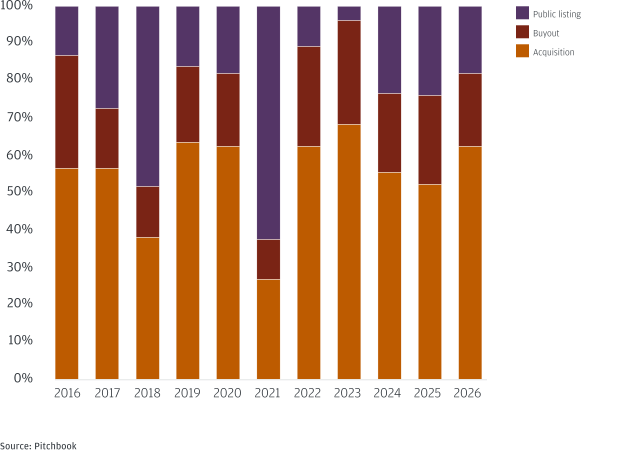
2026 has seen M&A lead deal activity, a slight uptick over previous years.
Investors are also proceeding cautiously. With companies staying private longer, investor scrutiny on revenue scale, predictable growth and strong unit economics — for example, profitability per customer or per transaction — raises the bar for consideration.
As a result, founders and investors are exploring secondary transactions as an alternative route to liquidity, continuing the elevated activity that defined the first half of 2026. “Secondaries are increasingly becoming a mainstream liquidity tool, enabling existing investors to realize value while allowing companies to continue scaling privately,” said Biscaldi . “This year will have seen the most secondary dealmaking activity in EMEA in several years. We’re already there. The question is, by how much — and can it continue?”
Access and stewardship emerge as deal differentiators
As a fast-evolving and disruptive technology, AI is providing fertile ground for the creation of new companies and products. In that environment, how founders stand out, and how VC funders connect to them, become just as important as the product or service in development.
“As capital becomes more concentrated, conviction needs to be matched by discipline.,” said Biscaldi. “The real differentiator will be which companies can translate technological leadership into commercial scale, and which investors can help them get there.”
Access to a robustly funded U.S. market is also a key differentiator for J.P. Morgan’s Venture Capital Coverage team.
“For many European founders, the U.S. is not just a funding market, it’s a commercialization market,” said McCracken. “Helping companies bridge that divide is a core part of how we support the ecosystem in a way that benefits everybody: founders, funders and the end user, who winds up with a product or service made better by the relationships we broker.”
“As capital becomes more concentrated, conviction needs to be matched by discipline. The real differentiator will be which companies can translate technological leadership into commercial scale, and which investors can help them get there.”

Silvia Biscaldi
Co-head of EMEA Venture Capital Coverage, J.P. Morgan
What to watch for next in the European VC space
Europe’s venture ecosystem continues to attract capital, but the opportunity is increasingly selective. This is playing out against a backdrop of elevated financing costs, macroeconomic uncertainty, geopolitical tensions and an evolving AI regulatory landscape.
For founders, strong management—the “how”— is as important as the “what” that’s being developed. For VCs, the advice is to stay disciplined on valuations in the search for sustainable, high-growth names to support. “The quality bar currently in place is there for a reason,” said McCracken. “For capital-intensive businesses, the priority is to connect technical milestones with commercial progress and a credible path to predictable revenue. Doing so will help determine not simply who can raise capital, but who can turn it into a durable business.”
“For many European founders, the U.S. is not just a funding market, it’s a commercialization market.”

Alex McCracken
Co-head of EMEA Venture Capital Coverage, J.P. Morgan
References
Pitchbook, “Q3 2026 PitchBook-NVCA Venture Monitor.” Accessed October 27, 2026. https://pitchbook.com/news/reports/q3-2026-pitchbook-nvca-venture-monitor
Related insights
-

Banking
Venture capital remains concentrated in AI and mega-rounds
October 08, 2026
AI captured 80%+ of venture capital through Q3 2026 while many startups face selective funding. Ginger Chambless and J.P. Morgan experts share insights on the bifurcated fundraising market.
-
1:51 - Banking
Main Sequence: Building the next generation of deep tech
September 16, 2026
See how Main Sequence transforms breakthrough research into high growth companies with strategic support and venture capital expertise from J.P. Morgan.
-

Global Research
What unprecedented AI capex means for markets and investors
October 19, 2026
AI capital expenditures are projected to approach $1 trillion in 2026. How much bigger could it get — and how much longer will this growth go on?
This material (including market commentary, market data, observations or the like) has been prepared by personnel in the Global Banking Group of JPMorgan Chase & Co. and/or its affiliates and subsidiaries worldwide (“J.P. Morgan”). It has not been reviewed, endorsed or otherwise approved by, and is not a work product of, any research department of J.P. Morgan.
Any views or opinions expressed herein are solely those of the individual authors and may differ from the views and opinions expressed by other departments or divisions of J.P. Morgan. This material is for the general information of our clients only and is a “solicitation” only as that term is used within CFTC Rule 1.71 and 23.605 promulgated under the U.S. Commodity Exchange Act.
RESTRICTED DISTRIBUTION: This material is distributed by the relevant J.P. Morgan entities that possess the necessary licenses to distribute the material in the respective countries. This material is proprietary and confidential to J.P. Morgan and is for your personal use only. Any distribution, copy, reprints and/or forward to others is strictly prohibited.
This material is intended merely to highlight market developments and is not intended to be comprehensive and does not constitute investment, legal or tax advice, nor does it constitute an offer or solicitation for the purchase or sale of any financial instrument or a recommendation for any investment product or strategy.
Information contained in this material has been obtained from sources believed to be reliable but no representation or warranty is made by J.P. Morgan as to the quality, completeness, accuracy, fitness for a particular purpose or noninfringement of such information. In no event shall J.P. Morgan be liable (whether in contract, tort, equity or otherwise) for any use by any party of, for any decision made or action taken by any party in reliance upon, or for any inaccuracies or errors in, or omissions from, the information contained herein and such information may not be relied upon by you in evaluating the merits of participating in any transaction. All information contained herein is as of the date referenced and is subject to change without notice. All market statistics are based on announced transactions. Numbers in various tables may not sum due to rounding.
J.P. Morgan may have positions (long or short), effect transactions, or make markets in securities or financial instruments mentioned herein (or options with respect thereto), or provide advice or loans to, or participate in the underwriting or restructuring of the obligations of, issuers mentioned herein. Any transactions presented herein are for illustration purposes only. J.P. Morgan does not make representations or warranties as to the legal, tax, credit, or accounting treatment of any such transactions, or any other effects similar transactions may have on you or your affiliates. You should consult with your own advisors as to such matters.
The use of any third-party trademarks or brand names is for informational purposes only and does not imply an endorsement by J.P. Morgan or that such trademark owner has authorized J.P. Morgan to promote its products or services.
J.P. Morgan is the marketing name for the investment banking activities of JPMorgan Chase Bank, N.A., J.P. Morgan Securities LLC (member, NYSE), J.P. Morgan Securities plc (authorized by the Prudential Regulation Authority and regulated by the Financial Conduct Authority and the Prudential Regulation Authority), J.P. Morgan SE (Authorised as a credit institution by the Federal Financial Supervisory Authority (Bundesanstalt für Finanzdienstleistungsaufsicht, BaFin) and jointly supervised by the BaFin, the German Central Bank (Deutsche Bundesbank) and the European Central Bank (ECB)), J.P. Morgan Securities Australia Limited (ABN 61 003 245 234/AFS Licence No: 238066 and regulated by Australian Securities and Investments Commission) and their investment banking affiliates. J.P. Morgan Securities plc is exempt from the licensing provisions of the Financial and Intermediary Services Act, 2002 (South Africa).
For Brazil: Ombudsman J.P. Morgan: 0800-7700847 / ouvidoria.jp.morgan@jpmorgan.com
For Australia: This material is issued and distributed by J.P. Morgan Securities Australia Limited (ABN 61 003 245 234/ AFS Licence No: 238066) (regulated by ASIC) for the benefit of “wholesale clients” only. This material does not take into account the specific investment objectives, financial situation or particular needs of the recipient. The recipient of this material must not distribute it to any third party or outside Australia without the prior written consent of J.P. Morgan Securities Australia Limited.
© 2026 JPMorgan Chase & Co. All rights reserved.