
6 min read
Key takeaways
- Cross-border payments are poised for significant growth, driven by modernization, digital assets and rising client expectations.
- AI and interoperability are redefining payment speed, security and operational resilience, making instant, intelligent transactions the new standard.
- Financial institutions should adopt new technologies, comply with evolving standards such as ISO 20022 and adapt FX solutions to evolving global trade flows.
Today’s global financial environment is shaped by dynamic regulations, new standards and rising client expectations—but it also offers unprecedented potential for growth and innovation. Cross‑border payments are projected to grow from $194 trillion in 2024 to $320 trillion by 2032.1
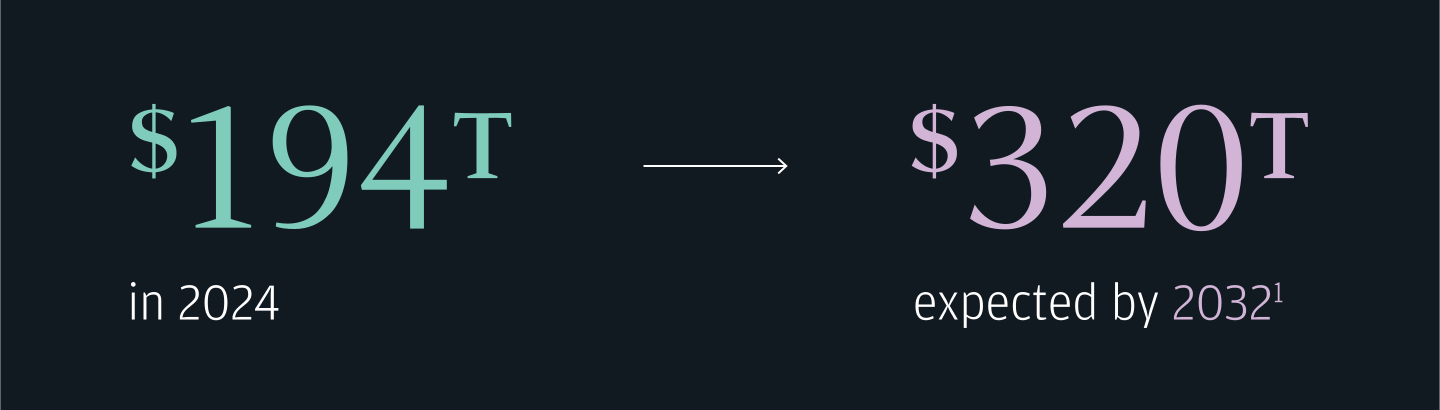
Cross border payments are projected to grow from $194 trillion in 2024 to $320 trillion by 2032.1
In this article, we explore five key trends driving transformation and unlocking new opportunities for growth and resilience in global payments.
Trend #1: Faster payments
Clients increasingly expect international transactions to match the speed, transparency and traceability of domestic payments—instant and available 24/7. Speed is no longer a differentiator: it’s a baseline expectation. Financial institutions (FIs) are moving beyond speed toward an intelligent, always-on network that connects traditional rails, real-time payments and emerging digital platforms.
Some ways FIs are innovating:
-

Infrastructure modernization: Adaptability is a strategic priority, with focus on collaboration, innovation and customer-centric solutions to help stay competitive.
-

Data intelligence in transactions: Structured data enables greater automation and efficiency, helping to reduce associated costs. FIs are leveraging transactional data intelligence for predictive analytics and revenue growth.
-

Controls and oversight: Modern payment systems increasingly rely on timely fraud detection, robust encryption and permissioned ledgers. These technologies help safeguard transactions, protect sensitive data and support compliance with regulatory requirements.
-

Global coordination: Industry collaboration and shared standards can unlock stability and scale. Examples include global initiatives such as SWIFT Digital, G20 and BIS projects.
How does J.P. Morgan Payments support innovative payments?
- J.P. Morgan adopted ISO 20022 as its standard payments protocol in 2023, embedding the universal format into daily operations. This shift helps seamless connectivity across financial platforms, supports data accuracy and visibility, and streamlines transaction processing.
- Wire 365 extends payment processing capabilities, allowing FIs to initiate and settle payments between J.P. Morgan clients every day—including weekends and U.S. holidays. This expanded schedule meets the growing need for around-the-clock payment activity.
- Real-time payments options help support improved liquidity, cost efficiency and a better customer experience, aligning with the demands of a 24/7 digital economy.
Trend #2: Modernization—AI, technology and transformation
AI is streamlining payment processes, reducing friction and boosting speed and resilience, while freeing talent for higher-value work. Human–AI collaboration can lift productivity and execution speed by up to 50%, and AI-powered data management improves decision speed and accuracy by up to 25%.2 Early adopters of AI are gaining a clear competitive edge.
Some current AI trends:
-

Return on AI investment: Organizations will prioritize AI ROI by scaling solutions beyond pilot projects.
-

AI regulatory compliance: Global oversight and tightened risk based, enforceable controls will require conformity assessments and human oversight.
-

Innovation and experimentation: AI will continue to lower experimentation costs, enabling rapid innovation and higher product quality.3
An agentic AI era: what FIs should know
FIs can strengthen operational resilience by preparing for and implementing agentic AI. Agentic AI gives autonomous systems the ability to make decisions and take independent actions to achieve goals. It has the potential to fundamentally reshape how FIs serve their customers via cross-platform integration and new business opportunities.
How agentic AI is changing the payments landscape:
- Cross‑platform integration and early adoption of AI is creating new business opportunities.
- Cross‑border flows are increasingly machine‑initiated and AI agents are beginning to discover, decide and execute transactions on customers’ behalf.4
- FX, routing and settlement decisions are happening in near real time, so risk, compliance and liquidity should operate at machine speed as well.
- FIs should consider implementing APIs, tokenization and fraud controls for AI‑initiated activity.
ISO 20022 countdown: what’s next?
ISO 20022 is delivering meaningful benefits across the financial industry by enabling richer, more structured payment data that improves interoperability and transparency—supporting faster processing, reduced costs and regulatory compliance.
As for the upcoming November 2026 deadline, key things to keep in mind:
- Structured or hybrid postal addresses become mandatory and payments must include at least the town name and country—unstructured address formats will be rejected.
- MT101 payments must migrate to ISO 20022 MX messages to process successfully over SWIFT Get ready for this big transition and ensure all payment instructions and address formats are compliant to avoid rejections.
Trend #3: Digital assets—all the buzz
Digital assets are quickly moving from concept to reality, reshaping the future of cross-border payments. While the market is still developing, early examples—such as closed-loop networks—are already showcasing how digital assets can streamline and enhance international transactions, pointing to what next generation cross border flows could look like.
Some key digital assets to know:
- SWIFT shared ledger: The blockchain-shared ledger is designed to deliver fast, transparent and predictable cross-border payments.
- Blockchain accounts: Bank account with fiat currency running on closed-loop permissioned Distributed Ledger Technology (DLT) infrastructure; interoperable with traditional rails (Wires/RTP) and next-generation DLT networks.
- Deposit tokens: An electronic payment instrument issued by a bank, representing funds deposited by a customer; can be deployed on public and private blockchain networks.
- Stablecoins: Blockchain-based tokens designed to maintain a stable value, typically by pegging to fiat currencies like the U.S. dollar.
- Central Bank Digital Currencies (CBDCs): Digital form of a country’s fiat currency, issued and regulated by a central bank.
- Cryptocurrencies: Digital or virtual currency that uses cryptography for security and operates on a decentralized system (blockchain).
Learn more about these and other key terms with our Blockchain 101 glossary.
Trend #4: Modernization—having a technology and transformation mindset
Modernizing payments can help FIs stay competitive in this new environment of rising customer expectations, changing operating models and regulatory compliance. Ninety-three percent of financial institutions are currently modernizing their payments infrastructure.5
Important focus areas for modernization:
-

Investing in core systems to support new products and offerings more efficiently
-

Building a robust data and AI backbone for operational efficiency, personalizing customer experience and supporting future technologies
-

Enhancing payment rails, including the possibility of integrating with digital assets, can help with faster transactions and always-on environment
Modernization is multifaceted and challenging, but advances in cloud technology and stage-gated migration strategies can make the process safer and more cost-effective.
How is J.P. Morgan Payments supporting modernization?
Each day, we move over $12 trillion on 60 million transactions6 across more than 200 countries and territories in approximately 120 currencies,7 achieving a 99.5% straight-through processing (STP) rate.8 Our deep investments in AI and machine learning (ML) play a large role in achieving this.
Our early adoption of ISO 20022 has been very beneficial, leading to standardized messaging, structured data, improved STP rate, rich data benefits, reduced false/positive screens and faster payments.
Trend #5: FX opportunities—new corridors and enhancing user experience
As cross-border payments evolve, FIs are adapting FX solutions to meet changing global trade flows and demand. Global trade shifts are changing FX flows and 30% of global trade could be redirected from existing trade corridors to alternative corridors by 2035.9
To enhance user experience in this shifting environment, FIs should consider:
- Expanding currency coverage
- Incorporating transparent, real-time solutions enabled by APIs
- Meeting growing market needs of local currency invoices
Efficiency in trade corridors is essential, and our FX solutions have direct connectivity to onshore FX for many emerging corridors. Xpedite offers easy-to-integrate cross-currency solutions that address consistency, control, transparency and value, while helping to make your payments faster and more cost-effective.
References
FXC Intelligence, 2025. "The cross-border payments market is now worth over $194 trillion and is forecast to reach $320 trillion by 2032"
PwC, 2025, “How AI is Reshaping Banking”
McKinsey & Company,“How an AI-enabled software product-development life cycle will fuel innovation”
Payments Journal, 2024. Beyond the click: How agentic payments are redefining global financial flow
J.P. Morgan Internal data, 2025 Please see your banker for a full list
J.P. Morgan Internal data, 2025
McKinsey & Company, “A New Trade Paradigm: How Shifts in Trade Corridors Could Affect Business”
© 2026 JPMorgan Chase & Co. All rights reserved. JPMorgan Chase Bank, N.A. Member FDIC. Deposits held in non-U.S. branches are not FDIC insured. Non-deposit products are not FDIC insured. The statements herein are confidential and proprietary and not intended to be legally binding. Not all products and services are available in all geographical areas. Visit jpmorgan.com/paymentsdisclosure for further disclosures and disclaimers related to this content.