
8 min read
Key takeaways
- Payments data offers some of the richest, most immediate source of truth merchants have about their customers, and businesses acting on that data often out-convert their competition
- Real-time data visibility overturns long-held assumptions about when customers spend, where the most valuable segments sit and how operational planning should be structured
- Agentic commerce helps close the gap between insight and action, using AI to anticipate customer needs, personalize the experience and protect against fraud
- Merchants who run data and agentic capabilities together on one payments infrastructure can gain a competitive advantage by treating their payment stack as a strategic asset
Connect with us to explore how payments data can help you better understand customers, anticipate needs and identify new opportunities.
Introduction
Commerce is being reshaped by merchants who treat data as a competitive advantage, and payments is where that data can often be the richest. To them, every transaction offers a real-time read on who their customers are, what they want and what they are likely to do next. Acting on that read is how merchants are out-converting their competition and capturing a disproportionate share of revenue in high-stakes commercial moments.
The opportunity to lead is widening. Customers expect more personalized and streamlined experiences at every touchpoint, and there are more channels to manage than ever before. Peak seasons, major events and demand surges reward merchants who can see and respond quickly. Investing in commerce intelligence is no longer a question of if, but of how fast it can be put to work.
Seeing the customer clearly
Merchants have long strived to understand who their customers are, and what they want. For years, the tools available to answer those questions were reactive, fragmented and largely disconnected from the moment of purchase.
With modern payments infrastructure, that’s no longer the case. Transactions are now able to generate a continuous stream of behavioral, geographic and demographic signals as a byproduct of everyday processing. Merchants can get a continuous, real-time view of customer activity within the payments stack itself. However, not every business is structured to act on it.
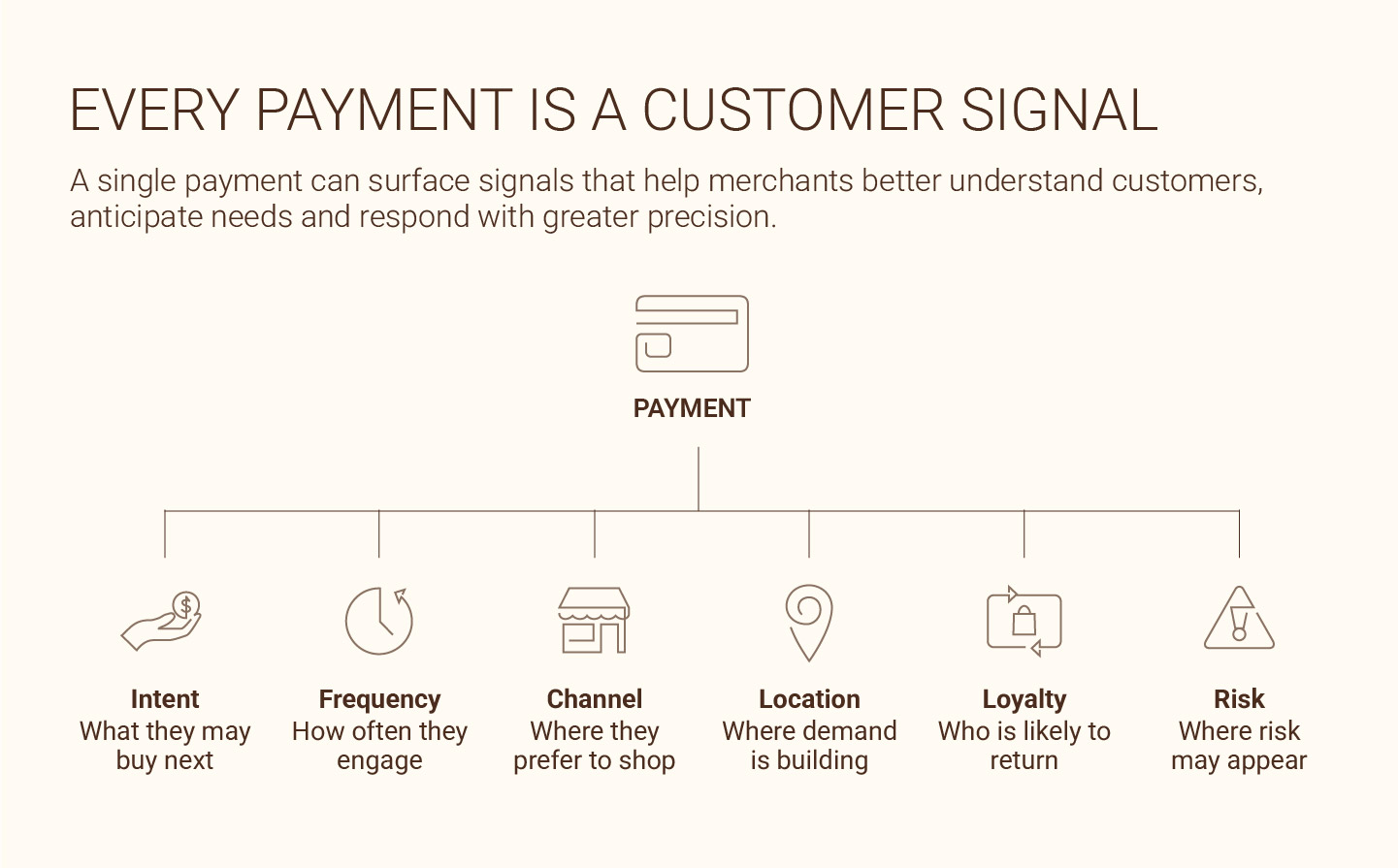
Heading: Every payment is a customer signal
Description: A single payment can surface signals that help merchants better understand customers, anticipate needs and respond with greater precision.
Payment signals include:
- Intent: What the customer may buy next
- Frequency: How often the customer engages
- Channel: Where the customer prefers to shop
- Location: Where demand is building
- Loyalty: Who is likely to return
- Risk: Where risk may appear
Data often tells a different story than intuition does. For example, the highest-revenue day of a major event window might fall midweek, not on the headline date. The most valuable customer segment might be sitting 1 to 3 miles from a venue. Such insights can overturn assumptions that have shaped planning and forecasting for decades.
“When a customer completes a purchase, they're telling you something more reliable than any survey ever could: where they were, what they valued in that instant, what finally moved them to act,” said Tony Wimmer, Managing Director of Data & Analytics at J.P. Morgan Payments. “Payments data captures all of it as a matter of routine, and the merchants who study it closely understand their customers in ways their competitors can only estimate.”
That visibility can change how businesses operate. Inventory moves to where demand is building, staffing aligns to data-proven peaks and marketing spend lands on the customers most likely to convert.
Turning insight into action
Insight alone, however, isn’t a strategy. Knowing what’s happening carries little value if businesses can’t respond fast enough to shape the outcome. This is where the shift from data to decision comes in.
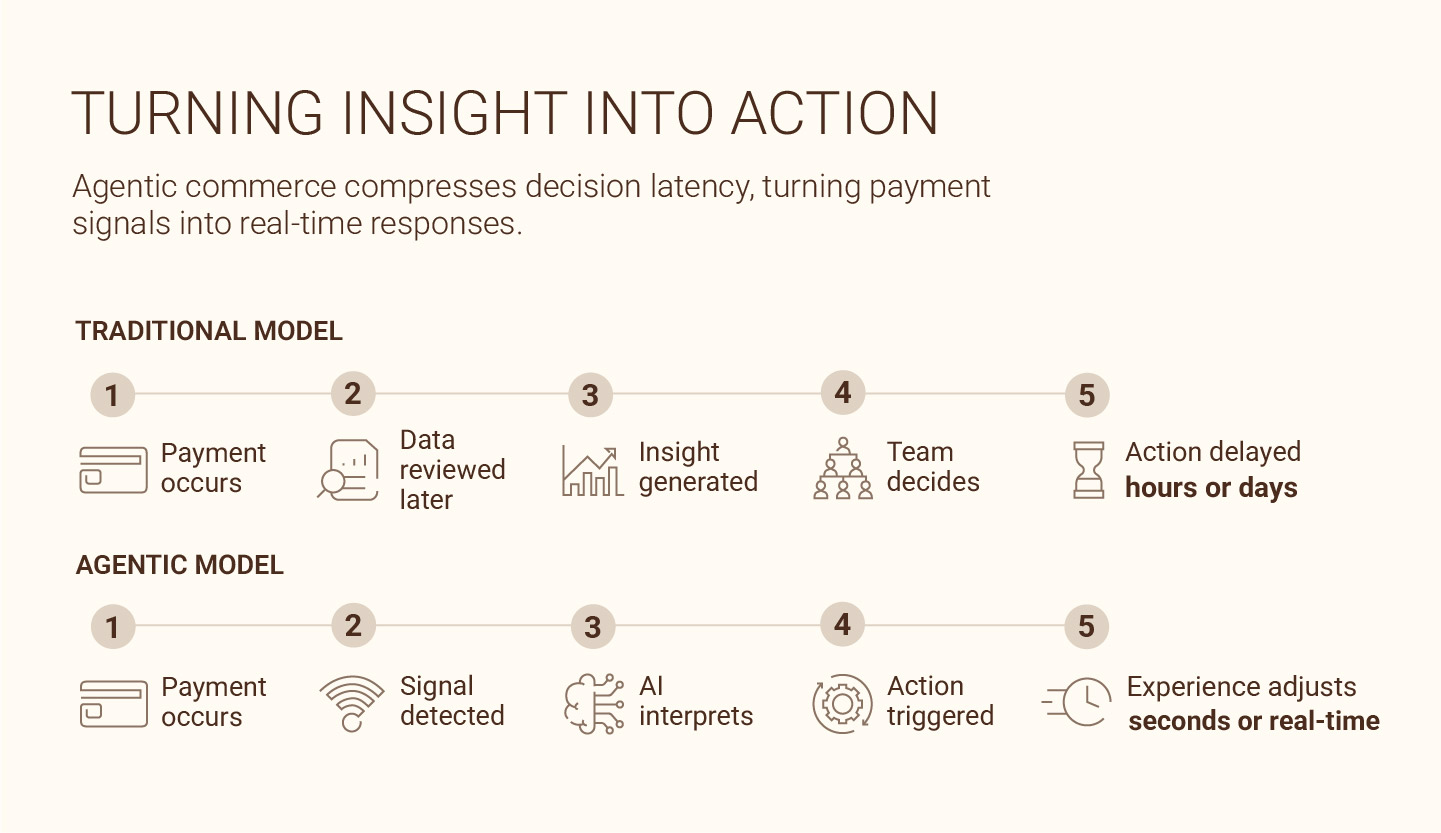
Heading: Turning insight into action
Description: Agentic commerce compresses decision latency, turning payment signals into real-time responses.
Traditional model steps:
1. Payment occurs
2. Data is reviewed later
3. Insight is generated
4. Team decides
5. Action is delayed by hours or days
Agentic model steps:
1. Payment occurs
2. Signal is detected
3. AI interprets the signal
4. Action is triggered
5. Experience adjusts within seconds or in real time
Agentic commerce uses AI to anticipate customer needs, make decisions and adjust the buying journey as it happens. The same intelligence that protects a transaction also shapes the experience around it. This enables merchants to offer security and speed of checkout without impacting conversion and risk management.
“The next generation of commerce won’t be powered by faster checkouts,” said Prashant Sharma, Global Head of Product, Biometric Payments and Agentic Commerce at J.P. Morgan. “It’ll be powered by smarter ones — systems that understand the customer, the context and the risk in real time.”
In practice, AI agents are designed to work with accurate, up-to-date product, inventory and pricing information, while enterprise payment infrastructure handles processing, tokenization and fraud protection in the background, all while keeping the underlying complexity invisible to the customer.
As a result of this combined intelligence, conversion can rise and loyalty can deepen. Lifetime value may climb as repeat purchase behavior becomes more predictable and easier to influence. These wins could be most pronounced in the high-stakes commercial windows where demand is concentrated, decisions need to be made quickly and the merchant who responds first captures the customer.
Integrating the data and agentic layers
Data without action is reporting; action without data is guessing. Merchants who run both together on one payments infrastructure have the opportunity to create a competitive advantage.
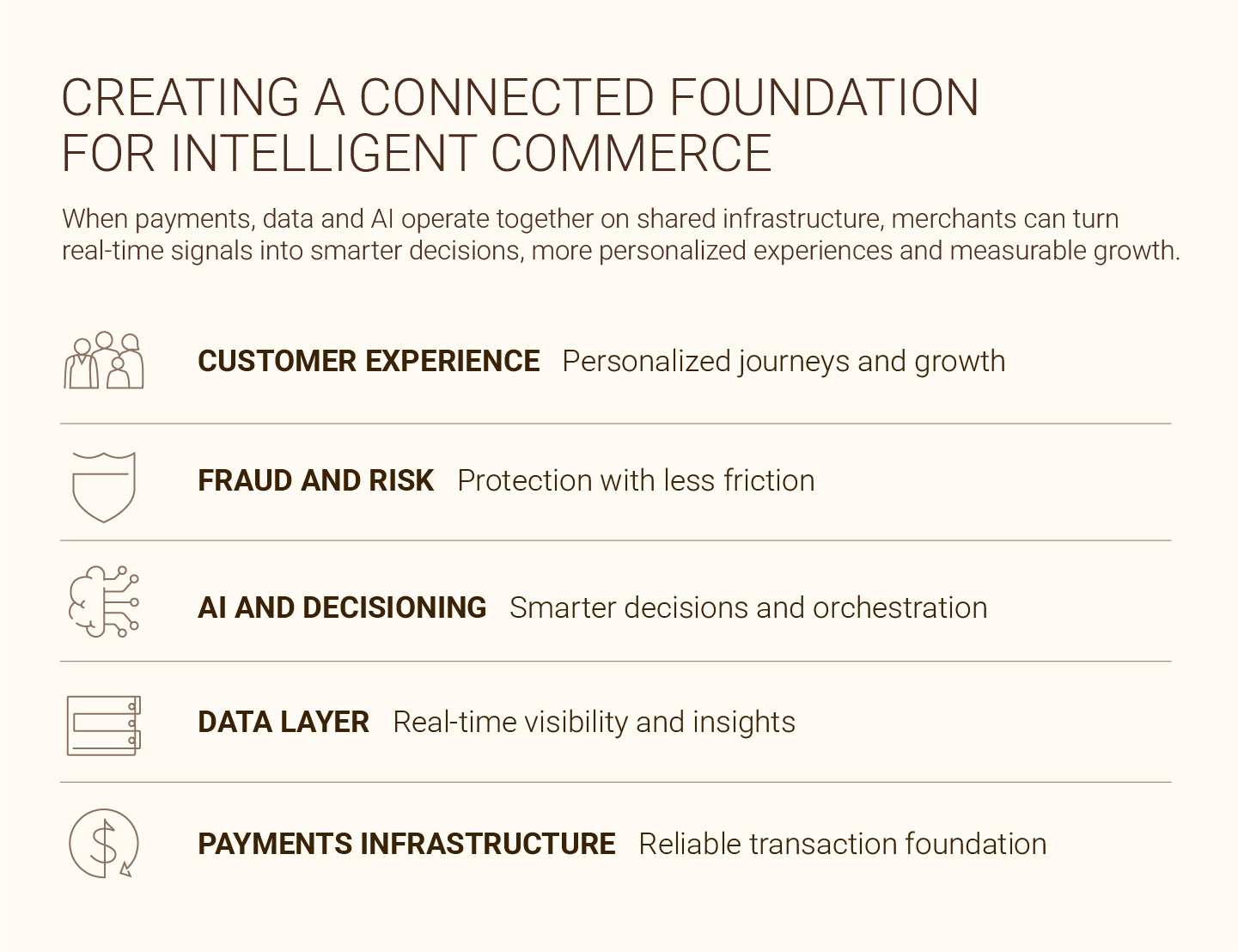
Heading: Creating a connected foundation for intelligent commerce
Description: When payments, data and AI operate together on shared infrastructure, merchants can turn real-time signals into smarter decisions, more personalized experiences and measurable growth.
Key components:
- Customer experience: Personalized journeys and growth
- Fraud and risk: Protection with less friction
- AI and decisioning: Smarter decisions and orchestration
- Data layer: Real-time visibility and insights
- Payments infrastructure: Reliable transaction foundation
Fragmented data and disconnected systems create an environment where businesses can see an opportunity clearly, but are unable to capture it. By the time the response is operational, the moment has passed.
A unified intelligence layer helps close that gap. Payments data feeds decisioning, which informs personalization and risk management. All of it runs on the same infrastructure, in real time, across channels. Payments intelligence uses every transaction to inform the next decision, creating a layer where businesses learn about their customers, decide how to act on what they’ve learned and compete for every sale in real time.
“The businesses that struggle rarely lack information; most have more than they can use,” said Florencia Ardissone, Managing Director, Head of Merchant Services Data & Analytics at J.P. Morgan. “What separates the leaders is how quickly that data becomes a decision, and that speed only exists when everything runs on shared infrastructure instead of systems that have to be stitched together after the fact.”
In the high-stakes commercial moments ahead, this capability creates a dividing line. On one side are the merchants who convert event-driven traffic into durable growth. On the other are the merchants who watch the opportunity move past them.
What this means for you
Putting payments intelligence to work is less about adopting a new technology and more about reorienting the business around the data and capabilities already in reach.
What executives may want to do now is see where the data already lives and what it’s being used for. The right infrastructure, expertise and internal alignment can help transform this data into decisions businesses can act on.
Next, leaders may want to identify the high-value commercial moments ahead. These are the windows where intelligence-led planning can change the outcome. Demand compresses into a narrow window during these moments. Small advantages in forecasting, staffing and personalization may translate into outsized revenue, while mistakes can be magnified at the same scale.
Long-term, treating payments infrastructure as a strategic capability could offer an advantage. Merchants who win the next era of commerce won’t necessarily be the ones with the biggest marketing budgets or the loudest brands. They could be the ones who saw clearly, acted in real time and built the integrated intelligence layer that made both possible.
The infrastructure is ready. The data is already moving. If you’re ready to build on that, J.P. Morgan Payments is ready to help.
Disclaimer
© 2026 JPMorgan Chase & Co. All rights reserved. JPMorgan Chase Bank, N.A. Member FDIC. Deposits held in non-U.S. branches are not FDIC insured. Non-deposit products are not FDIC insured. The statements herein are confidential and proprietary and not intended to be legally binding. Not all products and services are available in all geographical areas. Visit jpmorgan.com/paymentsdisclosure for further disclosures and disclaimers related to this content.