
8 min read
Fintech leaders are fielding the same question in their boardrooms: which infrastructure investments create leverage across your payments business?
Real-time settlement capabilities, AI-powered fraud detection, multi-rail network strategies, embedded finance architecture, stablecoin integration planning, account validation infrastructure—each has its own business case and timeline. But when capital and engineering capacity are finite, these decisions can’t be evaluated in isolation.
Real-time settlement creates fraud patterns that AI addresses at scale. Network interoperability determines how smoothly value moves across rails and institutions—and whether stablecoin integration remains a future option or becomes a dead end. Account validation requirements intersect with real-time payment flows. These six fronts form an interconnected system, and embedded payments represent the infrastructure layer that compounds on everything else, extending your capabilities into growth opportunities that weren’t previously accessible.
This framework helps you evaluate which investments make sense now versus which represent future optionality—and how to sequence them for compounding effect rather than isolated wins.
How the six fronts connect
Infrastructure decisions don’t exist in isolation—while they can unlock capabilities, they can also create dependencies that limit future optionality for growth. Understanding these connections helps you sequence investments strategically rather than reacting to individual pressures.
Real-time and instant payment schemes change everything downstream. When funds settle in seconds rather than days, traditional fraud detection models built for ACH timelines become inadequate. You need behavioral analytics and machine learning that analyze patterns within milliseconds. That AI infrastructure serves multiple use cases beyond fraud—intelligent payment routing, credit risk assessment and operational automation. Multi-network strategies require fraud defenses that work consistently across RTP, FedNow and card networks simultaneously. The Nacha 2026 validation requirements intersect here because verification needs to happen before funds move in real-time environments. AI-powered validation, assessing account risk and detecting suspicious patterns before transaction initiation, turns a compliance requirement into an advanced fraud detection layer.
Payment network interoperability shapes which products you can offer and how quickly you can add new ones. Multi-rail capabilities determine whether embedded payments can deliver seamless experiences at scale. They also dictate whether stablecoin integration becomes straightforward or requires parallel infrastructure. Routing efficiency—selecting optimal paths based on cost and speed—depends on the same foundation. Building modular architecture now, while separating business logic from network-specific implementation, means you can add new rails without rebuilding core systems.
AI creates leverage across fronts. Machine learning models that power real-time fraud detection use the same data pipelines and governance frameworks that enable intelligent routing, predictive cash flow analysis and personalized payment experiences. Companies investing in AI infrastructure gain capabilities that serve multiple fronts simultaneously rather than deploying point solutions that require separate integration.
Regulatory deadlines catalyze broader improvements. Nacha 2026 is more than a compliance milestone. It’s a forcing function for account validation infrastructure that benefits real-time payments, embedded experiences and fraud prevention. Using regulatory requirements as triggers for strategic infrastructure assessment turns compliance costs into competitive advantages.
Three questions for sequencing:
- Where do you have fixed deadlines? Nacha 2026 is non-negotiable; stablecoin frameworks are still developing. Real-time payment adoption is accelerating but not universally mandated. Regulatory timelines create natural prioritization.
- What capabilities are becoming baseline expectations versus true differentiators? Real-time payments have reached baseline status—the competitive question is whether your fraud architecture keeps pace. Multi-rail support is becoming table stakes. The differentiation comes from how intelligently you route, how seamlessly you embed and how resilient your processors are.
- Which investments unlock multiple capabilities? AI infrastructure and network interoperability create optionality across several fronts. Validation systems that serve both compliance and fraud prevention. Embedded payment infrastructure that compounds: unlocking revenue growth, margin improvement and deeper customer relationships.
These connections mean smart sequencing builds capabilities that create options rather than trying to address everything simultaneously. Some fronts require near-term action; others represent strategic optionality over a 12- to 36-month horizon.
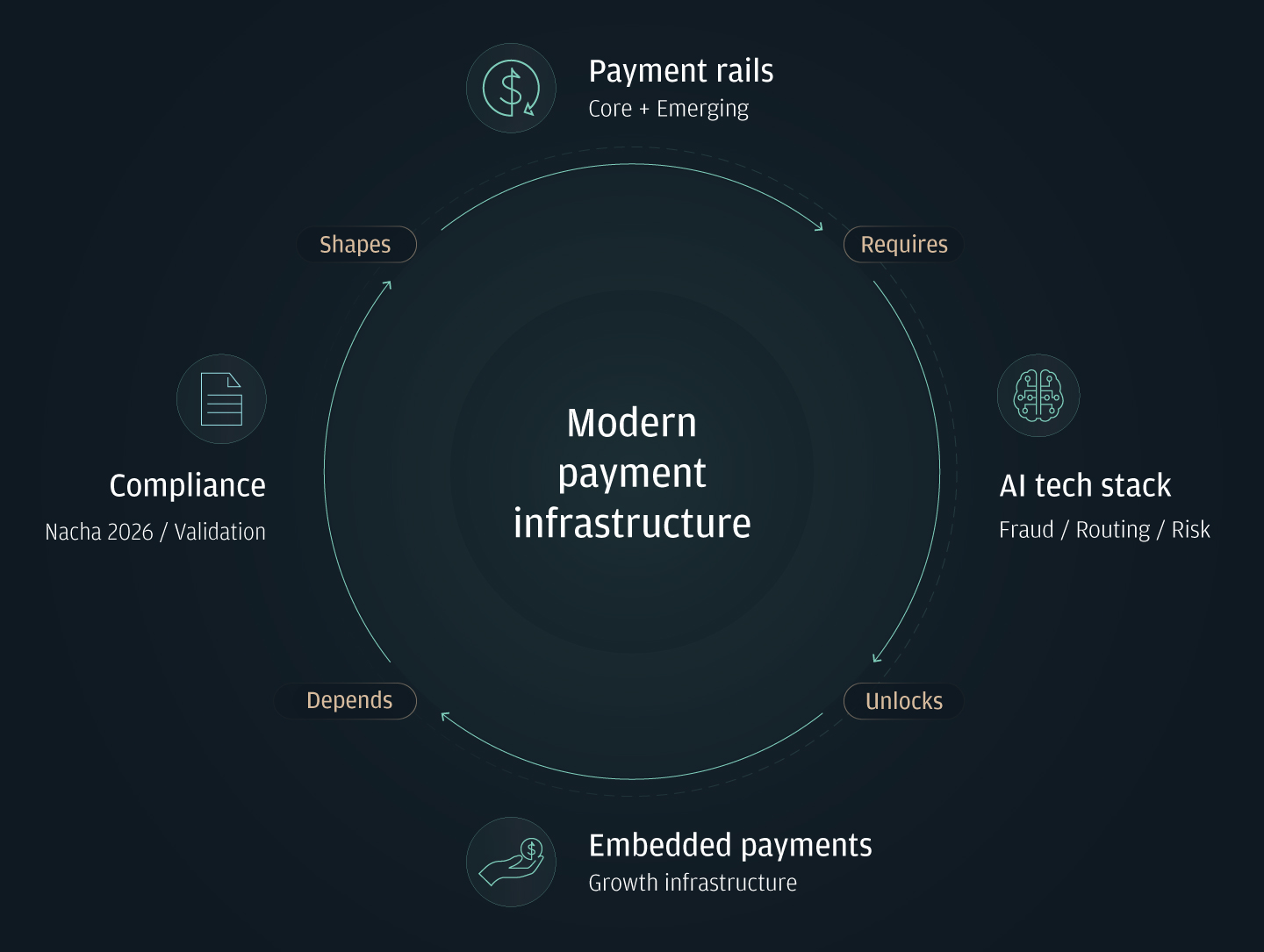
Circular ecosystem diagram titled “Modern payment infrastructure” with four interdependent components: payment rails, covering core and emerging networks; an A.I. tech stack for fraud, routing and risk; embedded payments as growth infrastructure; and compliance with Nacha 2026 and account validation. Clockwise relationships: compliance shapes payment rails; payment rails require the A.I. tech stack; the A.I. tech stack unlocks embedded payments; and embedded payments depend on compliance—forming a closed loop that conveys an interconnected payment system.
1. Real-time payments and fraud detection
Real-time payment infrastructure has reached broad adoption. The competitive question has shifted from whether you offer instant settlement to how well your fraud detection and prevention architecture keeps pace.
Funds moving in seconds rather than days render traditional fraud detection models inadequate. ACH-era controls that flag suspicious activity after settlement provide little protection when funds are irretrievable within minutes. Authorized push payment fraud and account takeover attacks exploit this speed advantage—social engineering victims into authorizing transfers that appear legitimate until after funds move.
What works: Detection before initiation. Behavioral analytics and machine learning models that assess risk within milliseconds. Consortium data sharing for broader threat intelligence. Adaptive authentication that adjusts friction based on real-time risk signals.
Regulatory momentum is building, The United Kingdom now mandates reimbursement for authorized push payment fraud victims, incentivizing banks to invest in prevention. For fintechs building or expanding RTP capabilities, fraud detection is a foundational requirement that is only growing in importance.
2. AI as foundational infrastructure
Artificial intelligence has moved from experimental deployment to core operational infrastructure. For fintechs, the strategic question isn’t whether to adopt AI—it’s which capabilities create leverage across multiple business functions.
The applications that matter most: Real-time behavioral analytics that assess transaction risk nearly instantly, learning from patterns across payment networks. Intelligent payment routing that selects optimal paths across multiple networks based on cost, speed and reliability. Automated reconciliation that matches payments with invoices and account records. Personalized payment options—installment plans, preferred methods, loyalty integration—based on user behavior.
The infrastructure play
AI capabilities are evolving faster than most roadmaps can accommodate. Models that detect fraud patterns or route payments today may look different in 18 months. The strategic investment isn’t in specific applications—it’s in data pipelines, model governance frameworks and integration architecture that support applications you can’t spec out yet. Companies building AI infrastructure for current use cases while maintaining flexibility for emerging capabilities create optionality. Those deploying point solutions for immediate problems will find themselves rebuilding repeatedly.
3. Stablecoins as strategic optionality
Stablecoins currently provide measurable value in specific contexts: cross-border transfers for companies operating in markets with capital controls, settlement between crypto-native counterparties and certain remittance corridors where traditional rails remain expensive. For most scaling fintechs serving domestic customers, they remain future optionality rather than current necessity.
The infrastructure is maturing unevenly. Regulated stablecoins like USDC maintain transparent reserves and established compliance frameworks. Regulatory clarity is emerging in some jurisdictions but fragmented globally. Integration with traditional banking infrastructure remains complex—bridging on-chain and off-chain environments requires technical investment that only makes sense when customer demand justifies it.
The strategic question: Do you need to decide today whether to deploy stablecoins or other blockchain-based rails like tokenized deposits? Most organizations don’t in the current environment. However, you should understand whether your network architecture and partnership models foreclose those options later. Monitor regulatory developments, understand specific use cases where cost savings justify complexity, and ensure infrastructure decisions don’t create dependencies that make future integration prohibitively expensive.
4. Network interoperability as competitive infrastructure
Customers expect payments to work—across ACH, RTP, FedNow, card networks and eventually blockchain-based payments—without understanding or caring about the underlying rails. The challenge for fintechs is building systems that route intelligently across multiple networks while maintaining consistent security, reconciliation and reporting.
The tech complexity is significant. Each network has distinct messaging standards, settlement timing, fee structures and operational requirements. ACH batch processing operates differently than real-time rails. Card rules differ from bank-to-bank transfers. Fraud detection models may not translate across rails.
What makes interoperability strategic: Modular architecture that separates business logic from network-specific implementation allows you to add new rails without rebuilding core systems. Adopting ISO 20022 messaging standards where possible reduces translation layers. The competitive advantage comes from intelligent routing—using AI capabilities to select optimal paths based on cost, speed and reliability for each transaction. This transforms multi-rail capability from defensive necessity into active differentiation.
Strategic partnerships with network operators and technology providers matter more than building everything internally.
5. Embedded payments as growth infrastructure
Embedded payments deliver value when the underlying infrastructure works invisibly—customers initiating transactions within software platforms, marketplaces or vertical SaaS applications without friction or awareness of payment rails.
The customer experience requirements are unforgiving. Embedded payments need real-time settlement that doesn’t create a liquidity crunch, intelligent routing across multiple networks based on cost and speed, and AI-powered fraud detection that protects without adding visible friction. When these pieces work together, you can offer embedded experiences in high-value contexts: payroll systems with instant access to funds, B2B marketplaces with automated split payments and escrow, and cross-border platforms with currency conversion built into checkout flows.
The build-versus-partner decision depends on control requirements, technical capacity and timing considerations to launch new capabilities. Direct bank partnerships provide better economics and customization, but require significant compliance and integration investment. Fintech intermediaries offer faster deployment at the cost of margin and flexibility. Most scaling fintechs benefit from hybrid approaches—owning customer relationships and core business logic while partnering for regulatory complexity and network access.
Embedded payments work when the infrastructure investments made across other fronts come together seamlessly.
6. Nacha 2026 as strategic catalyst
The Nacha account verification rule arrives this year, requiring stronger verification of bank account details before processing ACH transactions. Compliance is non-negotiable—fintechs need real-time account verification integrated into onboarding and payment flows to avoid penalties, reduce returns and prevent fraud.
The strategic value extends beyond compliance. Account validation infrastructure serves both ACH and RTP flows. AI-powered validation systems can assess account risk beyond basic ownership checks, flagging suspicious patterns at scale. Embedded payments depend on frictionless validation that protects without degrading customer experience.
Use Nacha 2026 as the trigger for broader infrastructure assessment. Validation requirements justify investments in capabilities that create value across multiple fronts—better fraud detection, smarter routing, and AI infrastructure that enables future applications. Companies treating this as isolated compliance work miss the opportunity to build leverage.
The deadline creates planning urgency. The infrastructure decisions you make to meet it determine optionality for everything that follows.
What comes next
Fintechs navigating this landscape effectively aren’t trying to tackle all six fronts simultaneously. They’re identifying which investments unlock multiple capabilities and sequencing accordingly. The right sequence depends on your business model, growth stage and regulatory exposure.
We’re here to help you evaluate infrastructure decisions in the context of your growth strategy. J.P. Morgan works with fintechs on infrastructure partnerships, regulatory guidance and capital for strategic initiatives. Our scale and relationships across payment networks, regulators and technology providers give you options as you build for what comes next.
JPMorgan Chase Bank, N.A. Member FDIC. Visit jpmorgan.com/commercial-banking/legal-disclaimer for disclosures and disclaimers related to this content.