Several factors are increasing demand for electricity, requiring a buildout of infrastructure over the next decade. From 2026–2030, global power demand is projected to grow at a 3.6% compound annual growth rate (CAGR), a pace 50% higher than that of the previous decade. Over the next five years, data centers will drive 465 terawatt hours (TWh) of demand growth, representing around 9% of total.1 Electrification to support new technologies and decarbonization goals, especially electric vehicles and heat pumps, will drive 25% of demand growth.2 Additional policy levers around industrial policy to increase manufacturing or support cross-border electricity trade will also bring additional capacity online.3
Key takeaways
- Electricity demand is surging, driven by data centers and electrification. To meet it, grid infrastructure will need to be built and upgraded over the next decade.
- The aging grid is a national security risk. Decades-old equipment is more likely to fail and is vulnerable to extreme weather, cyber risks and geopolitical threats, making it easier for adversaries or disasters to cause widespread outages — and economic disruption — if not addressed.
- This also presents a massive investment opportunity. Globally, about $5.8 trillion is forecast for grid upgrades between 2026–2035, with roughly $700 billion for digital grid tech; the U.S. alone expects investments of about $1 trillion over the coming decade.
- Policies and permits are key to success. While governments are pushing modernization, long siting and approval timelines can slow progress and affect costs for consumers.
Electric grids are undergoing a fundamental reframe — from aging legacy assets to strategic hard and soft infrastructure that must withstand physical threats, technological change and growing supply needs. In this context, grid resilience efforts are not just defensive infrastructure maintenance; they also increasingly underpin economic development, industrial competitiveness and national security. Activities that harden, expand and modernize the grid are becoming increasingly attractive investment opportunities and policy priorities globally.
Why is grid resilience needed?
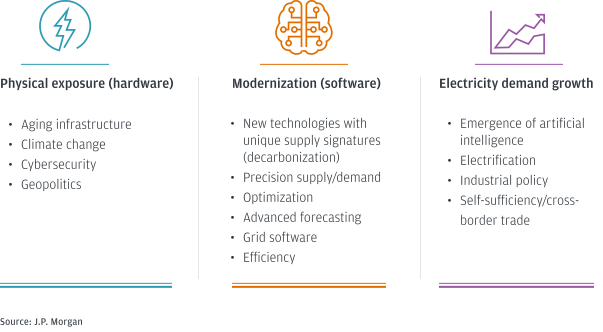
There are three main tailwinds driving grid resilience investment:
As the grid ages, it is increasingly prone to several threats, including breaking. In developed countries such as the U.S., much of the electric grid was built in the 1960s and 1970s, making it nearly 60 years old.4 These assets need maintenance and replacement as they reach the end of their useful life. External threats from climate change are altering extreme weather statistics and background conditions; projects conceived decades ago can be ill-prepared. Human interference, from cybersecurity exposures or geopolitical conflict, must also be managed.5 Given the demand growth cited above, shutting off the grid becomes increasingly likely in conflict.6 These physical exposures threaten downtime, emergency repairs and longer recovery times if left unmanaged.
As the grid is built out to support (1) and (2), there is an opportunity to weave these needs together with grid modernization. An increase in the number of power sources with diverse supply and demand signatures daily requires software to efficiently optimize supply. Advanced forecasting technologies, including AI, anticipate changes and provide precision management, both for daily operations and long-term investment and resilience planning. Cybersecurity software protects both software functions and hardware operations.
Grid resilience tailwinds
Source: J.P. Morgan
[chart description] The main drivers for grid resilience include physical exposure (hardware), modernization (software) and electricity demand growth.
[ALT text] Chart depicting the main drivers for grid resilience, including modernization, physical exposure and electricity demand growth.
A practical map: What counts as grid resilience?
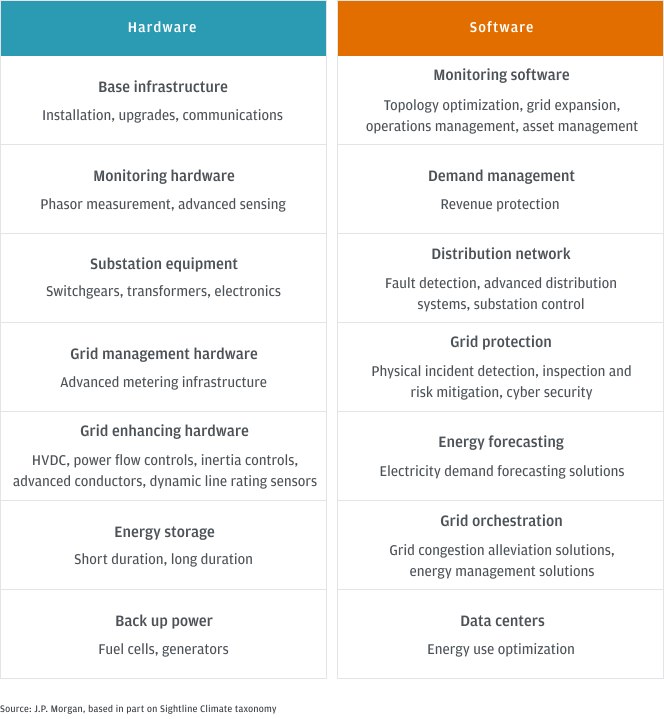
Grid resilience requires a systems-based approach, constructing a portfolio of options to meet demand needs and reduce vulnerabilities:
- Hardware: Physical assets that move, optimize, store and produce back-up energy.
- Software: The computational brain for all hardware, including digital data, analysis, investment, forecasting, control and maintenance functions.
Hardware and software can be knitted together to maximize electricity production when needed, store it for demand spikes or downtime, as well as inform further hardware investment and maintenance.
What is grid resilience?
Source: J.P. Morgan, based in part on Sightline Climate taxonomy
[chart description] Grid resilience from a hardware perspective includes considerations such as base infrastructure and energy storage; from a software perspective, it includes things like distribution networks and data centers.
[ALT text] Table depicting what grid resilience means for both hardware and software.
A growing market opportunity
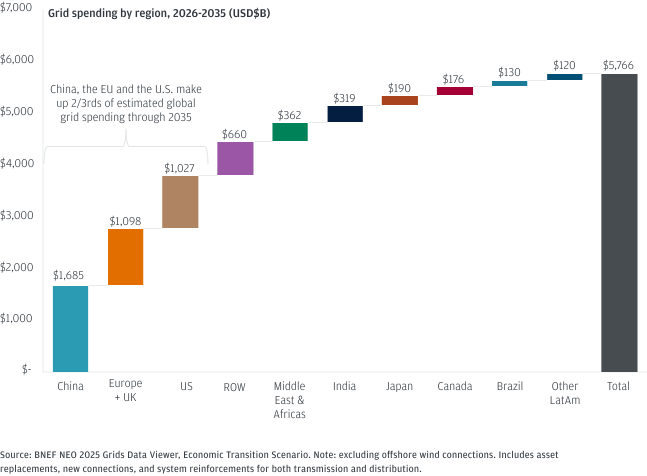
Global grid spending increased from $300 billion in 2020 to $480 billion in 2025. Looking ahead, $5.8 trillion of cumulative grid investment is forecasted globally between 2026–2035, with 12% ($700 billion) projected for digital-related grid capex.7
In the U.S., grid investment is expected to hit ~$1 trillion over the coming decade, split between transmission (37%) and distribution (63%).8 U.S. private capital indicates investors also see a growing opportunity, with volumes increasing from $3.2 billion in 2021 to $6.6 billion in 2025.9
In Europe, cumulative grid investment is projected to reach ~$1.1 trillion between 2026–2035, with Germany currently representing the single largest current grid investor at 28% of 2024 investment levels.10
In Asia Pacific, cumulative grid investment is projected to reach ~$2.6 trillion over the next decade, with China representing more than two-thirds of all grid investment in the region.11
Global grid capex forecast
Source: BNEF NEO 2025 Grids Data Viewer, Economic Transition Scenario. Note: excluding offshore wind connections. Includes asset replacements, new connections and system reinforcements for both transmission and distribution.
[chart description] Global grid investment is projected to hit $5.8 trillion between 2026–2035, with China, the EU and the U.S. making up two-thirds of spending.
[ALT text] Bar chart depicting global grid investment, which is projected to hit $5.8 trillion between 2026–2035.
Utilities companies have also shifted their public communications to focus on grid resilience needs and implementation. The frequency of resilience-related keywords in S&P 1500 utilities firms’ meeting transcripts has increased by 70% since 2016.12
Keyword frequency in S&P 1500 utilities firms’ transcripts
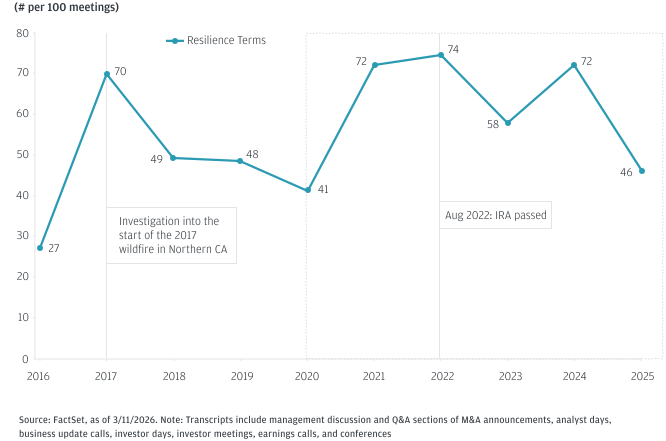
Source: FactSet, as of March 17, 2026. Note: Transcripts include management discussion and Q&A sections of M&A announcements, analyst days, business update calls, investor days, investor meetings, earnings calls and conferences.
[chart description] Overall, the frequency of resilience-related keywords in S&P 1500 utilities firms’ meeting transcripts has increased by 70% since 2016.
[ALT text] Line chart depicting the frequency of resilience-related keywords in S&P 1500 utilities firms’ meeting transcripts, which has increased by 70% since 2016.
Public policies are also catalyzing grid investment in the private sector. In the U.S., the Department of Energy (DOE) has prioritized grid modernization and critical minerals that support new hardware — a de-risking agent to mobilize further private capital.13 In the EU, policymakers are pairing grid-specific policy with industrial policy: the European Commission’s Grid Action Plan is designed to accelerate permitting, financing and modernization of electricity networks.14 In Asia, governments and multilaterals are pushing the ASEAN Power Grid as a regional infrastructure platform to fully achieve integrated grid operations in the region by 2045.15 And in the Middle East, Gulf nations such as the UAE have promoted greater unification of the grid network among Gulf Cooperation Council (GCC) members and greater integration of renewable energy sources.16
What roadblocks or fast lanes alter the speed of expansion?
Despite projected grid resilience opportunities, several issues may slow down or speed up resilient grid investment and implementation:
Consumers face increasing cost pressures. Food prices20 and property and casualty insurance rates21 have gone up globally. In some markets, electricity prices have risen materially. In the past year, wholesale power prices in the U.S. and Europe have surged by 30 to 40%. Consumer costs in the U.S. have seen a similar rise over the past five years.22 Electricity affordability is a growing political issue in the U.S. and EU and could inhibit or support efficient investment to bring costs down in price-sensitive markets.
Hardware installation and connection within the grid are enabled through policy decisions. In the U.S., it can often take over 10 years to site and build a transmission line.23 Meanwhile, in the EU, building interconnections takes, on average, a decade from inception to operation.24 Policy decisions will have to be made by local, state and federal governments, or risk social backlash if rates rise. At the international level, the buildout of electricity grids also allows countries to invest in energy-producing infrastructure for export and improve neighboring or transoceanic diplomatic relations. Broader volatility due to geopolitical conflict, supply chain disruptions or market prices may increase regional grid buildouts to smoothen electricity supply and pricing.
Utilities firms have historically been slow to implement new software, given their mandate of providing reliable and safe service, which can take precedence over technology adoption.25 As grid resilience software comes online, decisions will need to be made to avoid lock-in, should emerging solutions struggle to scale or deliver promised impact.
The bottom line
Power demand is increasing faster than legacy grids can support. Physical risks are elevated and growing. Resilience planning and investment can expand the grid, reduce outage frequency and duration and optimize for affordability and economic growth. This complex issue presents both a growing threat and opportunity, demanding attention from companies and governments across the globe.
“Grid resilience efforts are not just defensive infrastructure maintenance; they also increasingly underpin economic development, industrial competitiveness and national security.”

Dr. Sarah Kapnick
Global head of Climate Advisory, J.P. Morgan
Acknowledgement: Jesse McCormick and Andrew Tan for analysis and figure support.
References
1.
International Energy Agency, https://www.iea.org/data-and-statistics/charts/global-electricity-total-demand-growth-by-sector-and-end-use-2015-2030
2.
Ibid.
3.
J.P. Morgan, https://www.jpmorgan.com/insights/sustainability/climate/power-rewired-energy-and-geopolitics
4.
U.S. Department of Energy, https://www.energy.gov/gdo/articles/what-does-it-take-modernize-us-electric-grid
5.
J.P. Morgan, https://www.jpmorgan.com/insights/sustainability/climate/future-of-climate-security
6.
Council on Foreign Relations, https://www.cfr.org/reports/cyberattack-us-power-grid; Center for Strategic and International Studies, https://www.csis.org/programs/strategic-technologies-program/significant-cyber-incidents
7.
BloombergNEF. Digital investment includes hardware – like smart meters – and software – like analytics, cybersecurity, monitoring, automation
8.
BloombergNEF. Transmission is how the bulk of energy moves from generation to substations. Distribution is next, delivering electricity from transmission substations to end-users (residential, commercial, industrial)
9.
Sightline Climate. Data only for companies with U.S. headquarters. Sectors include: (a) grid technologies, (b) data center backup power and energy use optimization, (c) Built environment energy efficiency electronics, (d) energy storage, (e) fuel cells. Deal types include VC/Growth, PE, Project Finance, Debt, M&A. Excludes Grants, Secondary, and public market deals.
11.
Ibid.
12.
Factset, resilience terms include: burying lines, phasor measurement, cable trenching, advanced sensing, climate adaptation, switchgears, climate risk assessment, transformers, climate scenario, advanced metering infrastructure, coastal defense, smart meter, coastal flood, dynamic line rating, coastal resilience, inertia controls, coastal zone, power flow controls, disaster recovery, advanced conductors, emergency preparedness, topology optimization , flood defense, fault detection, grid resilience, substation control, line burial, energy forecasting, line resilience, grid orchestration, living shorelines, microgrids, operational flexibility, resilient infrastructure, saltwater intrusion prevention, sea wall construction, severe weather response, shoreline stabilization, smart grids, storm hardening, storm preparedness, storm-resilient, stormwater management, subsurface infrastructure, subsurface lines, subterranean lines, subterranean utilities, supply chain resilience, underground cabling, underground lines, underground power, undergrounding, weatherization, hail, heat wave, heatwave, hurricane, storm surge, tornado, tropical cyclone
13.
U.S. Department of Energy, https://www.energy.gov/articles/secretary-wright-acts-unleash-golden-era-american-energy-dominance; U.S. Department of Energy, https://www.energy.gov/sites/default/files/2025-11/Organization-Chart-11.20.2025.pdf; EE News, https://www.eenews.net/articles/wright-overhauls-doe-reflecting-shift-in-us-energy-priorities/
14.
European Union, https://energy.ec.europa.eu/topics/infrastructure/european-grids_en
15.
Asian Development Bank, https://www.adb.org/where-we-work/southeast-asia/asean-power-grid
16.
Abu Dhabi Fund for Development, https://www.adfd.ae/en/media-center/news/adfd-and-gcc-interconnection-authority-sign-aed-752-million-agreement-to-expand-gcc-power-grid
17.
Transition Zero, https://www.transitionzero.org/shedding-light-on-pakistans-distributed-solar-revolution
18.
World Bank, https://blogs.worldbank.org/en/transport/pakistan-devastating-floods-have-widened-spatial-disparitiess/
19.
Lawrence Berkeley National Laboratory, https://emp.lbl.gov/publications/economic-evaluation-modernization
20.
J.P. Morgan, https://www.jpmorgan.com/insights/sustainability/climate/fate-of-farming-and-food
21.
J.P. Morgan, https://www.jpmorgan.com/insights/sustainability/climate/homeowners-insurance-future
22.
Rocky Mountain Institute, https://rmi.org/affordability-not-volatility-renewables-cost-advantage-grows/
23.
American Clean Power, https://cleanpower.org/wp-content/uploads/gateway/2024/04/ACP-Pass-Permitting-Reform_Fact-Sheet.pdf
24.
European Union Agency for the Cooperation of Energy Regulators, https://www.acer.europa.eu/sites/default/files/documents/Publications/ACER_2024_Monitoring_Electricity_Infrastructure.pdf, see also https://www.jpmorgan.com/insights/sustainability/climate/power-rewired-energy-and-geopolitics
25.
National Association of Regulatory Utility Commissioners, https://www.naruc.org/core-sectors/electricity-energy/