Key takeaways
- The Iran conflict could disrupt fertilizer supply — especially nitrogenous fertilizers shipped from the Persian Gulf — raising farming costs and, over time, contributing to higher food prices.
- Fertilizer shortages can hurt harvests because the timing is unforgiving: farmers need nitrogenous fertilizers at planting, and they can’t be effectively applied once crops are already in the ground. Even if fertilizer shortages abate, there can be lingering effects because restoring fertilizer production can take time, while planting windows arrive on schedule.
- A brewing El Niño could layer on additional seasonal climate and weather stress, shifting rainfall and temperature patterns, and bringing weather extremes. At the same time, fertilizer supply is tighter, increasing the risk of lower output and added food inflation pressure.
When I wrote my recent pieces on the intersection of climate and national security and agriculture and food security, I didn’t expect so many examples of “climate as a threat multiplier” to emerge so quickly. The food security piece highlighted where concentration risks in key farming inputs or climate sensitive crops could be threatened by trade disruptions or climate variability. We are seeing some of those vulnerabilities at play today, as emerging supply chain and business continuity threats are growing, amplified by natural gas price volatility and supply chain disruptions from the Iran conflict, a brewing El Niño and existing drought conditions.
This isn’t a new reality — we’ve been here before. In 2022, Russia invaded Ukraine, restricting access to and applications of potash and phosphorus fertilizers, lowering crop output and raising costs.i An El Niño later developed in mid-2023 with forecasts from central banks ii and commodity expertsiii that production could decline for certain staple crops after El Niño peak in early 2024. These effects did play out, but there were mitigating global factors for certain crops. For example, wheat remained stable globally due to increased harvests in the U.S. and India offsetting losses in Australia and China.iv However, for rice and cocoa, exports declined dramatically from India (rice)v and equatorial Africa (cocoa).vi
This edition of Climate Intuition highlights what to watch in the Persian Gulf, energy and fertilizer markets, and how climate variability (an El Niño) may exacerbate soft commodity outcomes.
Iran conflict impact on fertilizer
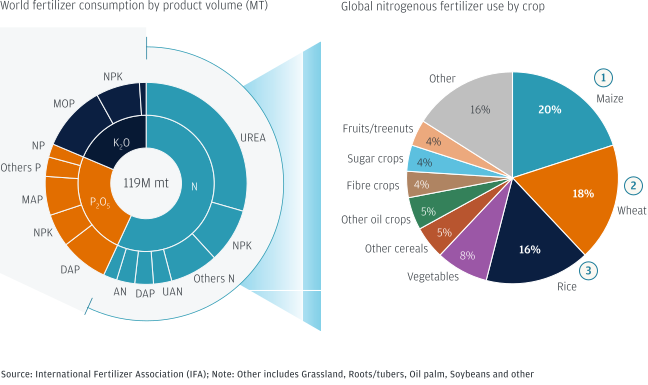
Nitrogen is an important element for agriculture productivity. It is the largest fertilizer consumed by mass with over 50% of global demand going to three staple crops: maize/corn (20%), wheat (18%) and rice (16%). The cost of fertilizer is a major component of production, historically representing 21% of total corn production and 19% for wheat.
Sizing fertilizer types and consumption by crop
TBD
Nitrogenous (nitrogen-based) fertilizer has to be applied into the soil during planting to ensure it is available for plants to access through their roots to grow. It is a critical nutrient in the early growing stages. For example, urea is a widely used nitrogen-based fertilizer, applied at the beginning of the growing season at the time when seeds are planted. If applied too late in the growing season at the surface of the soil, it can also convert to ammonia gas in the air above the soil, killing or damaging the plants it is supposed to support. For this reason, the timing of urea delivery is critical, since it cannot be applied after crops are already sown. Early availability of nitrogenous fertilizers is critical for a farmer to increase crop yield. Widespread strategic reserves for nitrogenous fertilizers are not available as they are for oil, partially due to their instability and conversion into a toxic gas (ammoniavii).
Synthetic nitrogen production converts natural gas into urea, a nitrogen-rich fertilizer used globally. Over 36% of global urea is imported from the Persian Gulf, where production plants typically have a steady feedstock supply of natural gas.viii Since the beginning of the Iranian conflict, the production of these materials has slowed, and the shutdown of the Strait of Hormuz has inhibited global trade – leading to rapid supply reductions and commodity price increases.
Dependency on nitrogenous fertilizers from the Persian Gulf
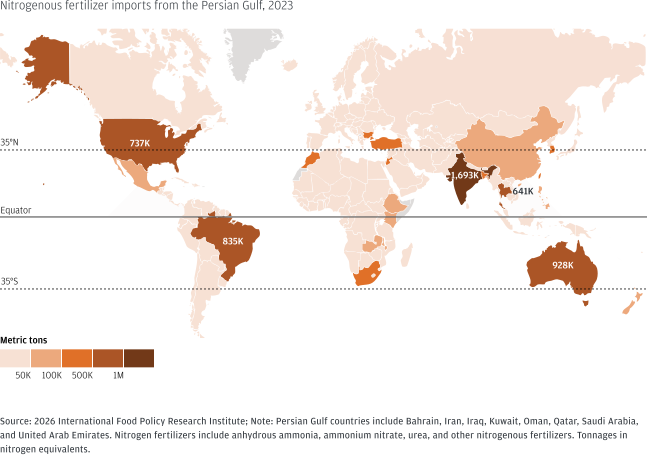
TBD
Damage to natural gas and fertilizer facilities further delays the availability of fertilizer supply. Since synthetic fertilizers in the Persian Gulf use natural gas as a feedstock, fertilizer production facilities take time to get back online, which happens only after natural gas is available. This adds a timing dependency for synthetic fertilizer production, which requires both natural gas facilities and fertilizer plants to be brought back online.
Synthetic fertilizer plants are also difficult to build and generally require environmental review and careful engineering, given their potential to release ammonia. This complexity inhibits rapid scaling of synthetic fertilizer production by building new natural gas feedstock plants while existing ones are repaired.
Timeline of fertilizer supply chain recovery
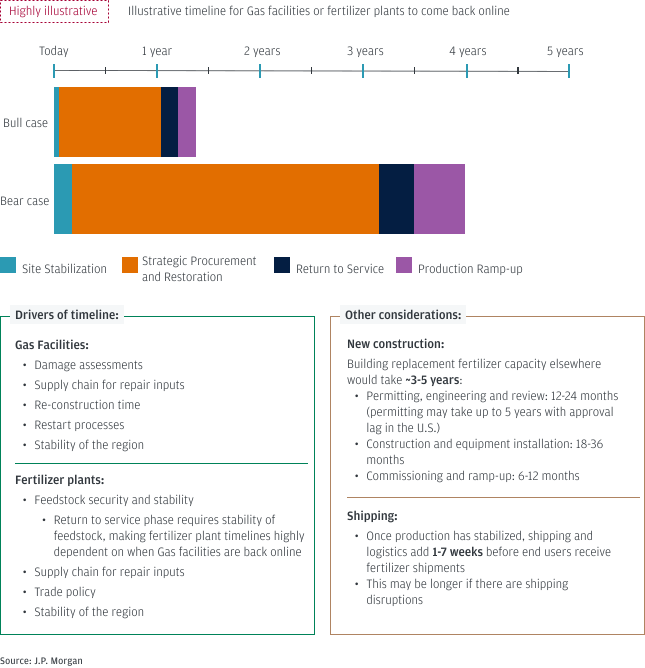
TBD
It is estimated to take 1-4 years for fertilizer production to be brought back online at full capacity given speed of repairs. However, some damaged natural gas facilities have already been estimated to take 3-5 years to be brought back online when including damage to wells.ix This highlights current uncertainty of bringing natural gas feedstocks back online. This could extend fertilizer recovery, especially if long-term LNG contracts take precedent over use of natural gas for fertilizer feedstock.
Given crop production cycles, nitrogenous fertilizer delivery needs to match the timing of seed sowing, which varies by crop and region.
- Corn: South American corn crops to be planted from September to January may be the first affected by fertilizer supply disruptions, especially in Brazil, a major importer of Persian Gulf nitrogen.
- Wheat: While some spring wheat plantings may have been impacted by fertilizer availability, winter wheat plantings starting in September in the EU, China, India, Russia and the U.S. may be the first planting broadly affected.
- Rice: India, China and Bangladesh spring and summer rice plantings began just after the conflict started. Fall and winter plantings in India, Bangladesh, Indonesia and Vietnam may be the first rice crops affected by fertilizer supply.
Crop production timelines for corn, wheat and rice
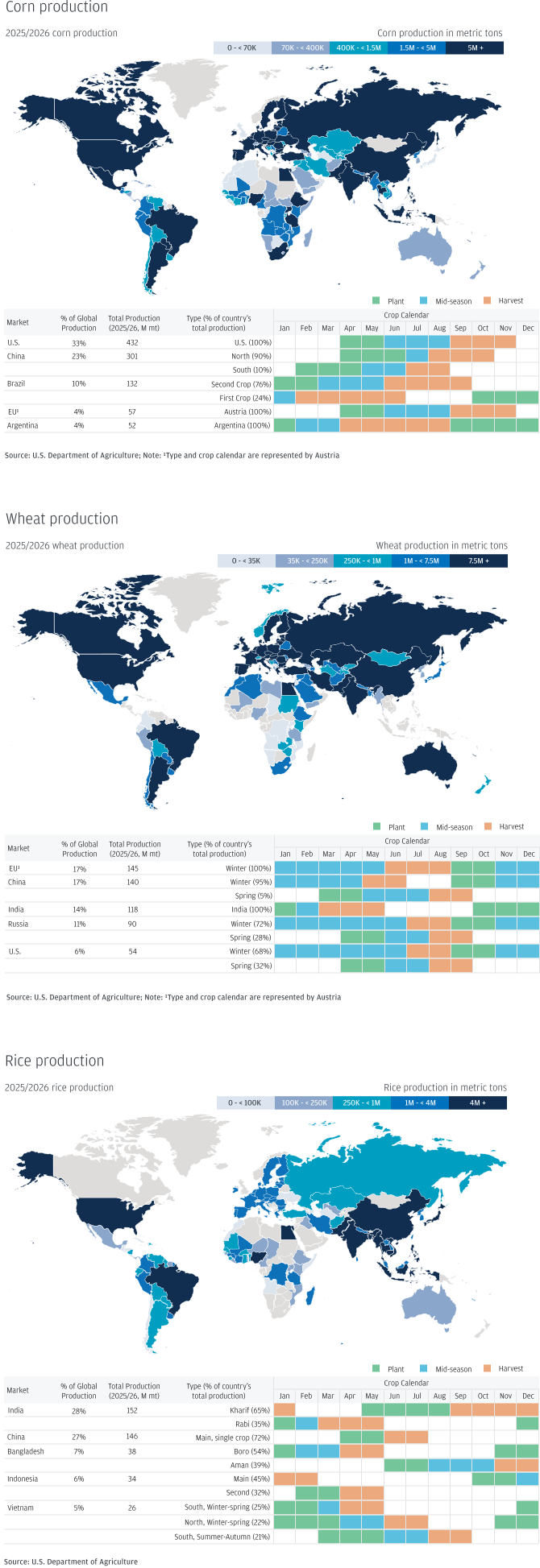
TBD
With this multi-month to multi-year time horizon of normalizing nitrogenous fertilizer production, farmers are likely to be presented with three main choices, each with local and global crop implications:
Responses to fertilizer supply disruptions
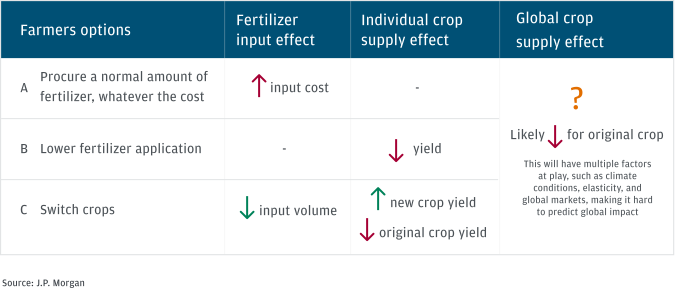
TBD
The first option (A) is if farmers want to maintain output. They increase input costs to try to maintain output. In the last two options (B,C), individual farmers choose to reduce fertilizer application (B) or switch to a new crop (C), both of which reduce crop supply.
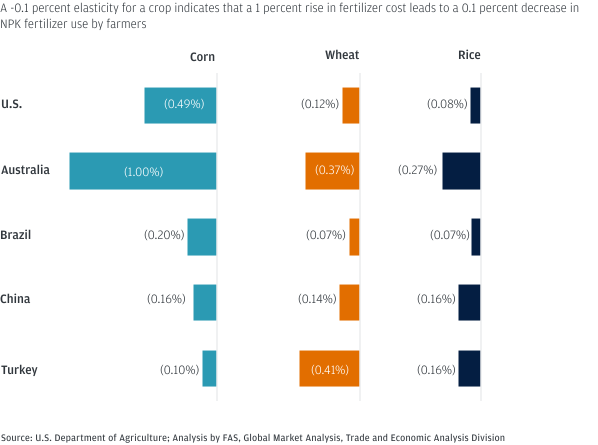
In regions of high fertilizer import volumes, the elasticity of fertilizer use to price increase is well known, making Option B the most likely path. Corn in particular typically sees lowered applications with fertilizer price increases.
Globally, supply falls if other regions are unable to scale production. Inputs are not the only factor in shifts in crop output however. Climate conditions can improve production (i.e. ideal growing season weather) or some regions may try to scale staple crop production with enhanced planting.
Fertilizer use elasticity of major importers for staple crops
TBD
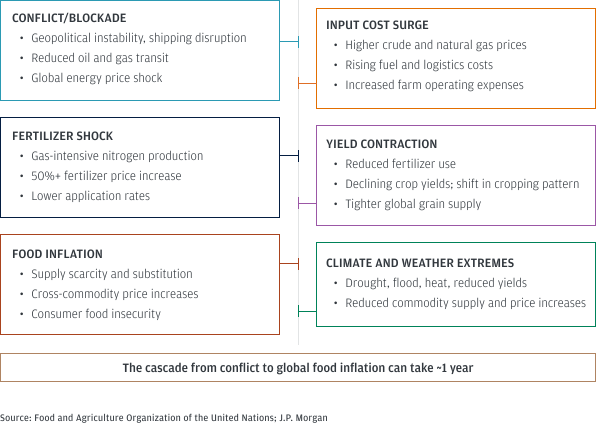
The Iran conflict is slowly rippling through fertilizer availability and planting decisions, which will only be fully realized months after being initiated. Even if the conflict ends today, there will be lasting residual impacts if shocks cascade. Seasonal climate predictions become important in this case as one of the potential shocks.
Energy shocks cascade in food inflation
TBD
A brewing El Niño could compound agriculture risks
El Niños are global climate phenomena where the Pacific Ocean releases heat from the ocean into the atmosphere across the equator. Changes in patterns of ocean temperatures impact global patterns of rainfall, flooding, drought and wildfires. For agriculture, El Niños tend to introduce a distinct geographic imbalance in conditions: tropical regions have warmed broadly, while temperate (regions towards the poles) have seen cooler than average conditions in historic El Niños. In a warming climate this isn’t guaranteed to happen. While temperate regions may experience cooler temperatures than the tropics under an emerging El Niño, the background warming from climate change may result in hotter than average temperatures.
Historically, El Niños have been associated with a production decline of 3.5 percent on average in the tropics versus a 2.4 percent increase in temperate locations.x This does not mean temperate locations are safe havens. During the most recent El Niño in 2023-2024, several extreme events occurred in temperate locations, reducing output.xi
The last time a strong El Niño coincided with a fertilizer price spike was during the 2023-2024 El Niño. Due to global trade dynamics, the countries most at risk for El Niño production declines are the same countries that import the most fertilizer from the Persian Gulf (between 35˚N and 35˚S on Dependency on nitrogenous fertilizers from the Persian Gulf figure). An El Niño can be expected to compound the impact in India and Brazil of reduced fertilizer imports. This is what occurred in 2023-2024: India imposed export bans to stabilize commodity prices and protect domestic supply as production declined. Regional trade can also break down under these conditions, since neighboring countries often face similar production shocks.
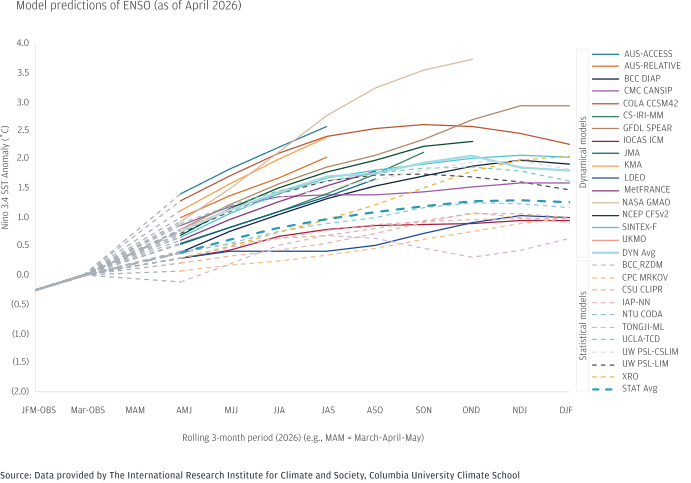
Seasonal El Niño forecasts become more reliable after June, making the June outlook especially important for assessing the likelihood of a winter peak. This is when they are historically declared by meteorological agencies globally and financial markets respond the most.xii Currently, most El Niño forecasts show the development of an El Niño, with the highest forecasts suggesting an extreme “Super El Niño event” registering Pacific Ocean temperatures 2˚C above normal. There is still the potential for a weak El Niño or neutral conditions, but those odds are less probable. The probability of an El Niño has been growing with each monthly forecast this spring.xiii
El Niño forecast
TBD
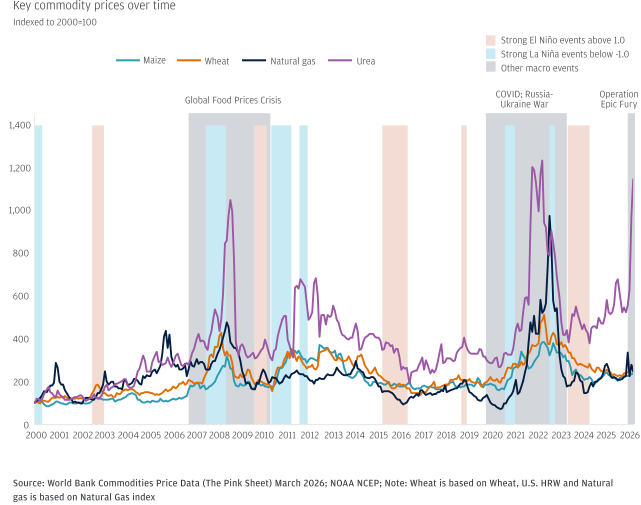
The compounding impact of this event will likely be determined by the strength of the El Niño and adaptive capacity of farmers to switch to drought-resistant crops. Historically, commodity prices for fossil fuel inputs and synthetic fertilizers and corn have all followed one another. Crop price effects are often delayed from El Niño or La Niñaxiv onset as they develop in summer but show peak impacts by the following winter.
Commodity prices, geopolitics and climate extremes
TBD
While most of the impact from the Iran conflict is focused on energy security, fertilizer pressures and a potential El Niño could lower supply, especially in tropical locations most affected with high Persian Gulf fertilizer imports and drive commodity inflation. Food securityxv faces similar issues as energy, especially due to the reliance of synthetic fossil fuel fertilizers: choke points threatening trade, a need for diverse supply chains to manage inputs and costs and reduced exposure to volatile fossil fuel markets.
While natural gas production can come back online and ship globally, directly restoring energy supplies, synthetic fertilizer application is constrained by its feedstock availability and planting windows. Fertilizer production may be delayed if LNG commands a higher price. If delays in fertilizer delivery collide with an El Niño–driven yield shock and are mistimed to planting seasons, an energy-market shock could translate into a longer-horizon disruption in soft commodities.
Acknowledgements: Isabel Ernst for analysis and figure support.
References
iihttps://www.ecb.europa.eu/press/economic-bulletin/focus/2023/html ecb.ebbox202306_01~36e78cc75e.en.html
iiihttps://www.spglobal.com/energy/en/news-research/latest-news/metals/071624-feature-commodities-markets-brace-for-la-nina-weather-impacts
viiihttps://www.ifpri.org/blog/the-iran-wars-impacts-on-global-fertilizer-markets-and-food-production/
xHsiang, Solomon M., and Kyle C. Meng. 2015. "Tropical Economics." American Economic Review 105 (5): 257–61. DOI: 10.1257/aer.p20151030
xiiLemoine, D., Kapnick, S. Financial markets value skillful forecasts of seasonal climate. Nat Commun 15, 4059 (2024). https://doi.org/10.1038/s41467-024-48420-z
xivthe opposite cool phase of an El Niño, with similar disruptions in global climate patterns
xvHistorically, programs like the UN Food and Agriculture Organization and USAID have intervened with funding, agriculture inputs, water technology, and other options during concerns over food security from macroeconomic, geopolitical, and climate extremes. Example from 2023-24 interventions: https://openknowledge.fao.org/items/4aef7f11-07ce-487e-bfd3-cb9540cfd213