Payments
Advanced tech drives resilience, growth
October 19, 2026

Amid geopolitical unrest, supply chain disruption and working capital headwinds, treasury modernization is emerging as a strategic lever to drive expansion and build resilience in the Middle East and Africa (MEA).
Organizations are adopting streamlined cross-border payments and seeing massive growth in digital payments and mobile banking. Both markets are embracing stablecoins and tokenization, with security threats also evolving rapidly.
Supported by data and local expertise, this report explores the evolution of payments in MEA.
Digital maturity drives treasury advances in the Middle East
Ambitious investment in digital infrastructure and AI is helping Middle East organizations adopt advanced practices that improve visibility and control. Examples include Saudi Arabia’s Zakat, Tax and Customs Authority (ZATCA) e-invoicing mandate and the United Arab Emirates’ Electronic Invoicing System.1
“The treasury function has evolved from being operational and transaction-based to becoming more strategic. That’s a big lever for business growth.”

Siddharth Sabherwal
Head of Product, Treasury Solutions, CEEMEA, Payments, J.P. Morgan
94%
of EMEA survey respondents think AI will have a material impact on their business.2

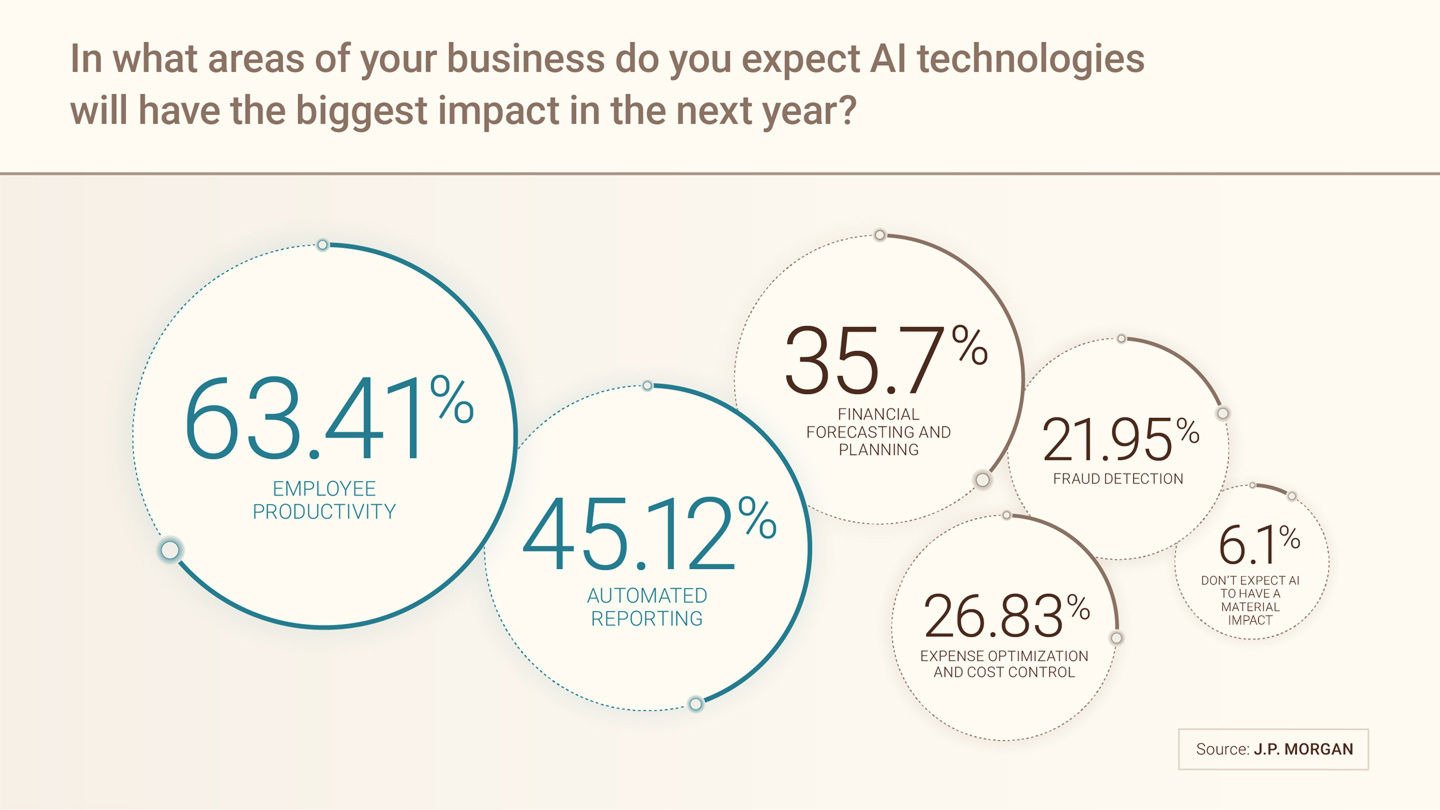
the infographic indicates that 63.41% expect the biggest impact in employee productivity, 45.12% in automated reporting, 35.7% in financial forecasting and planning, 26.83% in expense optimization and cost control, and 21.95% in fraud detection; 6.1% say they don’t expect AI to have a material impact. Source: J.P. Morgan.
Africa building digital-first ecosystem
In sub-Saharan Africa, 40% of adults had a mobile money account in 2024, up from 27% in 2021.3 Adoption has been particularly strong in markets such as Kenya, Ghana and South Africa, helping drive financial inclusion and the growth of digital payments across the region.4 Growth in instant payments is allowing businesses to modernize their treasury departments, boosting decision-making and financial agility.

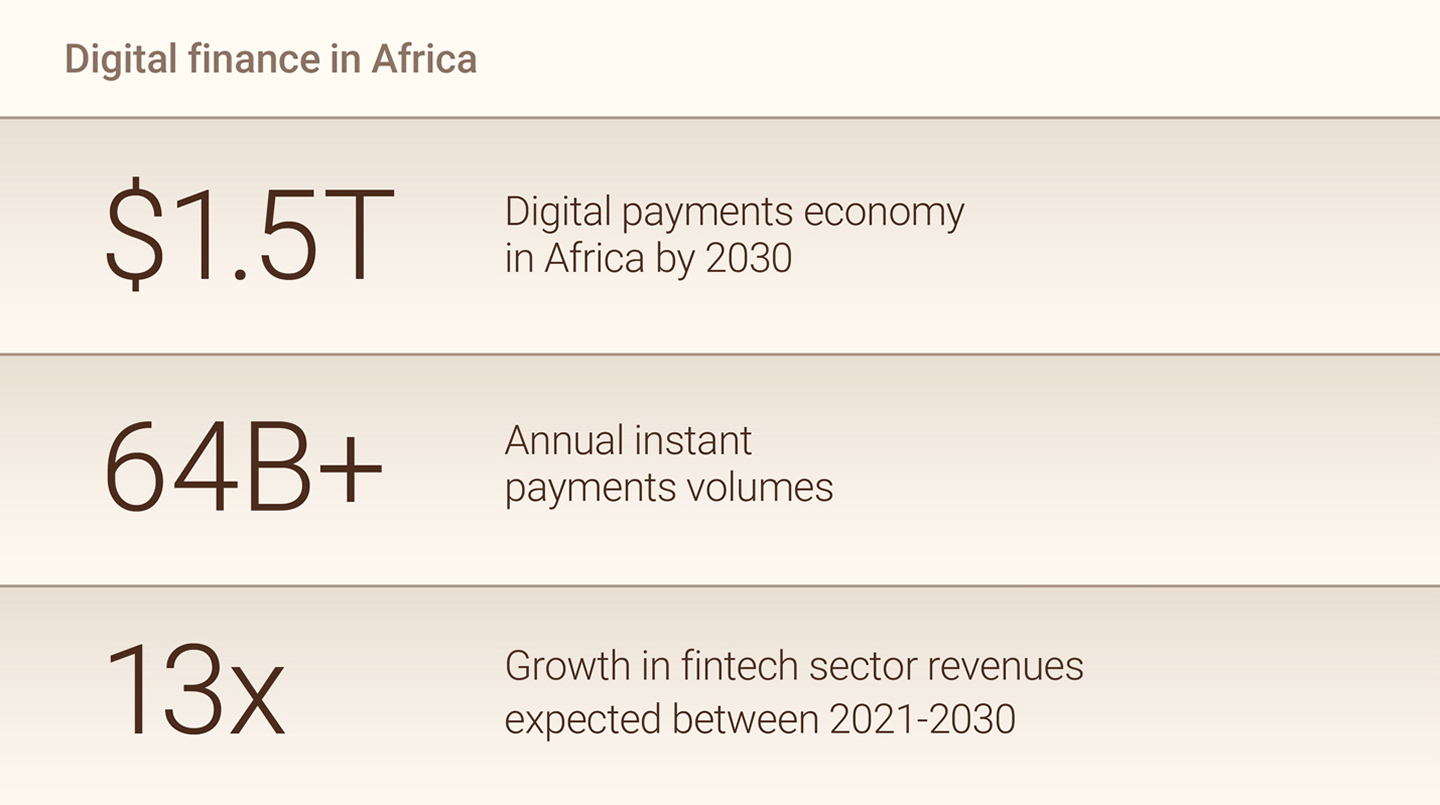
it projects a $1.5T digital payments economy in Africa by 2030, notes 64B+ in annual instant payments volumes, and estimates 13x growth in fintech sector revenues between 2021 and 2030.
Cutting cross-border payment friction in Africa
Cross-border transactions in sub-Saharan Africa are among the most expensive in the world.8 However, a growing focus on interoperability, regulatory collaboration and digital payment rails is starting to change that.
“The regulatory clarity that is being provided, especially in the Middle East, is making it very innovation-friendly for clients to embrace many of these solutions.”
Siddharth Sabherwal
Head of Product, Treasury Solutions, CEEMEA, Payments, J.P. Morgan
Rethinking resilience
Rather than simply a question of technology, resilience is increasingly being viewed as a people and process issue—how well can these assets be maintained in times of crisis?

“Resilience gets so much more airtime after a crisis or conflict has actually happened. We recommend that our clients make resilience a permanent state of mind.”

Tristan Attenborough
Senior Executive Officer, Payments, Abu Dhabi, J.P. Morgan

APIs deliver financial agility
To keep processes functioning in challenging environments, organizations need total visibility and control to move cash when and where it’s needed. Application programming interface connectivity is crucial, as it enables direct links between banking partners and enterprise resource planning systems. In the Gulf region, organizations are adopting zero-trust architecture that assumes they are always compromised.
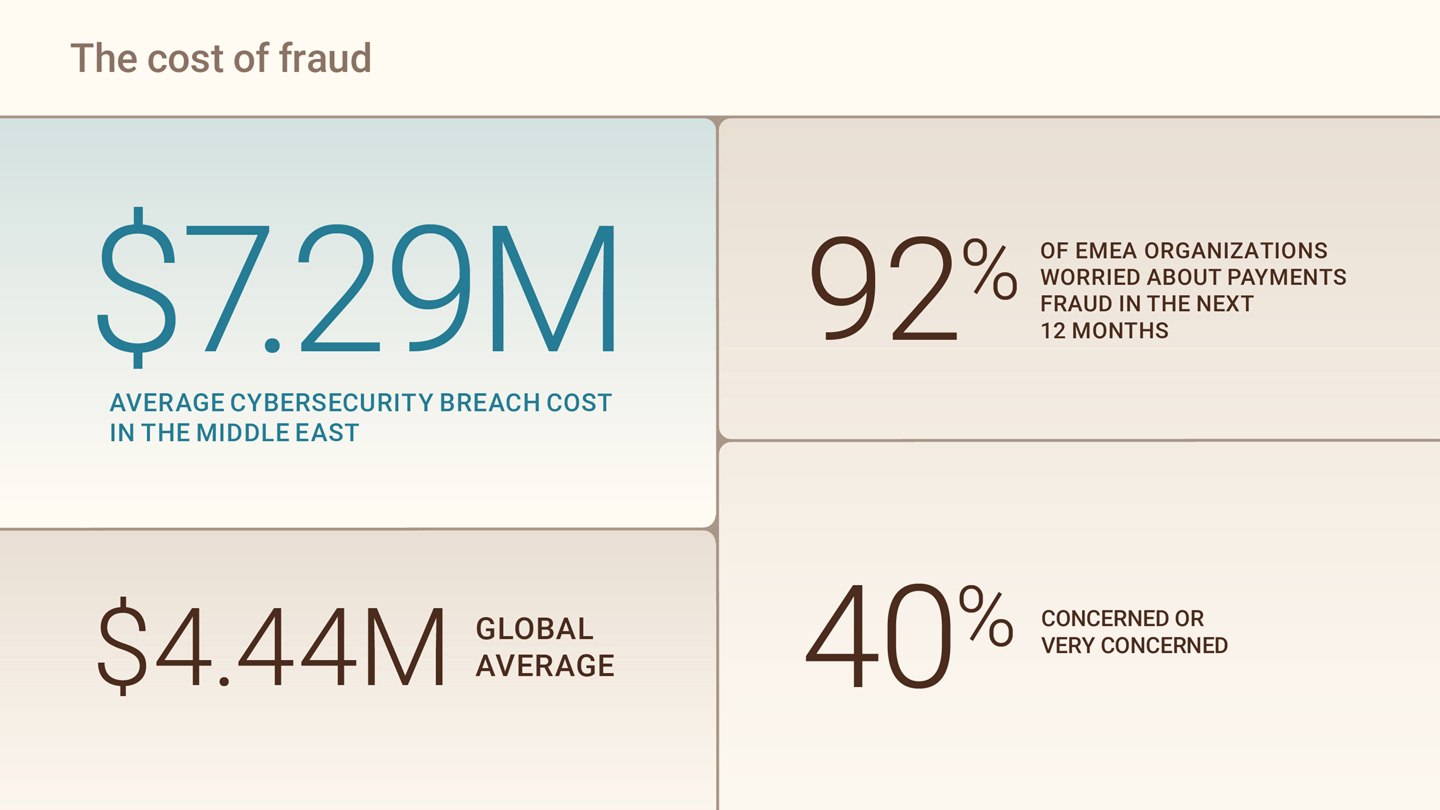
reports that the average cybersecurity breach cost in the Middle East is $7.29M (vs. a $4.44M global average), and that 92% of EMEA organizations are worried about payments fraud in the next 12 months; it also notes that 40% are concerned or very concerned.
“The focus is shifting from perimeter defenses to a more holistic model of cyber resiliency that includes prevention, detection, response and recovery.”
Sorab Khan
Head of MEA Financial Institutions Group Sales, Payments, J.P. Morgan

Modernization drives greater control, resilience and efficiency
Organizations in MEA are taking strides to unlock strategic value through advanced technology. The region is developing more connected ecosystems, real-time intelligence and seamless movement of money. However, the near-term outlook hinges on the geopolitical situation. With greater stability, organizations will be able to continue pursuing advanced technologies to improve visibility, control and efficiency in payment operations.
ZATCA, “What is E-invoicing?” Available at: https://zatca.gov.sa/en/E-Invoicing/Introduction/Pages/What-is-e-invoicing.aspx. Accessed June 2026.
J.P. Morgan, June 2026. “Treasurers in Europe shift priorities: Polling data highlights evolving strategies amid volatility.” Available at: https://www.jpmorgan.com/insights/banking/emea-treasurers-outlook#accordion-9cfc5ea97d-item-3a24b60266. Accessed July 2026.
Fintech Africa, August 2025. “Mobile Money Drives Surge in Financial Inclusion.” Available at: https://fintechnews.africa/45748/fintechafrica/mobile-money-drives-surge-in-financial-inclusion/. Accessed July 2026.
FinDev Gateway, Global Findex Database 2025,https://www.findevgateway.org/region/financial-inclusion-sub-saharan-africa. Accessed October 2026.
Mastercard, March 2025. “Digital payments economy in Africa expected to reach $1.5 trillion by 2030 according to new report.” Available at: https://www.mastercard.com/news/eemea/en/newsroom/press-releases/en/2025-1/march/digital-payments-economy-in-africa-expected-to-reach-1-5-trillion-by-2030-according-to-new-report/. Accessed June 2026.
AfricaNenda, “The State of Inclusive Instant Payment Systems in Africa.” Available at: https://africanenda.org/wp-content/uploads/siips_2025_ExecutiveSummary_en.pdf. Accessed June 2026.
BCG, March 2026. “Beyond Payments: Unlocking Africa’s Second FinTech Wave.” Available at: https://www.bcg.com/publications/2026/beyond-payments-unlocking-africas-second-fintech-wave. Accessed June 2026.
TryDuplo, June 2026. “Why Cross-Border Payments in Africa Are Still Slow and Expensive.” Available at: https://tryduplo.com/blog/why-cross-border-payments-africa-slow-expensive/. Accessed June 2026.
Oui Capital, May 2025. “Africa's Cross-border Payment Landscape.” Available at: Africa's Cross-border Payment Landscape. Accessed June 2026.
International Trade Administration, “Pan-African Payment and Settlement System.” Available at: https://www.trade.gov/market-intelligence/pan-african-payment-and-settlement-system. Accessed July 2026.
J.P. Morgan, June 2026. “Treasurers in Europe shift priorities: Polling data highlights evolving strategies amid volatility.” Available at: https://www.jpmorgan.com/insights/banking/emea-treasurers-outlook#accordion-9cfc5ea97d-item-3a24b60266. Accessed July 2026.
Kearney, “Real world asset tokenization: A $500 billion opportunity. For the GCC.” Available at: https://www.kearney.com/documents/d/asset-library-291362522/real-world-asset-tokenization-a-500-billion-opportunity-for-the-gcc-pdf-1-. Accessed June 2026.
IBM, “Cost of a Data Breach Report 2025.” Available at: https://www-api.ibm.com/adobe/assets/urn:aaid:aem:607b9590-38e0-4c91-b433-aa8a17f5b5e8/original/as/cost-of-a-data-breach-2025-full-report.pdf. Accessed June 2026.
J.P. Morgan
© 2026 JPMorgan Chase & Co. All rights reserved. JPMorgan Chase Bank, N.A. Member FDIC. Deposits held in non-U.S. branches are not FDIC insured. Non-deposit products are not FDIC insured. JPMorgan Chase Bank, N.A., organized under the laws of U.S.A. with limited liability. Commercial & Investment Bank Marketing, 383 Madison Avenue, New York, NY 10179-0001, United States. Important Reminder: JPMorganChase will never send emails that require you to send account information or passwords to us via public email or pop-up windows. Although this transmission and any links/attachments are believed to be free of any virus or other defect that might affect any computer system into which it is received and opened, it is the responsibility of the recipient to ensure that it is virus free and no responsibility is accepted by JPMorganChase, its affiliates, as applicable, for any loss or damage arising in any way from its use.