Payments
Payments Outlook: Europe
Market sovereignty meets flexibility
Market sovereignty meets flexibility
October 19, 2026
European companies are seeking more operational flexibility than ever before in response to a challenging market.
As new EU directives look to increase sovereignty and strengthen risk controls, organizations are focusing on flexible liquidity and real-time payments. Digital asset and stablecoin adoption is growing in Europe,1 and open banking and fintech-bank collaboration are supporting more innovative and flexible payment services.2
Using proprietary research and local expertise, this report explores what’s ahead in payments for Europe.
Organizations are shifting toward always-on, real-time treasury powered by blockchain, with interest in digital assets, stablecoins, tokenization and programmable payments growing.

“We are seeing the development of an on-chain ecosystem that works in harmony with a traditional banking infrastructure. You get the benefits of blockchain, but as an embedded part of a broader treasury system.”
Ciaran Walsh
Head of Europe Corporate Sales, Payments, J.P. Morgan
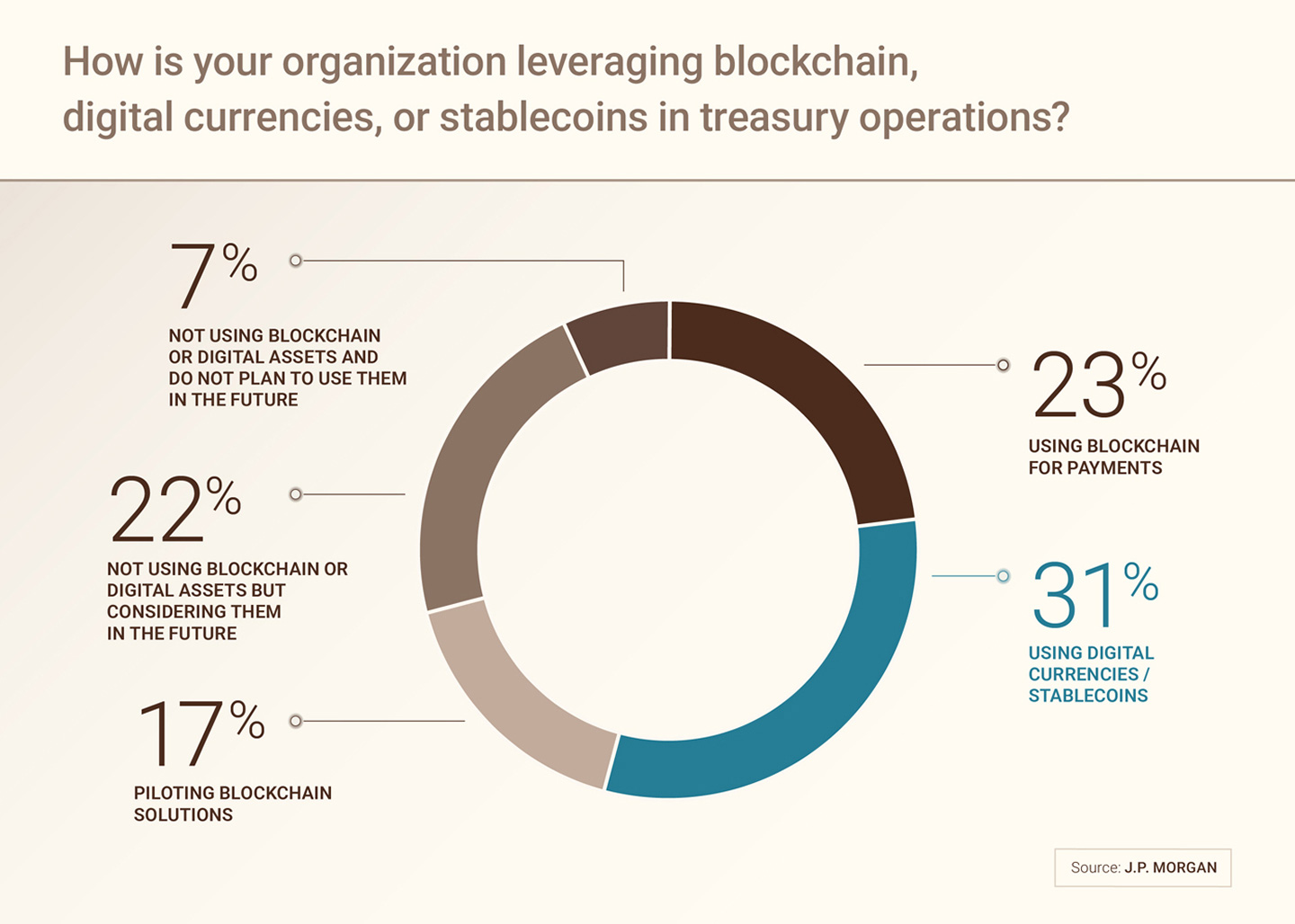
23% are using blockchain for payments, 31% are using digital currencies/stablecoins, and 17% are piloting blockchain solutions; meanwhile, 22% are not using blockchain or digital assets but are considering them in the future, and 7% are not using blockchain or digital assets and do not plan to use them in the future. Source: J.P. Morgan.
Organizations are unlocking greater flexibility as the traditional divide between fintechs and big banks evolves into a more collaborative landscape.
“Whereas historically fintechs were trying to compete with the incumbent banks, now we are seeing more of an environment of collaboration. The large financial institutions bring scale, balance sheet strength, regulatory expertise and global connectivity, while the fintechs have specialized.”

Jason Clinton
Head of Europe Financial Institutions Group Sales and Global Head of Non-Bank Financial Institutions, Payments, J.P. Morgan
Single payment solutions are no longer enough
Clients are customizing their tech stacks to meet specific payment priorities. An institution may use SWIFT to move money across borders but switch to SEPA Instant, the Single Euro Payments Area’s real-time payment scheme, for last-mile delivery to cut down overall settlement time.

ECB prepares digital euro
With policymakers concerned about a reliance on foreign technology, the European Central Bank (ECB) is now developing a digital version of the euro.
“There is a political driver for sovereignty for the digital euro—ensuring that at least the European population can make payments independently of other global methods. But success will depend on whether the ECB can make it attractive to users.”

Katja Lehr
Europe Product Head and EMEA Payments Industry Advocate, Payments, J.P. Morgan
“[The EUDI Wallet] could potentially streamline a lot of user experiences. Say you want to rent a car—there could be a solution that securely leverages the information from your digital identity wallet to reduce the steps in a checkout flow. Digital identity can be leveraged to add value, not just to comply.”

Andrea Monteleone
EMEA Payments Industry Advocacy Director, J.P. Morgan

Regulation to drive consumer trust
The third Payment Services Directive (PSD3), together with the Payment Services Regulation (PSR)—coming in 2027—will improve transparency and strengthen authentication. This should boost consumer trust in digital payments, leading to increased adoption of agentic commerce, tokenization and programmable payments.
Investing in AI for sanctions and compliance control
AI is now being used in areas such as beneficial ownership to help map complex ownership structures and uncover transaction beneficiaries. A key regulatory focus is explainability—companies will have to demonstrate that they understand the AI model, understand the source of the information and can explain and predict the outputs.
Conflict in Ukraine and the Middle East, together with the ongoing impact of tariffs and de-globalization, is creating a challenging operating environment.
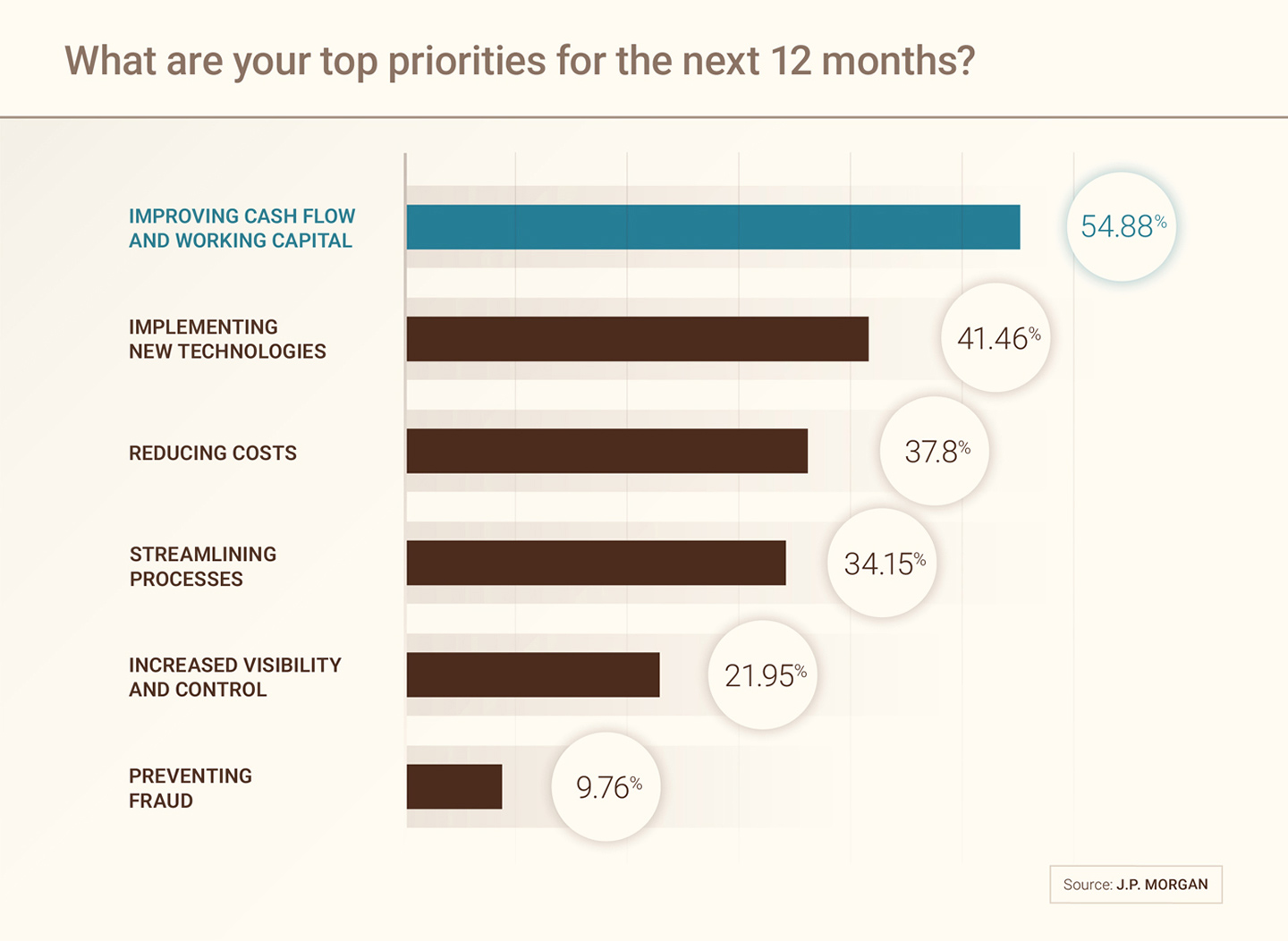
the infographic shows that improving cash flow and working capital is the top priority at 54.88%, followed by implementing new technologies at 41.46%, reducing costs at 37.8%, and streamlining processes at 34.15%; lower priorities include increased visibility and control at 21.95% and preventing fraud at 9.76%. Source: J.P. Morgan.
Managing risk as supply chains shift
Many companies are working with new suppliers and encountering new risks, driving an uplift in traditional finance solutions like letters of credit (LoC), as well as private blockchain networks for the instant transfer of shipping documents and AI algorithms to conduct fraud checks.
AI boom demands working capital
The race to develop Europe’s AI capacity is intensifying. Businesses with access to cheap working capital have a major advantage, and cost-effective inventory finance solutions that can mitigate the impact of these investments will be crucial.

“Companies are sinking huge amounts of capital into equipment and infrastructure that isn’t generating revenue—yet—and is burning a hole in the balance sheet.”
NATASHA CONDON
GLOBAL HEAD, CORE TRADE, PAYMENTS, J.P. MORGAN
$2.1T
total high-grade borrowing expected across hyperscalers, data centers and GPU-driven computer infrastructure over the next five years8
Sovereignty, continuity and flexibility for a region in transition
Increased sovereignty and security in payments may help strengthen the market, but Europe remains a demanding environment. In response, companies are embedding greater flexibility and control in their systems, largely through blockchain and technology stacks designed to meet specific priorities. Meanwhile, access to low-cost working capital is emerging as a core competitive advantage, and the coming years should bring further innovation in this space.
European Central Bank, Financial Stability Review (November 2025): notes the rapid growth of stablecoins and highlights that regulatory clarity under MiCA has supported development and adoption of stablecoin-related services in Europe.
European Commission, Financial data access and payments package, Accessed October 2026.
European Commission. European Digital Identity. Available at: European Digital Identity. Accessed August 2026.
European Commission. European Digital Identity Wallet. Available at: European Digital Identity Wallet. Accessed August 2026.
European Commission. eIDAS Regulation. Available at: eIDAS Regulation. Accessed August 2026.
European Commission. European Digital Identity Wallet. Available at: European Digital Identity Wallet. Accessed August 2026.
J.P. Morgan
J.P. Morgan, North America Fundamental Research, June 2026, ‘AI Capex 2.0. If You Build It, They Will Finance It - Updated Growth & Capital Markets Forecasts.’ Accessed June 2026.
© 2026 JPMorgan Chase & Co. All rights reserved. JPMorgan Chase Bank, N.A. Member FDIC. Deposits held in non-U.S. branches are not FDIC insured. Non-deposit products are not FDIC insured. JPMorgan Chase Bank, N.A., organized under the laws of U.S.A. with limited liability. Commercial & Investment Bank Marketing, 383 Madison Avenue, New York, NY 10179-0001, United States. Important Reminder: JPMorganChase will never send emails that require you to send account information or passwords to us via public email or pop-up windows. Although this transmission and any links/attachments are believed to be free of any virus or other defect that might affect any computer system into which it is received and opened, it is the responsibility of the recipient to ensure that it is virus free and no responsibility is accepted by JPMorganChase, its affiliates, as applicable, for any loss or damage arising in any way from its use.