Volatility in rates, geopolitics and markets demands stress-tested cash and funding assumptions, a clear liquidity buffer philosophy and well-governed hedging aligned to exposures that can move quickly.

Key takeaways
- Geopolitical tensions, market volatility and cybersecurity risks are reshaping long-term planning, with treasurers adopting a cautious but proactive mindset for the second half of 2026.
- AI and tokenization are moving from experimentation to targeted implementation, with data quality and governance emerging as prerequisites for scalable adoption.
- Improving cash flow and implementing new technologies are at the top of treasury agendas for the next 12 months.
Corporate treasurers are entering the second half of 2026 anticipating persistent volatility, accelerating technology innovation and a resilience agenda that must move beyond contingency planning. Against this backdrop, polling from finance leaders from 26 countries and 60-plus industries, gathered at J.P. Morgan's EMEA Treasurers Forum in London, offers a real-time benchmark of where treasury priorities stand. Caution dominates the economic outlook, AI and tokenization are advancing from exploration to execution, and operational resilience has become a strategic imperative in its own right. Here’s where treasurers in the region are focused.
Risk management and the economic outlook for 2H 2026
Long-term planning has shifted from forecasting to continuous scenario management. When asked to identify the biggest challenges shaping long-term business planning, treasurers pointed to a broad range of risks across interest rates, inflation and evolving cybersecurity threats. The most common challenge cited was geopolitical tensions, with over 50% of respondents identifying ongoing conflicts as their biggest barrier for future planning.
What are your biggest challenges for long-term business planning?
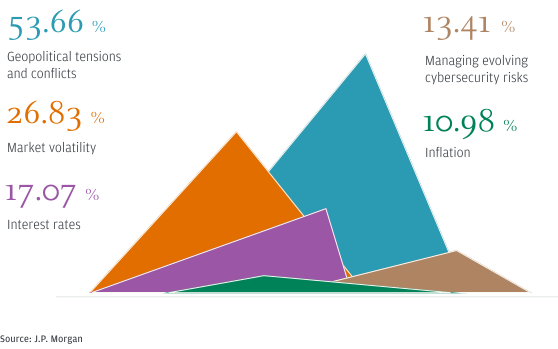
A bar chart showing over 50% of treasurers believe geopolitical tensions and conflicts are the biggest barrier to long-term planning.
The macro environment is structurally more complex than a typical cycle. Public and private investment forces are reshaping the macro landscape, as regional governments increase spending tied to domestic resilience priorities and technology hyperscalers drive large-scale infrastructure investment. This occurs while energy disruption and inflation pressure can quickly reprice risk. For treasury, that combination translates into a more fragile equilibrium: growth can persist, but the distribution of outcomes widens, increasing the value of flexibility.
Treasurers are well aware of the possible highs and lows. When polled on expectations for global economic conditions through year-end, respondents skewed toward stable or worsening conditions rather than a decisive improvement. The relevant planning response is to stress-test liquidity under adverse operating conditions while avoiding a blanket “risk-off” posture that blocks strategic optionality.
What is your view on global economic conditions as we look to the second half of 2026?
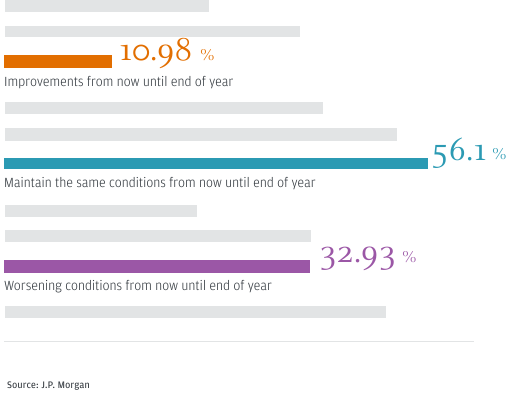
The majority of treasurers surveyed believe economic conditions will remain steady through the end of the year.
AI and tokenization: moving from experiments to foundations
AI has moved from a technology conversation to an operating model conversation. In polling on where AI will have the biggest impact over the next year, treasurers most frequently selected financially material use cases, including employee productivity, forecasting and planning, and automated reporting and fraud detection. These priorities reflect a pragmatic thesis: treasury is targeting applications that shorten close cycles, improve decision quality and reduce operational loss, not abstract innovation for its own sake.
In what areas of your business do you expect AI technologies will have the biggest impact in the next year?
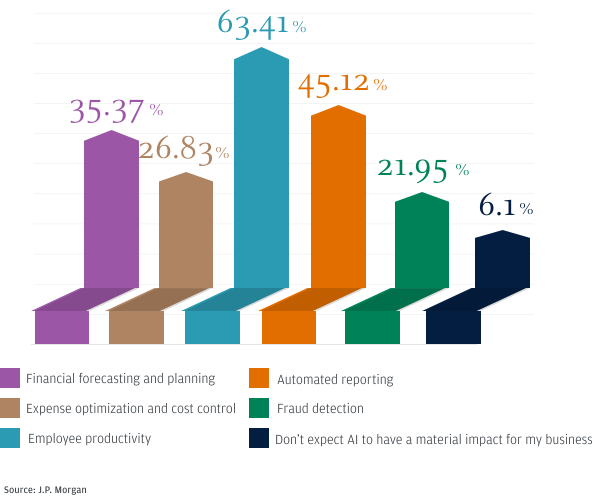
A bar chart showing nearly 70% of respondents believe employee productivity will be impacted most by AI technologies in the next year.
Successful AI deployment in treasury depends on readiness fundamentals. Forum discussion emphasized that many near-term “AI wins” are driven by process automation, disciplined data management and clearly defined controls, with advanced models only as effective as the data and governance that surround them. To prepare for AI implementation, treasurers should prioritize data quality, process documentation and policy controls, with a bias toward use cases that can be tested and scaled without creating new operational risk.
Tokenization is on a similar trajectory, with treasury interest clustered around tangible workflow benefits. Polling on tokenization highlighted use cases such as programmable payments, avoiding cutoff windows, moving money and information simultaneously and improving transaction security. For globally distributed corporates, these capabilities map directly to pain points: timing friction, reconciliation delays and operational risk created by handoffs across systems and time zones.
Overall, tokenization is seen as complementary to existing treasury infrastructure. The operational path is to start with a defined use case, clarify what “success” looks like in measurable terms (for example, faster settlement confirmation) and ensure controls keep pace with speed. Tokenization does not eliminate the need for governance, segregation of duties and clear authorization frameworks.
How do you think tokenization will support your business in the future?
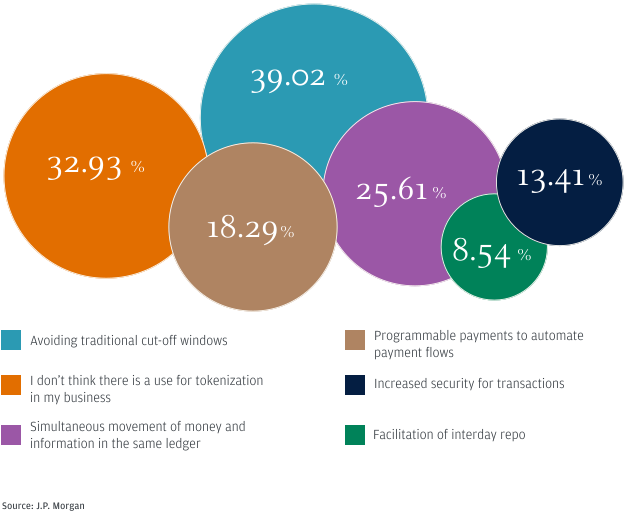
A bar graph showing where treasurers in EMEA believe tokenization can support their businesses. Nearly 40% cite avoiding traditional cutoff windows as the main benefit.
Liquidity, M&A and capital allocation
Forum polling on expected M&A activity in the second half of 2026 shows over 40% of respondents anticipate an increase versus the first half, with over 30% expecting M&A activity to stay steady. In a volatile market, that expectation shows treasurers want to preserve the ability to act if valuation gaps close or if opportunities emerge.
Forum discussion on capital structure and ratings highlighted how that readiness is being financed and governed. The session themes included flexible leverage targets, liquidity as both buffer and “firepower” and the growing complexity introduced by hybrid capital and private credit structures. For treasury leaders, the control objective is to align capital structure choices with the company’s strategic plan and risk appetite, then ensure liquidity metrics and funding diversification support that plan under stress.
These strategic considerations sit alongside a packed operating agenda. When asked to identify top priorities for the next 12 months, the majority of respondents highlighted improving cash flow and working capital. Other concerns included implementation of new technologies, reduced costs and streamlined processes. The list is notable for its breadth and internal tension: treasurers must both modernize and de-risk, often with constrained resources.
What are your top priorities for the next 12 months?
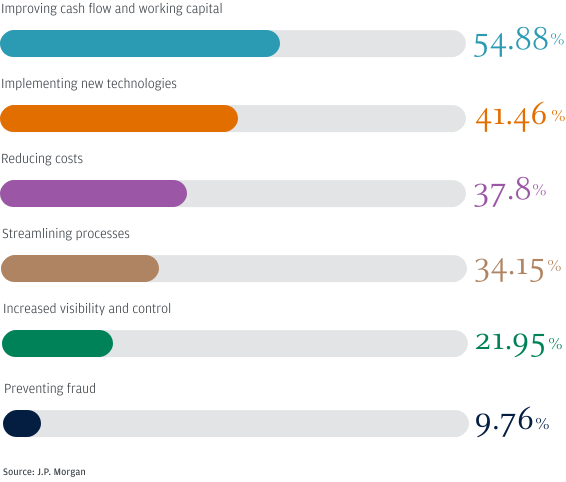
Bar chart showing a majority of respondents are focused on improving cash flow and working capital.
The next twelve months: three imperatives for treasurers
AI and tokenization can deliver measurable gains in forecasting, controls and payment operations, but only where data quality, process clarity and governance are established upfront.
Fraud prevention and cyber preparedness are now core treasury priorities, requiring playbooks, escalation rights and regular testing rather than static documentation.
In a market defined by both uncertainty and innovation, deliberate preparation is the most reliable source of optionality.
Related insights
-

Banking
We help clients achieve their long-term strategic goals through financing, liquidity, payments, risk management and investment banking solutions.
-

Banking
The CFO View: Asia Pacific Outlook 2026
November 26, 2025
CFOs and treasurers in APAC share their views on the economy and business priorities for 2026 in a new J.P. Morgan survey.
-

Banking
Chase, J.P. Morgan, JPMorgan and JPMorgan Chase are marketing names for certain businesses of JPMorgan Chase & Co. and its affiliates and subsidiaries worldwide (collectively, “JPMC”, “We”, “Our” or “Us”, as the context may require).
The information contained in this material is not advice on legal, tax, investment, accounting, regulatory, technology or other matters. You should always consult your own financial, legal, tax, accounting, or similar advisors before entering into any agreement for JPMorgan Chase products or services. In no event shall JPMorgan Chase or any of its directors, officers, employees or agents be liable for any use of, for any decision made or action taken in reliance upon or for any inaccuracies or errors in, or omissions from, the information in this content.
The information does not include all applicable terms or issues and is not intended as an offer or solicitation for the purchase or sale of any product or service. Products and services offered by Chase and its affiliates are subject to applicable laws and regulations, as well as our service terms and policies. Not all products and services are available in all geographic areas or to all customers. In addition, eligibility for particular products and services is subject to satisfaction of applicable legal, tax, risk, credit and other due diligence, JPMorgan Chase’s “know your customer,” anti-money laundering, anti-terrorism and other policies and procedures.
Products and services may be provided by banking affiliates, securities affiliates or other JPMorgan Chase affiliates or entities. In particular, securities brokerage services other than those that can be provided by banking affiliates will be provided by appropriate registered broker/dealer affiliates, including J.P. Morgan Securities LLC and J.P. Morgan Institutional Investments Inc. Any securities provided or otherwise administered by such brokerage services are not deposits or other obligations of, and are not guaranteed by, any banking affiliate and are not insured by the Federal Deposit Insurance Corporation.
Changes to Interbank Offered Rates (IBORs) and other benchmark rates: Certain interest rate benchmarks are, or may in the future become, subject to ongoing international, national and other regulatory guidance, reform and proposals for reform. For more information, please consult: https://www.jpmorgan.com/IBOR.
ABOUT THIS MESSAGE: © 2026 JPMorgan Chase & Co. All rights reserved. JPMorgan Chase Bank, N.A. Member FDIC. Deposits held in non-U.S. branches, are not FDIC insured. Non-deposit products are not FDIC insured. JPMorgan Chase Bank, N.A., organized under the laws of the U.S.A. with limited liability.
J.P. Morgan, JPMorgan, JPMorgan Chase and Chase are marketing names for certain businesses of JPMorgan Chase & Co. and its affiliates and subsidiaries worldwide (collectively, “JPMC”, “We”, “Our” or “Us”, as the context may require). Securities, syndicated loan arranging, financial advisory, lending, derivatives and other investment banking and commercial banking activities are performed by the appropriately licensed subsidiaries and affiliates of JPMorgan Chase & Co. worldwide.
We prepared these materials for discussion purposes only and for your sole and exclusive benefit. This information is confidential and proprietary to our firm and may only be used by you to evaluate the products and services described here. You may not copy, publish, disclose or use this information for any other purpose unless you receive our express authorization. If accompanied by any oral briefing provided by JPMC, these materials are incomplete without reference to, and should be viewed solely in conjunction with, that briefing. These materials do not represent an offer or commitment by any JPMC entity to underwrite, subscribe for or place any securities or to extend or arrange credit or to provide any product or service. In preparing the information, we have relied upon, without independently verifying, the accuracy and completeness of publicly available information or information that you have provided to us. Our opinions, analyses and estimates included here reflect prevailing conditions and our views as of this date. These factors could change,and you should consider this information to be indicative, preliminary and for illustrative purposes only. This information is provided as general market and/or economic commentary. It in no way constitutes research and should not be treated as such. In addition, our analyses are not and do not purport to be appraisals of the assets, stock, or business of any entity.
These materials and any oral briefing provided by JPMC are not advice on financial, legal, tax, investment, accounting, regulatory, technology or other matters. You should always consult your own financial, legal, tax, accounting, or similar advisors before entering into any agreement for our products or services. JPMC makes no representations as to the actual results which may be achieved in connection with any transaction nor the legal, tax or accounting effects of consummating any transaction. In no event shall JPMC or any of its directors, officers, employees or agents be liable for any use of, for any decision made or action taken in reliance upon or for any inaccuracies or errors in, or omissions from, the information in these materials. We are not acting as your agent, fiduciary or advisor.
Our policies prohibit employees from offering, directly or indirectly, a favorable research rating or specific price target, or offering to change a rating or price target, to a subject company as consideration or inducement for the receipt of business or for compensation. We also prohibit our research analysts from being compensated for involvement in investment banking transactions except to the extent that such participation is intended to benefit investors.
The information in these materials does not include all applicable terms or issues and is not intended as an offer or solicitation for the purchase or sale of any product or service. Our products and services are subject to applicable laws and regulations, as well as our service terms and policies. Not all products and services are available in all geographic areas or to all customers. In addition, eligibility for particular products and services is subject to satisfaction of applicable legal, tax, risk, credit and other due diligence, JPMC’s “know your customer”, anti-money laundering, anti-terrorism and other policies and procedures.
Products and services may be provided by banking affiliates, securities affiliates or other JPMC affiliates or entities, and such affiliate or entity may or may not be the JPMC entity operating and regulated in your jurisdiction locally. In particular, securities brokerage services other than those that can be provided by banking affiliates will be provided by appropriate registered broker/dealer affiliates, which may include J.P. Morgan Securities LLC and J.P. Morgan Institutional Investments Inc. Any securities provided or otherwise administered by such broker/dealer affiliates are not deposits or other obligations of, and are not guaranteed by, any banking affiliate and are not insured by the Federal Deposit Insurance Corporation.
Changes to Interbank Offered Rates (IBORs) and other benchmark rates: Certain interest rate benchmarks are, or may in the future become, subject to ongoing international, national and other regulatory guidance, reform and proposals for reform. For more information, please consult: www.jpmorgan.com/IBOR.
JPMorgan Chase Bank, N.A. Member FDIC. Deposits held in non-U.S. branches are not FDIC insured. Non-deposit products are not FDIC insured. JPMorgan Chase Bank, N.A. is organized under the laws of USA with limited liability.
For informational purposes only, these materials may refer to or introduce third party service providers (“Vendors”), and their products and services. Any such reference to or introduction of Vendors, their products and services does not constitute an endorsement by JPMC of such Vendors, or their products and services. JPMC neither makes any representations or warranties, express or implied, with respect to any such Vendor, their products and services, nor guarantees the capability, reliability, suitability or fitness for any particular purpose of any of the foregoing. Upon your request, JPMC may arrange for an introduction between you and the Vendors. JPMC’s role is limited to arranging such an introduction and thereafter all engagement with the Vendors shall be entirely at your discretion, without any reference or recourse to JPMC for any claims of losses or damages whatsoever or howsoever arising, JPMC’s responsibility and liability for which is excluded to the maximum extent permitted by applicable law. You must make your own independent evaluation and assessment of the Vendors before making any decision to engage them, and you acknowledge and agree that you will do so independently of JPMC. Investments or strategies discussed herein may not be suitable for everyone. Neither JPMC nor any of its directors, officers, employees or agents shall incur any responsibility or liability whatsoever to you or any other party with respect to the contents of any matters referred herein, or discussed as a result of, these materials. These materials are not intended to provide, and should not be relied on for, accounting, legal or tax advice or investment recommendations. Please consult your own tax, legal, accounting or investment advisor concerning such matters.
For information on JPMC legal entities see: www.jpmorgan.com/disclosures. For information on JPMC’s policies on data privacy see: www.jpmorgan.com/privacy.
© 2026 JPMorgan Chase & Co. All rights reserved.
Additional EMEA Disclosures:
CB “J.P. Morgan Bank International” (LLC) is regulated by the Central Bank of Russia.
JPMorgan Chase Bank, N.A., Johannesburg Branch is an Authorized Financial Services Provider (FSP No. 7795)
JPMorgan Chase Bank, N.A. at its London Branch is a bank authorized and subject to supervision and regulation by the Office of the Comptroller of the Currency,and is also supervised and regulated with respect to certain matters by the Board of Governors of the Federal Reserve System, each in the jurisdiction of the United States of America. Authorised by the Prudential Regulation Authority. Subject to regulation by the Financial Conduct Authority and limited regulation by the Prudential Regulation Authority. Details about the extent of our regulation by the Prudential Regulation Authority are available from us on request. (Firm Reference Number: 124491).
J.P. Morgan SE is authorized as a credit institution by the Federal Financial Supervisory Authority (Bundesanstaltfür Finanzdienstleistungsaufsicht, BaFin) and jointly supervised by the BaFin, the German Central Bank (Deutsche Bundesbank) and the European Central Bank (ECB).For additional information on J.P. Morgan SE and its branches see: EMEA Regulatory Disclosures. https://www.jpmorgan.com/global/disclosures/legal-entity-information