In 2025, 14% of workers in legal services were at least 65 years old, compared with just 8% in professional and business services and 7% across all industries.

4 min read
Key takeaways
- The legal services industry may be entering a new phase of institutionalization as owners look to modernize and address succession planning while sponsors position for consolidation playbooks.
- Companies and investors are exploring managed service organizations (MSOs) as a scalable operating model to drive efficiencies in non-legal functions (e.g., human resources).
- The emergence of artificial intelligence (AI) has meaningful potential in the legal services sector and could influence decisions about operating models and business structures.
Modern modernization
Firms in the legal services sector are increasingly looking for ways to modernize their operations while upholding the professional standards that define the sector. New ownership models are expanding access to law firm economics, creating compliant pathways for sponsors to invest behind operational, technological, AI and growth-oriented value creation. Private equity interest in the legal services sector has been rising in recent years as MSOs provide an opportunity for investment and innovation. Law firms, meanwhile, are increasingly receptive to outside capital—succession gaps, limited long-term capital formation and AI disruption to billable-hour economics are pushing firms to consider a more corporate, “perpetual” capital structure.
MSOs are often positioned as a modern evolution of earlier outsourcing structures (notably business process outsourcing), allowing firms to access scalable technology and professionalized administrative support while keeping the legal practice and decision-making within the firm. This MSO model has been successfully adopted in adjacent professional services settings like accounting, where non-core functions can be outsourced without compromising professional independence.
U.S. mid‑market sponsors are increasingly looking at this type of playbook—rolling up fragmented, process‑heavy segments (e‑discovery, mass‑tort servicing, claims administration, outsourced contract review, etc.)—for the legal services sector. The sector may be entering a new phase of institutionalization though only a modest number of deals were completed in the U.S. during the first half of 2026. Early waves of institutional capital are poised to reshape competitive dynamics as scaled platforms professionalize operations, accelerate technology adoption and consolidate a historically fragmented market.
“MSOs can be positioned as engines for investment and innovation opportunities, particularly where legal markets are fragmented and firms need scalable support.”

Melroy Patterson, Jr.
Head of Professional Services for North America, J.P. Morgan Commercial Banking
AI has potential and challenges
AI could be an important new factor affecting decisions about ownership models. While the future of AI is of course uncertain, there may be significant potential impacts for AI in the legal services sector due to the nature of the work in the industry, including a high volume of language-heavy tasks, as well as a high cost of related labor. Along these lines, Anthropic has flagged the legal sector as an industry in which AI could theoretically speed up a large share of job tasks, with only a small portion of the potential adoption in the legal sector realized to date.1
AI could theoretically speed up a large share of legal services job tasks
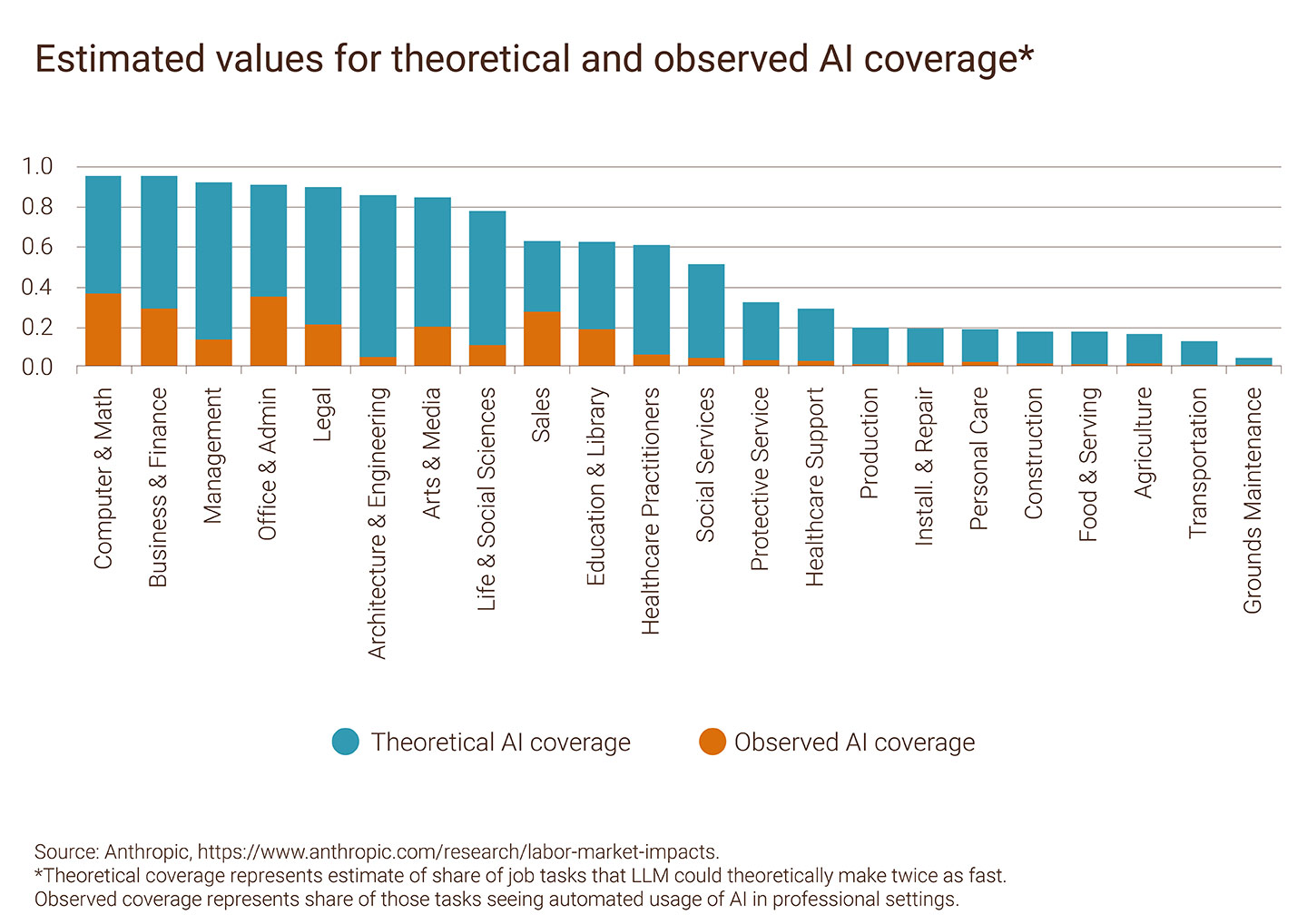
Stacked bar chart titled “Estimated values for theoretical and observed AI coverage” comparing job categories. Each category has a teal bar for theoretical AI coverage and an orange segment for observed AI coverage, on a 0 to 1.0 scale. The highest theoretical coverage appears in Computer & Math, Business & Finance, Management, Office & Admin, and Legal, while lower theoretical coverage appears in fields like Construction, Food & Serving, Agriculture, Transportation, and Grounds Maintenance. A note explains theoretical coverage is the estimated share of job tasks LLMs could theoretically do about twice as fast, while observed coverage reflects the share of tasks where automation using AI is already used in professional settings (source: Anthropic).
Despite this potential, there might be challenges to embracing AI in the legal sector, including a skew towards older workers, smaller firm sizes, and considerations around judgement and ethical standards. Older workers may be less likely to quickly change established ways of doing business and smaller establishments may have high bars for adopting new and potentially expensive technologies.
Legal services has an outsized share of employees 65 and older
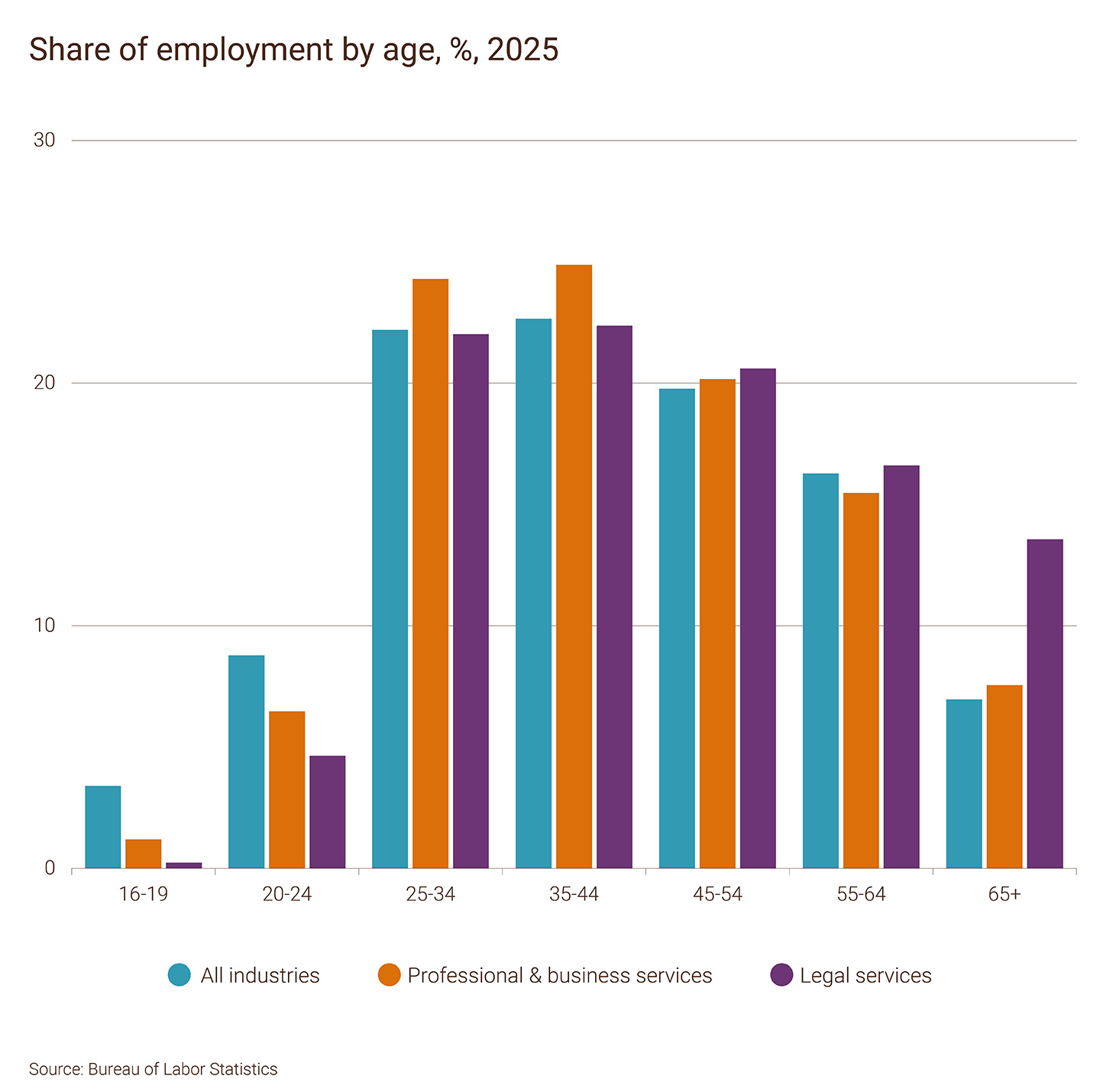
In 2025, 14% of workers in legal services were at least 65 years old, compared with just 8% in professional and business services and 7% across all industries.
A large share of legal services establishments have fewer than 5 employees
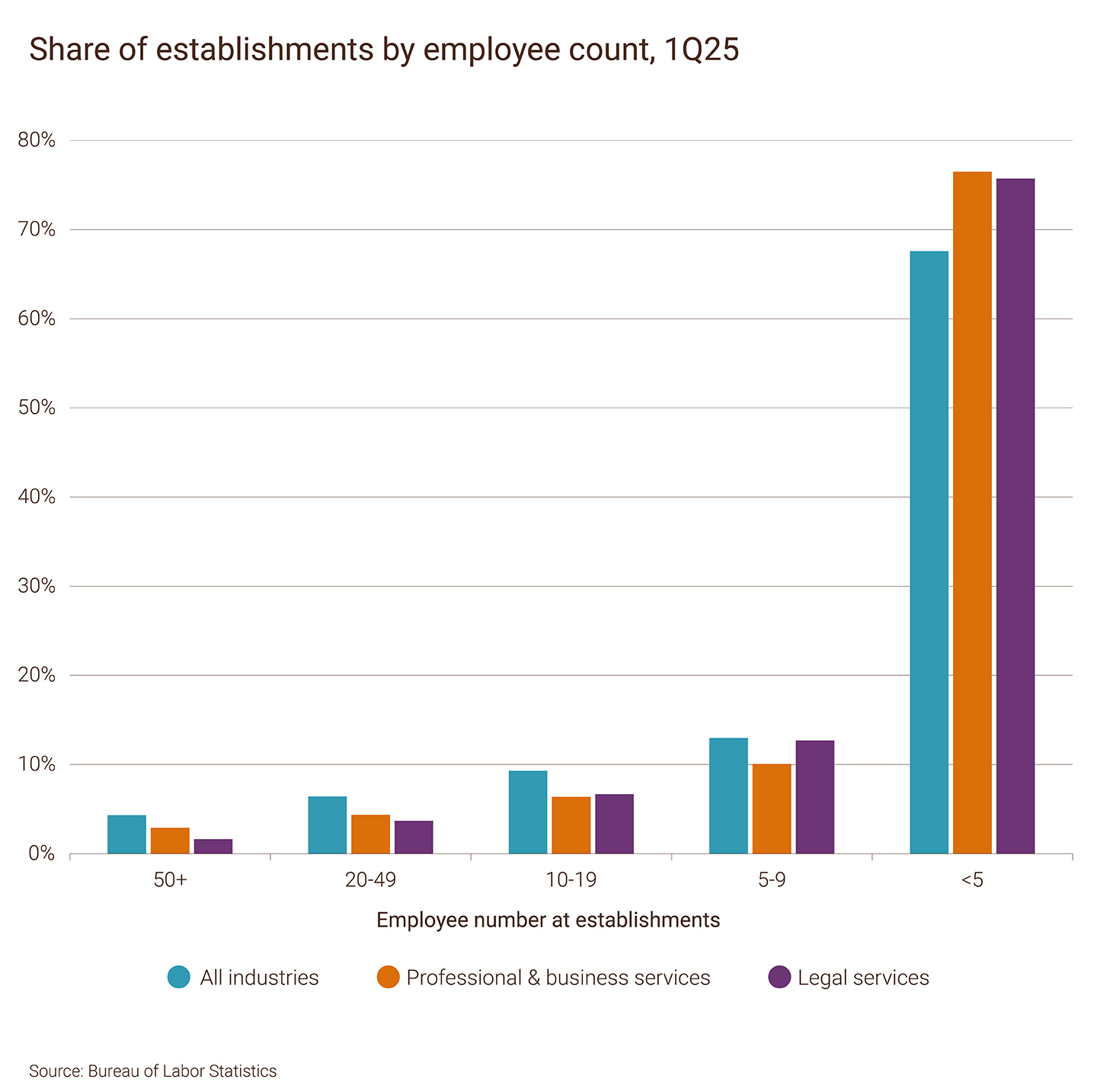
The share of legal services establishments with fewer than five employees, 76%, was similar to that of all professional and business services establishments. Across all industries, only 68% of establishments had fewer than five employees.
The share of legal services establishments with fewer than five employees, 76%, was similar to that of all professional and business services establishments. Across all industries, only 68% of establishments had fewer than five employees.
While the legal services sector's engagement with AI will likely evolve over time, there almost certainly will remain a need for humans in the loop for judgment, ethical considerations and broader business strategies, in addition to other roles. There also is the possibility that AI makes legal services workers more productive and valuable, increasing demand for them (a Jevons paradox). So far, the legal services sector as a whole still looks willing to hire and pay for workers. Employment growth in the legal services sector has outpaced that of the broader professional and business services sector and the overall private sector lately. And in recent years, the wage premium for workers in legal services relative to both professional and business services and the broader private sector has been above pre-pandemic norms.
Legal services share of private sector employment has risen lately
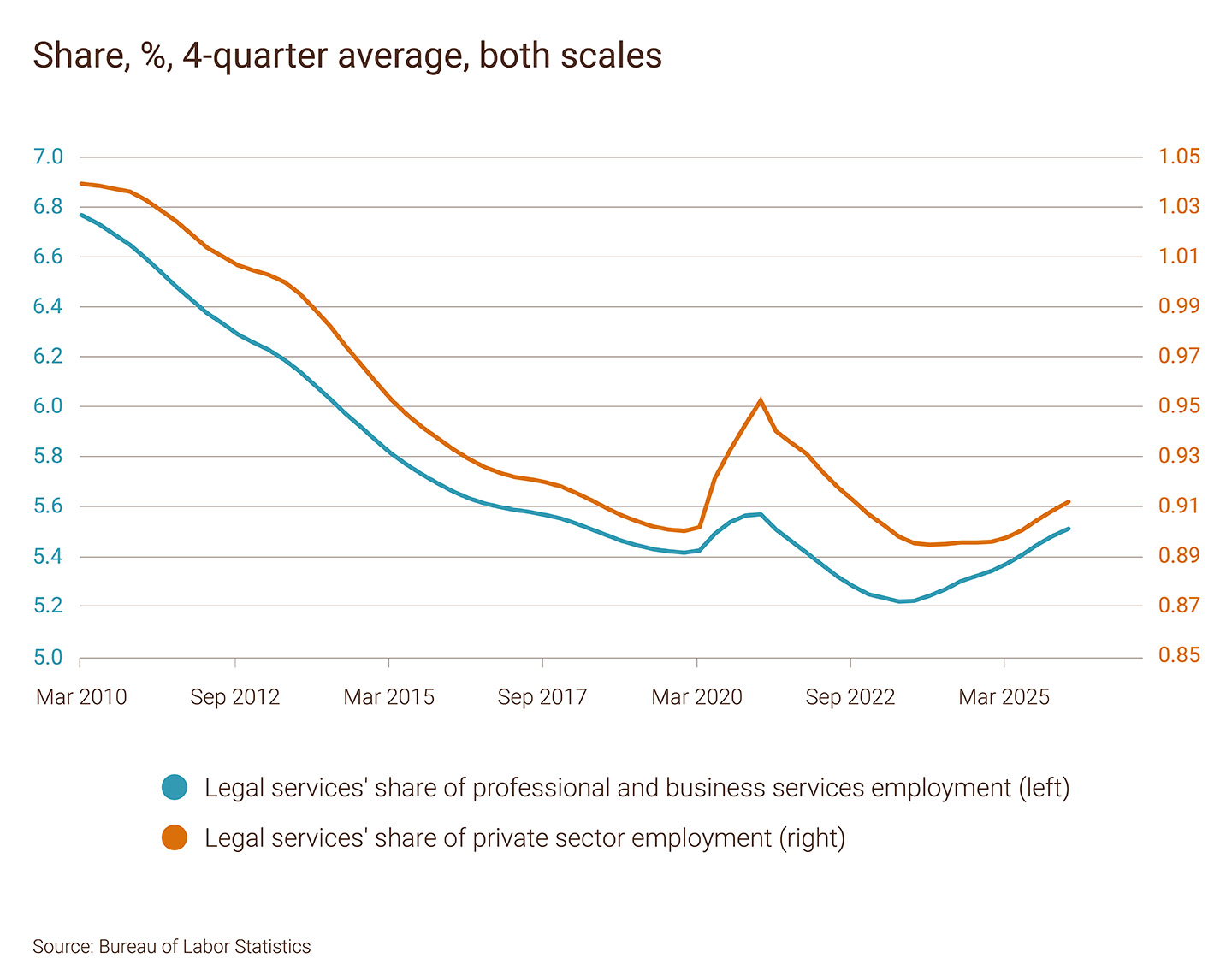
After trending lower for over a decade, legal services employees have accounted for a growing share of private sector employment in recent years.
After trending lower for over a decade, legal services employees have accounted for a growing share of private sector employment in recent years.
The wage premium for legal services is above pre-pandemic levels
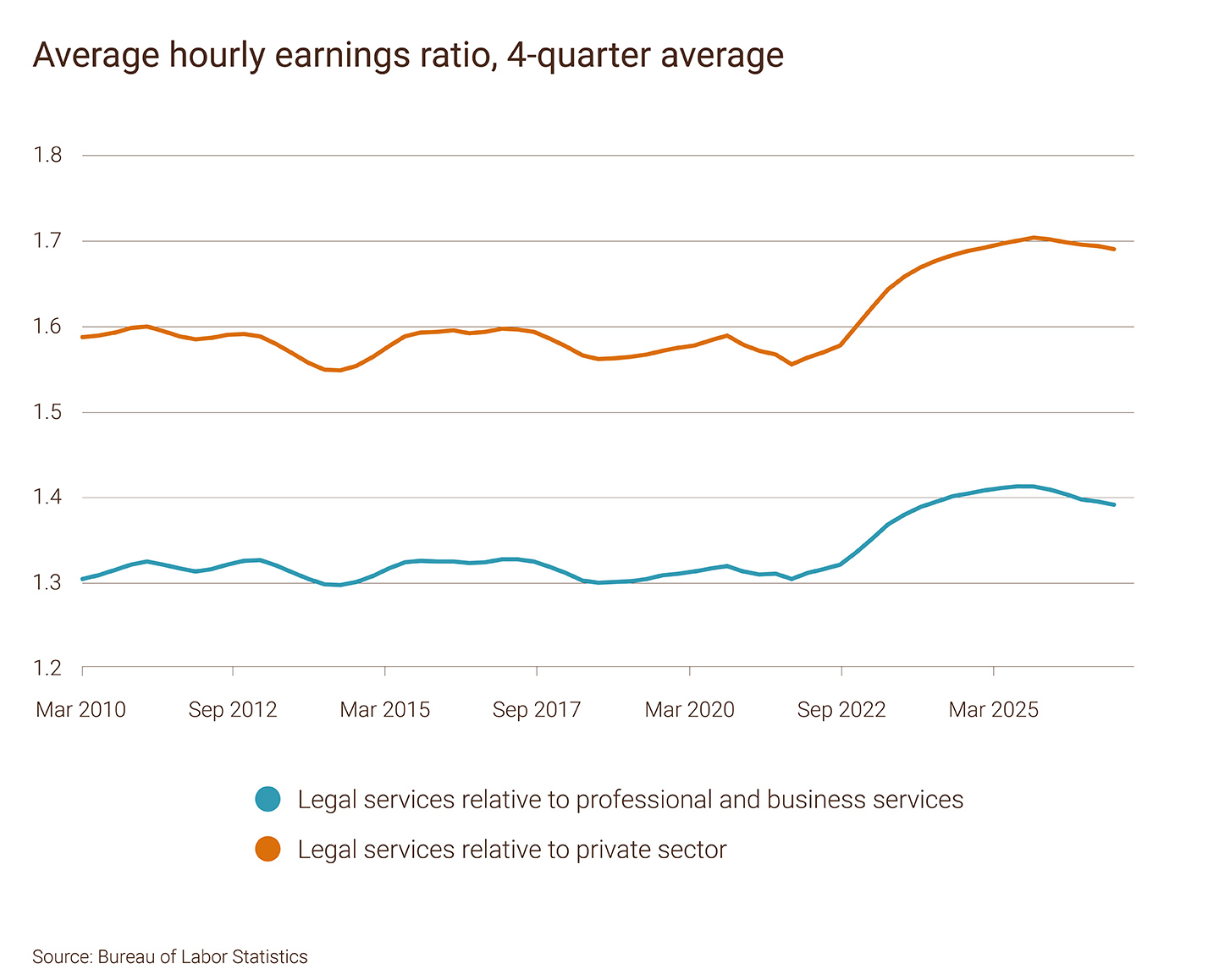
Average hourly earnings for legal services employees have been running 1.7x those of overall private sector workers and 1.4x those of professional and business services sector workers, above pre-pandemic norms.
Average hourly earnings for legal services employees have been running 1.7x those of overall private sector workers and 1.4x those of professional and business services sector workers, above pre-pandemic norms.
The bottom line
Many owners are looking to modernize and address succession planning and sponsors are positioning for consolidation playbooks. MSOs could be a pathway to help the legal services industry modernize operations and increase efficiencies. While many factors may influence the related decision making, AI has emerged as an important issue given its potential in the sector.
Contributors

Ginger Chambless
Head of Market Insights, J.P. Morgan Commercial Banking
Melroy Patterson, Jr.
Head of Professional Services for North America, J.P. Morgan Commercial Banking
References
1.
Maxim Massenkoff and Peter McCrory, “Labor market impacts of AI: A new measure and early evidence,” Anthropic Research, March 5, 2026, https://www.anthropic.com/research/labor-market-impacts.
Contact us
Hide
Contact us
Hide
© 2026 JPMorgan Chase & Co. All rights reserved. JPMorgan Chase Bank, N.A. Member FDIC. Chase, J.P. Morgan, JPMorgan and JPMorgan Chase are marketing names for certain businesses of JPMorgan Chase & Co. and its subsidiaries worldwide (collectively, "JPMC"). The material contained herein is intended as general market commentary. To the extent indices have been used in this commentary, please note that it is not possible to invest directly in an index. The views, opinions, estimates and strategies, as the case may be ("views"), expressed herein are those of Daniel Silver and/or the other respective authors and speakers named in this piece and may differ from those of other JPMC employees and affiliates. These views are often based on current market conditions and are subject to change without notice. Any examples used are generic, hypothetical and for illustration purposes only. This information in no way constitutes J.P. Morgan research and should not be treated as such. Further, the views expressed herein may differ from that contained in J.P. Morgan research reports. The above summary/prices/quotes/statistics have been obtained from sources deemed to be reliable, but we do not guarantee their accuracy or completeness.
Visit jpmorgan.com/cb-disclaimer for full disclosures and disclaimers related to this content.