
Key takeaways
- Digital assets and tokenization are moving from concept to institutional reality, but regulatory clarity and operational readiness are required to accelerate adoption.
- Private markets access is being reshaped by new fund structures, data transparency and a focus on diversification and resilience.
- Data governance, analytics, and AI are now foundational to risk management, operational efficiency and client experience.
From digital assets to AI-driven operating models, institutional investing in Asia Pacific is undergoing a profound transformation. Against this backdrop, J.P. Morgan brought together leading pension funds, central banks, insurers, asset managers and public sector clients at the APAC Investor Services Forum in Tokyo to explore the trends shaping the industry.
Over two days, investors discussed the themes defining the next chapter of institutional investing: digital assets and tokenization, private markets, data, operating models and AI-driven innovation. Drawing on insights from a panel of industry experts and interactive polling, here’s what they had to say.
How are digital assets and tokenization transforming finance in Asia Pacific?
Valeria Zafar, Director of Market Development for Kinexys at J.P. Morgan APAC, set the tone for the forum by examining how tokenized securities and digital assets are transforming market infrastructure, custody and settlement. “Tokenized securities across the globe amount to approximately $30 billion in assets. By 2030, that is expected to grow to anywhere between $4 to $16 trillion in assets, which is something that we believe most financial institutions need to be prepared for,” said Zafar, emphasizing the scale of the opportunity.
Institutional use cases are rapidly evolving, with panelists citing efficiency gains in custody, settlement and programmability, as well as new distribution channels and investor access models.
Reflecting on the changing expectations of investors, Emma Pecenicic, Head of Digital Assets Distribution at Fidelity International, noted that today’s new generation of investors expects 24/7, instant access and yield—much like the experience of crypto. She explained that realizing this vision with tokenization starts with building regulated products for institutions, with the goal of eventually expanding to the retail market.

Top left: Valeria Zafar, Director of Market Development for Kinexys at J.P. Morgan APAC; Bottom left: Chetan Karkhanis, Senior Vice President, Franklin Innovation Research Strategies and Technology (FIRST) Group, Franklin Templeton, APAC; Right: Emma Pecenicic Head of Digital Assets Distribution Fidelity International; Kengo Naruyama, Vice President, Digital Asset Strategies Office Nomura Holdings, Inc.
Robust operating models that can support both digital twins of traditional assets and natively tokenized products are needed, with a focus on interoperability and risk management.
Polling revealed that 43% of attendees view tokenization of real-world assets as “transformative and likely to scale to more than 50% of the financial market within the next 10 years,” while only 2% see it as a failed experiment. Kengo Naruyama, Vice President, Digital Asset Strategies Office at Nomura Holdings, noted that Japan’s first public security token launched in 2021 and primarily backed by real estate has already reached nearly $2 billion in issuance, with a strong focus on retail investors. He emphasized that successful tokenization depends on building a robust ecosystem of partners and evolving roles for service providers, especially around custody and key management.
During the session, Chetan Karkhanis, Senior Vice President, Franklin Innovation Research Strategies and Technology of Franklin Templeton discussed how blockchain technology can dramatically reduce transaction costs and increase speed, with blockchain-based transfers costing a fraction of traditional methods and enabling much faster processing. The discussion also highlighted the importance of regulatory clarity to enable adoption of tokenization at scale, both in region and globally.
In your opinion, how impactful is tokenization of real world assets?
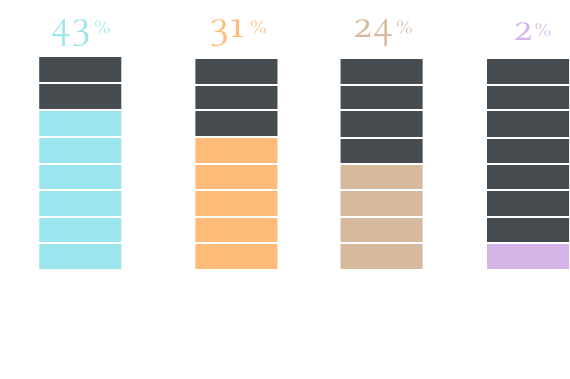
Attendees at the Investor Services Forum believe tokenization will be transformative for the financial market.

What challenges are shaping private market access in Asia?
Pulkit Sharma, head of Alternatives Investment Strategy and Solutions, J.P. Morgan Asset Management, explored the structural and operational challenges facing asset owners and managers as they increase allocations to private equity, credit, infrastructure and real estate. Panelists discussed the growing complexity of fund structures, the need for more frequent and transparent valuation processes, and the importance of data-driven decision-making.
Hazman Hilmi, Chief Investment Officer at KWAP, emphasized that a healthy public market depends on a strong private market foundation, particularly in Malaysia where supporting early-stage companies is essential. He advised investors to remain prudent and not let market sentiment distract them from long-term objectives.
Sharma also underscored the value of thoughtful diversification in adapting to changing market conditions: “We believe that a diversified portfolio that includes private equity, private real estate, private infrastructure, and private credit may be the best approach to accessing private markets, because the answer to which asset class will outperform will keep changing as the market environment changes.”
Liquidity and investment horizon were further addressed by Masashi Kataoka, Expert Executive Officer and head of the Alternative Investment Unit at Daiichi Life Group. He explained that semi-liquid fund structures are designed to balance the appeal of private assets with the realities of limited liquidity, restricting redemptions to protect investor capital and ensure portfolio stability. Kataoka also highlighted the need for a long-term perspective, suggesting private markets are best approached with a decade-long horizon.
Addressing recent concerns about defaults in private credit, Tomoki Murai, Managing Director, Credit & Insurance at Blackstone, noted that much of the noise in headlines is overstated, as direct lending remains a small part of the global investment landscape. He emphasized that private credit is still in its early stages—representing $2 trillion out of a $30 trillion addressable market—and that the structure of these products, with built-in liquidity limitations, helps protect investors and deliver premium returns. Murai stressed that the long-term outlook for private credit remains positive, and that current headlines do not reflect the true risk or scale of the asset class.
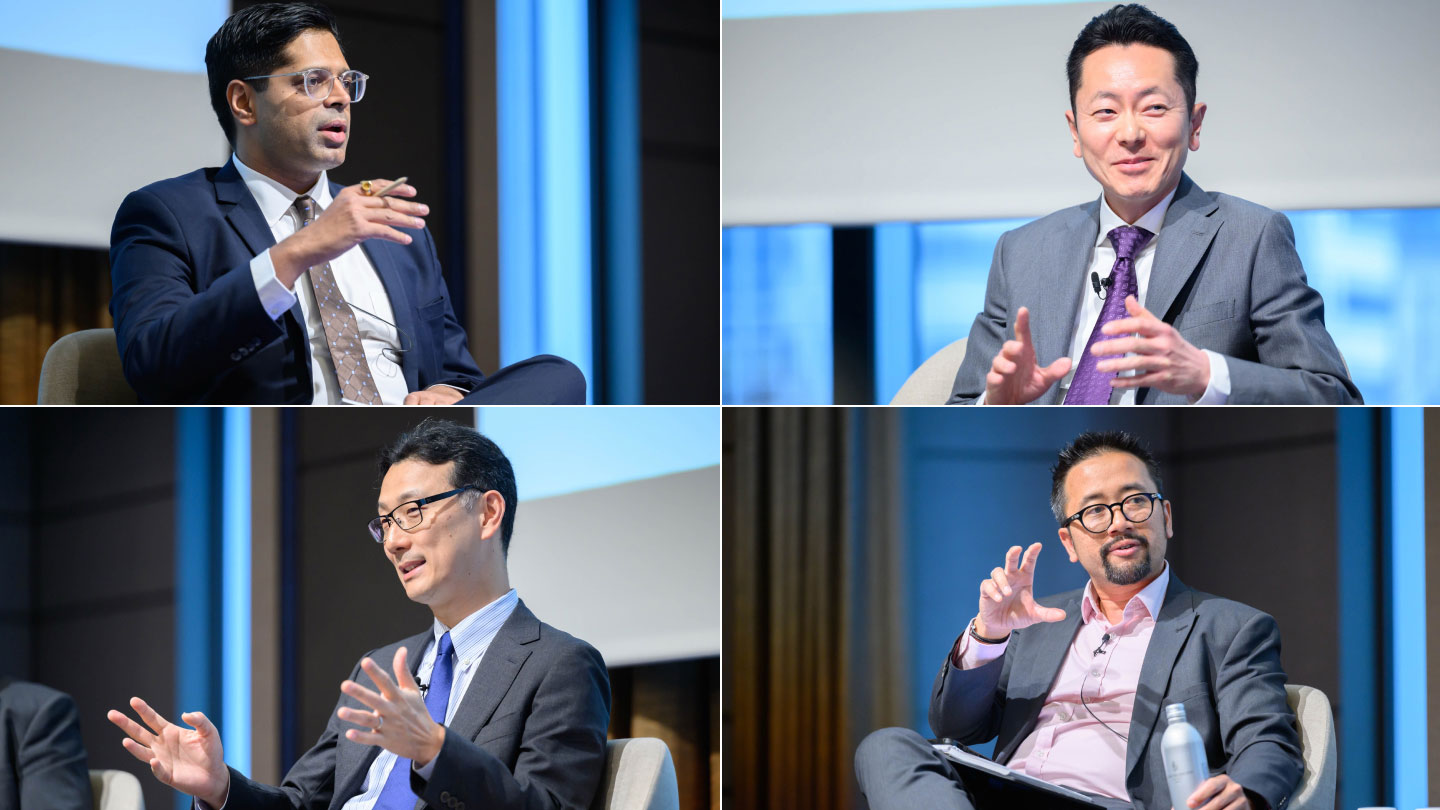
Top left: Pulkit Sharma, Head of Alternatives Investment Strategy and Solutions (AISS), J.P. Morgan Asset Management; Bottom left: Masashi Kataoka, Expert Executive Officer, Head of Alternative Investment Unit Daiichi Life Group, Inc.; Top right: Tomoki Murai, Managing Director, Credit & Insurance, Blackstone; Bottom right: Hazman Hilmi, Chief Investment Officer, KWAP.
Why is data governance foundational for institutional investors?
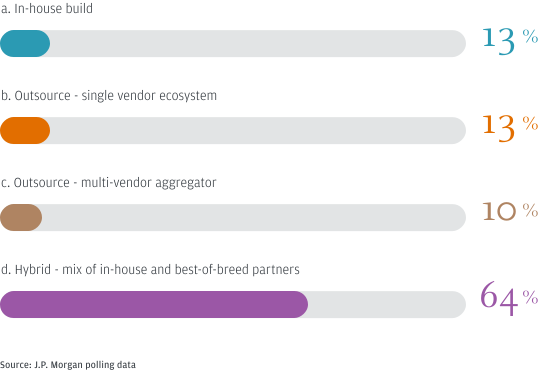
Data governance, quality and analytics emerged as central themes throughout the forum. Institutional investors are increasingly focused on building hybrid data platforms that combine in-house and best-of-breed partner solutions, with 64% of attendees reporting a hybrid approach to data management. As Gen Uehara, Head of Financial Services Industry, Japan at Snowflake, observed, advances in data platforms now make it far easier for organizations to build data-driven solutions—provided they have access to large, well-connected data sets that can be easily integrated and processed.
Peta Stevenson, Group Head of Data and Analytics at Cbus Super, outlined their hybrid data strategy—leveraging partners with transparent lineage for speed, while defining a vendor-agnostic, AI-ready core data model that lets Cbus swap components as technology and partner capabilities evolve, without a major migration.
How would you best describe the approach your organization takes to building and managing your data platforms?
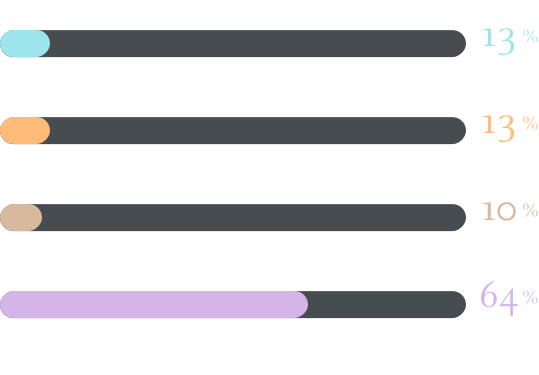
A majority of respondents leverage a mix of in-house and best-of-breed partners to manage their data platforms.
The session highlighted the need for robust data governance frameworks, containerized data and catalog/mesh architectures to support analytics, risk management and regulatory compliance. Keith Bunnell, Global Head of Enterprise Data and Technology Sales at Bloomberg, emphasized that discipline is at the heart of effective data management. He explained that organizations should focus on building a consistent, integrated data environment — a single source of truth — so that all systems and users are aligned and operational efficiency is maximized.
J.P. Morgan’s James Goh, Head of APAC Data & Analytics Sales, agreed that data discipline is critical. “The more data you have, the more insights you gain, but not necessarily more useful insights. It’s when you have organized data at scale that you start to realize sustainable AI outcomes that move the needle,” said Goh.

Left: James Goh, APAC head of Data & Analytics Sales, J.P. Morgan; Top right: Gen Uehara, Head of Financial Services Industry, Snowflake Japan; Bottom right: Peta Stevenson, Group Head of Data and Analytics, Cbus Super; Keith Bunnell, Global Head of Enterprise Data & Technology Sales, Bloomberg.
How are operating models evolving for asset managers?
Multiple forces are reshaping how asset owners and managers deliver products and services in an increasingly complex environment. Nick Dekker, head of Northeast Asia & head of Technology Consulting (International) at Alpha FMC, observed, today’s operating models are being fundamentally transformed by five converging drivers: firms are grappling with more complex products, the adoption of integrated platforms, the growing importance of data and AI, increased regulatory and resilience demands, and the challenge of deciding what to keep in-house versus what to outsource or partner on. Dekker framed the challenge succinctly: “The industry has evolved. The operating model has not. More products, more complexity, same operating model.”
Paul You, from the Securities Investment Trust and Consulting Association of Taiwan, agreed. He explained how the industry is increasingly moving toward a model where different players—asset owners, managers, and service providers—work together in specialized roles, each focusing on their strengths to best serve investors. Operating models will need to support this interconnected ecosystem.
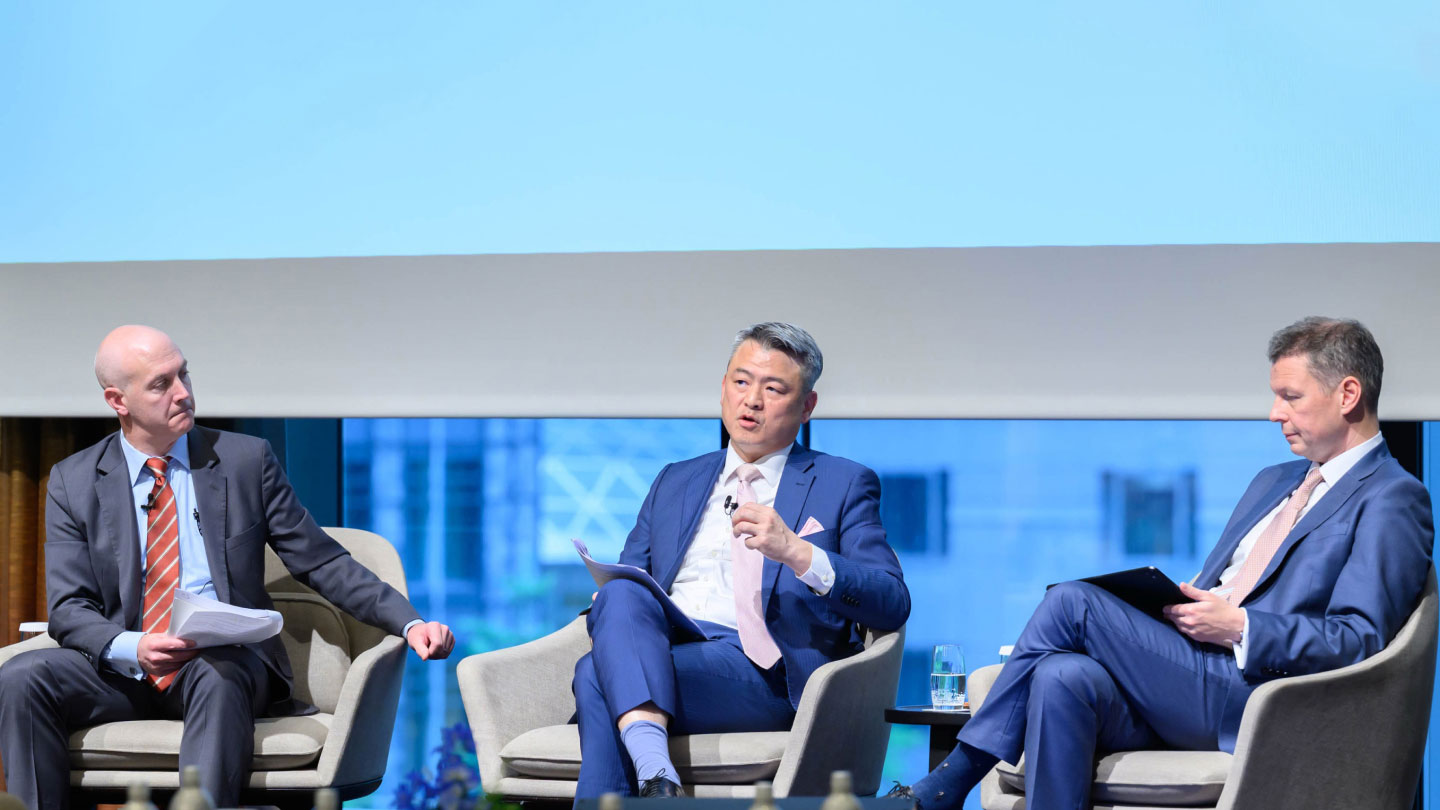
From left: Christopher Hinds, Global Head of Client Servicing Platforms, Fidelity International; Paul You
Chairman, Securities Investment Trust & Consulting Association of the R.O.C. (SITCA); Nick Dekker
Head of Northeast Asia & Head of Technology Consulting (International), Alpha FMC.
The forum highlighted the shift toward data-centric, resilient operating models.
Christopher Hinds, Global Head of Client Servicing Platforms at Fidelity International, said “We are still in a service model where data is being sent in report format, but I see this changing to open APIs and data sharing platforms for clients. This will gain more traction as clients adapt, and while we’ve seen progress, there is more to be done across the industry.”
Dekker explained, “Success will require adaptability: platform-based, hybrid models that are data-centric, resilient, and locally tailored.” The discussion contrasted the requirements of public markets—high volume, low margin, tight timelines—with those of private markets—low volume, high complexity, flexible processes—and emphasized the need for operating models that can handle both scale and complexity.
What is the impact of AI and technology on investing?
Artificial intelligence is reshaping how institutions operate, strengthen resilience and serve clients. J.P. Morgan’s Deep Thomas, APAC Chief Data & Analytics Officer highlighted that the pace of change is accelerating rapidly as advances in AI create new opportunities to rethink workflows, decision-making and execution.
“AI is no longer just a technology agenda - it is increasingly a business agenda,” Thomas said. “The institutions that will lead are the ones that can combine innovation with clear use cases, strong data foundations and the right governance from the start.” In-session polling reflected that shift, with 75% of forum participants identifying data and AI as their top investment priorities over the next two to three years.
Where are you investing most in the next 2-3 years?

75% of respondents plan to invest most in Data and AI in the near-term.

The discussion also highlighted how AI is becoming more embedded across the enterprise, with adoption increasingly focused on practical applications that improve productivity and deliver value at scale. “The value of AI will ultimately depend on the quality of the data behind it,” Deep said. “Strong data foundations - with the right context, controls and accessibility - are what make AI scalable, reliable and useful in a business environment.”
Looking ahead, Deep said the evolution toward more autonomous and agentic AI capabilities will make responsible deployment even more important. “We are moving from AI that supports tasks to AI that can increasingly orchestrate and execute parts of a workflow,” he said. “That creates significant opportunity, but it also raises the bar for data quality, guardrails and human oversight.”
APAC Investor Services Forum polling highlights
- 43% of attendees believe tokenization will transform more than half of financial markets within 10 years.
- 46% say AI will deliver the most value in knowledge search and internal productivity.
- 64% report a hybrid approach to data platform management.
- 55% cite eliminating manual processes as a top data initiative.
- 75% are prioritizing investment in data and AI over the next 2–3 years.
As the financial landscape continues to evolve, institutional investors in APAC are well positioned to lead the way by harnessing technology, data and partnership to unlock new sources of value and deliver sustainable growth.
Related insights
-

Securities Services
Australia’s superannuation system stands at a pivotal crossroads, as the industry tackles the transition from saving to spending, builds trust, and shapes the future of retirement.
-

ETF
From automation to tokenization: ETF trends to watch
April 24, 2026
The ETF landscape is being reshaped by technology as investors seek greater efficiency and lower costs. What are the key developments in this space?
-

16:45 - Markets and Economy
Digital assets unveiled: Industry insights and regulatory shifts
September 19, 2025
This document is provided for information only and is not intended as a recommendation or an offer or solicitation for the purchase or sale of any security or financial instrument. The opinions, estimates, strategies and views expressed in this document or publication constitute our views as of the date of this document or publication and are subject to change without notice. Any opinions expressed herein may differ from the opinions expressed by other areas of J.P. Morgan, including research. The information contained herein is as of the date of this document or publication and J.P. Morgan does not undertake any obligation to update such information. Any market prices, data or other information contained herein are not warranted as to completeness or accuracy and are subject to change without notice. This document does not purport to contain all of the information that an interested party may desire and provides only a limited view of a particular market, product and/or service. This document does not constitute advice by or on behalf of J.P. Morgan, and nothing in this document should be construed as legal, regulatory, tax, accounting, investment or other advice. No reliance should be placed on the information herein. The recipient must make an independent assessment of any legal, credit, tax, regulatory and accounting issues and determine with its own professional advisors any suitability or appropriateness implications and consequences of any transaction in the context of its particular circumstances. J.P. Morgan assumes no responsibility or liability whatsoever to any person in respect of such matters. Transactions involving securities and financial instruments mentioned herein may not be suitable for all investors.
The products and services described in this document are offered by JPMorgan Chase Bank, N.A. or its affiliates subject to applicable laws and regulations and service terms. Not all products and services are available in all locations. Eligibility for particular products and services will be determined by JPMorgan Chase Bank, N.A. and/or its affiliates.
J.P. Morgan is a marketing name for businesses of JPMorgan Chase & Co. and its subsidiaries and affiliates worldwide. The material is produced and distributed on behalf of the entities offering Commercial and Investment Banking activities including but not limited to JPMorgan Chase Bank N.A. (including through its authorized branches), J.P. Morgan SE (including its authorized branches), J.P. Morgan (Suisse) SA, J.P. Morgan Europe Limited, J.P. Morgan Securities LLC and J.P. Morgan Securities plc. JPMorgan Chase Bank, N.A., organized under the laws of U.S.A. with limited liability, is authorized by the Office of the Comptroller of the Currency in the jurisdiction of the U.S.A. For additional regulatory disclosures regarding these entities, please consult: www.jpmorgan.com/disclosures.
©2025 JPMorgan Chase & Co. All rights reserved.