
Key takeaways
- Growing ETF volumes and tighter regulations are requiring investors to leverage electronic workflows that are easier to document and scale.
- Active ETFs, which typically feature more complex set-ups than passive ETFs, are further fueling developments in electronification.
- There is growing experimentation around tokenizing ETFs, but the technology has yet to hit the mainstream.
Exchange-traded funds (ETFs) have come a long way since making their debut on the market in 1993. Defined as pooled investment funds that hold a basket of different assets, they were once traded on exchanges via manual, high-touch processes. In recent years, they have undergone rapid electronification as the industry has expanded, transforming how they are priced and managed.
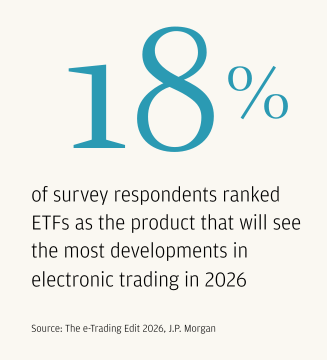
“Fundamentally, an ETF is a wrapper delivering flexibility, diversification, transparency and cost efficiencies, all driven by technology. As such, having them operate in the most technologically advanced environment is key,” said Ciarán Fitzpatrick, global head of ETF Product, Securities Services at J.P. Morgan. Clients agree; in J.P. Morgan’s 10th annual e-trading survey, respondents said they expect ETFs to see the most developments in electronification in 2026 compared with other products.
What’s driving this paradigm shift, and what are the key trends to watch?
The automation of ETF trading is gaining pace
The global ETF market is expanding as investors seek alternatives to traditional mutual funds. Assets under management (AUM) are widely expected to reach $35 trillion by 2030, up from $19.5 trillion in 2025, according to a PwC survey. This growth is necessitating the use of automated systems, which can process trades more efficiently and at lower cost.
“Over the years, the overall number of ETF orders, as well as total volumes traded, has increased significantly. These have contributed to the scale of the market, in turn creating greater benefits around electronifying a large portion of the flow,” said Matthew Legg, global head of Delta One and ETF Sales at J.P. Morgan.
In addition, stringent requirements around trade reporting, liquidity and controls are necessitating the use of electronic workflows that are easier to document and scale. “As markets and regulatory requirements get more complex, the ability to adhere to them can really only be satisfied by a technological platform, as it becomes too challenging to manage that manually,” Legg added.
Increasingly, authorized participants — organizations that have the right to create and redeem ETF shares — are using their own proprietary Order Management Systems (OMSs), which enable them to manage trades in a single, consolidated environment. These systems are typically built on application programming interfaces (APIs), allowing for direct integration with multiple trading venues. This gives users a comprehensive view of the entire trade lifecycle.
“At J.P. Morgan, we receive probably 50% of our primary market flow through APIs. This means authorized participants are jumping onto their own systems and placing their orders, which then feed automatically into our systems,” Fitzpatrick shared. “The velocity of API integration is being greatly enhanced.”
Active ETFs are raising the bar for technology
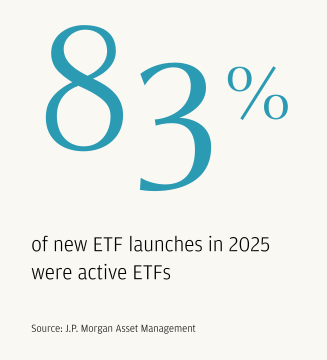
Another factor driving electronification is the growth of active ETFs — which, according to figures from J.P. Morgan Asset Management, accounted for 83% of new ETF launches in 2025.
Compared with passive ETFs, active ETFs change their holdings more often in response to market opportunities and risks. They may also trade in underlying assets that are harder to price or source, and may have less transparent structures. As such, they typically require richer data, tighter controls and more automated workflows, prompting ETF providers to upgrade their technology suite accordingly.
“Active ETFs are driving a significant amount of investment into our technology,” Fitzpatrick said. “We deliver a lot of daily reporting to market makers, and we’ve had to make significant enhancements over the past two or three years to ensure we can cater for those more complex instruments. We’ve moved away from just using index constituents and into more sophisticated tools.”
For instance, J.P. Morgan is leveraging its trading and analytics platform Athena — which is used by the firm’s trading desks for cross-asset pricing and risk management — to enhance its ETF reporting capabilities. “We’re taking direct live feeds from Athena and plugging them into our Securities Services platforms to produce more granular ETF reporting, which then goes out to market makers,” Fitzpatrick said. “The shift toward active ETFs is really impacting how we develop and what we need to deliver to the street.”
Looking ahead, active ETFs will likely continue raising the bar for technology, fueling innovation across the broader ecosystem. “As new products come out in the active ETFs space, including new underlying assets, new tech capabilities need to be developed. This will keep pushing out the target for what is required for electronification,” Legg added.
“As new products come out in the active ETFs space, including new underlying assets, new tech capabilities need to be developed. This will keep pushing out the target for what is required for electronification.”

Matthew Legg
Global head of Delta One and ETF Sales, J.P. Morgan
Tokenized ETFs: The next big thing?
The industry is experimenting with tokenizing ETFs, which could potentially bring benefits including more streamlined creation and redemption processes, near-instant settlement and 24/7 market access. “My view on tokenization is that it will become part of the ETF ecosystem, but we’re a couple of years away from some good use cases,” Fitzpatrick said.
Currently, tokenization falls into two distinct categories:
- Synthetic tokenized ETFs: This involves creating digital clones of real-world ETFs. These clones mirror the price of the ETF via a derivative contract, without holding the actual asset — which means that their returns may sometimes differ slightly from the ETF, depending on how they are structured.
- Native tokenized ETFs: Here, the ETF’s share is issued directly on the blockchain; the on-chain token then becomes the security of record. This approach, which is still being piloted, could drive down costs by reducing operational friction and eliminating intermediary fees.
“At J.P. Morgan, we’re looking at proof of concepts around tokenizing ETFs through our Kinexys platform, but we have some way to go,” Fitzpatrick said. “We believe tokenization will certainly drive how the market changes, not just for ETFs but across the funds industry as a whole.”
“We believe tokenization will certainly drive how the market changes, not just for ETFs but across the funds industry as a whole.”

Ciarán Fitzpatrick
Global head of ETF Product, Securities Services, J.P. Morgan
All in all, ETFs reflect the broader move toward electronification taking place across financial markets — a trend J.P. Morgan is well-positioned to pursue. “ETFs are forming a part of the new evolution of the financial industry. And I think the fact that we have capabilities in traditional markets, and now in the digitization and tokenization spaces — it’s just one of the advantages we have as a firm,” Fitzpatrick said.
Related insights
-

42:04 - Markets and Economy
Discuss the rapid evolution, growth drivers, and future trends shaping the global ETF industry
-

Securities Services
The active ETF era has arrived. J.P. Morgan's insights can help you understand the complexities and meet investor demands. Unpack the ETF landscape here.
-

Global Research
ETF market guide: Understanding the $22 trillion industry
August 03, 2026
ETFs continue to grow in scale and complexity, with total assets under management up 43% year over year as of April 2026. What are their benefits, and how are regional ETF markets performing?
FOR INSTITUTIONAL & PROFESSIONAL CLIENTS ONLY — NOT INTENDED FOR RETAIL CUSTOMER USE
This is not a product of J.P. Morgan Research.
J.P. Morgan is a marketing name for the Securities Services businesses of JPMorgan Chase Bank, N.A. and its affiliates worldwide. JPMorgan Chase Bank, N.A. is regulated by the Office of the Comptroller of the Currency in the U.S.A., by the Prudential Regulation Authority in the U.K. and subject to regulation by the Financial Conduct Authority and to limited regulation by the Prudential Regulation Authority, as well as the regulations of the countries in which it or its affiliates undertake regulated activities. Details about the extent of our regulation by the Prudential Regulation Authority, or other applicable regulators are available from us on request.
J.P. Morgan and its affiliates do not provide tax, legal, regulatory or accounting advice. This material has been prepared for informational purposes only and is not intended to provide, and should not be relied on for, tax, legal, regulatory or accounting advice. You should consult your own tax, legal, regulatory and accounting advisors before engaging in any transaction.
This document is not intended as a recommendation or an offer or solicitation for the purchase or sale of any security or financial instrument. Rather, this document has been prepared exclusively for the internal use of the J.P. Morgan’s clients and prospective client to whom it is addressed (including the clients’ affiliates, the “Company”) in order to assist the Company in evaluating, on a preliminary basis, certain products or services that may be provided by J.P. Morgan. This document is provided for informational purposes only and is incomplete without reference to, and should be viewed solely in conjunction with, the oral briefing provided by J.P. Morgan. Any opinions expressed herein may differ from the opinions expressed by other areas of J.P. Morgan. This document may not be disclosed, published, disseminated or used for any other purpose without the prior written consent of J.P. Morgan. The statements in this material are confidential and proprietary to J.P. Morgan and are not intended to be legally binding. All data and other information (including that which may be derived from third party sources believed to be reliable) contained in this material are not warranted as to completeness or accuracy and are subject to change without notice. J.P. Morgan disclaims any responsibility or liability to the fullest extent permitted by applicable law, whether in contract, tort (including, without limitation, negligence), equity or otherwise, for any loss or damage arising from any reliance on or the use of this material in any way. The information contained herein is as of the date and time referenced only, and J.P. Morgan does not undertake any obligation to update such information.
J.P. Morgan is the global brand name for JPMorgan Chase & Co. and its subsidiaries and affiliates worldwide. All product names, company names and logos mentioned herein are trademarks or registered trademarks of their respective owners. Access to financial products and execution services is offered through J.P. Morgan Securities LLC (“JPMS LLC”) and J.P. Morgan Securities plc (“JPMS plc”). Clearing, prime brokerage and brokerage custody services are provided by JPMS LLC in the U.S. and JPMS plc in the U.K. Bank custody services are provided by JPMorgan Chase Bank, N.A. JPMS LLC is a registered U.S. broker dealer affiliate of JPMorgan Chase & Co., and is a member of FINRA, NYSE and SIPC. JPMS plc is authorized by the PRA and regulated by the FCA and the PRA in the U.K. JPMS plc is exempt from the licensing provisions of the Financial and Intermediary Services Act, 2002 (South Africa). J.P. Morgan Securities (Asia Pacific) Limited is regulated by the HKMA. J.P. Morgan Europe Limited, Amsterdam Branch does not offer services or products to clients who are pension plans governed by the U.S. Employee Retirement Income Security Act of 1974, as amended (ERISA). For additional regulatory disclosures regarding these entities, please consult: www.jpmorgan.com/disclosures.
The products and services described in this document are offered by JPMorgan Chase Bank, N.A. or its affiliates subject to applicable laws and regulations and service terms. Not all products and services are available in all locations. Eligibility for particular products and services will be determined by JPMorgan Chase Bank, N.A. and/or its affiliates.
© 2026 JPMorgan Chase & Co. All rights reserved. JPMorgan Chase Bank, N.A. Member FDIC.