[hopeful music]

On screen:

This video opens with black and white images of historical industrial brick buildings.

Joe Hearn:

These buildings sat idle for a number of years, and people started to look at this differently because it was run down and in demise, but they started to see what might this area be.

On screen:

A man in a suit and glasses gestures as he speaks from the atrium of a modern, industrial-style office building. Then, a title appears beneath a 'J.P. Morgan' logo:

Text on screen:

'Dubuque Voices: From mill to momentum.'

On screen:

Identifying text appears as a blonde woman in a silk scarf speaks from the atrium:

Text on screen:

'Jill Connors, Economic Development Director, City of Dubuque, Iowa.'


Jill Connors:

Dubuque is the oldest city in Iowa, and we started in the early 1830s as a lead mining and river trading town.

On screen:

Archival clips show a main street awning, miners shoveling raw material, and dusty minerals traveling down metal chutes. Identifying text appears beside the man in the suit:

Text on screen:

'Joe Hearn, President and CEO, Dupaco Community Credit Union.'

Joe Hearn:

At one time this was the largest mill working district in the United States. The buildings fell in disrepair, and they sat idle for a number of years.

On screen:

More footage shows mill workers handling lumber. Now, a group meets in an office, and an aerial view lifts over the modern-day mill buildings.

Joe Hearn:

Local developer John Gronen and his wife Mary leaned into a project next door. They transformed that building, and they started to show people what this millwork district could potentially be.

On screen:

Black and white footage fades to a current view of the district as traffic flows down its streets. Text appears beside a man in glasses and a sweater:

Text on screen:

'John Gronen, President, Gronen Development.'

John Gronen:

After we restored that building, Dupaco did a search to figure out where would be the best place for them to build a new operations center for their company.

On screen:

John walks through the district with a group, including his wife and Joe, chatting and drinking from take-out coffee cups. Then, a lit-up sign in a renovated industrial office space reads: 'Dupaco.' Photos on the walls show the original building.

Joe Hearn:

We looked at new build, new construction, renovate, but the more we unpeeled the layers, looked into it, it just became readily apparent this was the thing to do. Come back to our roots and transform this and breathe new life into a building that was sitting there idle.

On screen:

A photo of the old building transforms into its current state, with red brick, gridded windows, and a vertical sign down the corner that reads: 'Dupaco Voices Building.'

John Gronen:

It would have been easier and more straightforward for them to build a brand new building in a cornfield, but it would have had no community impact to speak of compared to this.

On screen:

Joe chats with the group in a room with archival images, articles, and the word 'COMMUNITY' across the wall. Office floors and common spaces cycle past, featuring an earthy, industrial aesthetic with wood beams, exposed brick, black metal light fixtures, and mid-century modern furniture.

John Gronen:

But the numbers don't work on a building like this without partners like JPMorganChase.

On screen:

A man in a blue suit walks with Joe and others, then smiles with John. Text appears as he speaks from the atrium:

Text on screen:

'Kevin Goldsmith, Head of Tax Credit, J.P. Morgan.'

Kevin Goldsmith:

The New Markets Tax Credit and the Historic Tax Credit were both combined in the Voices Building here in Dubuque by bringing different capital sources together, and the combination of both created an additional amount of equity that helped fill the financing gap for the overall building renovation.

On screen:

Photos show the construction process: nails stick up from a dusty wooden floor, a workman is silhouetted by large windows while others stand on lifted platforms, operate machinery, and work from a crane in an oversized window frame. A new window shines in its place. A man in a vest and glasses touches the original wood floors in the community room, and a photo shows them covered in dirt and dust prior to being restored. Text appears beside him as he speaks from the atrium:

Text on screen:

'Jeff Morton, Owner and Architect, Jeffrey Morton Associates.'

Jeff Morton:

The thing that Historic Tax Credit is mostly concerned with is preserving historic materials. The stair that's right behind us here, that opening in the floor wasn't there. We got permission to cut the opening and install the stair, but we had to cut a huge beam that came across the building. So we repurposed that beam, we cut it into sections, and we used it for the treads of the stair.

On screen:

The beam stops at the opening, and a close-up of a stair tread shows a radial pattern in the wood grain. Then, time-lapsed footage shows builders at work in a wide-open space. Photos show the dusty, vacant spaces of the pre-renovation building.

John Gronen:

Going from being 185,000 square feet of vacant building to putting hundreds of people into this building on a daily basis of office, commercial, the bike store, the art museum, Mindful Bites, the Crocus Foundation, is having an impact that's immense.

On screen:

Joe smiles at an employee wearing a headset as he stops by her cubicle, and pats another cubicle as he passes. A building map lists businesses on each floor. Rainbow colored lights run across the ceiling of a common room, sunlight pours into a bike shop, a gallery displays multimedia art, a woman serves a smoothie, and gym equipment fills a sunny room. Cozy tables are set up around the main floor atrium.

Joe Hearn:

The hardest things can be the best things. It's really heartwarming to look back and know what we went through to have this come to fruition and it really does give you a sense of pride.

On screen:

Kevin hugs John, and Jeff flips through blueprints with Joe and John. John talks in a casual meeting, chats outside with Joe and others, and poses for a photo with Joe and Jeff.

Joe Hearn:

Come together, lean in, be willing to go and forge the kind of partnerships that can truly make transformational changes in the lives of communities and in individuals.

On screen:

Images of the revitalized building flash by in quick succession, and sunlight shines down on the Voices Building as a view drifts past from above. The video ends with a logo over black:

Logo:

J.P. Morgan.

Side note:

Legal disclosures appear under a house symbol with an equals sign:

Text on screen:

'Equal Housing Lender.

Chase, J.P. Morgan, and JPMorganChase are marketing names for certain businesses of JPMorgan Chase & Co. and its affiliates and subsidiaries worldwide (collectively, “JPMC”, “We”, “Our” or “Us”, as the context may require).

We prepared these materials for discussion purposes only and for your sole and exclusive benefit. This information is confidential and proprietary to our firm and may only be used by you to evaluate the products and services described here. You may not copy, publish, disclose or use this information for any other purpose unless you receive our express authorization.

These materials do not represent an offer or commitment to provide any product or service. In preparing the information, we have relied upon, without independently verifying, the accuracy and completeness of publicly available information or information that you have provided to us. Our opinions, analyses and estimates included here reflect prevailing conditions and our views as of this date. These factors could change, and you should consider this information to be indicative, preliminary and for illustrative purposes only. This Information is provided as general market and/or economic commentary. It in no way constitutes research and should not be treated as such. 

The information is not advice on legal, tax, investment, accounting, regulatory, technology or other matters. You should always consult your own financial, legal, tax, accounting, or similar advisors before entering into any agreement for our products or services. In no event shall JPMorganChase or any of its directors, officers, employees or agents be liable for any use of, for any decision made or action taken in reliance upon or for any inaccuracies or errors in, or omissions from, the information in this material.

The information does not include all applicable terms or issues and is not intended as an offer or solicitation for the purchase or sale of any product or service. Our products and services are subject to applicable laws and regulations, as well as our service terms and policies. Not all products and services are available in all geographic areas or to all customers. In addition, eligibility for particular products and services is subject to satisfaction of applicable legal, tax, risk, credit and other due diligence, JPMorganChase’s “know your customer,” anti-money laundering, anti-terrorism and other policies and procedures.

Products and services may be provided by Commercial Banking affiliates, securities affiliates or other JPMC affiliates or entities. In particular, securities brokerage services other than those that can be provided by Commercial Banking affiliates will be provided by appropriate registered broker/dealer affiliates, including J.P. Morgan Securities LLC and J.P. Morgan Institutional Investments Inc. Any securities provided or otherwise administered by such brokerage services are not deposits or other obligations of, and are not guaranteed by, any Commercial Banking affiliate and are not insured by the Federal Deposit Insurance Corporation.

JPMorganChase Bank, N.A. Member FDIC. Copyright 2026 JPMorgan Chase & Co. All rights reserved.'

END

Dupaco Community Credit Union was founded in 1948 by 10 workers of the Dubuque Packing Company, then one of the largest meatpacking operations in the country and a major employer in the Midwest river town of Dubuque, Iowa. Like the city’s once-thriving millwork industry, the packing company eventually closed—but Dupaco survived and grew.

Today, the credit union employs more than 600 people and serves members in all 50 states, D.C. and 35 countries. 

In 2020, Dupaco chose to invest that success back into Dubuque’s Historic Millwork District, moving its headquarters into the Voices Building—a 1920s warehouse built during the neighborhood’s industrial peak—blocks away from the credit union’s original location.

Dupaco’s decision: community first

When Dupaco began searching for a new operating center, the credit union wanted a location to serve not only its own needs but also the surrounding neighborhood. 

“We looked at every option—new build, historic renovation, existing buildings,” said Joe Hearn, President and CEO of Dupaco. 

The team considered the Voices Building but it quickly proved to be a large undertaking. The numbers to rehab a vacant former manufacturing building weren’t adding up. While the district was once a thriving millwork hub, the industry declined in the mid-20th century. Buildings throughout the neighborhood—including the Voices Building—sat empty and fell into disrepair. 

John Gronen, CEO of Gronen Development, had already renovated another building in the area, so he knew what the rehabilitation entailed. His team performed due diligence on the Voices Building, mapping out the project and finding the right people to perform the necessary work. 

“The more we unpeeled the layers and looked into it, it became apparent renovating the Voices Building was what we needed to do to return to our roots,” Hearn said. “Ultimately, we believed we could be the next piece to continue the redevelopment of this entire area.”

Renovation challenges

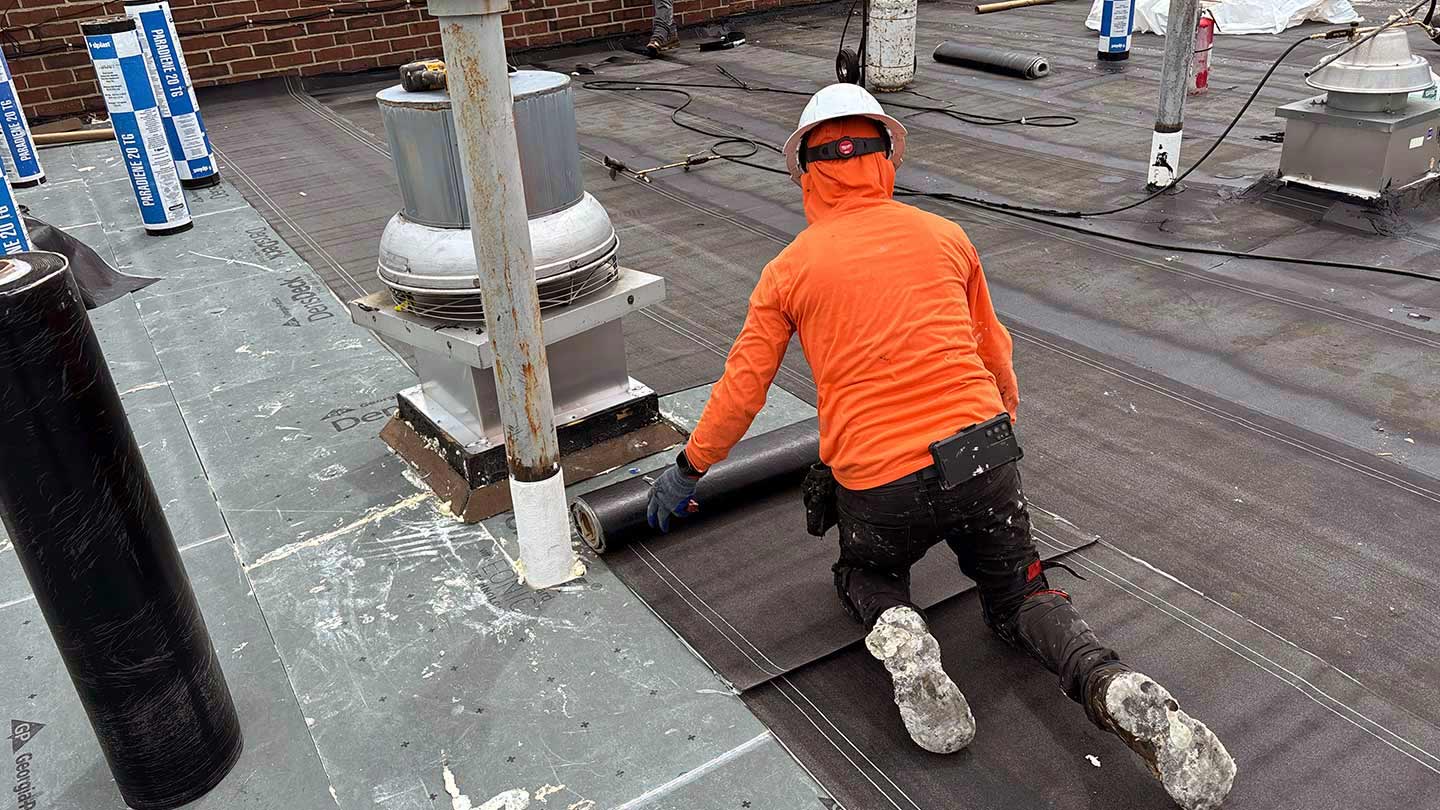
The rehabilitation was no small feat. To meet National Park Service requirements and receive Historic Tax Credit, the team replaced all 250 windows in the building and the entire roof system.

There were other challenges. All the building’s wood columns, for example, had been painted or whitewashed, so the team had to remove all of the paint to return the material to its original state. The team also had to contend with the Mississippi River’s highest water levels in years while conducting a major dewatering process to prevent future mold.

Many historic elements remain—but with a creative twist. 

“The windows in the building were old steel frame and sash windows. There were no thermal properties at all to them, so keeping them would have made this building difficult to heat and cool,” said Jeff Morton, owner and architect of Jeffrey Morton Associates. 

The team received permission to replace the exterior windows but saved the originals, installing them in other areas throughout the building, like separating meeting rooms, workspaces and the boiler room. “We used those to divide spaces in a fun way and remind people of the original construction,” Morton said.

The role of J.P. Morgan in the renovation

Transforming a vacant warehouse into a state-of-the-art headquarters required not only a strong vision but also complex, sophisticated financing. That’s where J.P. Morgan played a critical role, providing Historic Tax Credit (HTC) and New Markets Tax Credit (NMTC) equity to help fill the financing gap for the Voices Building project.

$5.2M

HTC equity investment

$2.3M

NMTC equity investment

HTC helps supplement the cost of rehabilitating a historic building. The NMTC program aims to stimulate economic growth in underinvested communities.

“We were excited to participate in the Voices Building rehabilitation because of the job creation and economic activity it was creating for downtown Dubuque. It felt like it would really be complementary and catalytic to other investments happening in the urban center,” said Kevin Goldsmith, Head of Tax Credit and Intermediaries at J.P. Morgan.

“I don’t know that this project could have come to fruition without J.P. Morgan,” Gronen said. “It was critical to help bridge the funding gap necessary to make the project cost-effective.”

The renovation’s community impact

The building includes four floors dedicated to Dupaco’s corporate functions and two floors supporting vocational training and community outreach. Other tenants include Mindful Bites, the Dubuque Museum of Art, the Crocus Foundation and Bicycle World.

“We were very deliberate in our planning to find tenants that would bring vibrancy to our downtown and Millwork District,” Gronen said.

The new headquarters has helped accelerate the neighborhood’s revitalization. Future developments nearby include apartment buildings and the University of Dubuque John and Alice Butler College of Osteopathic Medicine.

“The catalytic effect is immense,” Gronen said.

The firm’s investment in Iowa

As Dubuque has grown, so has JPMorganChase’s investment in the Hawkeye State. The firm has worked in Iowa since 1985 and opened its first brick-and-mortar location in 2023, with plans to add 150 new jobs and 25 new Chase branches by 2030.

“We are eager to listen, learn and support communities across the state of Iowa,” said Majda Hadzic, Market Director for Iowa and Nebraska at JPMorganChase.

JPMorgan Chase Bank, N.A. Member FDIC. Visit jpmorgan.com/commercial-banking/legal-disclaimer for disclosures and disclaimers related to this content.
Connect with a banker

This field is required.

This field is required.

This field is required.

Please enter a valid business email. This field is required.

This field is required.

This field is required.

By checking the boxes below I consent to JPMorganChase using the personal data I have provided to send me:

Learn more about our data practices in our privacy policy.

  • Equal Housing Lender

    Products and services are subject to approval and change. Certain restrictions apply.