The final frontier:
June 23, 2026
Key takeaways
- The space economy is evolving from an infrastructure build-out phase dominated by venture capital into more practical applications.
- The space defense market is projected by the World Economic Forum to reach $250 billion by 2035, as countries including the U.S., China, Japan and South Korea build comprehensive orbital defense systems.
- Meanwhile, the feasibility of space-based solar power (SBSP) depends on lowering costs for launch, which account for about 70% of overall SBSP expenses.
01
Lift off: The third space age
The space economy is transitioning from a niche sector to a launchpad for growth.
Historically, much of space startup investment was directed at space access. Spacecraft manufacturing and launches alone accounted for over half of all deals globally, and the infrastructure phase was dominated by private markets and venture capital.
The use-case phase, by contrast, has the potential to touch public companies across a range of established industries, making the space theme more investable for public market participants.
Defense demand, commercial investment and the possibility of space-based solar power (SBSP) are bringing the third age of the space economy into focus. What’s next for the industry?
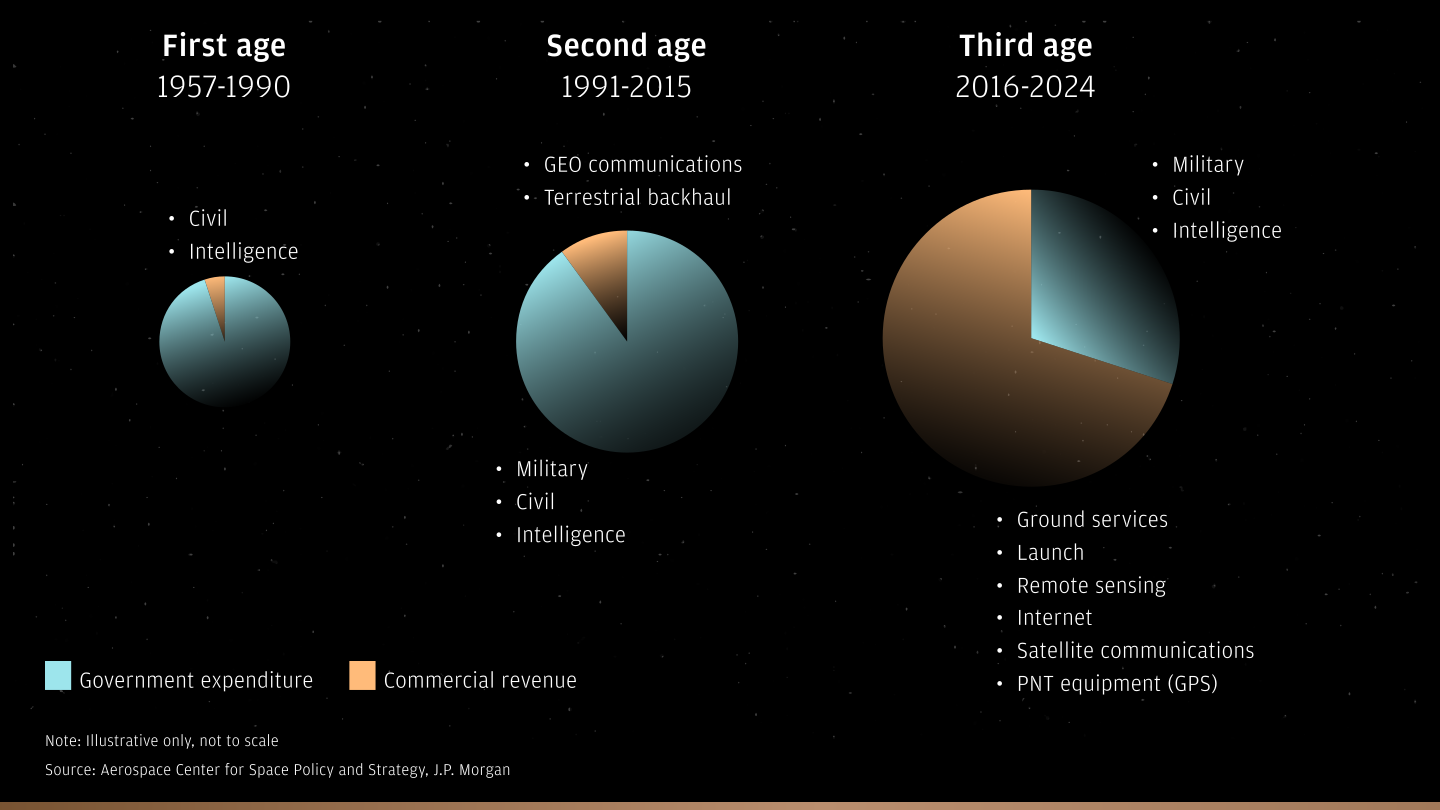
A history of the space economy in three parts
The third space age is characterized by a dynamic mix of defense, civil and commercial interests compared to the first and second age. These charts are illustrative only and not to scale.
02
Shoot for the moon: The new space race
In 2024, the U.S. had the largest space budget on (or rather, off) the planet at $130 billion, according to the European Space Agency.
Yet its share of global spending in recent years has declined as the total pool of capital grows and other countries invest in off-world projects. China is the clearest example: its share of global space budgets grew from about 2% in 2000 to 15% in 2024 according to the European Space Agency, illustrating a structural reorientation of national priorities.
Part of this budget expansion comes from efforts by both the U.S. and China to establish a permanent presence on the moon. Beyond the geopolitical prestige associated with building a lunar base, this eventual station could be used as a staging environment to assemble and launch spacecraft for more complex missions in deep space, as well as a site for scientific experimentation and astronomical observation.
Fly me to the moon
The U.S. and China are working simultaneously to establish a sustained presence on the moon.
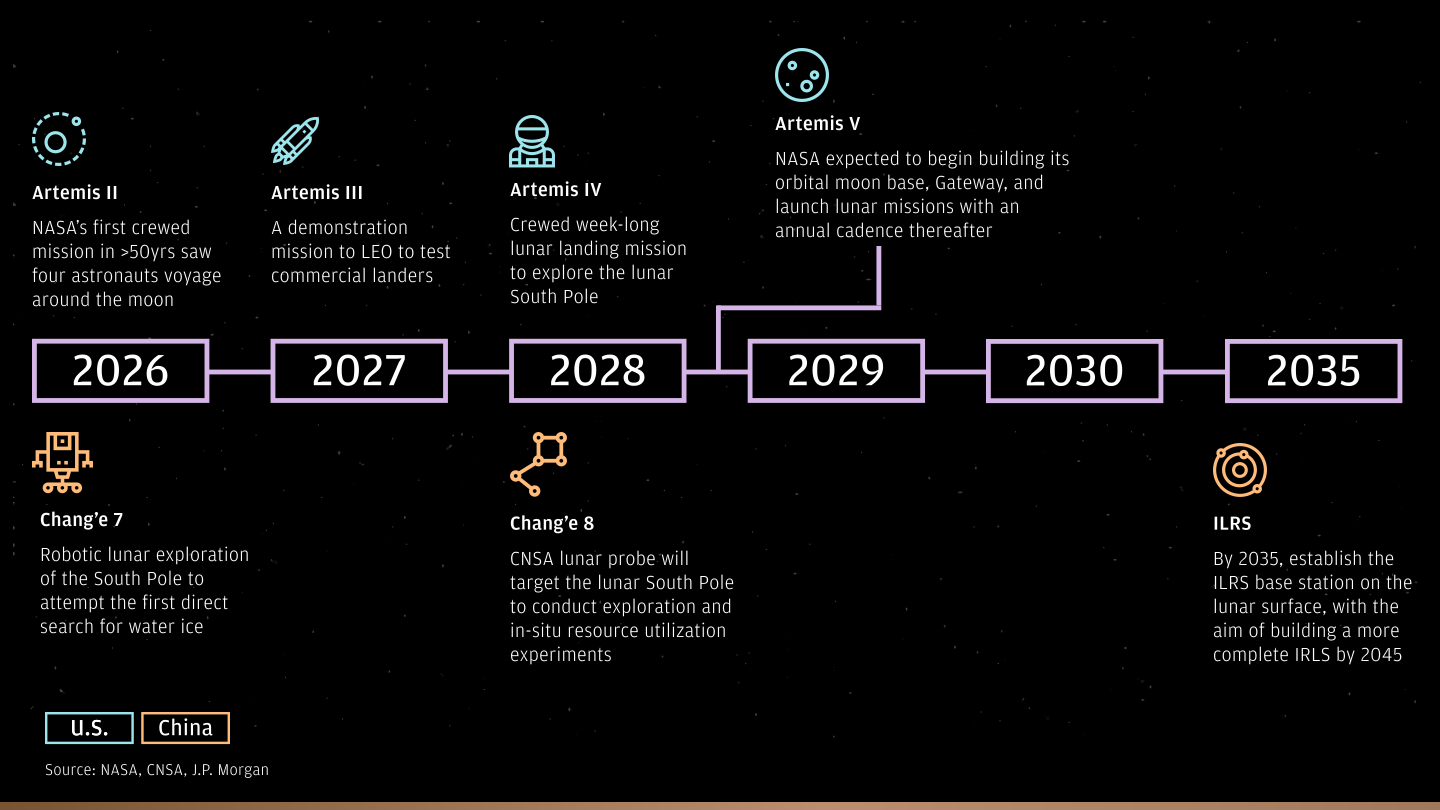
While the U.S. and China are major players in space activity, the field is widening.
“Historically, we’ve seen investment in space efforts as a two-horse race. That’s not the case anymore,” said Hannah Lee, head of APAC Equity Thematic and Sustainable Investing Research at J.P. Morgan. “India aims to capture 8% of the global space market by 2033 and is currently second only to the U.S. in space tech startups.”
To grow its market share to $44 billion, India is focused on becoming a leading low-cost launch provider, especially in the small satellite market. Modular design, reduced testing and lower labor costs may help to drive down cost per launch. Government support is also incentivizing private sector growth; the launch of the Indian National Space Promotion and Authorization Center (IN-SPACe) in 2020 has created a supportive environment for space-focused startups.
03
Gaining the high ground: Why defense dominates space budgets
Space’s status as a defensive cornerstone in modern warfare is underscored by the expansion of military space capabilities worldwide.
The Chinese government integrated space, cyber and electronic warfare missions with the creation of the Strategic Support Force (SSF) in 2015; while the SSF has subsequently been reorganized, the capabilities remain. India, the U.S., Japan and others followed suit in establishing their own space departments in the next decade.
Space defense efforts are primarily focused on control of orbital assets that can shape the outcome of on-the-ground conflicts. Increasing interest in dome initiatives — multilayered defensive shields that leverage space-based satellites and interceptors — indicate a focus on threat neutralization and deterrence. For example, the Golden Dome missile defense system in the U.S., targeting implementation by 2029, will leverage a comprehensive network of space-based assets to shield against ballistic, hypersonic and cruise missiles. Similar dome-style defense efforts are under way in Europe and South Korea.
A brief history of space defense departments
Since 2015, global military powers have established formal military branches dedicated to space-based capabilities.
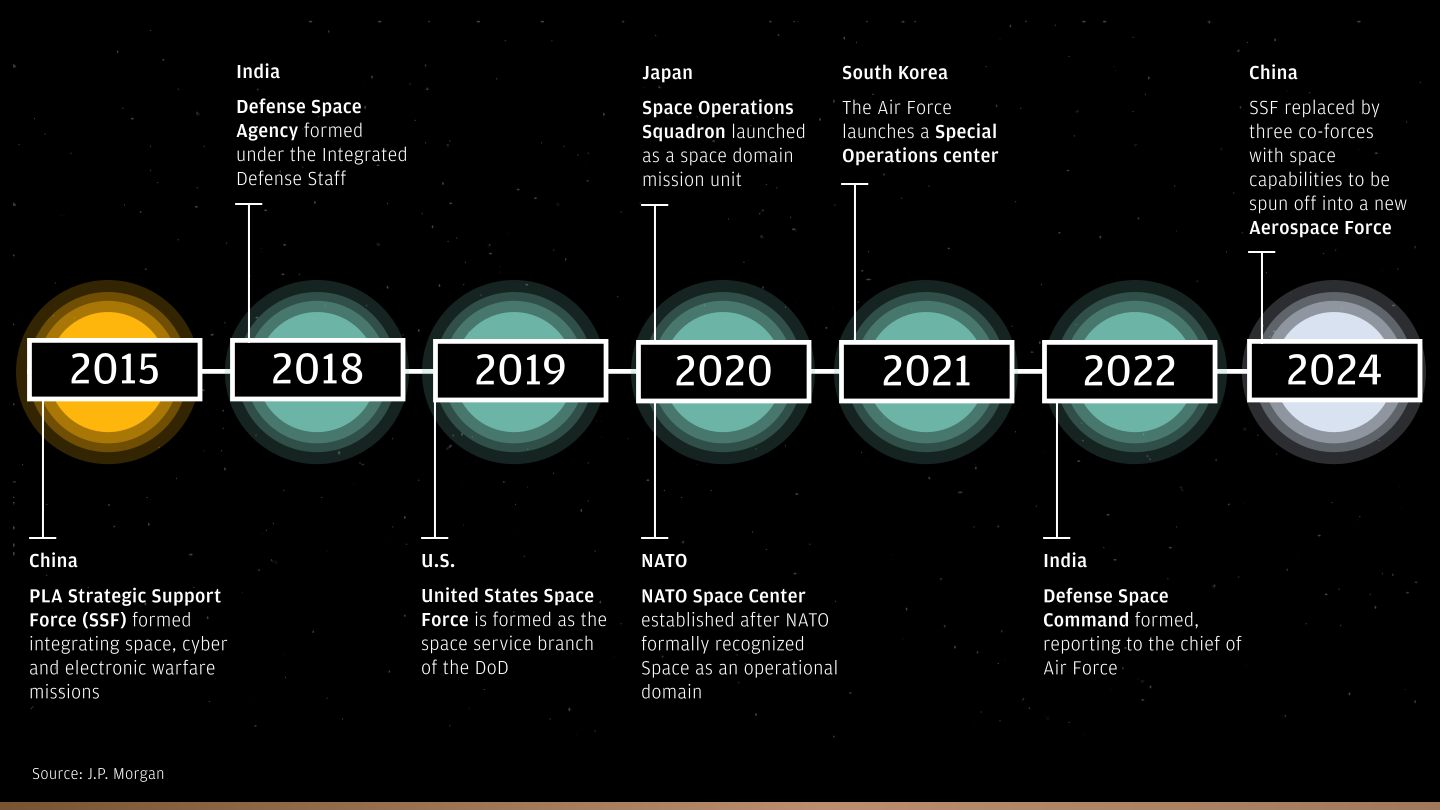
As the strategic importance of space grows, budgets are shifting accordingly.
In 2024, 54% of global space budgets were dedicated to defense, per the European Space Agency. This majority share comes as part of a broader increase in defense budgets overall: global military expenditure reached over $2.8 trillion in 2025, per the Stockholm International Peace Research Institute. The space-related defense market is currently valued at up to $120 billion (per J.P. Morgan estimates), and the World Economic Forum projects that number will grow to $250 billion by 2035.
The U.S. Space Force budget illustrates this trend. It grew from $15.4 billion in 2021 — about 2% of the defense budget — to $40.1 billion, or about 4%, in the proposed budget for 2026.
Despite the current shift to defense spending in government space budgets, Lee expects to see long-term commercial impacts. “We predict that defense spend in space will have wider ramifications, based on historical precedent,” said Lee. “For example, GPS was developed by the U.S. Navy and is now used daily by consumers.”
Counter-space technologies
As space capabilities expand, defense companies see concurrent opportunities in counter-space technologies, which are systems designed to disrupt, destroy or otherwise target space systems. There are four types of potential counter-space weapons:
- Kinetic physical: Missiles launched from the ground at a satellite or a ground station.
- Non-kinetic physical: High-powered lasers, microwaves and electromagnetic pulses that can damage a satellite.
- Electronic: Radio frequency signals that can jam or inject false data into satellite communications.
- Cyber: Digital attacks to intercept or corrupt data, or seize control of systems for malicious purposes.
04
Soak up the sun: Space-based solar power’s road to viability
As diversified energy sources become a clear strategic and economic priority, the concept of a perpetual noon is increasingly attractive for solar power generation.
SBSP aims to collect solar energy through panels in orbit and transmit it wirelessly to Earth. “Continuous sunlight turns solar baseload from aspiration into design, while solving for power-related bottlenecks on Earth,” said Lee.
Several regions are exploring SBSP seriously. China plans to launch an array of solar panels measuring one kilometer wide by 2028, although this date depends on launch capabilities. In Europe, the SOLARIS initiative is assessing feasibility for SBSP, and the U.K. Space Energy Initiative has assembled over 90 organizations behind the idea of extraterrestrial power generation.
The major headwind for SBSP lies in launch. NASA estimates launch costs account for about 70% of overall SBSP expenses. Until that changes, SBSP economics will remain challenging.
Supply chain constraints pose an additional roadblock. Gallium arsenide (GaAs) solar cells are preferred for space applications because of their durability and resilience to intense radiation in space, but they cost more than silicon alternatives and are difficult to procure. Critically, 98% of global gallium production in 2024 came from China per the U.S. Geological Survey.
Overcoming this bottleneck may require development of new technologies. “It’s possible that current constraints in GaAs models may drive innovation for silicon-based solutions,” said Lee. “This could help minimize supply chain risks and decrease costs.”
05
To infinity and beyond: The future of the space economy
The space economy stands at an inflection point.
For decades, high launch costs and uncertain demand confined most space activity to government-funded satellites and scientific missions. But that constraint is loosening, and the next phase hinges on launch economics. Reusable rockets, falling costs per kilogram to orbit and expanding lift capacity will determine when space-based solar arrays cross from concept to commercial reality.
As that threshold approaches, we expect the industry to broaden dramatically from traditional aerospace contractors into solar cell manufacturers developing radiation-tolerant modules, equipment suppliers building space-grade components and other innovative technologies supporting ambitious space projects.
The space economy is no longer the exclusive domain of governments and venture capital. It is becoming investable infrastructure, with implications that extend from national security to how countries generate power.
FAQs
- What is the space economy? Think of the space economy as the full sweep of government and commercial activity tied to space: national budgets, startup deal flow in spacecraft manufacturing and launch, and emerging concepts like space-based solar power.
- How large is defense’s role in space spending? 54% of global space budgets in 2024 were allocated to defense, per the European Space Agency. The U.S. Space Force budget more than doubled from $15.4 billion in 2021 to $40.1 billion in 2026.
- What is space-based solar power (SBSP)? SBSP involves harvesting uninterrupted sunlight in orbit and beaming it wirelessly back to Earth. The main commercial hurdle, as noted by NASA, is launch cost, estimated at about 70% of total SBSP costs.
Related insights
-

Global Research
Critical minerals outlook: surging demand, expanding supply chains
February 23, 2026
AI, the energy transition and increased defense spending are driving global demand for critical minerals and rare earth elements.
-

JPMorganChase is seeking to accelerate innovation, strengthen the defense industrial base, and help companies scale solutions that are critical to security and economic growth.
-

From market outlooks and economic forecasts to commodities deep dives and equity research, J.P. Morgan Global Research provides industry-leading analysis from market experts & analysts.
This communication is provided for information purposes only. JPMorgan Chase & Co. or its affiliates and/or subsidiaries (collectively, J.P. Morgan) normally make a market and trade as principal in securities, other financial products and other asset classes that may be discussed in this communication. This communication has been prepared based upon information, including market prices, data and other information, from sources believed to be reliable, but J.P. Morgan does not warrant its completeness or accuracy. Any opinions and estimates constitute our judgment as of the date of this material and are subject to change without notice. Past performance is not indicative of future results. This communication is not intended as an offer or solicitation for the purchase or sale of any financial instrument. J.P. Morgan Research does not provide individually tailored investment advice. Any opinions and recommendations herein do not take into account individual client circumstances, objectives, or needs and are not intended as recommendations of particular securities, financial instruments or strategies to particular clients. You must make your own independent decisions regarding any securities, financial instruments or strategies mentioned or related to the information herein. Periodic updates may be provided on companies, issuers or industries based on specific developments or announcements, market conditions or any other publicly available information. However, J.P. Morgan may be restricted from updating information contained in this communication for regulatory or other reasons. This communication may not be redistributed or retransmitted, in whole or in part, or in any form or manner, without the express written consent of J.P. Morgan. Any unauthorized use or disclosure is prohibited. Receipt and review of this information constitutes your agreement not to redistribute or retransmit the contents and information contained in this communication without first obtaining express permission from an authorized officer of J.P. Morgan.