Sub-Saharan Africa holds an estimated 30% of worldwide critical mineral reserves. Increased demand for cobalt, manganese and lithium has the potential to transform the region, especially if processing capabilities improve to enable exports of both raw materials and processed products.
What’s driving the growing demand for critical minerals?
Critical minerals have emerged as strategic assets at the heart of economic and national security. With demand surging for resources like lithium, cobalt and rare earth elements, global leaders are rethinking how they source, secure and invest in these vital materials. Here, we examine the pivotal role of critical minerals in powering the future and how their supply chains are evolving.
What are critical minerals?
Critical minerals are a broad category of naturally occurring elements and minerals, including lithium, cobalt, nickel and copper. They are used in the manufacture of everyday products like batteries and electrical wiring, as well as industrial products including energy storage systems (ESS) and military electronics.
Rare earth elements (REEs), a subset of critical minerals, are rarely found in pure form and are difficult and expensive to extract. They are crucial for both green energy initiatives and defense manufacturing. Electric motors, wind turbines, aircraft engines and generators all rely on magnets created with REEs.
Together, critical minerals and REEs are foundational to economic security, thanks to their key roles in fast-growing sectors like technology, defense and energy.
Critical minerals’ role in energy independence
“Wind turbines, solar batteries and ESS units, as well as consumer goods like electric vehicles, need minerals like lithium, nickel, cobalt, graphite and rare earths to function. Demand for many critical minerals is being shaped by the energy transition.”

Virginia Martin Heriz
Global coordinator of Sustainable Investing Research, J.P. Morgan
Global energy demand continues to grow, with artificial intelligence and related data centers driving a notable increase in energy consumption. “The rapid growth in artificial intelligence in the past few years is expected to continue for at least the rest of the decade, driving up demand for data centers. While these centers require a wide range of critical minerals to function, they also have substantial energy requirements,” noted Virginia Martin Heriz, global coordinator of Sustainable Investing Research at J.P. Morgan. By 2035, data centers could account for nearly 9% of U.S. electricity demand.
To meet rising energy consumption, the transition from non-renewable energy to solar, wind and other green energy sources is a top priority for many governments. This was underscored at COP28 , where participating nations committed to tripling their renewable capacity, which would increase the share of global renewable energy generation from 30% in 2022 to 60% in 2030.
In the EU, sustainability initiatives are becoming deeply intertwined with economic and competitive considerations. Policies in 2026 and beyond are expected to continue to reduce dependencies on fossil fuels while promoting green protectionism and circularity, all in pursuit of decreasing emissions and increasing energy independence .
Meanwhile, the share of renewables in China’s power mix has increased to 16% in 2025, primarily at the expense of coal, which has fallen from 81% to 62%. China aims to increase non-fossil fuel energy usage to 30% of its total energy mix by 2035.
The transition to renewable energy requires vast stores of critical minerals. “Wind turbines, solar batteries and ESS units, as well as consumer goods like electric vehicles, need minerals like lithium, nickel, cobalt, graphite and rare earths to function,” said Heriz. “Demand for many critical minerals is being shaped by the energy transition.”
For example, J.P. Morgan Global Research forecasts global demand for lithium to grow 16% year-over-year (YOY) in 2026. 58% of this incremental demand is projected to come from electric vehicles (EVs), while 30% will come from ESS; this is expected to grow to 36% by 2030 . As the demand for green energy solutions increases, the demand for lithium will rise accordingly, leading to a potential market deficit.
Copper, too, will be a priority for green energy, as it is necessary for grid infrastructure updates, generator manufacturing and the energy storage needed to support renewables. According to J.P. Morgan Global Research, global copper demand is expected to grow +2.6% YOY. Increased demand, coupled with supply disruptions and reduced global inventories, is expected to keep the copper market tight in 2026.
Critical minerals used in various methods of power generation
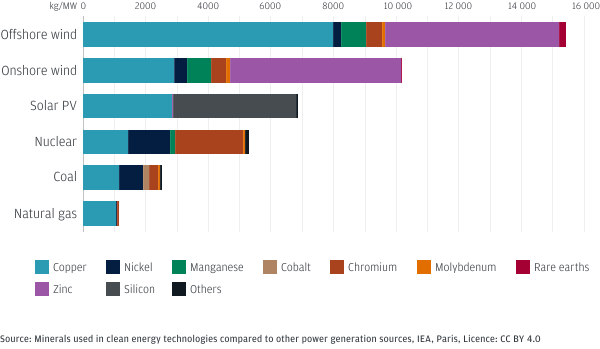
Renewable energy sources require more critical minerals than other energy sources.
Critical minerals, rare earth magnets and defense
Defense budgets are growing, with global spending up 9% YOY in 2024 from the 2.7% average growth seen betweet 2017 and 2022. Projections show NATO European countries spending nearly 3% of GDP on defense by 2030, reflecting a 10% potential compound annual growth rate (CAGR). In the U.S., the administration has signaled intent to boost the defense budget significantly in 2027.
As defense spending increases, greater emphasis will be placed on securing and stockpiling critical minerals, which are essential for developing advanced defense systems. Guided weapons systems alone use 18 different critical minerals; combat aircraft use 15; and naval warships use 14.
“Rare earth magnets are in everything we use for modern applications, from our cell phones to defense applications from F-35s and Tomahawk missiles and beyond.”

Kevin Colborne
Co-head of North American Mining, J.P. Morgan
To diversify critical mineral supply chains for defense, the federal government has focused on nearshoring wherever possible. The Pentagon has already increased procurement of rare earths and specialty minerals. The Defense Logistics Agency aims to create a $1 billion stockpile of critical minerals including cobalt, antimony, tantalum and scandium, each of which is required to develop defense systems.
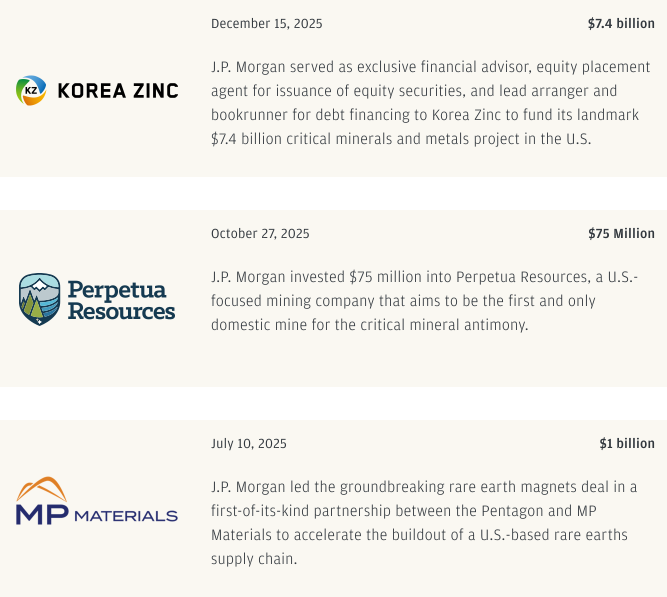
The public sector is also taking an interest in private companies to support the growing need for critical minerals. In 2025, the Pentagon became the largest shareholder of MP Materials, the only fully integrated rare earth magnets producer in the U.S., to enable increased manufacturing. The first-of-its-kind deal — in which J.P. Morgan was the sole financial advisor and lead left arranger on $1 billion of committed financing — accelerates the buildout of a local rare earths supply chain while meeting all of the Pentagon’s rare earth magnet needs.
“This administration wanted to move as fast as possible while being extremely thorough because we knew that what we were creating [with MP Materials] would set a precedent,” said Kevin Colborne, co-head of North American Mining at J.P. Morgan. “We believe this transaction is intended as a possible blueprint for other industries and companies of national security interest.”
In the private sector, investment into mining companies like Perpetua Resources will build resiliency within concentrated supply chains. Perpetua Resources will be the only U.S. integrated producer of antimony, a mineral used in munitions as well as flame retardants and batteries. J.P. Morgan recently announced a $75 million investment into the company as part of the firmwide Security and Resiliency Initiative. This investment will help to accelerate production and remediate a mine that was previously a critical supplier of minerals used to manufacture munitions in World War II.
Critical mineral supply chains
The supply chain for critical minerals and rare earths remains highly concentrated, with China supplying 91% of refined rare earths and 92% of magnets. For global industries reliant on these materials, the lack of diversification creates vulnerabilities, especially in aerospace and defense.
Critical minerals required for AI and Quantum overwhelmingly sourced from a few countries, mainly China
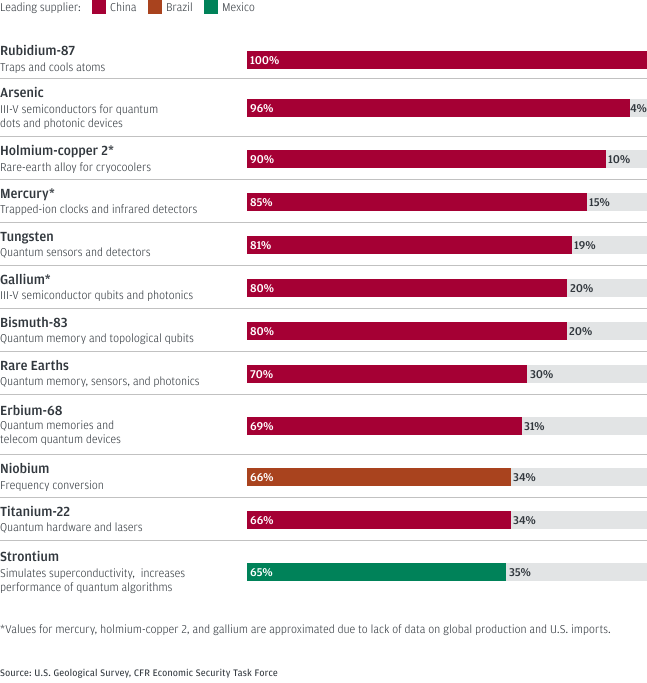
Critical minerals needed for AI and Quantum are overwhelmingly sourced from China, Brazil and Mexico.
“While the current critical minerals supply chain is concentrated in Asia Pacific, there are opportunities for growth and expansion across regions,” said Bill Peterson, head of Clean Tech and Metals & Mining Research at J.P. Morgan. “Diversification and expansion of supply chains will be crucial for fueling growth in industries that rely on critical minerals.”
Opportunities for mining and processing vary by region:
By 2040, the mining market in Southeast Asia is projected to reach $110 billion, with $70 billion coming from refined mineral output. Key players include Indonesia and the Philippines, where 72% of the world’s nickel and 14% of cobalt are produced.
10% of global copper output and 9% of global REE output come from North America. The market value for mining is expected to grow to $30 billion by 2030, while the refining market is projected to reach $14 billion.
Brazil is one of the five largest mineral producers globally, and with only 27% of territory mapped for prospecting, potential for growth is significant. As a whole, the region holds 45% of global lithium and 30% of copper reserves.
While the region isn’t currently a significant producer of critical minerals, processing capabilities are expected to improve, with refining growing to $3 billion by 2040.
Australia has the world’s second-largest lithium reserves and has significant deposits of manganese, cobalt, nickel and REEs. However, there is a gap between actual and potential production, and critical minerals projects are proving challenging thanks to high price volatility and upfront capital requirements.
Global powers are using regulation, investment and international partnerships to build supply chain resilience. The U.K., for example, is looking to maximize domestic production and processing while supporting adoption of rare earth magnet recycling programs. In the EU, the Critical Raw Materials Act sets benchmarks for diversification, including requiring no more than 65% of the bloc’s annual consumption to come from a single third country.
The U.S. is focused on reshoring, as illustrated by a recent deal between the U.S. government and Korea Zinc. The deal, worth $7.4 billion, will see Korea Zinc build the country’s largest zinc smelter; the facility will also produce 12 other critical minerals, which together will support increased defense manufacturing. The U.S. government, including the Departments of Commerce and Defense, contributed $2.15 billion in direct equity to the deal, underscoring its focus on building up production and refinement capabilities.
“Diversification and expansion of supply chains will be crucial for fueling growth in industries that rely on critical minerals.”

Bill Peterson
Head of Clean Tech and Metals & Mining Research, J.P. Morgan
The future of critical minerals
Both copper and lithium are expected to remain in tight supply, even as mining and refining capabilities ramp up. However, the development of cyclical economies through recycling could help meet demand: If successful, recycling programs could reduce new mining requirements by up to 30%.1
For the private sector, stockpiling of strategic reserves will likely continue to be a top priority. U.S. lawmakers have introduced a bill to create a $2.5 billion critical minerals stockpile to protect American industries, including defense and aerospace, against potential shortages. A similar program in Australia aims to fast-track an $802 million stockpile of rare earths, antimony and gallium.
Much of the sector’s future depends on the quickly evolving geopolitical landscape, including trade relationships. “Green energy, AI and defense demands will likely drive continued growth in the critical minerals space,” said Heriz. “Reinvigorated focus on mining and refining will be necessary to support industry ambition.”
Security and resiliency
The firm’s Security and Resiliency Initiative is a $1.5 trillion, 10-year plan to facilitate, finance and invest in industries critical to national economic security and resiliency. This initiative focuses on key sub-areas including critical minerals mining and processing.
Learn more about the Security and Resiliency Initiative here.
References
1.
International Energy Agency, “Recycling of Critical Minerals: Strategies to scale up recycling and urban mining.” https://iea.blob.core.windows.net/assets/3af7fda6-8fd9-46b7-bede-395f7f8f9943/RecyclingofCriticalMinerals.pdf
Related insights
-

Banking
J.P. Morgan leads groundbreaking rare earth magnets deal
October 02, 2025
The public-private partnership between the U.S. Department of Defense and MP Materials accelerates the buildout of a U.S.-based rare earths supply chain.
-

Sustainability
Climate Intuition: Power Rewired: The new map of energy and geopolitics
September 16, 2025
Explore the transformative shifts in global energy and geopolitical dynamics and their impact on investment.
-

12:05 - Banking
Rare earths, real impact: Inside the MP Materials deal
September 15, 2025