Version 1 - Primary Nav Search

Key takeaways

  • Small- and mid-cap (SMID) stocks are rebounding, with the Russell 2500 Index outpacing larger-cap benchmarks like the S&P 500.
  • This dynamic is playing out in developed markets (DM); conversely, SMID caps have underperformed in emerging markets (EM) year to date.
  • J.P. Morgan Global Research expects the SMID-cap revival to continue in the short term thanks to five reasons: improving fundamentals, depressed positioning, trough technicals, geopolitical tailwinds and record valuation discounts.

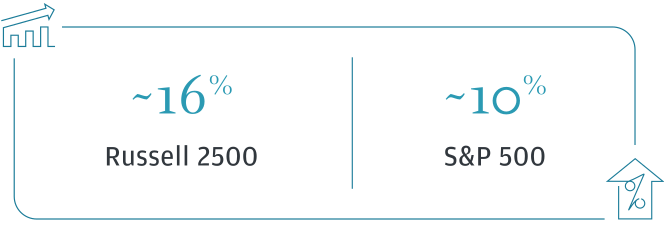
Mega-cap stocks have dominated headlines, with a handful of tech heavyweights driving the bulk of returns in recent years. Behind the scenes however, the picture is shifting, with small- and mid-cap (SMID) stocks experiencing a revival. The Russell 2500 Index — which tracks the performance of SMID-cap companies in the U.S. — has outpaced larger-cap benchmarks like the S&P 500 year to date.

This is chiefly a developed markets (DM) phenomenon. “SMID caps are up versus large caps in the U.S., flat in the U.K. and Australia, and down just 160 basis points in continental Europe — a far cry from the >25% underperformance witnessed between 2021–2023,” said Eduardo Lecubarri, global head of Small- & Mid-Cap Strategy at J.P. Morgan. “The opposite has happened in emerging markets (EM), where SMID caps held up between 2021–2023 but have underperformed year to date.” 

Year-to-date performance of major indexes

Infographic depicting the year-to-date performance of the Russell 2500 Index and the S&P 500.

Source: MarketWatch. Figures as of September 16.

Will the rally in SMID-cap stocks continue?

J.P. Morgan Global Research sees the SMID-cap revival in DM (excluding Japan) continuing in the coming months and years, driven by five key factors: 

In the past several years, SMID caps have had to grapple with headwinds including rising interest rates and wage inflation. “These weighed on SMID-cap earnings more than those of large caps, due to the former’s higher labor intensity and larger percentage of floating-rate debt,” Lecubarri explained.

These headwinds are now easing: wage inflation is falling and interest rate moves are relatively muted compared to those of 2022/23. In addition, 82% of large-cap debt is fixed and has yet to be refinanced at today’s higher rates, while close to 40% of SMID-cap debt is floating and has already been marked to market — suggesting that interest expense could rise more for large caps than SMID caps from here on.  

“SMID caps in DM, excluding Japan, have seen nothing but outflows over the last four years, with a cumulative magnitude that has surpassed what was witnessed during the Global Financial Crisis in some regions like the U.K. and continental Europe,” Lecubarri noted.

As a result, SMID caps remain heavily under-owned at a time when investors are questioning their overexposure to U.S. tech giants. As the mega-cap momentum stalls, capital is starting to rotate back into SMID caps, solidifying the rally.  

Despite the recent rebound, SMID caps are still lagging behind large caps versus their relative highs in 2021. “This underperformance has only been surpassed once before in history, during the tech bubble, which was then followed by a 14-year outperformance of SMID caps,” Lecubarri said.

With SMID cap market indicators recently hitting a multi-decade low, historical data suggests they have nowhere to go but up — as demonstrated by the ongoing market surge.

Against an uncertain geopolitical backdrop, SMID caps stand to benefit thanks to three structural advantages:

  • Domestic revenue exposure: These companies are more exposed to their home market than large caps, shielding them from global supply chain bottlenecks and tariffs.
  • Limited FX exposure: They have less direct exposure to FX volatility, which reduces their earnings risk during periods of uncertainty.
  • Regulatory and fiscal insulation: Large caps may face more regulatory and fiscal pressure as governments seek to fix large deficits and mounting debt. SMID-cap companies account for only 25% of market cap but employ ~90% of workers, making them politically harder to squeeze. 

All of the above factors have resulted in an extraordinary valuation discount for SMID caps versus large caps, with the latter still near their historical peak. This represents an attractive investment opportunity, with SMID caps potentially offering earnings growth at lower relative valuations. 

“We see the global landscape as being one that should put a premium on domestic versus international exposure, given ongoing deglobalization and geopolitical tensions.” 

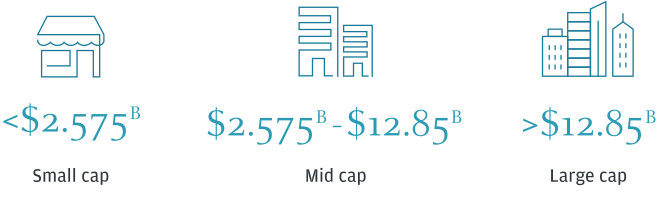
Market cap ranges for 2026 

Source: J.P. Morgan. These market cap ranges were first set in 1990 and are adjusted annually for U.S. inflation. 

What are the risk factors to consider?

Ultimately, it’s important to note that the investment opportunity in SMID caps is relative to that offered by large caps. On an absolute return basis, there are several risk factors that warrant caution for investors in the short term.

For starters, the macro backdrop remains challenging: J.P. Morgan Global Research forecasts that interest rates will rise in the coming months, with the Federal Reserve hiking at its recent September meeting and the European Central Bank expected to follow suit in December. Plus, oil prices remain at around $100 per barrel, while a super El Niño could potentially add more downward pressure to growth and upward pressure to inflation through much of 2027.

In addition, there is no clear sector leader in the market at present:

  • Tech: Tech stocks are already trading near highs despite mounting questions about the sustainability of the AI supercycle and its potential consequences (i.e. how AI might impact software companies, if AI capex can continue at its current pace and fears about AI’s impact on humanity).
  • Financials: The sector has benefited from sticky inflation and a rising rates outlook, but valuations now look more demanding.
  • Utilities, Staples and Telecom: These high-yield sectors — industry groups that consistently pay high cash dividends relative to their share price — could be vulnerable if rates move higher.  
  • Energy and Materials: These sectors are generally considered too small in terms of weight to meaningfully carry the broader index.
  • Industrials: Many names are trading at or near historic highs given their exposure to today’s super cycles, leaving the sector looking expensive.

All things considered, J.P. Morgan Global Research maintains a positive stance on SMID caps versus large caps, while advising caution in the short term as the year-to-date rally could prove choppy or eventually stall. With all this in mind, selectivity is key, with stocks that have achievable estimates, undemanding valuations and earnings visibility preferred in the U.S. and Europe. “Our relative views on SMID caps versus large caps have delivered alpha year to date, and we see little reason to change them at this juncture,” Lecubarri said. 

“Our relative views on SMID caps versus large caps have delivered alpha year to date, and we see little reason to change them at this juncture.” 

Related insights