
Key takeaways
- J.P. Morgan Global Research now forecasts Brent crude to average $86 per barrel (bbl) in the third quarter of 2026, $80 in the fourth quarter and $78 at year end.
- The oil market has rebalanced via larger-than-expected demand losses and smaller-than-expected OECD commercial inventory draws, with China providing a case study in possible demand destruction.
- Long-term damage to oil production in the Gulf region is believed to be minimal, though the uncertain future of OPEC may complicate oil price predictions.
For much of 2026, global oil markets have navigated a challenging environment brought on by geopolitics and supply chain disruptions. Where do things stand now, and what’s the forecast for oil prices in the second half of the year and beyond?
Surprising demand losses and inventory draws have altered the oil price forecast
Since the beginning of the U.S.–Israel military operation against Iran, which began in late February, crude oil has traded at or above $100 per barrel (bbl) for most of the second quarter. In mid-June, prices fell to under $70/bbl thanks to supply and demand rebalancing after the reopening of the Strait of Hormuz.
Brent crude price projections through 2027
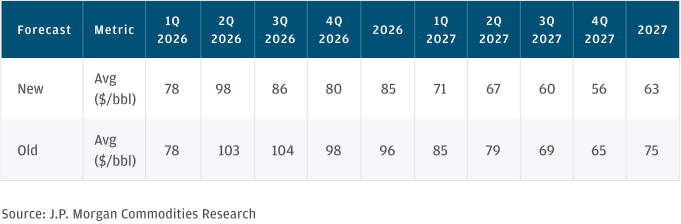
A data table shows crude oil price forecasts from the start of 2026 through the end of 2027. Rows are split by new and old forecasts. Notably, the new projection for price per barrel at the end of 2026 is $78, which is lower than the previous forecast of $95.
“We expected the market to absorb the shock through a roughly equal combination of demand losses and inventory draws,” said Natasha Kaneva, head of Global Commodities Strategy at J.P. Morgan. “However, while the overall magnitude of the rebalancing appears broadly consistent with our expectations, the composition has been materially different.”
Citing data from the International Energy Agency (IEA) and Joint Organizations Data Initiative (JODI), Kaneva said a key divergence came from two variables: Organisation for Economic Cooperation and Development (OECD) commercial inventories declining materially less than expected, and demand losses appearing to have been substantially larger than first thought.
Reported OECD oil inventories have exceeded projections
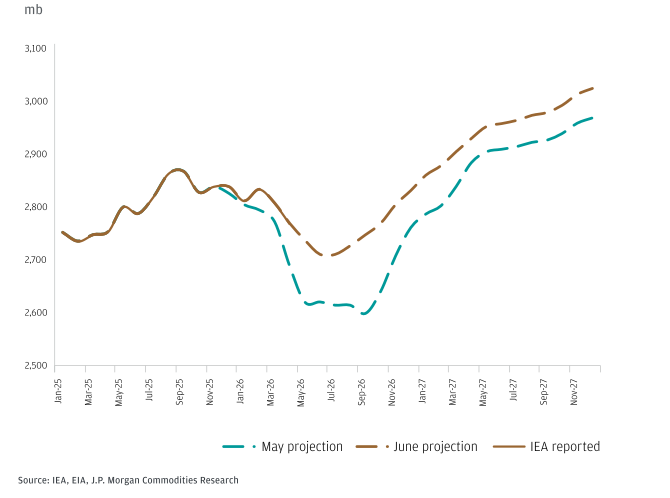
A line chart shows two lines. One, dotted, is the May projection of OECD oil inventories, which dips precipitously from the actual amount reported by the IEA, in line with the timing of geopolitical disruptions. The projected amount appears to be significantly lower than the actual amount, suggesting that projections were far more dire than realities.
“When commercial inventories decline, prices typically rise as market participants compete for an increasingly scarce physical supply,” Kaneva added. “But when the market clears through weaker demand, the price response works in the opposite direction.”
Additionally, while governments have released strategic petroleum reserves to keep prices down, commercial participants appear to have held on to private oil inventories rather than draw them down.
“This was despite prompt cash barrels trading at historically large premiums to the next month’s futures in March and April — conditions that would normally incentivize commercial inventories to instantly liquidate,” Kaneva said.
China: A case study in oil demand destruction
The demand destruction story is perhaps best exemplified in China, which Kaneva highlighted as “a key area of uncertainty.”
“Over recent months, Chinese oil demand appears to have fallen much faster than we initially anticipated, implying the economy may be adapting to higher energy prices more efficiently than past experience would indicate,” Kaneva said.
She pointed to behavioral patterns like the growth in consumer EV purchases as well as the country’s ongoing transition to electrification and decarbonization.
“Even before the current shock, gasoline demand was on a structurally weaker trajectory as rapid EV adoption displaced incremental gasoline use,” Kaneva said. “The oil situation acted as an accelerant, reinforcing the shift through higher fuel costs, energy-security concerns, supportive policy and the continued rapid expansion of charging infrastructure. We estimate China’s gasoline demand destruction at about 180 thousand barrels per day (kbd), and expect 70% of that loss may not return even after markets normalize. In practical terms, this could translate into crude import requirements as much as 1 million barrels per day (mbd) below prior expectations, a scenario that would require significantly smaller inventory drawdowns going forward.”
“We estimate China’s gasoline demand destruction at about 180 thousand barrels per day, and expect 70% of that loss may not return even after markets normalize.”

Natasha Kaneva
Head of Global Commodities Strategy, J.P. Morgan
Will there be long-lasting damage to energy markets?
Kaneva does not believe there will be long-lasting damage to energy market production as a result of the situation in Iran. She cited the recent example of COVID-era Organization of Petroleum Exporting Countries (OPEC) cuts, in which producers temporarily removed more than 10 million barrels per day from the supply chain. “Most production ultimately returned without major, lasting damage to reservoir performance,” Kaneva said.
However, short-term operational issues may linger, dragging on recovery time. Extended downtime can drive corrosion, scale buildup or failures in artificial-lift systems such as electrical submersible pumps (ESPs), which are used to bring crude oil to the surface when natural reservoir pressure is insufficient.
Even if disruptions were to persist, any losses would likely remain limited to no more than 800 kbd. “And even that should be viewed as mostly recoverable over time rather than permanently destroyed capacity,” Kaneva said. “Large-scale reservoir capacity is difficult to lose in the Gulf, where operators have decades of experience managing mature fields and temporary shut-ins.”
“Large-scale reservoir capacity is difficult to lose in the Gulf, where operators have decades of experience managing mature fields and temporary shut-ins.”
Natasha Kaneva
Head of Global Commodities Strategy, J.P. Morgan
Turbulence in OPEC may heavily impact oil prices and predictions
One other long-term factor to consider is how the UAE’s decision to leave OPEC, which took effect May 1, will affect oil markets. “OPEC is losing a key actor,” said Nicolaie Alexandru-Chidesciuc, head of EMEA EM Economics at J.P. Morgan. “With the departure of a member accounting for more than 11% of its 2025 production, OPEC’s ability to stabilize the market will be diminished, as the UAE’s sizeable spare capacity will also be lost to the group.”
The UAE, which contributes around 1.4% of global oil supply, has vowed to increase production in the second half of the year, with authorities aiming to expand capacity to 5 mbd by 2027 — or roughly 1.5 million barrels higher than current levels. But losing coordinative ability makes the situation more difficult to predict.
Kaneva believes that moves like the UAE’s could contribute to another surprising scenario: an oil oversupply, which could occur as soon as late summer. “The first surplus will emerge in August, at around 1.2 mbd, as Persian Gulf supply recovers to about 90% of pre-war volumes, rising further to 97% in October and reaching near full recovery in November,” Kaneva predicted. “This backdrop ultimately sets up a reversion toward a $60/bbl price regime, with prices moving into the low $60s beginning in the second half of 2027.”
Related insights
-

Global Research
Will gold prices hit all-time highs again in 2026?
June 09, 2026
Spot gold prices have rallied and retreated this year. What’s the latest gold price forecast?
-
Global Research
Diversified energy sources can decrease risk and improve economic resiliency. What are the key innovations to watch?
-

Global Research
With $100/bbl crude, commodities markets are repricing risk in real time — with some surprising results.
This material (Material) is provided for your information only and does not constitute: (i) an offer to sell, a solicitation of an offer to buy, or a recommendation for any investment product or strategy, or (ii) any investment, legal or tax advice. The information contained herein is as of the date and time referenced in the Material and J.P. Morgan does not undertake any obligation to update such information. J.P. Morgan disclaims any responsibility or liability, whether in contract, tort (including, without limitation, negligence), equity or otherwise, for the quality, accuracy or completeness of the information contained in this Material, and for any reliance on, or uses to which, this Material, is put, and you are solely responsible for any use to which you put such information. Without limiting any of the foregoing, to the fullest extent permitted by applicable law, in no event shall J.P. Morgan have any liability for any special, punitive, indirect, or consequential damages (including lost profits or lost opportunity), in connection with the information contained in this Material, even if notified of the possibility of such damages. Any comments or statements made herein do not necessarily reflect those of J.P. Morgan, its subsidiaries or its affiliates.
All materials and information shared with you are, unless otherwise indicated to you, proprietary and confidential to J.P. Morgan. You are hereby notified that any disclosure, dissemination, copying, distribution, or use of the information provided to you, in whole or in part, other than as expressly permitted by J.P. Morgan, is STRICTLY PROHIBITED. You are permitted to disclose the materials and information to your officers and employees on a need to know basis. Should you have any questions regarding this, please contact your usual J.P. Morgan contact. For further information please visit: https://www.jpmorgan.com/pages/disclosures/materialdisclaimer.
© 2026 JPMorgan Chase & Co. All rights reserved. J.P. Morgan is a marketing name for businesses of JPMorgan Chase & Co. and its subsidiaries and affiliates worldwide.
JPMorgan Chase Bank N.A. (member of FDIC), J.P. Morgan Securities LLC (member of FINRA, NYSE and SIPC), J.P. Morgan Securities plc (member of the London Stock Exchange and authorized by the Prudential Regulation Authority (PRA) and regulated by the Financial Conduct Authority and the PRA) and J.P. Morgan SE (authorised by the BaFin and regulated by the BaFin, the German Central Bank and the European Central Bank) are principal subsidiaries of JPMorgan Chase & Co. For legal entity and regulatory disclosures, visit: www.jpmorgan.com/disclosures. For additional regulatory disclosures, please consult: www.jpmorgan.com/disclosures.