Global inflation forecast 2026:
The rise of regional cross-currents

- Inflation has remained resolutely above central bank targets, with global core CPI hovering at around 3% since 2024.
- Looking ahead, J.P. Morgan Global Research expects global core inflation to be stable at 2.8% in 2026.
- However, there will likely be disparate outcomes across regions, with inflation projected to accelerate in the U.S. and moderate in Europe.
Global inflation has remained elevated for the past two years, driven by rising goods prices and increasing labor costs. This stickiness has been broad-based, with core Consumer Price Index (CPI) prints proving persistently high in the U.S., Europe and LATAM.
However, the inflation outlook could soon change. “A phase of sticky inflation reflecting common global dynamics is ending,” said Bruce Kasman, chief global economist at J.P. Morgan. Against this evolving macro backdrop, what’s the global inflation forecast for 2026?
Global core CPI forecasts
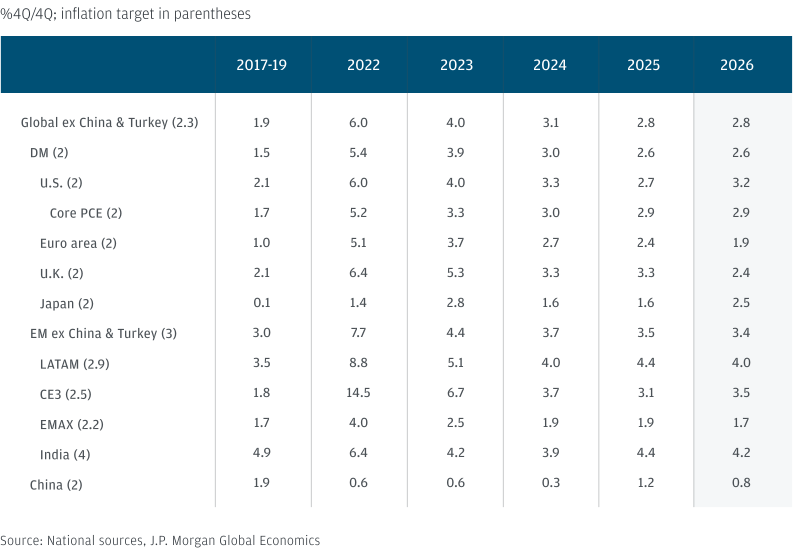
In 2026, core CPI is expected to be 2.8% globally, 3.2% in the U.S., 2.4% in the U.K. and 1.9% in the euro area.
Why has global inflation been so high?
Global goods prices soared post-pandemic on the back of supply chain disruptions, elevated commodity costs and fluctuations in demand. “These factors promoted a synchronized dynamic in which global goods price inflation spiked during 2021–2023, moderated and then subsequently firmed,” Kasman explained.
In addition, service prices and wage growth surged in the early stages of the post-COVID recovery. While there was some unwinding of the pandemic wage shock in 2023 and 2024, this was tempered by sustained service sector demand and tight labor markets, with unemployment rates reaching historic lows.
Together, these factors have kept inflation elevated above central bank targets, with global core CPI remaining stuck at around 3% since 2024.
Is global inflation expected to fall in 2026?
Overall, J.P. Morgan Global Research sees global core inflation remaining stable at 2.8% in 2026. “However, the moderation of common elements and the rise of regional cross-currents reduces our conviction in this year’s global projection,” Kasman said.
On the goods prices front, common global impulses are fading as broad-based inflationary pressures related to supply chain disruptions and rising commodity prices have weakened. Instead, regional divergences are coming to the fore, rotating global goods price pressures toward the U.S. and Japan and away from Europe.
For starters, there were notable currency moves in 2025, with the U.S. dollar and Japanese yen down 6–7% in trade-weighted terms and the euro up by a similar percentage. Over in emerging markets (EM), LATAM and EMEA currencies appreciated while EMAX (Emerging Asia, excluding China and India) currencies weakened against a broadly stable Chinese yuan. “These moves explain a large portion of the variation in EM inflation dynamics, where FX pass-through tends to be stronger and goods account for a larger share of consumer baskets,” Kasman observed.
The U.S. trade war is also contributing to divergent goods prices inflation, as tariffs have boosted core goods prices in America but not elsewhere. In addition, the redirection of Chinese exports to other markets continues to generate downward pressure on import prices. “This impact varies by country, depending on FX moves as well as relative exposure to imported goods from China,” Kasman said.
Looking at service price inflation, job growth has slowed and the unemployment rate in developed markets (DM) is about 0.5 percentage points above its 2024 low. But again, regional divergences are apparent. “The message from Western Europe is clear as wage inflation is moderating across the region. In Japan, wage inflation is clearly moving higher. However, U.S. measures are harder to read and, on balance, point to an interruption of the earlier downward trend,” Kasman shared.
All in all, these developments could translate into disparate inflation outcomes across the globe in 2026. “U.S. inflation is expected to accelerate above 3% oya (over a year ago) as an early-year rebound combines with persistent goods price pressures. Meanwhile, declining goods prices and moderating wage pressures should push inflation in Western Europe to 2% by mid-year,” Kasman said. “If right, the projected upswing in the U.S. alongside moderation in Europe is likely to open up a large inflation gap between the two regions over the first half of 2026.”
Wages and core services prices in DM are moderating
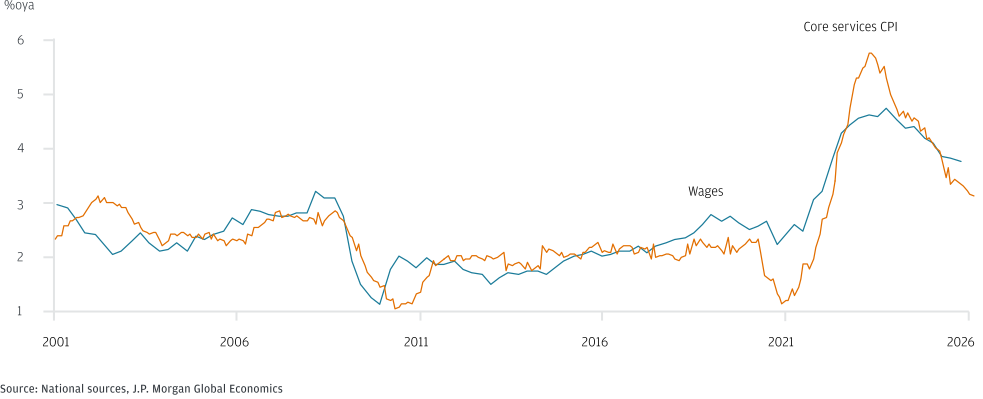
Wages and core services prices in DM surged post-pandemic but are now showing signs of moderation.
Are central banks expected to cut this year?
Disparate inflation outcomes will likely result in divergent monetary policy among global central banks in 2026. In light of inflationary pressures in the U.S., J.P. Morgan Global Research expects the Fed to remain on hold this year. Elsewhere, the European Central Bank (ECB) looks to have entered an extended pause while the Bank of England (BoE) is tilting dovish, signaling that a cut could be imminent due to labor market weakness.
“In Sweden, we expect the Riksbank to remain on hold due to strong growth, but the odds of a March cut have increased after another downside surprise left inflation running below its forecast,” Kasman noted. “And in Poland and Hungary, we pencil in just two more rate cuts this year.”
Over in EMAX, an inflation rate nearing 2% will likely keep the Bank of Korea (BoK) on a prolonged hold. “In the Philippines, we continue to expect three more 25 bp rate cuts through June as inflation remains below the Bangko Sentral ng Pilipinas’ (BSP) target midpoint, despite a January upside surprise,” Kasman added. “We expect the Monetary Authority of Singapore (MAS) will be the only one to tighten this year, but if growth remains strong, Malaysia’s Bank Negara (BNM) could follow later in the year.”
Global Research
What’s the Fed’s next move?
February 04, 2026
Following the latest jobs report numbers and the nomination of Kevin Warsh as new Fed chair, what’s the outlook for interest rates for the rest of the year?

Global Research
2026 market outlook: A multidimensional polarization
December 09, 2025
Against a backdrop of uneven monetary policy, relentless AI expansion and intensifying market polarization, what’s the outlook for equities, commodities, currencies and more?

Global Research
Will the job market improve in 2026?
December 10, 2025
The U.S. labor market cooled in 2025, but supports like tax cuts and rate reductions point to growth potential in the second half of 2026.
Disclaimer:
This communication is provided for information purposes only. Please read J.P. Morgan research reports related to its contents for more information, including important disclosures. JPMorgan Chase & Co. or its affiliates and/or subsidiaries (collectively, J.P. Morgan) normally make a market and trade as principal in securities, other financial products and other asset classes that may be discussed in this communication.
This communication has been prepared based upon information, including market prices, data and other information, from sources believed to be reliable, but J.P. Morgan does not warrant its completeness or accuracy except with respect to any disclosures relative to J.P. Morgan and/or its affiliates and an analyst's involvement with any company (or security, other financial product or other asset class) that may be the subject of this communication. Any opinions and estimates constitute our judgment as of the date of this material and are subject to change without notice. Past performance is not indicative of future results. This communication is not intended as an offer or solicitation for the purchase or sale of any financial instrument. J.P. Morgan Research does not provide individually tailored investment advice. Any opinions and recommendations herein do not take into account individual client circumstances, objectives, or needs and are not intended as recommendations of particular securities, financial instruments or strategies to particular clients. You must make your own independent decisions regarding any securities, financial instruments or strategies mentioned or related to the information herein. Periodic updates may be provided on companies, issuers or industries based on specific developments or announcements, market conditions or any other publicly available information. However, J.P. Morgan may be restricted from updating information contained in this communication for regulatory or other reasons. Clients should contact analysts and execute transactions through a J.P. Morgan subsidiary or affiliate in their home jurisdiction unless governing law permits otherwise.
This communication may not be redistributed or retransmitted, in whole or in part, or in any form or manner, without the express written consent of J.P. Morgan. Any unauthorized use or disclosure is prohibited. Receipt and review of this information constitutes your agreement not to redistribute or retransmit the contents and information contained in this communication without first obtaining express permission from an authorized officer of J.P. Morgan. Copyright 2024 JPMorgan Chase & Co. All rights reserved.