Video Series:
Security and Resiliency in Action
JPMorganChase is championing long-term economic security and resiliency by supporting critical industries including supply chain and manufacturing, defense and aerospace, energy independence and resilience, strategic and frontier technologies, and pharma and healthtech.
Learn more here.
Manufacturing capacity and supply chain reliability have moved from operational considerations to strategic determinants of economic security. Repeated shocks — pandemic disruption, rising geopolitical tensions and renewed competition in critical technologies — have exposed how quickly a missing input can halt production and weaken economic confidence.
JPMorganChase launched the Security and Resiliency Initiative to meet this moment with capital, advice and execution at scale. The initiative is a 10-year, $1.5 trillion effort to rebuild critical industries, including the supply chains and manufacturing capabilities that underpin long-term competitiveness.
Why supply chains are now a national security priority
The strategic implications of interrupted supply chains have become apparent to many leaders as geopolitical risks have delayed critical inputs. One industry that has felt the impact of such disruptions is the global automotive industry, which relies on rare earth magnets sourced almost exclusively from China. Michael Johnson, Security and Resiliency Initiative lead for Energy and the U.S. Government, described the stakes directly: “In April of 2025, when the supply of rare earth magnets got cut off, two months later, auto factories started shutting down.”
For many inputs, the vulnerability is not just extraction but refining and component manufacturing. Andrew Castaldo, co-head of Mid-Cap Mergers & Acquisitions at J.P. Morgan, framed the issue in systemic terms: “There are a whole host of critical materials and other supply inputs that are critical to the overall functioning of our economy, and we need to figure out ways to onshore those materials.”
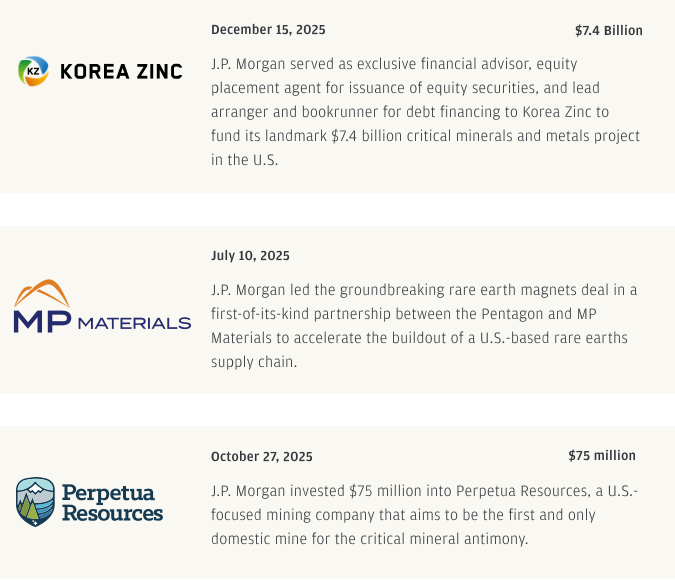
The need to onshore has led to unique transactions in the sector. For example, in 2025 the U.S. Department of Defense became the largest shareholder and customer of MP Materials, a fully integrated rare earth magnets producer. The deal, in which J.P. Morgan was the sole financial advisor and lead left arranger, nearshores a critical industry at a time when the evolving geopolitical landscape could disrupt supply chains globally.
“There are a whole host of critical materials and other supply inputs that are critical to the overall functioning of our economy, and we need to figure out ways to onshore those materials.”

Andrew Castaldo
Co-head of Mid-Cap Mergers & Acquisitions, J.P. Morgan
The real bottlenecks are often in tiers two and three
Large manufacturers rely on dozens of specialized suppliers whose constraints can become the binding factor. As Castaldo put it, “The end manufacturer has to rely on dozens of individual suppliers of components and pieces for them to produce the ultimate end product.”
One focus of the Security and Resiliency Initiative is to work with clients to map value chains end to end to find where small constraints create outsized disruption. Johnson described the gap between headlines and reality: “We do a lot of research, but we also call our clients, call people that build power plants or nuclear plants and ask them, ‘What are you worried about?’ And what we hear is not always what you read in the press.” Resilience is not only about big-ticket facilities but about overlooked components and specialized capacity.
This is where targeted capital can be a catalyst. The supplier base often includes smaller businesses that need funding to expand and scale. Ben Wilson, co-head of North American Mergers & Acquisitions at J.P. Morgan, underscored the broader value: “By providing the capital to invest in these businesses, we’re creating jobs, we’re strengthening the supply chain, we’re building a better economy with more opportunity for people.”
“We do a lot of research, but we also call our clients and ask them, ‘What are you worried about?’ And what we hear is not always what you read in the press.”

Michael Johnson
Security and Resiliency Initiative lead for Energy and the U.S. Government, J.P. Morgan
From just-in-time to resilience: What changes in capital allocation
COVID and rising geopolitical tensions have accelerated a shift in operating philosophy: away from minimal inventory and toward planning for disruption. “We up until recently lived in a just-in-time economy. Companies were punished for having too much inventory,” said Wilson. “And now, companies are realizing the importance of having stockpiles of things like pharmaceuticals and inputs for advanced manufacturing. One goal of our SRI initiative is to help people adjust to the new way they need to think about having access to the inputs they need to continue to function.”
That mindset change forces a practical rethinking of capital allocation. Resilience requires more working capital tied up in buffer inventory, as well as investment in upstream capacity, dual sourcing, domestic or allied sourcing, logistics, warehousing and risk management so inputs can arrive when they are needed. “We used to focus on having the capability to do all of this advanced manufacturing and then we realized no matter how great the facilities are, they can’t run without the inputs,” said Wilson.
In practice, “just-in-case” means treating supply assurance as an enterprise priority rather than a procurement afterthought. Companies map tier-two and tier-three dependencies, build stockpiles where appropriate, contract for priority access and invest in the processing and refining capacity that often determines whether upstream resources can translate into usable inputs. Boards and management teams are also resetting governance expectations, signaling a greater willingness to spend to build resilience because shocks are recurring and the mentality shift is not going away in the coming decade.
“We up until recently lived in a just-in-time economy. Companies are realizing the importance of having stockpiles of things like pharmaceuticals and inputs for advanced manufacturing.”

Ben Wilson
Co-head of North American Mergers & Acquisitions, J.P. Morgan
The Security and Resiliency Initiative
A missing input can disrupt critical services and erode strategic independence, but targeted capital, better structuring and stronger supplier ecosystems can reduce those points of failure while sustaining long-term competitiveness. Resiliency can be improved through coordinated investment across inputs, processing, manufacturing capacity and workforce. For leaders, the mandate is to treat supply chain resilience as a strategic priority with real capital allocation and clear accountability.
Learn more about the Security and Resiliency Initiative and how the firm is facilitating, financing and investing in critical industries to strengthen economic security and resiliency.
Recent transactions
Related insights
-

Global Research
With the U.S. shipbuilding industry experiencing a multi-decade decline, a sea change is needed, especially in light of growing national security concerns.
-

3:17 - Economy
What is a supply chain, how does it work and what happens when there are issues?
-

Global Research
Critical minerals outlook: surging demand, expanding supply chains
February 23, 2026
AI, the energy transition and increased defense spending are driving global demand for critical minerals and rare earth elements.
This material (including market commentary, market data, observations or the like) has been prepared by personnel in the Investment Banking Group of JPMorgan Chase & Co. It has not been reviewed, endorsed or otherwise approved by, and is not a work product of, any research department of JPMorgan Chase & Co. and/or its affiliates (“J.P. Morgan”). It is for informational purposes only, is not intended as an offer or solicitation for the purchase, sale or tender of any financial instrument and does not constitute a commitment, undertaking, offer or solicitation by any J.P. Morgan entity to extend or arrange credit or to provide any other products or services to any person or entity.
Any views or opinions expressed herein are solely those of the individual authors or speakers and may differ from the views and opinions expressed by other departments or divisions of J.P. Morgan. This material is for the general information of our clients only and is a “solicitation” only as that term is used within CFTC Rule 1.71 and 23.605 promulgated under the U.S. Commodity Exchange Act.
RESTRICTED DISTRIBUTION: This material is distributed by the relevant J.P. Morgan entities that possess the necessary licenses to distribute the material in the respective countries. This material is proprietary and confidential to J.P. Morgan and is for your personal use only. Any distribution, copy, reprints and/or forward to others is strictly prohibited.
This material is intended merely to highlight market developments and is not intended to be comprehensive and does not constitute investment, legal or tax advice, nor does it constitute an offer or solicitation for the purchase or sale of any financial instrument or a recommendation for any investment product or strategy.
Information contained in this material has been obtained from sources believed to be reliable but no representation or warranty is made by J.P. Morgan as to the quality, completeness, accuracy, fitness for a particular purpose or noninfringement of such information. In no event shall J.P. Morgan be liable (whether in contract, tort, equity or otherwise) for any use by any party of, for any decision made or action taken by any party in reliance upon, or for any inaccuracies or errors in, or omissions from, the information contained herein and such information may not be relied upon by you in evaluating the merits of participating in any transaction. All information contained herein is as of the date referenced and is subject to change without notice. All market statistics are based on announced transactions. Numbers in various tables may not sum due to rounding.
J.P. Morgan may have positions (long or short), effect transactions, or make markets in securities or financial instruments mentioned herein (or options with respect thereto), or provide advice or loans to, or participate in the underwriting or restructuring of the obligations of, issuers mentioned herein. Any transactions presented herein are for illustration purposes only. J.P. Morgan does not make representations or warranties as to the legal, tax, credit, or accounting treatment of any such transactions, or any other effects similar transactions may have on you or your affiliates. You should consult with your own advisors as to such matters.
The use of any third-party trademarks or brand names is for informational purposes only and does not imply an endorsement by J.P. Morgan or that such trademark owner has authorized J.P. Morgan to promote its products or services.
J.P. Morgan is the marketing name for the investment banking activities of JPMorgan Chase Bank, N.A., J.P. Morgan Securities LLC (member, NYSE), J.P. Morgan Securities plc (authorized by the Prudential Regulation Authority and regulated by the Financial Conduct Authority and the Prudential Regulation Authority), J.P. Morgan SE (Authorised as a credit institution by the Federal Financial Supervisory Authority (Bundesanstalt für Finanzdienstleistungsaufsicht, BaFin) and jointly supervised by the BaFin, the German Central Bank (Deutsche Bundesbank) and the European Central Bank (ECB)), J.P. Morgan Securities Australia Limited (ABN 61 003 245 234/AFS Licence No: 238066 and regulated by Australian Securities and Investments Commission) and their investment banking affiliates. J.P. Morgan Securities plc is exempt from the licensing provisions of the Financial and Intermediary Services Act, 2002 (South Africa).
For Brazil: Ombudsman J.P. Morgan: 0800-7700847 / ouvidoria.jp.morgan@jpmorgan.com
For Australia: This material is issued and distributed by J.P. Morgan Securities Australia Limited (ABN 61 003 245 234/ AFS Licence No: 238066) (regulated by ASIC) for the benefit of “wholesale clients” only. This material does not take into account the specific investment objectives, financial situation or particular needs of the recipient. The recipient of this
material must not distribute it to any third party or outside Australia without the prior written consent of J.P. Morgan Securities Australia Limited.
© 2026 JPMorgan Chase & Co. All rights reserved.