
Key takeaways
- Sponsor volumes in EMEA have increased by around 40% year over year, as per J.P. Morgan estimates, primarily driven by mega-deals.
- Large-cap sponsors are deploying capital across take-privates and corporate carve-outs to generate operational alpha.
- Traditional exits such as IPOs remain challenging, and sponsors are lining up strategic buyers earlier to maximize execution certainty.
Financial sponsors in EMEA are demonstrating renewed appetite for dealmaking. According to J.P. Morgan, sponsor-led volume in the region is up around 40% year over year, primarily driven by mega-deals, with transactions above $5 billion up nearly 180%.
“Sponsors are very much in the market for large transactions, contrary to what we’ve been seeing in the headlines,” said Isik Guven Toktamis, head of the EMEA Financial Sponsors Group at J.P. Morgan. “They’re willing to deploy big tickets — they just have to be for the right deals.”
This comes as sponsors face increasing pressure to improve distributed paid-in capital (DPI) — a measure of cash returned to investors relative to capital invested. But with traditional tailwinds like cheap leverage and multiple expansion no longer reliably driving returns, sponsors are looking elsewhere to unlock value. What’s working in today’s market — and how are deals getting done?
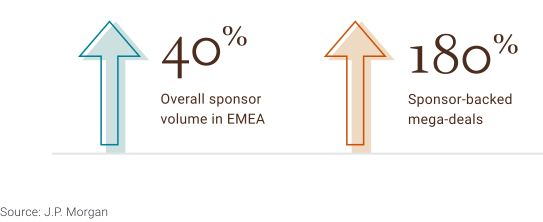
Overall sponsor volume and sponsor-backed mega-deals in EMEA have risen by 40% and 180% respectively in 2026.
“Sponsors are very much in the market for large transactions, contrary to what we’ve been seeing in the headlines. They’re willing to deploy big tickets — they just have to be for the right deals.”

Isik Guven Toktamis
Head of the EMEA Financial Sponsors Group, J.P. Morgan
Take-privates: Driving business transformation
Take-privates have become the dominant deal structure for large-cap sponsors in EMEA.
“Where we see sponsors spending money is in sizeable public-to-private transactions,” Toktamis noted.
In these transactions, sponsors acquire a publicly listed company, delist its shares and convert it into a privately held entity, removing the pressures of public market scrutiny and enabling deeper operational restructuring. The goal is to drive operational alpha — the creation of value through improvements to internal processes, technology and execution efficiency, rather than through financial engineering or multiple expansion.
A case in point is Swedish private equity (PE) firm EQT’s acquisition of British testing and certification company Intertek in June 2026, which was the second largest U.K. take-private in history. J.P. Morgan acted as lead financial advisor and corporate broker to Intertek in the £10.9 billion buyout, which is aimed at enhancing the latter’s operational flexibility and competitive positioning.
Corporate carve-outs: Unlocking hidden value
Corporate carve-outs have emerged as another major deployment theme for EMEA sponsors. Here, a parent company separates a division, subsidiary or business unit to create a new standalone entity. This simplifies the parent’s operations while allowing the carved-out entity to operate with greater focus.
“Sponsors are looking at corporate carve-outs as very fertile ground for deployment. They clearly want to do primary deals where they can show their limited partners, or LPs, that there is significant room for value creation, and corporate carve-outs are the perfect example,” Toktamis said.
J.P. Morgan has been active on this front, recently acting as joint financial advisor to automotive manufacturer Volkswagen in its divestment of engineering company Everllence to Bain Capital. The acquisition streamlines Volkswagen’s structures and processes, while enabling Bain Capital to harness its industrial sector expertise and wide operational support network to fuel Everllence’s growth.
“Sponsors are looking at corporate carve-outs as very fertile ground for deployment. They clearly want to do primary deals where they can show their LPs that there is significant room for value creation.”
Isik Guven Toktamis
Head of the EMEA Financial Sponsors Group, J.P. Morgan
Sectors in the spotlight: Industrials and healthcare
There has been significant dealmaking activity in the industrials space, with sponsors shifting away from software buyouts to focus on hard assets. This comes as governments increase spending on defense and energy amid heightened geopolitical uncertainty; in addition, the AI buildout continues to gain steam, reinvigorating demand for hardware.
“For most of last year, sponsors were reluctant to do capex-heavy industrial deals. But the trend has now reversed, with a resurgence in aerospace and defense in particular,” Toktamis said. “In addition, themes around grid resilience and energy security resonate very much with investors these days, and that’s where we’re seeing a lot of activity.”
In December 2025, British industrial engineering company Smiths Group announced the £2 billion carve-out sale of its Detection division to private investment firm CVC, with J.P. Morgan acting as joint financial advisor. This will help Smiths Group streamline its operations while giving CVC the opportunity to scale Smiths Detection as a newly independent company. J.P. Morgan previously advised Smiths Group on a separate carve-out of its Interconnect division to electronics manufacturer Molex.
Sponsor-led healthcare deals are also on the rebound following several years of muted activity. For instance, J.P. Morgan is acting as financial advisor to CVC in its acquisition of Italian pharmaceutical firm Recordati, which will mark the largest sponsor-backed biopharma take-private of all time. While CVC already owns a controlling stake in Recordati, the latest move is aimed at taking the latter fully private and delisting it from the Euronext Milan.
Sponsor exits: Rising activity among strategic buyers
While overall sponsor activity in EMEA has ramped up, traditional exits such as IPOs remain challenging due to a sizeable backlog, prolonged holding periods and a valuation gap between buyers and sellers. According to PitchBook data, the deals-to-exit ratio among European PE sponsors widened from 2.4x in 2025 to 2.9x in the first half of 2026 — the highest level in at least a decade.
“It’s no secret that sponsor exits have become more difficult, but where we’re seeing real success is when sponsors’ portfolio companies are acquired by strategic buyers [companies that acquire other businesses to integrate them into their existing operations]. That has driven a lot of the successful sponsor exits of this year,” Toktamis observed.
In July, British defense and aerospace group Cobham Ultra (part of Advent International) agreed to sell global undersea warfare systems company Ultra Maritime to American aerospace and defense manufacturer Lockheed Martin for $3.45 billion. J.P. Morgan is advising Advent International on the deal, which will help Lockheed Martin expand its undersea and anti-submarine warfare capabilities.
Then, in August, sponsors Apollo Global Management and Triton Partners announced the sale of Kelvion, a German manufacturer specializing in heat exchangers, to global energy technology company SLB. J.P. Morgan acted as sole financial advisor to SLB in the $4.1 billion acquisition, which will complement the latter’s data center solutions business with critical thermal management technologies.
“This is a real area of focus for sponsors. As such, we’re spending a lot of time with our clients to ensure they’re in discussions with relevant strategic buyers from the early days and positioning themselves for the eventual exit,” Toktamis said.
European PE sponsors are entering deals faster than they can exit them
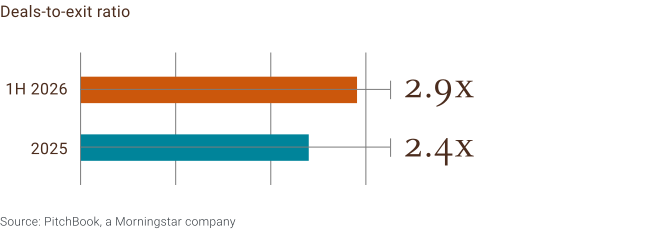
The deals-to-exit ratio among European PE sponsors widened from 2.4x in 2025 to 2.9x in the first half of 2026.
EMEA sponsors outlook: Why selectivity is key
All in all, the sponsor market in EMEA has become more discerning, with selective deployment now a defining feature. Sponsors are prioritizing operational alpha, and capital is flowing to situations with clear potential for value creation: take-privates that enable long-term transformation away from the public spotlight, and carve-outs where non-core assets can be reshaped into high-growth units. And with exits remaining challenging, sponsors are increasingly focused on lining up strategic buyers early to maximize execution certainty.
As Toktamis put it, sponsors are ready to deploy — but only where the deal merits it.
Related insights
-

Banking
How financial sponsors are unlocking value in 2026
February 11, 2026
Discover how financial sponsors are capitalizing on macro tailwinds and strategic innovation as dealmaking ramps up.
-

Markets and Economy
What’s driving financial sponsors to diversify?
June 03, 2026
-

Markets
Financial sponsors are reshaping global credit markets
September 09, 2026
As large-cap sponsors scale multi-strategy credit platforms, they are changing how liquidity is created, distributed and tested under stress.
This material (including market commentary, market data, observations or the like) has been prepared by personnel in the Investment Banking Group of JPMorgan Chase & Co. and/or its affiliates and subsidiaries worldwide (“J.P. Morgan”). It has not been reviewed, endorsed or otherwise approved by, and is not a work product of, any research department of J.P. Morgan.
Any views or opinions expressed herein are solely those of the individual authors and may differ from the views and opinions expressed by other departments or divisions of J.P. Morgan. This material is for the general information of our clients only and is a “solicitation” only as that term is used within CFTC Rule 1.71 and 23.605 promulgated under the U.S. Commodity Exchange Act.
RESTRICTED DISTRIBUTION: This material is distributed by the relevant J.P. Morgan entities that possess the necessary licenses to distribute the material in the respective countries. This material is proprietary and confidential to J.P. Morgan and is for your personal use only. Any distribution, copy, reprints and/or forward to others is strictly prohibited.
This material is intended merely to highlight market developments and is not intended to be comprehensive and does not constitute investment, legal or tax advice, nor does it constitute an offer or solicitation for the purchase or sale of any financial instrument or a recommendation for any investment product or strategy.
Information contained in this material has been obtained from sources believed to be reliable but no representation or warranty is made by J.P. Morgan as to the quality, completeness, accuracy, fitness for a particular purpose or noninfringement of such information. In no event shall J.P. Morgan be liable (whether in contract, tort, equity or otherwise) for any use by any party of, for any decision made or action taken by any party in reliance upon, or for any inaccuracies or errors in, or omissions from, the information contained herein and such information may not be relied upon by you in evaluating the merits of participating in any transaction. All information contained herein is as of the date referenced and is subject to change without notice. All market statistics are based on announced transactions. Numbers in various tables may not sum due to rounding.
J.P. Morgan may have positions (long or short), effect transactions, or make markets in securities or financial instruments mentioned herein (or options with respect thereto), or provide advice or loans to, or participate in the underwriting or restructuring of the obligations of, issuers mentioned herein. Any transactions presented herein are for illustration purposes only. J.P. Morgan does not make representations or warranties as to the legal, tax, credit, or accounting treatment of any such transactions, or any other effects similar transactions may have on you or your affiliates. You should consult with your own advisors as to such matters.
The use of any third-party trademarks or brand names is for informational purposes only and does not imply an endorsement by J.P. Morgan or that such trademark owner has authorized J.P. Morgan to promote its products or services.
J.P. Morgan is the marketing name for the investment banking activities of JPMorgan Chase Bank, N.A., J.P. Morgan Securities LLC (member, NYSE), J.P. Morgan Securities plc (authorized by the Prudential Regulation Authority and regulated by the Financial Conduct Authority and the Prudential Regulation Authority), J.P. Morgan SE (Authorised as a credit institution by the Federal Financial Supervisory Authority (Bundesanstalt für Finanzdienstleistungsaufsicht, BaFin) and jointly supervised by the BaFin, the German Central Bank (Deutsche Bundesbank) and the European Central Bank (ECB)), J.P. Morgan Securities Australia Limited (ABN 61 003 245 234/AFS Licence No: 238066 and regulated by Australian Securities and Investments Commission) and their investment banking affiliates. J.P. Morgan Securities plc is exempt from the licensing provisions of the Financial and Intermediary Services Act, 2002 (South Africa).
For Brazil: Ombudsman J.P. Morgan: 0800-7700847 / ouvidoria.jp.morgan@jpmorgan.com
For Australia: This material is issued and distributed by J.P. Morgan Securities Australia Limited (ABN 61 003 245 234/ AFS Licence No: 238066) (regulated by ASIC) for the benefit of “wholesale clients” only. This material does not take into account the specific investment objectives, financial situation or particular needs of the recipient. The recipient of this material must not distribute it to any third party or outside Australia without the prior written consent of J.P. Morgan Securities Australia Limited.
© 2026 JPMorgan Chase & Co. All rights reserved.