Key takeaways
- AI is driving unprecedented data center capex: J.P. Morgan estimates hyperscaler capex will reach $697 billion in 2026, making AI infrastructure financing one of the defining capital deployment themes today.
- Financing AI infrastructure requires structural creativity: Capital needs are large, build timelines are long and cash-flow profiles differ from traditional investment-grade markets.
- Execution risk is real: Power availability, supply chain constraints and permitting timelines are gating factors that can materially extend project schedules and affect financing structures.
- Investor discipline is holding firm: Despite the scale of capital being deployed, investors are conducting rigorous credit analysis — a signal of a healthy, sustainable market rather than speculative excess.
AI-driven demand is reshaping the US data center market
The U.S. data center market is experiencing unprecedented growth, fueled by the rapid adoption of AI, cloud computing and enterprise migration. In 2026 alone, J.P. Morgan estimates capex for the five largest U.S. hyperscalers — large-scale cloud and technology companies — will reach $697 billion, up by $173 billion since the beginning of the year. As John Servidea, global co-head of Investment Grade Finance at J.P. Morgan, said, “AI financing is the biggest secular theme in our professional lifetimes.”
The industry ambition is visible in recent transactions. Project Stargate, the AI infrastructure initiative announced by the U.S. government in January 2025, plans to invest up to $500 billion in U.S. data centers and energy infrastructure over four years. J.P. Morgan originated $9.6 billion across two construction loans for the initiative’s Abilene, Texas campus, acting as lead left, sole underwriter and sole structuring agent on both transactions — a single engagement that illustrates the scale of capital now moving into AI infrastructure.
Yet the industry faces significant headwinds:
- Power constraints: Demand for compute is outpacing available grid capacity, extending project timelines.
- Supply chain pressure: Bottlenecks across semiconductors, electrical gear and skilled labor are elevating costs.
- Input cost inflation: Rising RAM and memory prices add further pressure on project economics.
“AI financing is the biggest secular theme in our professional lifetimes.”

John Servidea
Global co-head of Investment Grade Finance, J.P. Morgan
Physical requirements of AI data centers
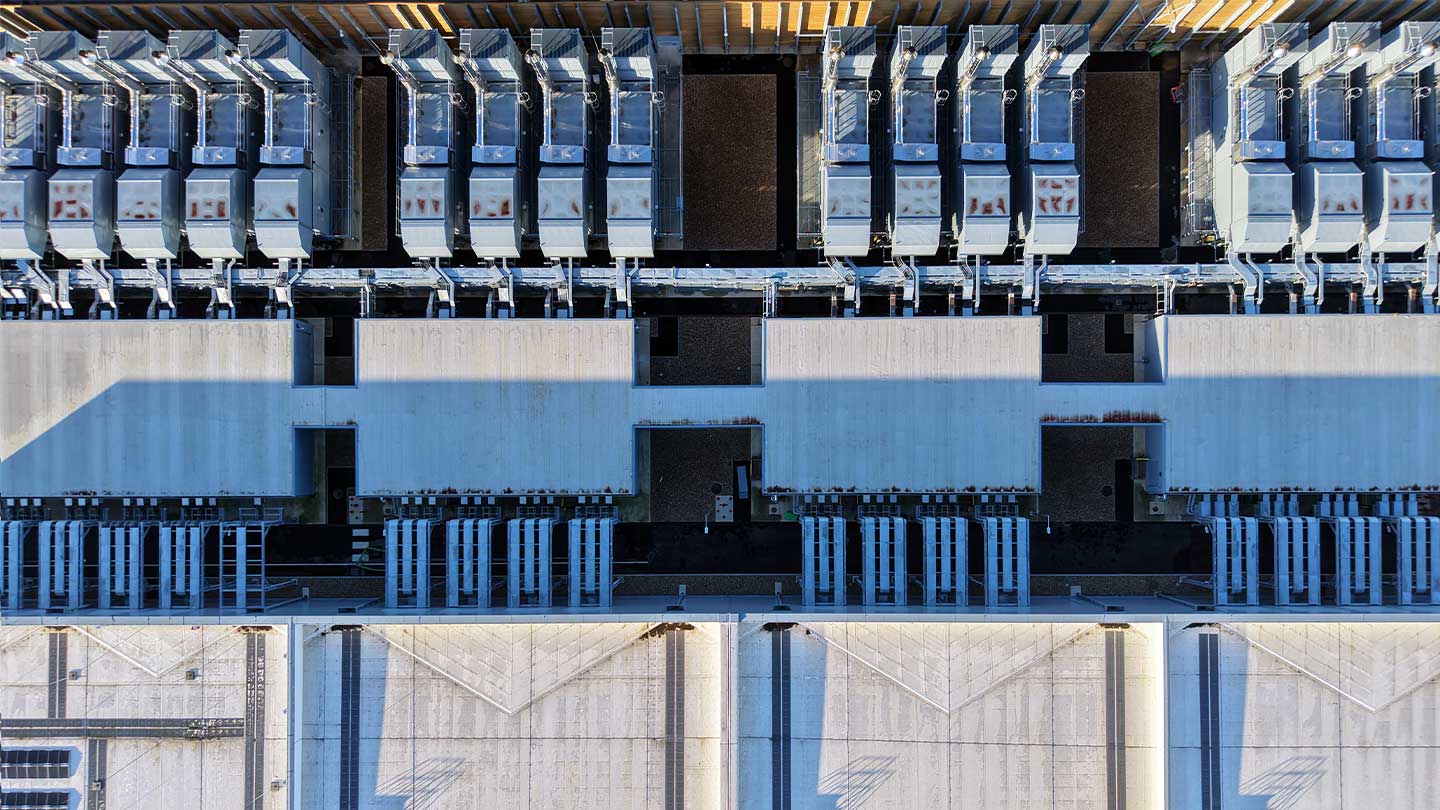
Behind every AI model training run and cloud query sits a physical support structure: purpose-built facilities that require land, power, cooling and connectivity at industrial scale. “That’s digital infrastructure. Most people don’t realize it, but there’s billions of dollars of physical assets supporting virtually every technology experience that you enjoy today,” said Scott Wilcoxen, head of Global Digital Infrastructure Investment Banking at J.P. Morgan.
Historically, this infrastructure spanned foundational physical networks including cell towers, fiber-optic cables and satellites. As AI adoption and cloud computing grow, data centers are emerging as the most critical facilities to support increased demand.
Not all open land can support industrial-grade utilities and long-term expansion possibilities. Developers must closely evaluate data center build sites based on unique requirements, including:
-

Acreage: According to IBM, the average onsite data center typically has between 2,000 and 5,000 servers, with a footprint reaching 100,000 square feet — roughly the equivalent of 38 standard tennis courts.
-

Connection: The space must offer proximity to power transmission and fiber networks, or the project must consider installation of these connections as part of the build cost.
-

Environmental security: Consideration of earthquakes, floods and other environmental risks is critical to ensure consistent compute capabilities with minimal interruptions.
-

Community considerations: Developers must address concerns from communities near data center build sites prior to breaking ground. This goes beyond paperwork to include public hearings and stakeholder negotiation. Doing so is a crucial step in establishing permitting rights across zoning, building permits, water rights and more.
“Data doesn’t move in a vacuum, it moves over a medium.”

Scott Wilcoxen
Head of Global Digital Infrastructure Investment Banking, J.P. Morgan
How AI infrastructure is financed
AI infrastructure financing requires both scale and bespoke structuring. The capital needs are large, build timelines are long, and the cash flow profile often differs from what traditional investment-grade markets are accustomed to underwriting.
“What’s particularly exciting for us is the level of creativity that is required to finance all of this. Thinking about how to raise this capital in the most efficient way requires a lot of collaboration across teams and markets,” said Servidea.
How debt financing structures AI infrastructure capital
In AI infrastructure, debt most often comes in two core structures: corporate (balance-sheet) debt and project-level debt. Corporate debt allows for speed and flexibility: proceeds can fund capex across data center buildouts, power-related spending, networking and compute without tying the lender to one specific project’s performance.
Project-level debt, by contrast, is underwritten primarily to a defined set of project cash flows, often supported by long-term contracts or otherwise high-visibility revenues. The trade-off is less flexibility and more structural complexity, in exchange for tighter lender protections and debt sizing that is anchored to the asset’s own cash generation.
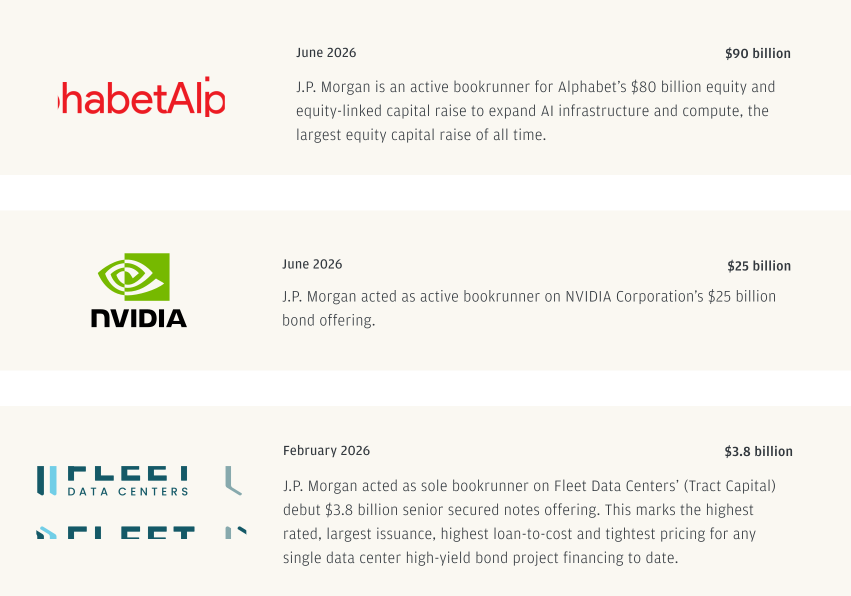
The June 2026 financing of Hut 8’s Beacon Point data center in Nueces County, Texas illustrates how project-level debt can be structured around durable, contracted cash flows. J.P. Morgan acted as lead left bookrunner on the $4.25 billion senior secured notes offering, which was 100% pre-leased under a 15-year triple-net lease to a high investment-grade tenant. The transaction achieved a 95% loan-to-cost ratio — the highest ever for a high-performance computing data center bond — and priced at T+165, the tightest spread ever recorded for a data center construction bond.
Equity’s role in multi-layered AI infrastructure capital stacks
Equity is the risk-absorbing capital in AI infrastructure, used to fund growth and shoulder uncertainties that debt investors typically discount, such as technology obsolescence, ramp-up timing, utilization volatility and customer concentration. In practice, equity is often used to get projects built and scaled, with the expectation that the business can later add more debt once revenues are contracted and performance is more predictable. As capital needs grow, equity financing structures have become increasingly complex, often drawing on multiple layers of the capital stack simultaneously.
“More often, forming this capital means going to multiple pockets, across multiple regions and, in many instances, looking across multiple layers of the capital stack and incorporating both structured as well as common equity to ultimately fund these investments,” said Wilcoxen.
CoreWeave’s April 2026 capital raise demonstrates how AI-first companies are increasingly drawing on multiple layers of the capital stack simultaneously. J.P. Morgan acted as lead left and active bookrunner on a $5.25 billion combined offering comprising of $1.75 billion in senior unsecured notes and $3.5 billion in convertible senior notes. This deal represents one of the largest combined high-yield and convertible offerings ever executed. It also reflects both the scale of capital required to build and operate AI infrastructure at speed and the sophistication of the financing structures now available across the sector.
“Investors are not blindly buying everything. There’s a tremendous amount of capital being deployed, but investors are taking the time to do the credit work, understand the stories and figure out relative value and pricing. To me, that’s a healthy sign for the market.”
John Servidea
Global co-head of Investment Grade Finance, J.P. Morgan
Key risks in AI infrastructure financing
Why time to power is the critical constraint for AI data centers
As the demand for data center capacity grows, pressure builds on key components of the supply chain. According to Wilcoxen, the most crucial of these is power supply. Demand for compute is rising faster than many regional grids can support, and the friction shows up in aging transmission infrastructure, limited local capacity and multiyear wait times to connect to power that can push project timelines out materially. As a result, time to power has become a limiting factor for data center and compute deployments. “Accelerating time to power is a top priority for many of our clients, but the grid infrastructure isn’t there,” said Wilcoxen. “There’s a lot of work to do.”
Beyond the grid itself, the supply chain is constrained by natural resources and physical inputs that are harder to scale quickly than capital. Builders must secure available land in the right locations, water access and cooling requirements, and appropriate permitting that determines whether a project can move from plan to energized facility. Clients are responding by securing sites and utility pathways sooner, evaluating alternative cooling approaches where feasible and bringing energy and infrastructure specialists into the diligence process to underwrite power availability and execution risk with the same rigor as the underlying compute demand.
How AI infrastructure developers are managing over-capacity risk
Over-building is a parallel risk: AI capital expenditure has, in many cases, outpaced monetization. “The uncertainty around how, when and in what magnitude end-user demand materializes in a monetizable way does make it difficult to plan out over a multiple-year cycle,” said Wilcoxen.
As a result, long lead times for power and construction are colliding with rapidly evolving technology cycles and shifting customer needs. In response, many operators and sponsors are trying to structure buildouts in phases, pursue more contracted or pre-committed demand where possible, and maintain optionality so capacity can scale with real adoption.
Debt concentration risk as AI financing scales
Debt concentration is an emerging systemic consideration as AI’s share of the overall financing market grows rapidly. “I don’t think we’re at a point yet where concentration limits are a huge concern, but it is part of the dialogue because as a portion of the overall market, AI is growing very quickly,” said Servidea.
Practically, clients are working to keep funding channels resilient by diversifying capital sources, matching debt structures to cash-flow visibility and avoiding overly correlated exposures to a single counterparty, technology node or demand narrative. The throughline is that the next phase of AI infrastructure buildout will be shaped as much by execution discipline as by the availability of capital.
“We’re building the physical underpinnings of the future technological progress of mankind.”
Scott Wilcoxen
Head of Global Digital Infrastructure Investment Banking, J.P. Morgan
US data center outlook
Investor appetite for AI infrastructure is strong, but it’s not indiscriminate. “Investors are not blindly buying everything. There’s a tremendous amount of capital being deployed, but investors are taking the time to do the credit work, understand the stories and figure out relative value and pricing. To me, that’s a healthy sign for the market,” said Servidea.
Rather than jumping on the bandwagon, investors are positioning themselves to finance a long-term buildout, considering downside protection as much as upside. “The red lights would start flashing if it felt like there was blind euphoria. That’s not what we’re seeing,” Servidea said.
While AI is a major incremental driver, infrastructure buildout is broader than a single theme. “This entire AI dynamic is additive to an already extraordinarily large investment base,” said Wilcoxen. For instance, public cloud and software-as-a-service (SaaS) models are expected to expand meaningfully in the near future. Compute growth won’t map one-to-one with revenue or usage because efficiencies improve over time, but the direction of travel remains clear: more workloads, more data movement and more always-on digital services will translate into continued expansion of data centers, networks and supporting hardware.
The next phase of AI infrastructure will reward platforms that can secure reliable, scalable power, navigate grid access and interconnection timelines, and structure financing around durable demand signals. If AI meaningfully reshapes products and workflows, the practical implication is sustained investment not just in compute, but in the physical and energy foundations that make that compute usable at scale.
“When you think about all the different things society will be able to do with AI over the next five years, 10 years, 20 years, it’s really hard to comprehend what that’s going to ultimately require,” said Wilcoxen. “We’re building the physical underpinnings of the future technological progress of mankind.”
Related insights
-

18:23 - Banking
The data center surge: Building the backbone of the digital age
September 23, 2025
Our experts dive deep into the world of digital infrastructure — exploring the critical role of data centers, fiber, and towers in powering today’s digital economy. They also discuss the risks of overbuilding, and the importance of operational expertise.
-

7:38 - Banking
Powering the AI Revolution
June 16, 2026
AI is transforming global economies and revolutionizing industries. Technology experts from J.P. Morgan discuss why investing in strategic technology is critical for security and resiliency.
-

Global Research
Critical minerals outlook: surging demand, expanding supply chains
February 23, 2026
AI, the energy transition and increased defense spending are driving global demand for critical minerals and rare earth elements.