
Key takeaways
- AI data center construction and hyperscaler demand are absorbing a disproportionate share of global memory capacity, creating a dynamic random access memory (DRAM) shortage that may take years to unwind.
- J.P. Morgan Global Research estimates that DRAM prices will have risen more than 400% from the start of 2024 to the end of 2026.
- The Consumer Price Index (CPI) for software and accessories and Producer Price Index (PPI) for storage devices have both risen 23% since the end of 2024.
- The memory supply crunch is also straining cybersecurity infrastructure, with analysts warning that a major cyberattack could unleash an estimated $145 billion in additional chip demand on an already constrained market.
AI data center demand is creating a shortage of global memory capacity, with prices for dynamic random access memory (DRAM) estimated to rise more than 400% from the start of 2024 to the end of 2026, according to J.P. Morgan Global Research. How long might the shortage go on — and what are the risks to consider?
Why is there a memory shortage?
Making sense of what is behind the memory shortage begins with understanding DRAM’s function within technology at large, from common consumer devices like computers and smartphones to the AI ecosystem.
DRAM, the most common type of system memory used in modern electronics, can be thought of as a device’s short-term working memory, holding the data a processor needs to run apps and multitask smoothly. The term “dynamic” refers to how DRAM’s tiny capacitors lose power and must be refreshed thousands of times per second to prevent data loss. When a device is moving slowly and can’t switch between apps smoothly, a memory issue may be to blame.
In advanced computing, high-speed DRAM is seen as vital for complex, memory-intensive tasks like AI processing and model testing. The AI data center buildout has intensified demand for DRAM, with hyperscalers — large cloud and data center operators —securing output from fabricators in the form of long-term agreements (LTAs) that in some cases run for five years or longer. The scale of investment is accelerating: for example, Meta raised its capex guidance by $10 billion, citing higher AI hardware and memory costs.1
While LTAs may help keep costs manageable for hyperscalers, they dramatically decrease the flexibility of memory fabricators to address demand for memory chips in consumer goods.
Additionally, new memory supply is unlikely to meet demand in the near term. “The market tends to underestimate the elongated pace of supply addition and new capacity buildout, not to mention new technologies with higher trade loss,” said Jay Kwon, an equity analyst covering memory and semiconductors at J.P. Morgan. “Given ~90% annualized token cost per watt decline and rising agentic AI computation workload demand, it is not a secret that the industry will stay in shortage for multiple years. All this makes a timetable for resolution difficult to set.”
AI inflation has already increased DRAM prices significantly
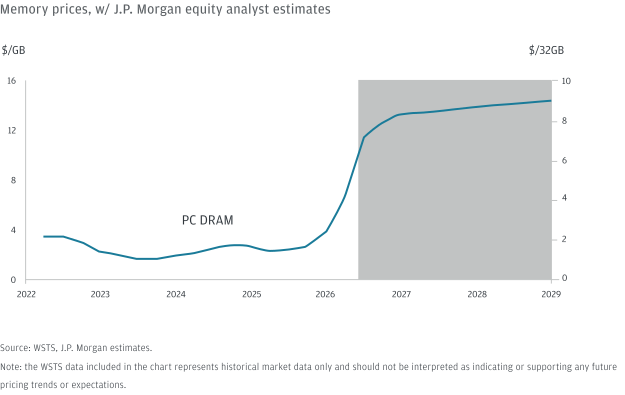
Memory prices have seen a fourfold increase since the start of 2024, with forward projections showing little sign of abatement.
How the memory crunch may already be creating “chipflation”
For the average consumer, implications of the memory shortage may already be felt in the form of “chipflation,” or inflation of the cost of memory for chips in common electronics — from phones and computers to smartwatches and TVs. In many cases, manufacturers pass through these elevated costs in the form of raised prices.
Data suggests that while some of these costs have already been passed through to consumers by consumer technology companies, other costs are still on the rise. “The Consumer Price Index (CPI) for software and accessories and Producer Price Index (PPI) for storage devices have both risen 23% since the end of 2024, with the import price index for computers, peripherals and parts up 37%,” noted Abiel Reinhart, an economist at J.P. Morgan.
There are wider knock-on effects for inflation as well. “Every 10% increase in hardware costs is estimated to raise core CPI and PCE inflation by around 0.1%, with a 0.2–0.4% lift to inflation attributed to the shock in memory prices,” said Reinhart.
This raises the question of whether the impacts of chipflation are already being felt, or if more are yet to come — a difficult prospect in a year that has already seen elevated inflation related to energy costs arising from the Middle East conflict.
Memory-related price inflation is already showing up in tech goods
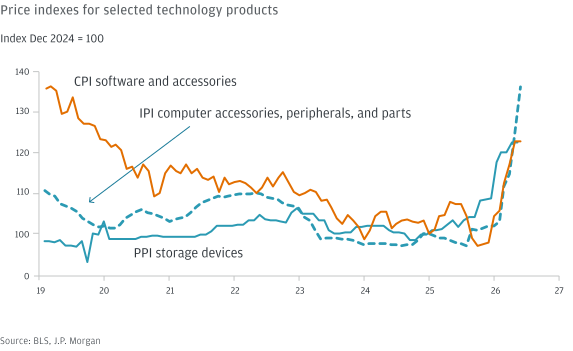
Memory-related price inflation is already showing up in tech goods
How the memory chip shortage affects cybersecurity and critical infrastructure
Beyond higher memory costs and more upside risks to inflation, the memory shortage also places pressure on existing vulnerabilities in cybersecurity.
“Major cloud providers, or hyperscalers, are consuming most of the available semiconductors, leaving security hardware manufacturers, those making firewalls, intrusion detection systems and secure routers struggling with limited supply and rising costs,” said Jahangir Aziz, co-head of Economics Research at J.P. Morgan. “This bottleneck is delaying the deployment of critical containment mechanisms and slowing upgrade cycles, especially for organizations that depend on on-premises hardware for their security controls.”
In an analysis comparing the relative vulnerabilities of information technology (IT) and operational technology (OT) to cyberattack, Aziz highlighted OT’s heavy reliance on physical hardware and segmentation architectures, which are highly impacted by the memory supply crunch. “In the event of a widespread cyberattack, it is highly unlikely that demand could be met within six to 12 months, and prices would almost certainly soar well above current levels,” Aziz said. “Given current supply constraints, a nationwide cyberattack in the U.S. would unleash an estimated $145 billion in additional chip demand on a market already operating at full capacity.”
While these are speculative scenarios, they underscore the importance memory chips have in maintaining existing infrastructure — an issue that could be addressed through global coordination and appropriate oversight.
“Regulation is essential to ensure firms invest in resilience beyond market incentives and account for AI’s lifecycle costs, including cybersecurity risks,” said Aziz. “Measures such as mandatory certification, expanded liability, cyber-risk insurance and targeted levies on high-risk AI can help. But without global coordination, jurisdictions that neglect regulation may gain unfair advantages.”
References
Fortune, “Meta just bumped its 2026 capex forecast up to as much as $145 billion for the AI boom—and investors flinched.” Amanda Gerut, published 4/29/2026, accessed 7/8/2026, https://fortune.com/2026/04/29/meta-zuckerberg-145-billion-ai-spending-roi/
Related insights
-
Global Research
Is AI already impacting job growth?
August 15, 2025
AI is poised to displace jobs, with some industries more at risk than others. Is the paradigm shift already underway?
-

Global Research
Mid-year market outlook 2026: The tug of war continues
July 01, 2026
While the global expansion stands on solid ground, markets will need to balance competing forces as they head into the second half of the year.
-
Global Research
US tariffs: What’s the impact on global trade and the economy?
September 09, 2026
J.P. Morgan Global Research brings you the latest updates and analysis of President Trump’s tariff proposals and their economic impact.