
Key takeaways
- Financial market technology has overtaken access to liquidity as traders’ leading market structure concern.
- AI, blockchain, and consolidated tape developments are moving closer to practical use, changing how firms access liquidity, process information, and manage workflows.
- Adoption will be gradual, with new and existing infrastructure operating side by side as firms navigate regulation, reporting, cost, privacy, and operational risk.
Access to liquidity has been the main market structure concern among institutional traders for the past 10 years, according to the J.P Morgan Markets e-Trading Survey. But, for the first time, it's no longer at the top of the agenda.
In the 2026 edition of the survey, the development of financial market technology is the leading preoccupation of institutional traders, pushing liquidity into second place.
Yet liquidity remains a core consideration, even as technology reshapes how it is accessed and managed. But advances in AI, blockchain, and data use are having a greater influence over how traders process information and make decisions, while regulation and cost continue to shape what’s possible in practice.
Kate Finlayson, Global Head of FICC Market Structure & Liquidity Strategy, at J.P. Morgan, says this reflects how market participants’ use of AI is being adopted, primarily to increase efficiency, and this is coupled with the development of blockchain technology and digital assets.
She says:
“Access to liquidity has, unsurprisingly, been the top market structure concern for institutional traders for years. But, for the first time, it has been overtaken by the development of financial market technology.”
“That makes sense, because along with the increased use of AI, when it comes to digital assets it feels like these elements are finally moving from proof of concept to something more tangible, and there is more focus on them from a regulatory perspective too.”

If it had been possible to foresee this switch, there was little indication in the survey data. In the first annual survey, in 2017, liquidity and market volatility were jointly considered most impactful on market structure by those who felt there was an issue affecting the market, each with 17% of the vote. By 2022, access to liquidity had risen to 25%.
Yet despite the fact liquidity continued to score highly this year, with 21% of those surveyed saying it was their main market structure concern, the development of financial technology pipped it, with 22% of the vote.
That shift reflects how quickly the structure of markets is changing. Yet liquidity is unlikely to fade as a core issue, says Michael Harrison, Senior Lecturer in Economics and Finance at the University of East London in the UK.
“It’s hard to think of a time in the past, or scenario in the future, where liquidity isn’t a concern, as it’s so vital when trying to rebalance portfolio holdings,”
he says.
Harrison believes technology is reshaping how liquidity is accessed, rather than replacing its importance as a market structure concern.
“The technology which facilitates the microstructure of the market can facilitate liquidity provision and specialist matching,” he adds.
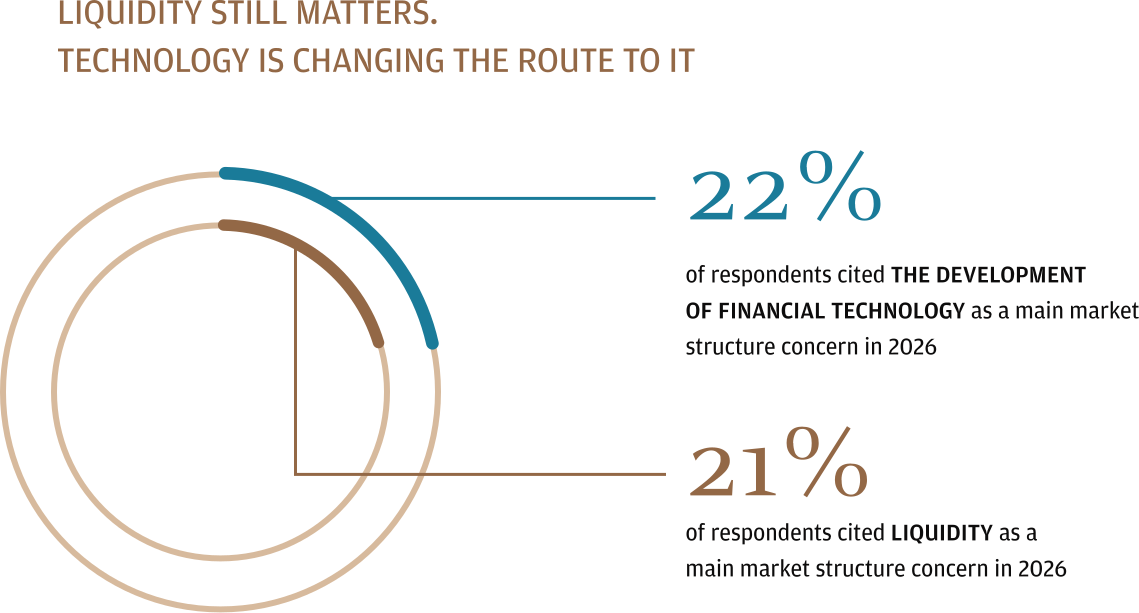
Infographic titled “Liquidity still matters. Technology is changing the route to it.” Concentric ring graphic with callouts showing 22% of respondents cited the development of financial technology as a main market structure concern in 2026, and 21% cited liquidity as a main market structure concern in 2026.
Technology takes center stage
The rise of technology as a top concern, albeit marginally, reflects rapid developments across trading infrastructure, data use, blockchain, and AI.
Finlayson says: “On a micro structural level, you have the development of trading techniques, and advancements in trading technology, particularly as it relates to how systems and trading practices can gain efficiencies from AI as well as the application of blockchain technology.”
These themes have become increasingly prominent both commercially, and from a policy perspective, with the use of distributed ledger technology, and the efficiencies that can provide, being more in focus in the last year or so.
That transition is key. Firms are asking how quickly these technologies can be embedded into existing workflows without introducing new risks or excessively high costs.

Blockchain adoption is accelerating
Blockchain is one of the clearest drivers of this change, particularly as regulatory and political support for its implementation has strengthened.
Emma Lovett, Credit Lead, Markets Distributed Ledger Technology at J.P. Morgan, says: “The new U.S administration has been a huge catalyst that has really pushed us forward in this field.”
Much of the industry’s work has historically been built around private, permissioned blockchain platforms, which were able to transact and facilitate access to real world assets. But this required every single participant to be onboarded to that platform.
These platforms offered control and security, but they also limited broader adoption.
Lovett says: “Private blockchain platforms were very safe and enabled people to start their journey using the technology, but they didn’t open up all the efficiencies and benefits that blockchain is known for enabling.”
That is now changing, with a growing appetite for public blockchains, says Lovett.
New opportunities in asset creation and post-trade efficiency
This shift is opening new possibilities in two key areas. First is the creation of new types of financial products. It is possible to use blockchain technology to “develop an asset class that doesn’t exist today.” (see box) Second is that public blockchain is opening new possibilities by improving post-trade processes. Lovett says: “If all participants of one trade could see exactly the same ledger, then, in part, it’s impossible to disagree with that ledger, because you’re all looking at the same thing,” Lovett says. This could significantly reduce friction in resolving failed trades.
She adds: “Users can see why a trade failed and can immediately put into place the remediation so that trade can go ahead and settle.”
“Blockchain also introduces programmability into financial markets, which can help to smooth out trades. Traders can program corporate actions, such as coupon payment redemption, so no manual payments need to take place.”
These kinds of efficiencies are often discussed in theory, but the growing focus now is on how they can be delivered consistently in practice, particularly at scale and across multiple market participants.
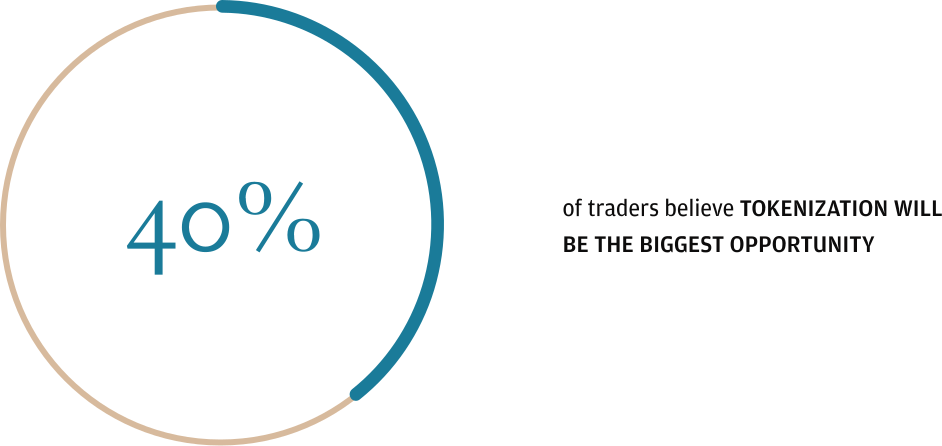
Circular ring infographic showing “40%,” with accompanying text stating that 40% of traders believe tokenization will be the biggest opportunity.
The blockchain bonus: improving trading liquidity and intraday settlement
Blockchain settlement has the potential to make existing financial infrastructure faster and more efficient, while presenting the opportunity to create entirely new forms of liquidity, which remains a main market structure concern.
One clear example of this is intraday repo, where traders are using tokenized collateral. They can exchange it, and on chain cash, with settlement and maturity specified to the minute. Provider capabilities include the ability to provide fixed income tokenization services to enable this trade and to have a “cross ledger” repo product that enables assets tokenized by HQLAx to be used for collateral.
Emma Lovett, Credit Lead, Markets Distributed Ledger Technology at J.P. Morgan, says: “This intraday repo is enabled by blockchain’s ability to define exact settlement times rather than just settlement dates. Traders can see who owned what, and exactly when, to the minute, or even second.”
This means repo desks no longer need to rely on overnight trading cycles. Instead, they can raise liquidity for shorter periods during the trading day, allowing treasury and financing desks to manage temporary liquidity gaps much more efficiently.
However, there are other ways blockchain and tokenization can potentially optimize liquidity continuously throughout the day, which is perhaps why 40% of traders in the latest J.P. Morgan Markets e-Trading Survey say they believe tokenization will be the biggest opportunity in digital market assets in 2026. Treasury desks may eventually be able to move collateral dynamically between trading, clearing and funding functions as market conditions change.
Eventually, blockchain may not just modernize the settlement infrastructure, but could blur the boundaries between trading, collateral management, and treasury operations. This may result in liquidity becoming continuously available, rather than being constrained by settlement timings.
A fragmented global landscape
However, blockchain adoption isn’t happening uniformly, with different regions taking different approaches.
Lovett says: “We’ve seen certain trends move almost jurisdiction by jurisdiction.”
For example, in the UK, the regulators have developed the Digital Security Sandbox, a regulated testing environment for using blockchain in financial markets. Meanwhile, the European Central Bank has introduced digital currency pilots, a means of controlling tests to see how a digital euro would work in practice.
Such variations add extra layers of complexity for firms deciding how and where to invest. They are having to navigate a patchwork of regulatory environments, each with its own priorities and timelines—without a single, global standard. This can slow adoption, but it can also create opportunities for region-specific innovation.

A growing focus on AI
AI is also becoming a major driver of change. Finlayson says: “Machine learning has been around for a long time, but gen AI and the application of more advanced AI models is being flagged in the survey as the most influential technology over the next three years.”
Firms aren’t only adopting AI but are also comparing approaches and learning from one another.
The focus is increasingly on practical application, and “how you can apply AI to your existing infrastructure to introduce efficiencies but also glean more information about how people are trading and where there are opportunities that could drive alpha,” Finlayson adds.
However, there are clear limits to how far this can go. Harrison says:
“AI offers significant potential to handle big datasets to produce insight, however we’re still at a point where the fiduciary duty limits the ability to use AI to its full potential in terms of decision-making and entering positions.”
There are already areas, particularly in high-frequency trading, where automation plays a significant role. But extending that level of autonomy more broadly raises questions. For example, there is a significant amount of technology in use that can make decisions with limited human supervision, says Harrison. This creates a dilemma for regulators as to how they would apply suitable controls to allow the technology to work as intended, and for it to be used across a wider range of applications.
Data and the impact of consolidated tape
Access to data is also becoming more important, Finlayson adds, with several imminent changes on the horizon.
She says: “The rules that dictate how quickly trade data is made publicly available have been a key focus, particularly in Europe.”
“We also have the formation of a consolidated tape – the UK tape launched on June 22 and the EU tape is expected to launch towards the end of 2026 or early 2027. With more real time data being made publicly available and these tapes launching, this could shape the data market participants consume and how they trade over time.”
However, greater transparency also creates new challenges, as the potential for information leakage associated with more real-time transparency may influence trading behaviors, Finlayson adds.
From a structural perspective, these developments are intended to improve how markets function. Harrison explains that following the MiFID II/MiFIR review, the transparency regime for bonds and derivatives was adjusted both in the EU and the UK.
This is expected to support the development of consolidated tapes across asset classes, aligning with progress underway in Europe.
In practice, the impact may be more incremental than immediately transformative.
These themes are all directly affecting how firms make decisions, both strategic and tactical, in turn directing time and resources towards them, Finlayson says. But the increasing sophistication of algorithmic trading growth has boosted market participants’ comfort levels when using this type of execution.

Cost remains a key constraint
Cost remains a constant concern for firms, even when they appreciate the opportunities presented by new technology. Finlayson says: “Accessing execution management system functionality requires resources – there are costs associated with either building one’s own functionality or accessing via a third-party vendor, which is a factor when thinking about tech investment spend.”
Lovett adds: “Blockchain also introduces budgetary considerations, especially when needing to ensure the security of distributed ledger technology and the securities that sit on them are robust, legal and compliant.”
For many firms, the challenge will be familiar: identifying where technology can add value but also determining whether the benefits will outweigh the costs in a meaningful timeframe.
Compliance and privacy challenges
Public blockchain adoption also raises important compliance and privacy issues. Lovett says:
“It’s no good for the capital markets to just say anybody can access them, because then these securities might get into the hands of bad actors.”
Privacy is another concern. No one wants trades to necessarily be accessible by everyone, says Lovett, but solutions to this are still under development.
“Different options are currently being worked through to make sure that the good parts of the technology are maintained,” she says. “We’re still at the beginning of this journey. We don’t necessarily know where it’s going to land.”
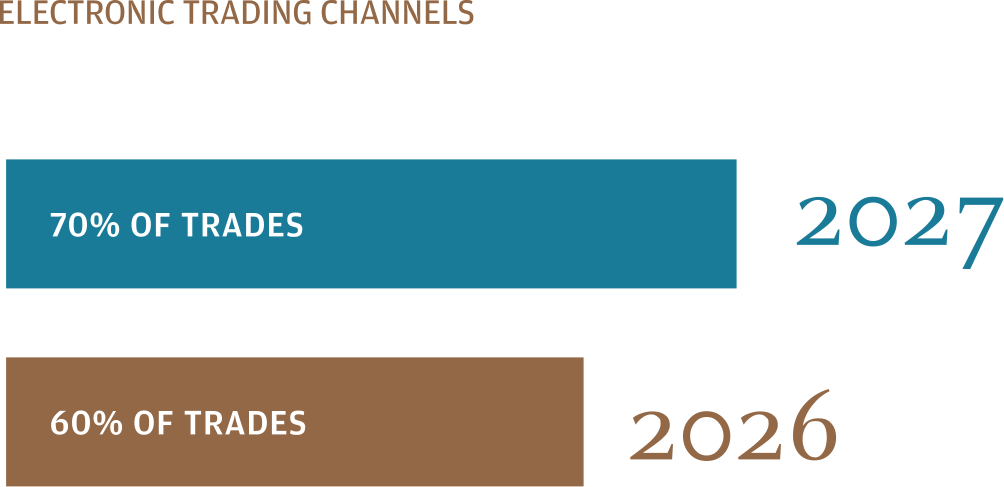
“Electronic Trading Channels” graphic comparing two years: 2027 shows 70% of trades (teal bar) and 2026 shows 60% of trades (brown bar), indicating a higher share in 2027.
Integrating fragmenting trading systems
The increasing electronification of trading has allowed companies to differentiate themselves from their competitors in the way their trade and post-trade infrastructure operates.
Execution, clearing, collateral management and settlement have often been operated across fragmented systems, which also need significant human intervention to ensure they work correctly. This model is increasingly inefficient as trading volumes, automation, and volatility rise. This is perhaps a primary reason why developments in financial market technology are the main market structure concern for traders in this year’s J.P. Morgan Markets e-Trading Survey.
In addition, electronic trading channels are expected to account for 70% of trading in 2027 according to the latest survey, up from 60% in 2026. But for traders, the ability for the various systems involved in trade execution to communicate seamlessly in real time is paramount, especially in volatile markets. These include trading platforms, risk systems, collateral, and settlement infrastructure.
Kate Finlayson, Global Head of FICC Market Structure & Liquidity Strategy, at J.P. Morgan, says:
“Market participants and investors are looking at how they access and interact across platforms and engage with liquidity, how they consume market or trade data, how they assess not only liquidity, but also their choices in how and where they execute. That also includes on a post-trade basis evaluating the execution, the trading techniques that they employed.”
Delays between execution and post-trade processing can increase funding costs, tie up collateral, and create operational risk for traders. This is pushing institutions towards integrating these typically separate functions into a single workflow, so execution, analytics, collateral management, and settlement operate together, rather than working in silos.
Do. More.
on J.P. Morgan Markets
Direct access to market leading liquidity harnessed through world-class research, tools, data and analytics.
Explore more themes
No results found
Adjust your filter selections to find what you’re looking for
FOR INSTITUTIONAL & PROFESSIONAL CLIENTS ONLY – NOT INTENDED FOR RETAIL CUSTOMER USE
This material has been prepared by J.P. Morgan Sales and Trading personnel and is not the product of J.P. Morgan’s Research Department. It is not a research report and is not intended as such. This material is provided for informational purposes only and is subject to change without notice. It is not intended as research, a recommendation, advice, offer or solicitation to buy or sell any financial product or service, or to be used in any way for evaluating the merits of participating in any transaction. Please consult your own advisors regarding legal, tax, accounting or any other aspects including suitability implications, for your particular circumstances or transactions. J.P. Morgan and its third-party suppliers disclaim any responsibility or liability whatsoever for the quality, fitness for a particular purpose, non-infringement, accuracy, currency or completeness of the information herein, and for any reliance on, or use of this material in any way. Any information or analysis in this material purporting to convey, summarize, or otherwise rely on data may be based on a sample or normalized set thereof. This material is provided on a confidential basis and may not be reproduced, redistributed or transmitted, in whole or in part, without the prior written consent of J.P. Morgan. Any unauthorized use is strictly prohibited. Product names, company names and logos mentioned herein are trademarks or registered trademarks of their respective owners. The products and/or services mentioned herein may not be suitable for your particular circumstances and may not be available in all jurisdictions or to all clients. Clients should contact their salespersons at, and execute transactions through, a J.P. Morgan entity appropriately licensed in the client’s home jurisdiction unless governing law permits otherwise. Past performance is not indicative of future results. All services are subject to applicable laws, regulations and service terms. This material is a “solicitation” of derivatives business only as that term is used within CFTC Rule 1.71 and 23.605. Where this material is an “investment recommendation” as that term is defined in MAR visit: www.jpmm.com/#mardisclosures. This material is subject to terms at: www.jpmorgan.com/salesandtradingdisclaimer.
© 2026 JPMorgan Chase & Co. All rights reserved.
J.P. Morgan is a marketing name for investment banking businesses of JPMorgan Chase & Co. and its subsidiaries and affiliates worldwide. Bank products and services, including certain lending, derivative and other commercial banking activities, are offered by JPMorgan Chase Bank N.A. (JPMCB), including through its authorized branches and other global affiliates registered with local authorities as appropriate. Securities products and services, including execution services, are offered in the United States and in other jurisdictions worldwide by J.P. Morgan Securities LLC (JPMS LLC), in EMEA by J.P. Morgan Securities plc (JPMS plc) and J.P. Morgan SE (JPM SE) and in other regions by other appropriately licensed global affiliates. JPMCB, JPMS LLC, JPMS plc and JPM SE are principal subsidiaries of JPMorgan Chase & Co. For information on which legal entities offer investment banking and securities products and services in each jurisdiction, please consult: https://www.jpmorgan.com/disclosures/investment-bank-legal-entity-disclosures#securities-transactions
For additional regulatory disclosures, please consult: www.jpmorgan.com/disclosures.