
Key takeaways
- Machine learning’s helping private credit teams extract, standardize, and validate data from complex non-standard documents.
- Predictive models can help analysts identify probability of default and prioritize where attention’s most needed.
- Human expertise remains essential to interpret outputs, challenge errors, and maintain trust in the model.
Private credit analysts are increasingly employing machine learning to improve efficiency, allowing the asset class to scale at the rate of demand. The sector was worth around $3.5 trillion in 20241, and this figure is expected to rise still further in the coming years.
Analysts have historically relied on detailed, manual work within the private credit sector to spot both opportunities and risks. This includes reviewing financial statements, pulling out key figures, and then forming a view on credit risk, based on both quantitative and qualitative factors. This could take days depending on the information they needed to extract.
However, with machine learning, it’s now possible to identify relevant data in a matter of seconds, leaving analysts free to do what they do best: assess private credit risk and find suitable investment opportunities.
This has allowed private credit to scale significantly. Kanav Kalia, Managing Director at Oxane Partners, says:
“Private credit has scaled quickly from a niche strategy into a core institutional asset class.”
“As portfolios have expanded in size and complexity, the strain has shown up less in investment judgment and more in the effort required to assemble clean, decision-ready information. That is the point at which machine learning starts to matter.”
Traders ranked machine learning as likely to be the second most influential technology in the industry over the next three years, according to this year’s J.P.Morgan Markets e-Trading Survey. This was second only to generative AI, with 18% of traders seeing machine learning as having the greatest influence.
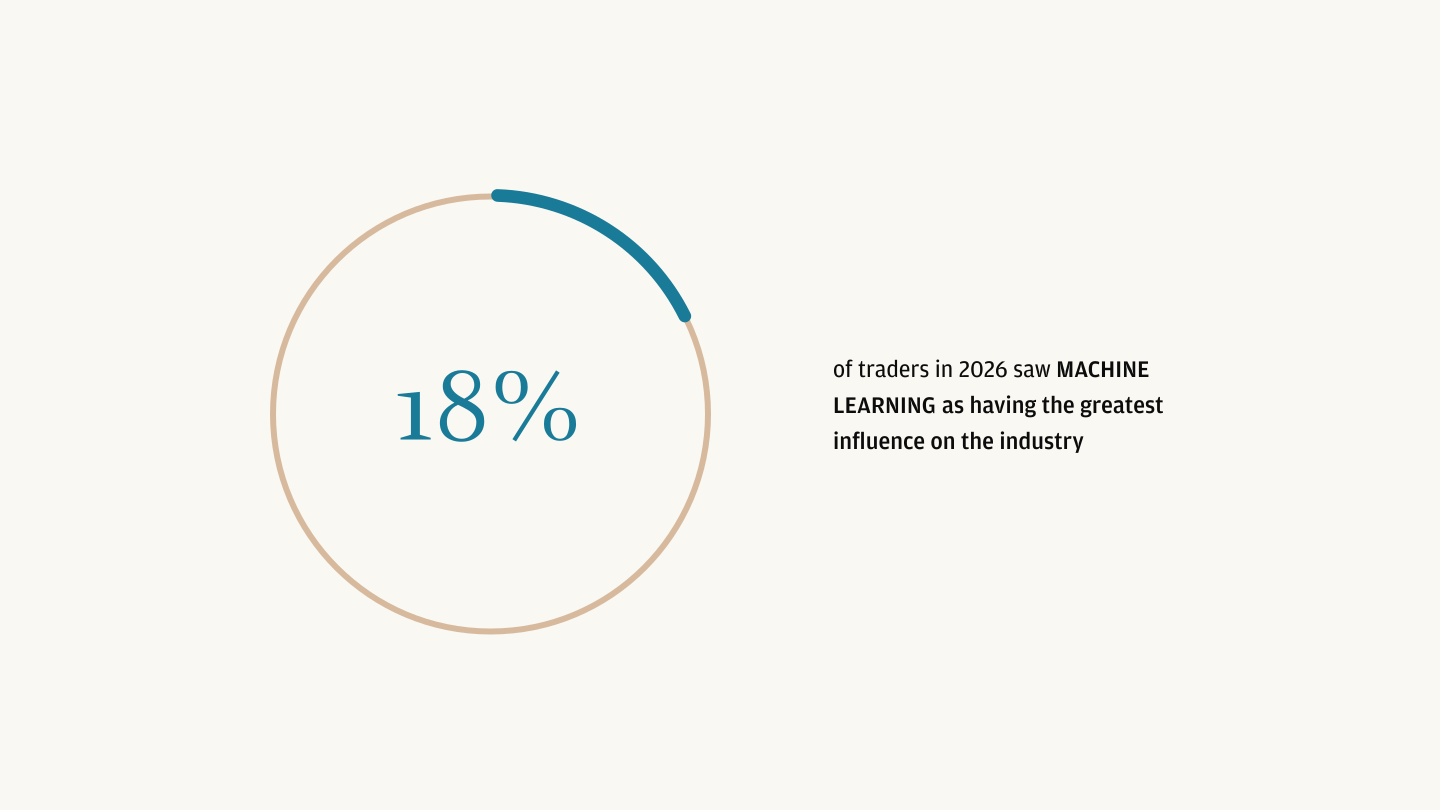
Donut chart showing 18% with a teal progress segment; accompanying text reads: “18% of traders in 2026 saw machine learning as having the greatest influence on the industry.”

Transforming traditional workflows
Data in private credit markets is not delivered in a uniform way, making it harder for analysts to extract the information they need. The bespoke nature of each company’s documentation means analysts must spend time searching for comparable information, which is far more complex than the relatively uniform delivery of public market documentation.
This variation makes it harder to apply consistent rules and methods to data analysis, which is why the expertise of the analysts in the private credit sector is so vital. But machine learning creates an opportunity to improve the consistent presentation of this data.
“These are what we call ‘non-standard’ documents. They can be very varied, and getting the data out of them can be difficult,” says Sarah Gang, Global Head of Underwriting, Credit Financing at J.P. Morgan.
“What we’re trying to find is a way that credit analysts can get the information they require to do the actual analysis, without needing so many people opening up PDFs and spreading numbers.”
This is where machine learning is playing a big part, as it is most useful “in the ingestion and document intelligence layer—extracting data from structured and unstructured sources, classifying it, standardizing it, and helping validate it before it enters the analytical workflow,” says Kalia.
Kevin Hsu, Chief Executive of Lumonic, part of PitchBook, says that underwriting and due diligence is one of the biggest areas in which he has seen machine learning being used. In a survey the company conducted with around 150 private credit lenders, the adoption of third-party underwriting technology doubled year-on-year from around 10% to 20%, “with nearly all of that driven by AI-native tools,” he says. “The switching cost is low, so adoption moves fast.”
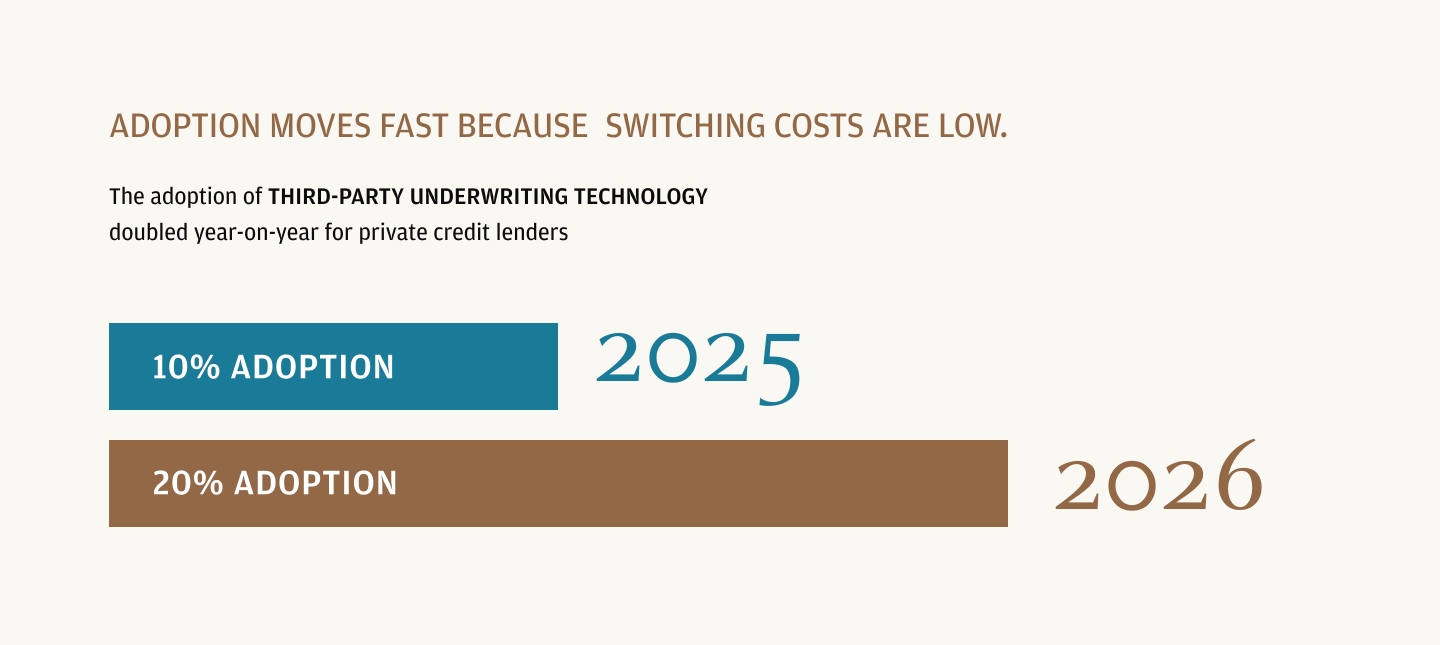
Infographic titled “Adoption moves fast because switching costs are low.” It states that adoption of third‑party underwriting technology doubled year over year for private credit lenders, increasing from 10% adoption in 2025 to 20% adoption in 2026, shown with two horizontal bars (shorter teal bar for 2025 and longer brown bar for 2026).
Alternative dataset usage rises
Alternative datasets are increasingly being used as sources for information to help private credit managers look beyond their traditional balance sheet-style analysis to assess borrower quality, liquidity resilience, and refinancing risk.
The LexisNexis Risk Solutions 2025 Alternative Credit Data Impact Report found that 67% of 875 lending professionals across 10 countries had “increased confidence in decisions supported by alternative data. Three-quarters of those surveyed say alternative data has improved portfolio performance, including earlier risk detection, more efficient workflows, and identifying more credit-worthy consumers.”2
Those responding to the survey reported using alternative data across areas as wide as acquisition, underwriting, account management and collections to reduce exposure. This enables them to identify risk earlier and reduce exposure. It also enables more confident decision making throughout the credit lifecycle. No surveyed institutions indicated plans to expand reliance on traditional data alone.
The types of alternative datasets being used in private credit analysis include resources such as payment flows, supply chain activity, receivables performance, and wider sector signals to determine whether a company is a good credit risk or not. But including these elements in underwriting models is not about faster credit approval. Instead, they help to identify early deterioration risk across portfolios that are inherently less liquid and often more difficult to price.
Kevin King, Vice President, Credit Risk, LexisNexis Risk Solutions, says: “Lenders today face unprecedented complexity in assessing creditworthiness. What was once viewed as supplemental is now essential and central to credit risk decisioning models. Lenders that fail to integrate alternative data earlier in the credit lifecycle risk falling behind in an increasingly complex environment. By bringing richer insights into decision making earlier, lenders can sharpen risk precision, improve portfolio performance, and responsibly expand access to credit for consumers who have historically had limited coverage in traditional credit scores and reports.”3
From hours to seconds: a transformational time saving
Reducing the time taken for data extraction, which would typically take around 45 minutes for one company, to just 30 seconds, is where the biggest time savings can be made. “That’s what we’re trying to do,” Gang says.
This has important implications for how teams operate, as analysts will be able to review more data points and respond more quickly to changes in credit quality, which improves the efficiency and capacity of the department. But the ambition is to go even further and apply machine learning to the analytical stage as well.
Gang says, “AI could take all the metrics that need to be analyzed and run them through a predictive model at the click of a button.”
Hsu adds, “When you can ingest a quarterly reporting package, normalize the financials, and flag covenant issues automatically, the analyst’s role fundamentally changes.”
Providing the space for analysts to use their skills in a more beneficial way with fewer time constraints can only be good for private credit teams. As machine learning evolves, the predictive capabilities will become even more powerful.
In a keynote speech, Philip R. Lane, Member of the Executive Board of the European Central Bank (ECB)45, highlighted the importance of these changes.
“If governed well, AI can strengthen risk assessment, improve operational resilience, and enhance efficiency. More granular data and stronger predictive capabilities can improve credit pricing. Better detection tools can enhance security and reduce losses. Over time, these improvements can support a more efficient allocation of credit and greater risk-bearing capacity. To the extent that it enables a more efficient allocation of credit and pricing of risk, it may also stimulate loan demand. Consistent with this, the dispersion of interest rates on new term loans has increased over time for banks reporting stronger AI adoption for credit scoring relative to other banks, in line with greater information availability for loan pricing.”6
Human expertise remains essential
These advances herald an exciting shift in analysis, but human expertise will continue to play a central role in credit analysis. Machine learning outputs still require interpretation, and experienced analysts need to assess whether the results being generated are accurate.
“Credit analysis is still, at its core, a judgment exercise. Machine learning can process large volumes of information, but it does not understand context the way an experienced credit professional does,” Kalia says.
Blindly trusting the model to provide the right answers would be a dangerous game, especially in the early stages. This is why “you need to make sure you always have people who can spot if it looks wrong,” Gang adds.
Any AI outputs must be reviewed, challenged, and traced back to their source, says Kalia, with clear guardrails around where automation stops, and human judgement begins.
Butti agrees and says close collaboration between analysts and Quant/ML Engineers is essential to ensure the accuracy of the model.
He adds, “Analysts contribute the domain expertise required to shape the model and encode the features they have observed over their careers, while both teams jointly review and challenge the outputs to iterate and refine the models over time."

Predictive modeling and the probability of default
Estimating the probability of default is where predictive models can be especially helpful, as proactive insights support more engaged risk management. By predicting where there is likely to be either a covenant breach or a default, risk management is augmented. The probability of default is “exactly what we’re trying to solve,” says Gang.
“If you have 100 companies in a portfolio, AI could give you a probability of default on each of them.”
This signposting points analysts towards where their attention is most needed, improving efficiency and supporting earlier intervention. Gang adds, “The analyst is going to start with the names that have the higher probability of default, and what we always want to do is predict defaults before they happen.”
Accuracy, reliability, and trust
Above all, machine learning models must be accurate consistently for them to be effective. Without this, they risk creating work rather than reducing it. Random answers that are inconsistent mean the model can’t be trusted, says Gang.
Yet trust in the model is non-negotiable. As Gabriele Butti, Global Head of Credit Quantitative Research at J.P. Morgan, says:
“Any model needs to gain the trust and the confidence of the user.”
So, significant effort is required to test, validate, and refine models before they can be used at scale, which further enforces the need for human intervention to ensure the model is sound.
Getting things wrong in private credit analysis can create serious consequences, especially if an incorrect figure flows into EBITDA, which then flows into leverage ratios and drives covenant compliance decisions, says Hsu. This is why firms must always have full control to stop the AI when it gives the wrong information.
Confidence and trust in the system are not always enough. Users also need to know the process itself is controlled in the right way.
The performance of machine learning models depends heavily on the volume and quality of data used to train them.
“Any model that we build in this space is always going to be better if it has access to more data and more high-quality data,” Butti says.
Given most data in private credit is usually confidential and highly sensitive, security becomes a major concern, which limits the systems available to private credit analysts. This is why the need to build proprietary systems is paramount.
Gang says:
“As good as ChatGPT is, I can’t open up ChatGPT and put my private stuff into it. We need to make sure everything is watertight from a legal and compliance perspective.”

A brave new world
The potential benefits of machine learning in private credit cannot be underestimated. It will create an environment where risk assessment can become more accurate, enabling the private credit sector to expand as analysts develop the capacity to use their skills in novel ways to explore new and exciting opportunities.
Where next for the human-in-the-loop?
Trust is a key part of the human-machine interaction. For this to be present there must be ethical considerations, but also human explainability—which is not always as easy as it sounds.
Deep learning algorithms that support AI systems can become so complex that even their developers struggle to explain how decisions are generated. This can make it difficult for regulators to assess the model, see how fair it is, and for its users to trust its decisions.
Gabriele Butti, Global Head of Credit Quantitative Research at J.P. Morgan has an additional caveat, as new groups of private credit analysts rely more on the capabilities that AI brings.
He says, “My concern is not even a short-term one. Let’s say these models can be wrong right now. But fast forward any number of years—who’s going to have the expertise to recognize a wrong output? When today we speak about the human in the loop, we implicitly assume that the human has the expertise to spot wrong outputs. But the human has that expertise because they created that in a world before the existence of this model. Who’s going to have the expertise 15 years from now?”
It’s clear, therefore, that benefits from advances in machine learning are unquestionable, but because of these considerations there is little chance it will fully replace human judgment and expertise. Analysts will need to continue to provide interpretation, oversight, and final decision making.
Do. More.
on J.P. Morgan Markets
Direct access to market leading liquidity harnessed through world-class research, tools, data and analytics.
Explore more themes
No results found
Adjust your filter selections to find what you’re looking for
FOR INSTITUTIONAL & PROFESSIONAL CLIENTS ONLY – NOT INTENDED FOR RETAIL CUSTOMER USE
This material has been prepared by J.P. Morgan Sales and Trading personnel and is not the product of J.P. Morgan’s Research Department. It is not a research report and is not intended as such. This material is provided for informational purposes only and is subject to change without notice. It is not intended as research, a recommendation, advice, offer or solicitation to buy or sell any financial product or service, or to be used in any way for evaluating the merits of participating in any transaction. Please consult your own advisors regarding legal, tax, accounting or any other aspects including suitability implications, for your particular circumstances or transactions. J.P. Morgan and its third-party suppliers disclaim any responsibility or liability whatsoever for the quality, fitness for a particular purpose, non-infringement, accuracy, currency or completeness of the information herein, and for any reliance on, or use of this material in any way. Any information or analysis in this material purporting to convey, summarize, or otherwise rely on data may be based on a sample or normalized set thereof. This material is provided on a confidential basis and may not be reproduced, redistributed or transmitted, in whole or in part, without the prior written consent of J.P. Morgan. Any unauthorized use is strictly prohibited. Product names, company names and logos mentioned herein are trademarks or registered trademarks of their respective owners. The products and/or services mentioned herein may not be suitable for your particular circumstances and may not be available in all jurisdictions or to all clients. Clients should contact their salespersons at, and execute transactions through, a J.P. Morgan entity appropriately licensed in the client’s home jurisdiction unless governing law permits otherwise. Past performance is not indicative of future results. All services are subject to applicable laws, regulations and service terms. This material is a “solicitation” of derivatives business only as that term is used within CFTC Rule 1.71 and 23.605. Where this material is an “investment recommendation” as that term is defined in MAR visit: www.jpmm.com/#mardisclosures. This material is subject to terms at: www.jpmorgan.com/salesandtradingdisclaimer.
© 2026 JPMorgan Chase & Co. All rights reserved.
J.P. Morgan is a marketing name for investment banking businesses of JPMorgan Chase & Co. and its subsidiaries and affiliates worldwide. Bank products and services, including certain lending, derivative and other commercial banking activities, are offered by JPMorgan Chase Bank N.A. (JPMCB), including through its authorized branches and other global affiliates registered with local authorities as appropriate. Securities products and services, including execution services, are offered in the United States and in other jurisdictions worldwide by J.P. Morgan Securities LLC (JPMS LLC), in EMEA by J.P. Morgan Securities plc (JPMS plc) and J.P. Morgan SE (JPM SE) and in other regions by other appropriately licensed global affiliates. JPMCB, JPMS LLC, JPMS plc and JPM SE are principal subsidiaries of JPMorgan Chase & Co. For information on which legal entities offer investment banking and securities products and services in each jurisdiction, please consult: https://www.jpmorgan.com/disclosures/investment-bank-legal-entity-disclosures#securities-transactions
For additional regulatory disclosures, please consult: www.jpmorgan.com/disclosures.