
Key takeaways
- Complexity may make electronic workflows more valuable, not less.
- As AI lowers the barrier to automation, proven platform controls become essential.
- Voice trading plays a vital role in larger, more bespoke, or harder-to-source trades.
Electronic trading platforms have existed for more than half a century, but the evolutionary pace of change continues to accelerate as the needs of institutional traders, and the markets more widely, become ever more sophisticated.
Even though e-trading began around 55 years ago, it was the advent of the internet that created the biggest acceleration in the development of e-trading platforms, with FX platforms leading the way. This is partly due to the fungibility of FX trades, says Andrew Cole, Head of Execute Product at J.P. Morgan.
he adds:
“If you’re trading euro/US dollar, you’re swapping two currencies. Then, if someone comes in and wants euros, and you’re still holding euros, you can make that transaction. Relatively speaking, there are a lot of ways to get in and out of a position in FX because there are a bunch of other currencies you can cross it with. Whereas if you’re selling 10-year treasury bonds, you need someone that wants 10-year treasury bonds.”
From the advent of the internet onwards, e-trading platform growth has been relentless. And other catalysts along the way have boosted technological advancements, such as the Covid lockdowns, which created significant advancement in the last five years.

Patrick Whelan, Global Head of FICC Digital Markets at J.P. Morgan, says: “Covid did have an impact across the OTC markets, more broadly, where everybody needed solutions that allowed them to get pricing, book things, do things differently, and people got comfortable doing it. Once that happened, it also gave a leg up to some of the more OTC products that had traditionally been traded by voice. It also added a lot more to the volatility in general, like the number of tickets that people were having to handle. If you look at somewhere like repo, which is a fixed buying space, the volume of tickets that has been generated in the last five years has increased substantially. You’re talking 30,000 to 40,000 tickets a month being handled by salespeople manually at one stage, maybe two years ago.”
Since then, volumes have gone up considerably, with anything from 70,000 to 90,000 tickets a month being dealt with through voice and single dealer platforms. This boosted the need for workflow efficiencies, where pricing, liquidity, execution and reporting need to be in line with client needs, says Whelan.
Nina Suhaib-Wolf, Senior Director, Market Practice and Regulatory Policy, ICMA, says electronic trading volumes actually reduced during Covid, as the market became very illiquid, which meant market participants returned to bilateral and voice trading methods during this time.
She adds:
“Interestingly, this feature didn’t repeat itself in more recent events such as the Ukraine invasion, or the introduction of tariffs by the current US administration, where electronic trading levels remained constant. This can perhaps be explained by algorithms becoming more robust and resistant recently, and the Covid pandemic arguably being a larger shock to the system.”
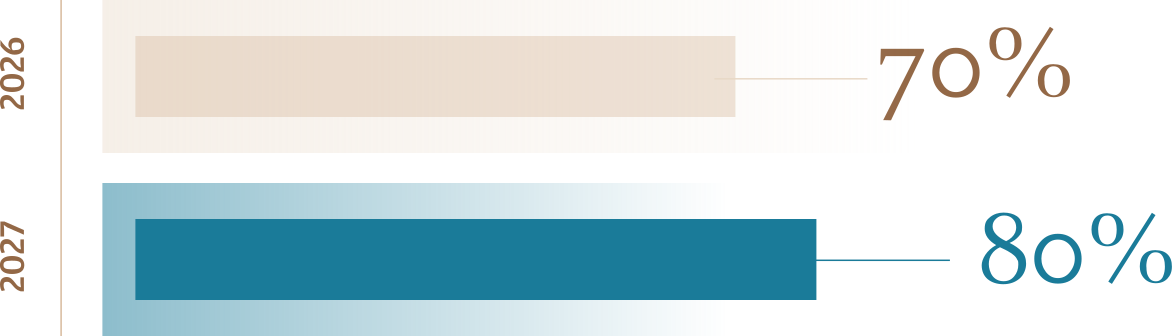
Horizontal bar chart comparing two years: 2026 shows 70% (light beige bar) and 2027 shows 80% (dark teal bar), with 2027 higher than 2026.

The growing dominance of e-trading
The J.P. Morgan Markets e-Trading Survey results from 2022, which came just as the world was beginning to recover from the Covid crisis, showed 78% of traders were intending to use e-trading more in that year, while 63% were intending to increase their amount of algorithmic trading.
The results from the 2026 survey show that electronic channels are expected to account for 70% of trading activity in 2027, compared to 60% in 2026. The most popular response—40% of those surveyed—use both a single dealer and a multi-dealer platform to trade, and 22% of all the respondents say the ease of access to a platform and the experience, is the main factor in their choice. This is closely followed by advanced analytics and tools, cited by 20% as important.
E-trading capabilities continue to grow across all asset classes, but the speed of growth isn’t even. Some sectors, such as FX, are around 95% electronically traded now, with just 5% executed via voice trades. At the other end of the scale, credit is only around 40% electronically traded, because of the complexity of the product and the greater need for human intervention.
Cole says:
“It isn’t surprising that the last markets to fully embrace electronification, such as credit, are where you have thousands of different instruments that aren't fungible.”
While the majority of open outcry pits have been closed in favor of e-trading, there are still examples of trading floors that, while less busy than in recent years, are still available, says Todd Hohman, Managing Director of SEDA Experts. These include the Chicago-based Cboe SPX and VIX options pits, where, when the complexity or the size of a trade warrants it, trades can be done face-to-face.
Hohman adds:
“If a large institution has a big, complicated trade that’s billions of dollars in notional, they’re not going to just drop that into an electronic trading system. There’s going to be a sourcing of liquidity, and a lot of humans are still involved in that process. But when it comes to the eventual execution of the child orders of that transaction, almost 100% will hit an electronic trading system.”
“So, there’s dealing that still happens at a manual level, but the transactional level, and some portion of the trade life cycle, will almost always hit an electronic system.”
The uneven growth pattern of e-trading
In both the UK and Europe, e-trading in sovereign bonds has increased substantially in the last few years, according to Nina Suhaib-Wolf, Senior Director, Market Practice and Regulatory Policy, ICMA. Off-venue trading has fallen by a further 10% to 41% between 2022 and 2025. Over the same period, electronic trades of sovereign bonds rose by 59%.1
However, this isn’t the whole story. Suhaib-Wolf says: “If we look at the distribution channel by trade sizes, we can see that for tickets below €1m, around 65% of trades were traded electronically vs 35% off-venue in H1 2025. These numbers then change with trade sizes going larger.”
“For example, for ticket sizes between €5-10m, around 55% of all trades are traded off-venue and 45% electronically, and it’s around a 60%/40% split off-venue vs electronic in trade sizes of €25-50m. So, unsurprisingly, our data suggests that smaller trade sizes correlate more closely with an increased use of electronic trading.”
E-trading on the credit side has also increased. Around 60% of overall trades were executed electronically, in H1 2025, with 40% conducted off venue. But again, the larger the trade size gets, the less likely it’s to be executed electronically.
Suhaib-Wolf says: “Overall, there is an ongoing trend towards more electronification, but it’s important to distinguish between different sub-bond classes, and importantly, between the different trade ticket sizes.”
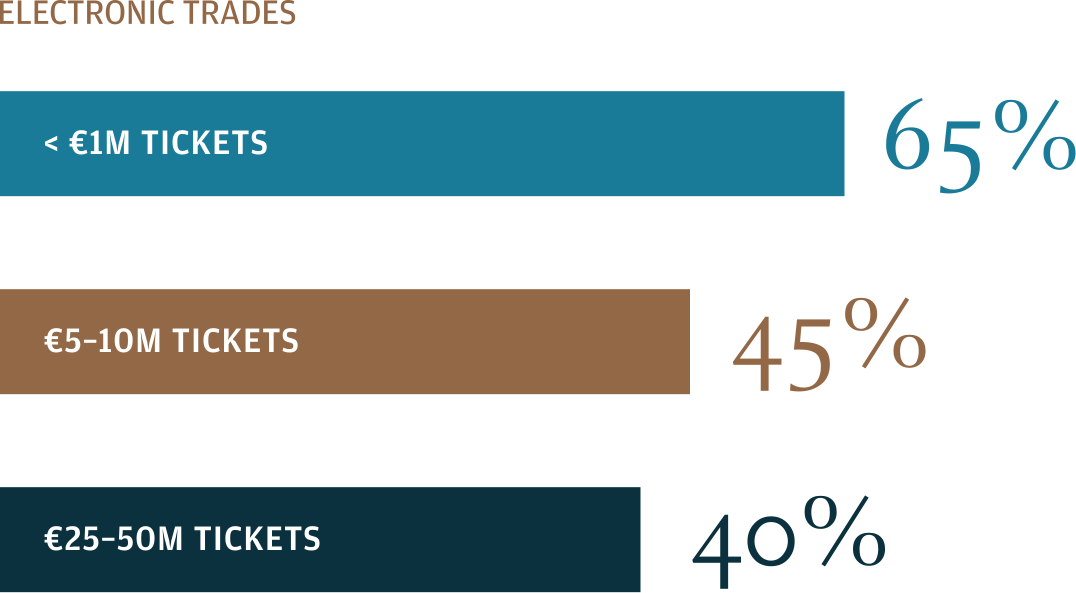
“Electronic Trades” horizontal bar chart showing the share of trades executed electronically by ticket size: under €1M tickets 65%, €5–10M tickets 45%, and €25–50M tickets 40%.
Humans vs machines
This desire to still work with another human rather than a machine to deal with larger or more complex trades is supported by evidence collected on trading volumes by the ICMA (see box). But this may change over time, as e-trading and additional tools surrounding it, such as LLMs, become more integrated. But there are times when it can be beneficial to deal with more complex trades through an electronic platform.
Cole says: “Derivatives is an area where a third-party platform at any level is just a technology vendor, and if you're trading in something complicated, where the fields are very interlocked with each other, you know the way that a derivative trades. Even on a simple swap, there are 20 plus parameters that can change, and the way they change is all linked.”
“So, if I change it from this currency to that currency, if I change the accrual tenors concept from this to that: everything is linked in a very complicated way and replicating that complexity on a third-party platform is hard. It’s also hard for clients to transact some of those things via voice, even via chat, because there’s a lot of complexity to explain. And if you want to hedge something in a particularly creative way, with the data and the modeling and the LLM, the way clients are going to hedge things is going to continue to get more complicated.”
“The more complicated the product, the better it suits electronification. That reflects the fact that clients want the peace of mind of knowing if they can see the structure, they can model it as they want. They can check the parameters. They can really be very specific about the product definition.”

How the divergence of liquidity boosted e-trading
Liquidity has consistently been a main market structure concern throughout the 10 years of the J.P. Morgan Markets e-Trading Survey, which is understandable since it’s an essential part of the trading process.
In the 2010s, there was a big divergence of liquidity, with less concentration of liquidity on one or two venues, and an increase in the number of venues where liquidity grew, says Andrew Cole, Head of Execute Product at J.P. Morgan.
He adds:
“That led to growth in algo trading, which in the 2010s was a big theme. We built those algos for our traders to use because they had to grapple with liquidity being all over the place. And clients also benefited from those tools as we rolled them out, and that had an impact on the way people traded.”
Alongside these new tools, there was a necessary period of education as e-trading platforms took hold, fundamentally changing the entire nature of trading. Suddenly, it was possible to contact 20 dealers at once – and everyone thought it was a great idea, says Cole.
He adds: “You have to explain to your client that if you go into the market with a specific request, and everyone knows it’s out there, you’re going to have market impacts. Then people start diving back in again and putting in tools to allow them to select dealers more effectively.”
Thanks to this realization, third parties built a further series of tools to generate a “rules engine” to control how many dealers these requests would be going to. But this again creates a need for education about the way to interact with these tools.
Cole says: “For every electronification that enables traders to do good things, there’s a counter way where we educate them on why that’s not the right way to do things. And there’s a push-pull between the venues that are desperate to implement things that get clients to trade on that platform, versus the bank participants on those venues that say: ‘Actually, this thing you’re doing is detrimental to the market.’”
Compliance risks in the world of agentic AI
The speed of trading has increased phenomenally through e-trading, and compliance has had to run to keep up as e-trading became mainstream. This hasn’t always been an easy task.
Hohman says: “Manually dealing with something is very, very, slow vis-à-vis the speed of trading. At the hyperspeed end, certain groups are trying to shave nanoseconds off their trades, sometimes even picoseconds from their trading algorithms. As humans, the fastest we can react to something is maybe 100 milliseconds. And we’re obviously not going to do that in a trading environment—we’re going to take seconds. Compliance had to keep up with market electrification, dramatic growth in transaction volumes, and expanding algorithmic complexity. They had to enhance their electronic capabilities as well, and they did that admirably, they started digging into the new types of data and had to build systems able to keep pace with electronic evolution.”
“They also had to start enforcing rules that used to be more physical in an electronic space. One example is the separation between client position and order information, and proprietary trading systems. In the human world, you just sat those two desks on different floors and told them not to talk to each other. When you’re in an electronic space, you must build systems that enforce that separation and can monitor and test that separation.”
Ironically, the compliance risk, which had reduced in some ways thanks to the electronification of trading platforms, may now rise as AI creates scenarios where less experienced people can build systems more quickly.
Hohman adds: “The development of automation used to be relatively slow and required serious expertise. You had to have experienced programmers, and sensitive changes took days, weeks, sometimes even months of coding and testing before you rolled something out. But with the improvements in AI, and especially agentic AI making the automation of processes more accessible across the sophistication spectrum, we’ll see non-experts leaning in, perhaps inadvertently and too quickly, without the awareness or the expertise to properly manage this operational risk.”
That’s all down to the nature of a big technology change like this, he continues. “People want to move fast. New organizations come in, and they just don’t have the awareness or the expertise of veteran organizations. These electronically experienced banks, hedge funds and trading firms touched the hot stove on their own many times, and they’re more disciplined about funding and implementing operational risk controls from the get-go, on a regular basis. Whereas new, fast-moving, small entrants, perhaps facilitated by expanded AI capability, don’t have this corporate experience of having been burned.”
Even though these developments are undoubtedly exciting, Hohman urges a cautious approach. “I foresee additional operational risk in this space while we move through this transition,” he says.
Do. More.
on J.P. Morgan Markets
Direct access to market leading liquidity harnessed through world-class research, tools, data and analytics.
Explore more themes
No results found
Adjust your filter selections to find what you’re looking for
FOR INSTITUTIONAL & PROFESSIONAL CLIENTS ONLY – NOT INTENDED FOR RETAIL CUSTOMER USE
This material has been prepared by J.P. Morgan Sales and Trading personnel and is not the product of J.P. Morgan’s Research Department. It is not a research report and is not intended as such. This material is provided for informational purposes only and is subject to change without notice. It is not intended as research, a recommendation, advice, offer or solicitation to buy or sell any financial product or service, or to be used in any way for evaluating the merits of participating in any transaction. Please consult your own advisors regarding legal, tax, accounting or any other aspects including suitability implications, for your particular circumstances or transactions. J.P. Morgan and its third-party suppliers disclaim any responsibility or liability whatsoever for the quality, fitness for a particular purpose, non-infringement, accuracy, currency or completeness of the information herein, and for any reliance on, or use of this material in any way. Any information or analysis in this material purporting to convey, summarize, or otherwise rely on data may be based on a sample or normalized set thereof. This material is provided on a confidential basis and may not be reproduced, redistributed or transmitted, in whole or in part, without the prior written consent of J.P. Morgan. Any unauthorized use is strictly prohibited. Product names, company names and logos mentioned herein are trademarks or registered trademarks of their respective owners. The products and/or services mentioned herein may not be suitable for your particular circumstances and may not be available in all jurisdictions or to all clients. Clients should contact their salespersons at, and execute transactions through, a J.P. Morgan entity appropriately licensed in the client’s home jurisdiction unless governing law permits otherwise. Past performance is not indicative of future results. All services are subject to applicable laws, regulations and service terms. This material is a “solicitation” of derivatives business only as that term is used within CFTC Rule 1.71 and 23.605. Where this material is an “investment recommendation” as that term is defined in MAR visit: www.jpmm.com/#mardisclosures. This material is subject to terms at: www.jpmorgan.com/salesandtradingdisclaimer.
© 2026 JPMorgan Chase & Co. All rights reserved.
J.P. Morgan is a marketing name for investment banking businesses of JPMorgan Chase & Co. and its subsidiaries and affiliates worldwide. Bank products and services, including certain lending, derivative and other commercial banking activities, are offered by JPMorgan Chase Bank N.A. (JPMCB), including through its authorized branches and other global affiliates registered with local authorities as appropriate. Securities products and services, including execution services, are offered in the United States and in other jurisdictions worldwide by J.P. Morgan Securities LLC (JPMS LLC), in EMEA by J.P. Morgan Securities plc (JPMS plc) and J.P. Morgan SE (JPM SE) and in other regions by other appropriately licensed global affiliates. JPMCB, JPMS LLC, JPMS plc and JPM SE are principal subsidiaries of JPMorgan Chase & Co. For information on which legal entities offer investment banking and securities products and services in each jurisdiction, please consult: https://www.jpmorgan.com/disclosures/investment-bank-legal-entity-disclosures#securities-transactions
For additional regulatory disclosures, please consult: www.jpmorgan.com/disclosures.