Key takeaways
- Despite unprecedented wealth gains, housing affordability in the U.S. is at multi-decade lows, with factors including tight inventory and high mortgage rates pricing buyers out of the market.
- Recent U.S. policy actions such as the passage of the 21st Century ROAD to Housing Act and the purchase of agency mortgage-backed securities (MBS) have provided limited relief.
- Beyond the U.S., housing affordability is very much a global story. For instance, China remains in a prolonged housing reset, while affordable housing is losing market share in India.
Housing affordability has reached a critical inflection point across global markets. Factors including chronic supply-demand imbalances are putting upward pressure on house prices, creating positive wealth effects for homeowners but amplifying difficulties for buyers. “Housing affordability remains the most enduring post-pandemic challenge to the cost of living, with homeownership increasingly out of reach,” said Joyce Chang, chair of Global Research at J.P. Morgan.
How are these issues playing out in the U.S. and international markets — and is relief in sight?
“Housing affordability remains the most enduring post-pandemic challenge to the cost of living, with homeownership increasingly out of reach.”

Joyce Chang
Chair of Global Research, J.P. Morgan
Real home prices have risen over the last decade
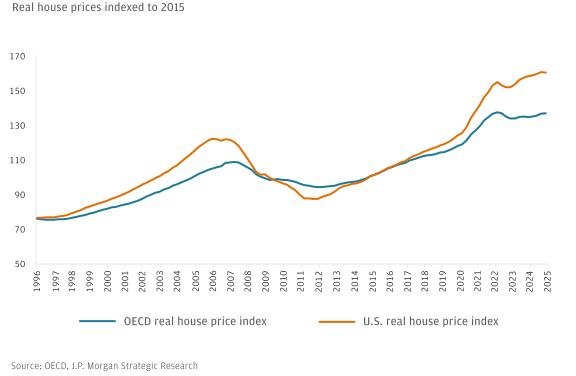
Real home prices in the U.S. and OECD countries have risen over the last decade.
Housing affordability in the US is at historical lows
Buyers continue to be priced out of the market
Despite unprecedented wealth gains, housing affordability in the U.S. is at its lowest level since the 2008 global financial crisis. The Atlanta Fed’s Housing Ownership Affordability Monitor (HOAM) shows that buying a median-priced home in the U.S. requires 43% of the median household income — significantly above the 30% threshold traditionally considered affordable. And in 2025, the income needed to afford a median-priced home topped $100,000 in 169 of the country’s 387 metro areas, compared with just 31 metros in 2020.
“Owning remains more expensive than renting in most major metro areas, and affordability constraints are hitting first-time and under-35 buyers hardest,” noted Bennett Parrish, an economist at J.P. Morgan. While the national homeownership rate stood at 65% in the second quarter of 2026, homeownership for the under-35 cohort was just 35.2%.
This is largely due to a chronic supply-demand imbalance in the U.S. housing market, which is more acute in some regions than others. “Scarce for-sale inventory and a slow, uneven construction recovery have kept affordability stretched and continue to price out many first-time buyers. Supply has increased only incrementally, while demand remained muted through 2025, leaving the imbalance persisting into 2026,” Chang said. “But there is meaningful regional variation — for instance, home prices are falling most along the West Coast and in parts of the Sun Belt, where pandemic-era construction left pockets of excess new home inventory.”
Mortgage rates, which remain above 6%, are compounding the affordability shock through the so-called “lock-in effect”: homeowners with low existing rates have little incentive to sell, since buying a new home would require taking on significantly higher financing costs. This is in turn keeping existing supply off the market. “Looking ahead, we see 10-year Treasury yields hitting 5.05% by the end of 2026, while the average 30-year fixed mortgage rate has surged to nearly 7%,” noted Jay Barry, head of Global Rates Strategy at J.P. Morgan.
Beyond mortgage rates, rising non-mortgage costs are adding to the ownership burden. Insurance premiums have outpaced inflation for the last two decades, reflecting greater exposure to natural disasters, higher repair and reconstruction costs, supply-chain disruptions and continued population shifts into disaster-prone regions. In 2025, average annual property insurance payments rose 6.6% to hit an all-time high. “First-time homebuyers now face a much higher inflation-adjusted cost of ownership than a household that purchased 20 years ago at the same mortgage rate,” Chang said.
Overall, U.S. housing prices are expected to remain elevated for the foreseeable future. “We expect home prices to remain flat overall in 2026 and to rise 3% in 2027,” said John Sim, head of Securitized Products Research at J.P. Morgan.
Housing in the US is becoming increasingly unaffordable
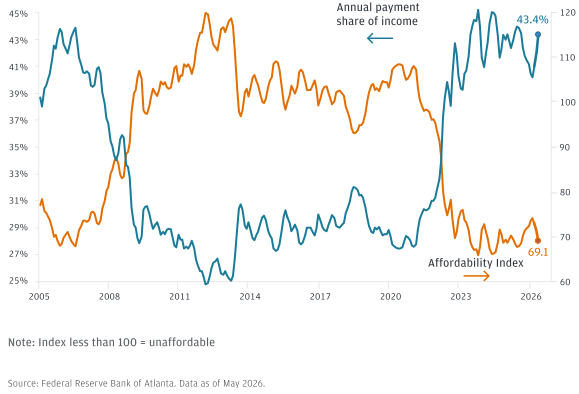
According to the Atlanta Fed, owning a median-priced home in the U.S. now requires 43% of the median household income. In addition, the Affordability Index hit 69.1 in June, indicating that housing is highly unaffordable.
Affordability is similarly stretched for renters
While the U.S. rental market is unwinding from historically tight conditions as new multifamily supply improves, this is not translating into broad affordability relief. The Federal Reserve reports that 23% of renters were behind on their rent at some point in the past year, up 6 percentage points from 2021.
As with the for-sale market, rent trends vary by region:
- Sun Belt: Phoenix is experiencing an oversupply of rental properties, especially new high-end apartment stock built during the pandemic-era boom. Austin is posting the steepest rent drop among major metros; median rent is down 5.1% year over year and more than 20% below its 2022 high.
- West Coast: In contrast, the Bay Area is seeing the strongest rent gains. Rents in San Francisco and San Jose are up 6.3% and 5.4% year over year respectively, supported by the AI-driven expansion in high-paying technology jobs.
Overall, rental housing in the U.S. remains unaffordable across the income spectrum. According to the Joint Center for Housing Studies (JCHS), steeper construction costs for new units and rent increases on existing units have shifted the rent distribution higher. At the same time, consumers deterred by homeownership affordability challenges continue to prop up rental demand. “While states and cities are loosening regulations — including zoning reforms — to boost supply, rent increases have still outpaced income growth,” Chang noted.
Policy fixes have not solved the affordability problem
Affordable housing has become a key political issue in the U.S., with more policy actions being taken to address the crisis. These include:
- 21st Century ROAD to Housing Act: The legislation, which became law in July 2026, had broad bipartisan support and includes more than 40 provisions aimed at boosting housing affordability, such as prohibiting large institutional investors from buying single-family homes.
- Purchase of agency mortgage-backed securities (MBS): The Trump administration issued a directive for government-sponsored enterprises (GSE) Fannie Mae and Freddie Mac to purchase $200 billion of agency MBS, aimed at lowering interest rates.
While the passage of the ROAD to Housing Act is an important first step, there are concerns about its implementation, funding and scope. Many provisions still require agencies to write rules, provide guidance, conduct studies and launch new programs — work that will likely take 12 to 24 months or longer. Moreover, the package doesn’t include dedicated funding as it is designed to not increase the deficit; many of the provisions depend on future funding from Congress. It also does not override local zoning laws, leaving zoning decisions to states and local communities rather than the federal government.
“While the ROAD to Housing Act takes steps to reduce the regulatory burden and improve mortgage access, we do not see the current actions meaningfully changing supply dynamics, reducing home prices or lowering mortgage rates over the near term,” said Mohammed Hossain, who is part of the Strategic Research team at J.P. Morgan. “Its effectiveness will depend on follow-through by agencies, Congress and state and local partners.”
Similarly, the GSE directive has had minimal impact so far, given the size of purchases needed to move rates materially. “We remain skeptical of proposals to lower mortgage rates through policy changes at Fannie Mae and Freddie Mac. This is unlikely to provide significant relief to mortgage borrowers as elevated Treasury yields — the primary benchmark for mortgage rates — make it difficult to get mortgage rates below 6%,” Chang said.
“Additionally, the GSEs only have so much cash on hand from their retained earnings, making it hard for them to push mortgage rates below 6% on their own,” added Nick Maciunas, head of Agency MBS research at J.P. Morgan.
Beyond the public sphere, the private sector is also taking action. For instance, JPMorganChase recently announced a new $750 billion investment in affordable housing as part of its American Dream Initiative. “This reinforces our view that policy solutions will increasingly be formed across sovereigns, sectors and companies,” Chang said.
Homeownership as part of the American Dream
Launched in March 2026, JPMorganChase’s American Dream Initiative includes a $750 billion investment to increase housing supply and support homeownership in the U.S. This capital, which will be deployed through 2035, will go toward financing 1,000,000 affordable housing units and helping 500,000 customers (including 200,000 first-time homebuyers) purchase homes.
Housing affordability is a global story
Beyond the U.S., the housing affordability crisis is very much a global phenomenon, with markets grappling with differing problems that require localized solutions.
India: Affordable housing loses share
India’s housing cycle is being pulled higher by premium demand, even as affordable housing loses share. Housing sales value across the top seven Indian markets rose 16% year over year in July (7% year over year on a 12-month rolling basis).
“Wealthy domestic buyers and the non-resident Indian community continue to drive demand for larger homes and higher-quality lifestyle offerings. The premium end of the market remains the backbone of supply by top-tiered developers, while ultra-luxury and high-end tiers punch above their historical weight,” said Gaurav Khandelwal, who covers India Financials and Property at J.P. Morgan.
At the other end of the spectrum, affordable housing is likely to shrink further as a share of overall activity, squeezed by rising land values and elevated building costs in the country’s eight largest cities. New affordable housing has declined to just 6% of total launches, down from 52% in 2018. In addition, the EMI-to-income ratio (equated monthly installment, or debt payments as a share of income) for budget buyers has increased from 43% to 60%, suggesting that affordable housing is becoming further out of reach for the lower-income segment.
Australia: Down from cyclical peaks
Australia’s housing market is slowing, with the effects showing up in lower turnover, weaker prices and a gradual shift in ownership composition.
“Housing policy changes to negative gearing — no longer allowing rental property losses to be deducted against other taxable income — have weakened property market sentiment and pushed auction clearance rates lower, a historically strong signal for home price growth,” explained Tom Kennedy, an economist at J.P. Morgan. “This reform should lower willingness to pay for established dwellings and gradually tilt demand away from investors and toward first-time homebuyers.”
In the rental market, the supply pipeline for new units has strengthened, with the number of dwellings already under construction moving higher. Additionally, net overseas migration has fallen more than 40% from its post-COVID peak. Taken together, these factors should help ease upward pressure on residential rents.
“Overall, Australia’s housing market is moving into a more subdued phase compared with its cyclical peak in 2022, with affordability pressures, higher rates and tax uncertainty narrowing the buyer pool,” Kennedy added.
Canada: Recovery is stalling
Canada’s housing recovery continues to be pushed out as high fixed mortgage rates and construction costs weigh on activity. The Canadian Real Estate Association recently downgraded its 2026 outlook for home sales and expects the national average home price to rise 1% year over year, reflecting a weak first half.
Affordability pressures and limited supply are constraining not only prospective homebuyers and renters, but also the broader real estate market. In response, recent policy adjustments and government initiatives have been rolled out to boost affordable housing. For instance, the federal launch of Build Canada Homes prioritizes innovative construction techniques like prefabricated and modular building to shorten delivery timelines, lower per-unit costs and mitigate labor constraints, which could improve the scalability of supply.
China: A prolonged housing reset
China’s housing market remains in a multi-year downturn, with excess supply, weak homebuyer confidence and expectations of further price declines weighing on demand. Today, the market is undergoing a prolonged, largely quantity-led adjustment rather than a broad-based recovery.
Tier 1 markets are outperforming, led by Shanghai and Shenzhen, but the improvement remains narrow. Beijing has lagged, while lower-tier cities continue to face significant oversupply and downward price pressures. Nationwide, new-home prices were 14.2% below their 2021 peak in August, while secondary-home prices were down 23.3%.
“The relative resilience of selected Tier 1 markets is encouraging, but it does not yet signal a broader recovery,” said Karl Chan, head of Mainland China/Hong Kong property equity research at J.P. Morgan. “Sustained stabilization could support confidence at the margin, but implementation of the latest reforms is uncertain, and developers are likely to remain cautious on land acquisition.”
The housing downturn is therefore likely to persist. “Excess supply is still meeting impaired demand, and the early signs of stabilization remain too narrow to mark a national turnaround,” said Feng Zhu, chief China economist at J.P. Morgan. This is demonstrated in the latest data: in August, residential floor space starts fell 31.3% versus one year ago, sales declined 16.2% and developers’ funding sources contracted 26.8%.
“The latest reforms should improve buyer protection over time, but the shift away from pre-sales will slow developers’ cash conversion and reinforce the sector’s structural downsizing,” Zhu added. “A convincing stabilization would require sustained improvement in sales, prices and inventories beyond selected Tier 1 cities, alongside broader balance-sheet repair.”
“In China’s housing market, excess supply is meeting impaired demand, leaving early signs of stabilization too narrow to mark a national turnaround.”

Feng Zhu
Chief China economist, J.P. Morgan
What’s next for global housing markets?
Ultimately, housing affordability is being squeezed by similar core forces across global markets: chronic supply constraints colliding with elevated financing and ownership costs, leaving both buyers and renters stretched even where conditions are starting to cool.
However, regional variations underscore why localized approaches are essential. Looking ahead, improvements will most likely be incremental and uneven, driven by sustained supply-side measures and targeted policy actions — with close coordination required across the public and private sectors. For many, the long road home is only just beginning.
Related insights
-
Global Research
Home prices remain stubbornly high amid chronic supply constraints, but a new federal statute could offer buyers some relief.
-

Real Estate
2026 multifamily market update for real estate investors
August 11, 2026
Take a closer look at what multifamily investors in cities across the country can expect in the months ahead.
-

Capitalize on opportunities and prepare for challenges throughout the real estate cycle.