Key takeaways

  • J.P. Morgan Global Research is positive on global equities for 2026, forecasting double-digit gains across both developed markets (DM) and emerging markets (EM).
  • Looking at the economy, J.P. Morgan Global Research forecasts a 35% probability of a U.S. and global recession in 2026, and sticky inflation will likely remain a prevailing theme.
  • Most DM central banks are expected to either stay on hold or conclude their easing cycle in the first half of the year.
  • While J.P. Morgan Global Research continues to be bearish on the dollar for 2026, it is moderately bullish on the euro.

“We expect the global economy to remain resilient in 2026, with AI investment continuing to drive market dynamics and support growth.”

What’s the overall outlook for global markets in 2026?

The year ahead will likely be defined by the collision of uneven monetary policy, the relentless expansion of AI and intensifying market polarization. These drivers, along with the evolving U.S. policy agenda, will continue to reshape the global macro and market landscape.

“At the heart of our outlook is a multidimensional polarization: equity markets split between AI and non-AI sectors, a U.S. economy balancing robust capex with soft labor demand, and a widening divide in household spending,” said Dubravko Lakos-Bujas, head of Global Markets Strategy at J.P. Morgan.

All things considered, J.P. Morgan Global Research sees a resilient global growth outlook for 2026 thanks to factors including front-loaded fiscal policy support. However, downside risks remain elevated, given weak business sentiment and the ongoing slowdown in the labor market. At the same time, the tailwinds of 2025 — such as healthy balance sheets for corporates and households, ample liquidity and the broadening of AI capex spending — will likely persist in 2026, driving earnings expansion.

“Overall, the market environment remains fragile, and investors must navigate a landscape where risk and resilience coexist,” added Fabio Bassi, head of Cross-Asset Strategy at J.P. Morgan.  

“At the heart of our outlook is a multidimensional polarization: equity markets split between AI and non-AI sectors, a U.S. economy balancing robust capex with soft labor demand, and a widening divide in household spending.”

Equity markets

J.P. Morgan Global Research is positive on global equities for 2026, forecasting double-digit gains across both developed markets (DM) and emerging markets (EM). This bullish outlook is buttressed by factors including robust earnings growth, lower rates, declining policy headwinds and the continued rise of AI.

“The AI-driven supercycle is fueling record capex and rapid earnings expansion. This momentum is spreading geographically and across a diverse list of industries, from technology and utilities to banks, healthcare and logistics, creating winners and losers in the process,” Lakos-Bujas observed.

Indeed, AI could further amplify polarization within an already unhealthy K-shaped economy, and market concentration could reach new highs as a result. “In such an environment, broad sentiment measures remain prone to sharp swings, even though underlying trends remain intact and fundamentals solid,” Lakos-Bujas said. 

Regional outlooks 

In 2026, style positioning will likely resemble 2025, with new extremes in crowding, record concentration and a “winner-takes-all” dynamic. Looking at the S&P 500, J.P. Morgan Global Research estimates the AI supercycle driving above-trend earnings growth of 13–15% for at least the next two years.

Activity momentum in the eurozone is likely to improve in 2026, thanks to better credit impulse and the rollout of fiscal stimulus. Earnings are expected to grow by 13%+ next year, supported by stronger operating leverage, reduced tariff headwinds, easier comps and better financing conditions.

Sanaenomics — the economic policies of new Japanese Prime Minister Sanae Takaichi — and corporate reforms will likely propel Japanese equities in 2026. Businesses will likely focus on unlocking excess cash, which could in turn fuel capital investment, wage growth and shareholder returns. In addition, Sanaenomics is expected to revive middle-class spending and strategic investments, providing tailwinds for the market.

EM equities are positioned for robust performance in 2026, boosted by lower local interest rates, higher earnings growth, attractive valuations, ongoing improvements in corporate governance, healthier fiscal balance sheets and resilient global growth. China could see green shoots emerging in the private sector after a multi-year slowdown, while Korea remains supported by governance reforms and AI. Elsewhere, LatAm could experience strong upside thanks to outsized monetary policy stimulus and key political shifts. 

The global economy

The global expansion is at an important juncture. While GDP growth has been resilient through 2025, imbalances have formed as demand has rotated toward tech capex and job gains have stalled.

“Business caution is the primary drag on hiring, reflecting trade war concerns and sluggish non-tech demand. In turn, weak labor demand is starting to erode purchasing power, particularly in the U.S., where softening private sector labor income growth is combining with firming inflation and a concentrated near-term public sector drag,” said Bruce Kasman, chief global economist at J.P. Morgan.

To this end, J.P. Morgan Global Research sees consumption downshifting in DM in the fourth quarter of 2025, with a 35% probability of a U.S. and global recession in 2026. However, global GDP growth is expected to receive a boost in the first half of the year thanks to front-loaded fiscal stimulus, promoting a rebound in sentiment.

“Our baseline forecast sees the health of the business sector, supportive financial conditions and fiscal stimulus as the ingredients that will enable the global economy to absorb the sentiment shock currently depressing labor demand. If we are right, job growth and sentiment will pick up as we move through the first half of 2026, supporting the recoupling of labor demand with solid GDP gains,” Kasman noted. In addition, an AI spending wave could deliver a limited boost to the global economy.  

Sticky inflation will likely remain a prevailing theme. After unwinding supply shocks related to the pandemic and the Russia-Ukraine war, inflation has hovered around 3% with little sign of moving lower. “Upward pressure on global goods prices related to the trade war is likely to be transitory, but we expect elevated goods price pressures to remain in place, at least through the first half of 2026,” Kasman added. 

Global outlook scenarios 
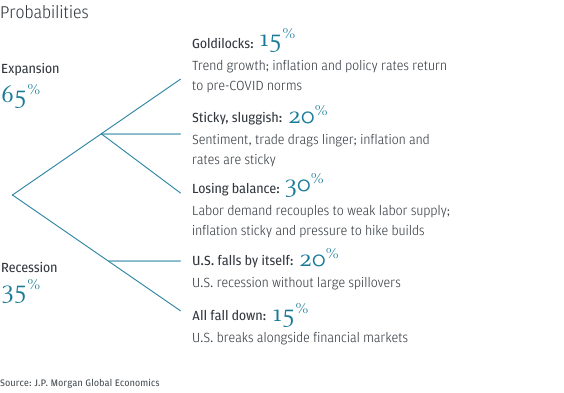
Infographic depicting global outlook scenarios for 2026, including a 35% probability of a U.S. and global recession.

Rates

J.P. Morgan Global Research assumes growth will run at or above potential across most DMs in 2026, and that inflation will continue declining — albeit remaining sticky in several jurisdictions. This could create a further decoupling in monetary policy outcomes: for instance, the Federal Reserve (Fed) is expected to cut rates by another 50 basis points (bp), while the Bank of Japan (BoJ) is expected to hike by the same amount. Elsewhere, most DM central banks will likely either stay on hold or conclude their easing cycle in the first half of the year.

However, risks surrounding this baseline view remain. In the U.S., downside risks from a more persistent cyclical weakening in the labor market contrast with upside risks to growth stemming from AI adoption — both of which could impact the Fed’s reaction function in different ways. And in the U.K., there is potential for further bouts of increased term premia around fiscal events, with political uncertainty also increasing.

Overall, DM yields are forecast to grind higher over the course of 2026. 10-year Treasuries, 10-year Bunds and 10-year gilts could reach 4.35%, 2.75% and 4.75% respectively by the fourth quarter, with mixed curve performance. “We project Treasury yields will remain range-bound over the next few months, before rebounding moderately once the Fed goes on hold in the spring,” said Jay Barry, head of Global Rates Strategy at J.P. Morgan. “Outside of the U.S., we see Bunds and gilts markets maintaining the same ranges they occupied in 2025, and potentially getting pulled cheaper within them as U.S. yields start to trend higher into the middle of the year.”

In Asia, J.P. Morgan Global Research remains bearish on Japanese government bonds (JGBs) and expects broad bear-flattening dynamic. “We do not yet see any clear evidence to suggest a bullish trend reversal looks imminent, especially as other DM markets look set to potentially weaken into the middle of next year,” Barry added. 

FX

J.P. Morgan Global Research continues to be bearish on the dollar in the coming year. “Our dollar view for 2026 is net bearish, albeit smaller in magnitude and less uniform in breadth than in 2025,” said Meera Chandan, co-head of Global FX Strategy at J.P. Morgan. “The combination of a Fed that continues to fret about labor market softness and a middle-of-the-smile risk environment that supports the high-yield FX cohort should deliver a lower dollar on the whole, but the runway for weakness is constrained by solid U.S. growth and sticky inflation.”

On the other hand, J.P. Morgan Global Research is moderately bullish on the euro — a view supported by eurozone growth and German fiscal expansion. “However, any EUR/USD gains should be moderate versus 2025 unless U.S. data materially weakens,” Chandan said.

Elsewhere, there could be a buy-the-dip opportunity in sterling given resilient domestic growth, an anticipated global growth upswing and a carry-friendly environment. “The structural drags for GBP are not going away, and this is why we’re taking more of a tactical buy-the-dip approach rather than turning more strategically bullish,” explained James Nelligan, an FX strategist at J.P. Morgan. “In our view, strength in sterling is more likely to come in the first half of the year, with the second half seeing fiscal fears coming back into focus ahead of the next budget, meaning underperformance becomes more of a central risk.”

In Japan, the sharp rise in USD/JPY has come to a halt, but the yen still declined slightly in 2025 — highlighting the challenge for it to sustainably outperform while interest rates remain negative. “In 2026, as the easing cycle among G-10 central banks nears its end, it will become even more difficult to prevent JPY depreciation through policy measures such as rate hikes or intervention,” said Junya Tanase, chief Japan FX strategist at J.P. Morgan. “Plus, if the initial budget for FY26 confirms the Takaichi administration’s expansionary fiscal stance, growing concerns about fiscal sustainability could heighten downward pressure on JPY.” 

Forecasts for major currency pairs
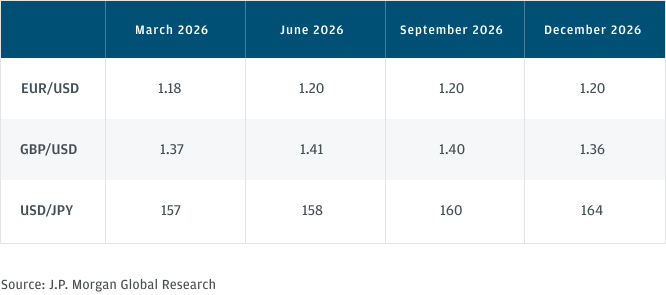
Chart depicting forecasts for EUR/USD, GBP/USD, USD/JPY for March 2026, June 2026, September 2026 and December 2026.

Credit

Across global credit markets, focus is shifting from the macro to the micro, and spreads are expected to widen in 2026. “Capex-related issuance across the AI and AI-adjacent ecosystems will take their toll on high-grade spreads, in particular. Plus, M&A and increased leveraged buyout activity will be a factor driving increased issuance across both high-grade and high-yield,” said Stephen Dulake, co-head of Global Fundamental Research at J.P. Morgan.

This dynamic is especially evident in the U.S. high-grade space. “While in recent years we have been more anxious about the macro backdrop disrupting spreads via the channel of lower yields, next year we are forecasting a relatively benign macro environment,” said Nathaniel Rosenbaum, a strategist on the U.S. High-Grade Credit team at J.P. Morgan. “What concerns us more is that high-grade corporates appear to be leaning into this constructive backdrop to increase leverage. With yields 35 bp lower than the starting point for 2025 and 130 bp below the cycle highs, funding costs are no longer as much of an impediment to capex and M&A activity.”

To this end, J.P. Morgan Global Research expects to see moderately wider spreads of 110 bp in U.S. high-grade by year-end 2026. “Even with this widening, high-grade bond spreads will remain quite tight by historical standards. This implies a flat excess return and a total return of 3.0%,” Rosenbaum added.

In Europe, the credit cycle is likely to advance in an environment of cheaper funding rates and reduced policy uncertainty, with some corporates releveraging their balance sheets. Furthermore, global data center construction and European infrastructure spending could require significant amounts of funding from both public and private credit markets.

“Investors in European investment-grade credit markets are suffering from recession fatigue after a string of scares in recent years, making them reluctant to price forward economic risk. Consequently, we are likely to stay in the current tight spread environment until we experience an actual downturn, with our forecast seeing spreads essentially flat at 90 bp,” said Daniel Lamy, head of European Credit Strategy at J.P. Morgan.

For European high-yield, default rates are expected to remain in the 3–4% range for the third consecutive year, but elevated recoveries are limiting credit losses. “We look for the current tight spread regime to continue, with a 2026 forecast of 300 bp, equivalent to a 5.5% total return,” Lamy added. 

Emerging markets

Lower macro volatility looks set to support EM local markets in 2026. Overall growth (excluding China) is forecast to maintain a trend-like pace of 3.3%, helped by factors including fading tail-risks on tariffs, easier monetary policy and ongoing tech capex. This resilience largely reflects EM export strength, with limited spillover to domestic demand.

In China, growth should outperform in the first half of the year — especially the first quarter — thanks to the delayed execution of supplementary fiscal measures and the usual front-loading of budget spending. “How much growth slows in the second half will depend on whether — and how quickly — the government introduces additional policy support,” said Tingting Ge, an economist at J.P. Morgan.

EM headline inflation (excluding China and Turkey) is expected to stabilize close to target at 3.2% for 2026. However, while EM core inflation has, on average, returned to central bank targets, there remains considerable variation across economies. “We continue to see further EM rate cuts in the pipeline, but the pace and breadth of cuts are expected to moderate in 2026. EM high-yielders are expected to deliver the bulk of our projected EM easing, with easing space more limited in the low-yielders,” said Jahangir Aziz, head of EM Economics Research at J.P. Morgan.

Risks to this outlook include worryingly high inflation in the U.S., which would cause the Fed to stay on hold. “This is likely to hit EM FX, rates markets and EM credit too, with sell-offs and negative returns resulting,” noted Luis Oganes, head of Global Macro Research at J.P. Morgan. “In addition, a collapse in U.S. equity prices would have knock-on effects for all risk markets, with credit spreads widening. EM would be hit even if the direct impact channels are limited to start with.”

“We continue to see further EM rate cuts in the pipeline, but the pace and breadth of cuts are expected to moderate in 2026.” 

Commodities

World oil demand is expanding, with expected growth of 0.9 million barrels per day (mbd) in 2026 and 1.2 mbd in 2027. Yet, supply is forecast to outstrip demand by threefold in 2026, before moderating to roughly one-third of that pace in 2027 — creating a significant surplus, at least on paper.

However, these market imbalances are unlikely to fully materialize in practice, as adjustments are expected on both the supply and demand sides. “We expect the market will find equilibrium through a combination of rising demand — driven by lower prices — and a mix of voluntary and involuntary production cuts. In line with this outlook, we maintain our Brent price forecast of $58 in 2026 and introduce our 2027 forecast of $57, while recognizing that considerable effort will be required to stabilize prices at these levels,” said Natasha Kaneva, head of Global Commodities Strategy at J.P. Morgan.

Elsewhere, rising supply of liquefied natural gas (LNG) looks set to support lower global natural gas prices. “As new supply projects come online, we anticipate longer-term prices will trend downward from current levels. We forecast TTF prices to average 28.75 EUR/MWh in 2026 and 24.75 EUR/MWh in 2027, or 3–4 EUR/MWh below current forward prices,” said Otar Dgebuadze, part of the Global Commodities Research team at J.P. Morgan.

In precious metals, J.P. Morgan Global Research remains bullish on gold on the back of boosted central bank buying and robust investor demand. Gold prices are expected to soar to $5,000/oz by the fourth quarter of 2026, averaging $4,753/oz for the full year. “Silver prices are forecast to rise toward $58/oz by the fourth quarter, averaging $56/oz for the full year, while platinum could continue to trade higher for longer next year before the gears of supply rebalancing gain momentum,” added Gregory Shearer, head of Base and Precious Metals Strategy at J.P. Morgan.

Finally, in agriculture markets, implied volatility has ticked up over recent weeks. “While there are no imminent signs of shortage or supply-side stress — outside of the livestock sector and, to a degree, cocoa markets — over the coming seasons, our projections of world agriculture stocks-to-use ratios remain close to multi-year lows for 2026/27 and 2027/28. This declining availability base, driven by low producer margins, raises sensitivity and price volatility to supply-side disruptions,” said Tracey Allen, an agricultural commodities strategist at J.P. Morgan. 

Global commodity price forecasts 
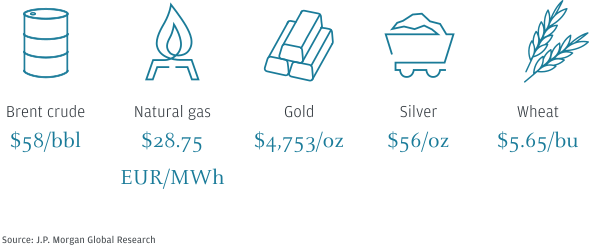
Infographic depicting 2026 price forecasts for Brent crude, natural gas, gold, silver and wheat.
41:39

Listen for more insights from Making Sense: 2026 outlook: What’s next for markets and the global economy?
poster image

The year ahead will likely be driven by three powerful forces: uneven monetary policy, the relentless AI cycle and deepening polarization across markets and economies. What are the key opportunities and risks to watch across equities, commodities, currencies and more? Join analysts from J.P. Morgan Global Research as they explore the outlook for 2026. This episode was recorded between December 9 and December 17, 2025.

2026 outlook: What’s next for markets and the global economy?

[Music]

Sam Azzarello: What's next for markets and the global economy after a year defined by escalating tariffs, persistent geopolitical tensions, and the rise of artificial intelligence across industries?

Mislav Matejka: We see a constructive outlook across most markets, with both DM and EM equities expected to beat other assets, in particular cash and bonds…

Meera Chandan: We're seeing growth forecasts getting upgraded across the curve as we going into the new year, and there's a lot of fiscal and monetary policy easing that is going to provide a tailwind for an improving growth backdrop.

Bruce Kasman: We do believe sticky inflation overall remains a theme on the global stage, and it is, I think, an important in terms of limiting the ability of central banks overall to lower interest rates.

Sam Azzarello: Welcome to J.P. Morgan's Making Sense. I'm Sam Azzarello, and I lead content strategy for global research here at J.P. Morgan. Today, I'm joined by a few of my colleagues to discuss our outlook for 2026. To kick things off, we'll hear from Bruce Kasman, our chief global economist. Bruce, thanks so much for being here today.

Bruce Kasman: Thanks, Sam, for having me.

Sam Azzarello: So Bruce, what surprised you most about the global economy in 2025?

Bruce Kasman: I think the biggest surprise was the resilience of the global economy in the face of some significant negative shocks. The particularly big one was the rise in U.S. tariffs, the trade war that had opened up. But at the same time, I think the resilience of the global economy has not come with balanced growth, and there was another surprise, which was the divergence in a global economy which seemed propelled by strong, uh, CapEx in particularly tech spending in 25, and at the same time, had a fairly sharp slowing in job growth. That juxtaposition of CapEx accelerating in job growth stalling for the most part, uh, was a major surprise.

Sam Azzarello: Fantastic. Thanks for that, Bruce. Where do you think the global economy is headed in 2026 and what are the key factors to watch?

Bruce Kasman: So the global economy's movement into 2026 to us is being driven by two broad factors. One is the sense that the sentiment shock that came this year in 2025 alongside the trade war begins to fade. And we think that will be an important catalyst for recoupling the labor market to the overall picture on growth. Labor markets have been quite weak. Job growth has nearly stalled across the major economies. And if we're right, we get a lift from fading of some of the concerns about policy, a lift that's partly supported by the easing we've seen in monetary and perspective easing in fiscal policies. And we therefore get as we move through 2026, an alignment of solid growth with more normal performance in terms of job growth rebounding. That's the first thing I would emphasize. The second thing we would look for is less synchronized, but still overall sticky inflation in that environment. That's partly driven by the continued overall environment of goods price pressures being different than that they were before the pandemic. And it's also being emphasized by the fact that as job growth recovers here, we continue to see weak labor supply dynamics, immigration policies, having shifted materially across most advanced economies. And with that, we begin to start to see a turn again towards labor market tightening, which basically shifts from what has been some softening we've seen in the U.S. and other countries this year. So sticky inflation, weak supply sides due to immigration policy and solid growth as you recouple the labor markets to an overall decent performance we're expecting across most of the globe. One of the consequences of this, of course, is that central banks do not get the opportunity to validate market expectations for interest rate declines, and we are not looking for much, if any, additional easing for most central banks, with the exception of a high yielding EM central banks that probably still have more to come.

Sam Azzarello: Final question for you. Will sticky inflation remain a prevailing theme next year?

Bruce Kasman: We do believe sticky inflation overall remains a theme on the global stage, and it is, I think, an important in terms of limiting the ability of central banks overall to lower interest rates. Uh, what I would also suggest, however, is we're moving away from a period in which inflation dynamics are more synchronized. That was clearly a factor in the post-COVID Russian invasion environment in which these global shocks were so important. Inflation dynamics are going to be more driven by local conditions, particularly labor market tightness. We do expect overall here to be relatively sticky and stable inflation, but also expect to see more variation with perhaps the most notable variation is that we have inflation in Western Europe coming down to target and inflation in the U.S. staying close to 3%.

Sam Azzarello: Bruce, thanks for your insights. Next up, we have Mislav Matejka, head of global equity strategy. Mislav, thanks so much for joining us today.

Mislav Matejka: Hi, Sam. Thanks for having me.

Sam Azzarello: So why don't you start by walking us through the overall outlook for global equities in 2026 across both developed markets and emerging markets.

Mislav Matejka: We see a constructive outlook across most markets, uh, with both DM and EM equities expected to beat other assets, in particular cash and bonds, with equities offering in the range of 10 to 25% upside in our view. And the Bullish goal is driven by the supportive growth policy trade-off where on one hand, we look for robust earnings delivery next year, and that is underpinned by resilient activity momentum in the U.S., but also an improvement among laggard regions. So China here, it could show green shoots of consumer recovery, and Euros on fiscal stimulus is likely to become much more impactful. And on the other side, inflation is likely to stay on the downtrend due to subdued brand, slowing wage growth and slowing services inflation, which in turn will keep Fed in particular dovish through the first half of 26. And the bond yields therefore are unlikely to break out higher, and especially not to break out higher for the, for the wrong reasons. Now, more specifically for the U.S., we are looking for the rally that is supported by continued rapid AI rollout, and therefore in the U.S., we keep preferences in terms of the styles for large caps and for the growth. In the rest of DM, we think that Eurozone will show better earnings delivery after three years of stalling, and that is on stronger activity and less headwinds from trade and from the FX. Japan was our key DM overweight call for 25, and we still think that it goes up further in 2026, but after the big rally, valuations are becoming fuller. And finally, within the EM, which we like, we in particular have bullish goals on Korea, India, and on Brazil.

Sam Azzarello: All right. Certainly a lot for us to keep our eyes on. How is the relentless expansion of AI fueling record CapEx and earnings expansion, and how might this impact markets in 2026?

Mislav Matejka: AI rollout remains a clear positive for markets, uh, focused on the U.S., given that almost half of S&P 500 weight is AI related these days. Now, the rapid AI CapEx is set to continue, and that's almost irrespective of whether stocks keep performing, as in a sense, this is seen to be a U.S. versus China race, and one can't lose. And within the U.S., there is a winner takes all mentality. So CapEx projections are only likely to get higher without anybody being able to step off, even if the stock prices don't follow. So the natural risk here is the, the one of commoditization with, uh, returns on investments not delivering of concentration risk and, and eventually of overcapacity. And, and we are cognizant of these, but we do believe that AI rollout is in early stages and that's really if you kind of branded year two or three out of potentially 10 plus. In contrast, smartphones, they took eight to 10 years, cloud took eight to 10 years of the accelerated adoption. So there is much more to go. Here, as we mentioned before, in the U.S. portfolio, we are staying constructive on the AI team and the overweight large caps versus small caps as well as the growth versus, uh, value style. Now, AI names have been responsible for pretty much all the incremental earnings growth in the past few years, and in our view, they're likely to deliver above market earnings growth again next year. Within this, as we move through '26, we do expect more and more companies to be able to point out the benefits of the implementation of AI tools in their operations, which would support their productivity and profit margins. So the AI trade should be broadening. It should be broadening into the adoption beneficiaries of AI, so the next 500 companies in S&P 500, and that will also be helping the international names.

Sam Azzarello: Besides AI, what are some other key factors that could shape global equity markets in 2026?

Mislav Matejka: For a long time, AI was the only story in town, and almost all the price returns, all the earnings, and all the CapEx in the past years were driven by AI. We do see additional sources of the upside for equities next year. In fact, for S&P 500 in the latest Q3 results, the remaining 493 stocks have recorded the best earnings growth in years at past 12%, and the gap with Max seven has narrowed quite a lot. That is healthy. And will address to some extent the concentration risk that is in the markets. It would help many connected trades. Also, Eurozone stimulus has not materialized really so far this year, and we feel that it was actually correct to fade the euros and rally from Q1. We have been arguing since March for our consolidation phase, as in our view, there wasn't likely to be much of a earnings follow through, if at all. This worked, and we now expect that into next year, there will be more positive performance of the region with earnings finally delivering on the upside. Besides these, uh, trade headlines will be an important consideration as into the midterms, U.S. administration might want to water down some of the tariffs in order to ease the cost of living pressure on the U.S. consumer. And Fed outlook, it really, it would be also the key factor driving equities where any potential turn towards more cautious funds could impact liquidity adversely, but also there is this wildcard of Fed potentially staying dovish if some of the inflation numbers do indeed move lower.

Sam Azzarello: Mislav, thank you for sharing your views.

Mislav Matejka: You're welcome, and, and nice talking to you.

Sam Azzarello: Next, we'll look at rates with Francis Diamond, head of European Rate Strategy. Francis, thanks for being on the podcast.

Francis Diamond: Hi, Sam. Thanks for having me.

Sam Azzarello: What's the overall outlook for rates markets in 2026? And are there any regions you'll be keeping a close eye on?

Francis Diamond: Yeah, well, I think, Sam, there are a variety of different themes for global rates markets for next year, based on our views around monetary policy and the macro outlook. And if we take the baseline view being one of resilient growth with a global recession likely avoided, and a generally broad disinflation backdrop with some increased divergence, that kind of sets a scene in terms of probably limiting the potential for yields to rally. But I do think that means as a theme, we can look to see carry opportunities in certain markets where central banks are in hold, particularly in the Euro area and in Sweden. I think there is a bit of divergence across curves, which we'll look to investigate, particularly at the front end of the U.S. curve where rates look probably a little bit too low in our view, against our macro backdrop. And we think the Fed is probably delivering slightly fewer cuts than markets are currently pricing. And maybe the conversation will slowly turn towards hikes at some point, but I don't really think that's a big story for next year, and that's probably more a 2027 theme that can start to kick in towards the backend of 2026. So I think this, this probably means there's a bit of a theme of cross-market divergence between U.S. and Euro, which we'll be keeping an eye on. And we also keep an eye on potentially, uh, increased fiscal and political term, meaning term premium in the UK, which might have an impact on intermediate yields from the second quarter of next year, and also the fiscal backdrop and issuance dynamics will be a focus for Japanese rate markets as well.

Sam Azzarello: Very interesting insights. Do you see monetary policy continuing to diverge across the globe next year?

Francis Diamond: Yes, for sure. I think there's definitely scope for some divergence across the DM central banks. It's probably limited in nature, but certainly there's probably the Bank of Japan expected to be the only DM bank that's tightening. We expect the policy rate to rise to 1% by the end of next year as underlying inflation, uh, continues to rise. We think the easing cycle for many central banks has ended. So we see the ECB, the Riksbank, the Nords Bank, the RBA, and the RBNZ all on hold over 2026. And I think it's only the Fed and BOE are expected to ease a little more. We forecast one further 25 basis point cut from the Fed in January, which is a bit less than what's priced into the front end of the curve in terms of the terminal rate over 2026. So we see terminal rate getting close to, or getting to 3.5%. Um, we expect the Bank of England to cut rates to about 3.5% by the middle of next year, which is a little more than priced into markets. So definitely some divergence, but relatively limited compared to what we've seen, over previous years.

Sam Azzarello: And final question for you, Francis. What's the forecast for yields? Are they expected to grind higher over the course of 2026?

Francis Diamond: Well, again, I think it's somewhat selective here, Sam. So in our base case forecast, I think we do think two year treasury yields can rise modestly over the second half of next year. But at the front end, in Germany, yields are a lot more range bound, and probably at the front end of the UK, maybe yields are grinding a little bit lower, to be honest, in terms of a modest rally over the next few months. And if we look further out, we see 10-year bonds, probably around about 2.75% by the end of next year. 10-year treasuries at 4.35% by the end of next year, and 10-year gilts around 4.75% at the end of next year. So that does imply modestly lower bond yields, whereas we do think 10-year gilts and 10-year treasury yields can grind models be higher over 2026. I'd say when we think about the curves, that just gives a bit more of a mixed view in terms of how curves can behave across regions. So probably a bit of steepening in the UK, unchanged in Germany, some modest steepening in the U.S. as well, and then flatter curves in Japan and Australia. And finally, when we just look at sovereign inter-EMU spreads, I think it's just a story of spreads moving sideways over the first half of next year, with maybe a slightly more cautious outlook over the second half of next year.

Sam Azzarello: Francis, thank you for joining and sharing your insights.

Francis Diamond: Great. Thanks for having me, Sam.

Sam Azzarello: Now, let's hear from Meera Chandan, co-head of Global FX Strategy. Hi, Meera. Great to have you on the podcast. Looking ahead, what are the main forces shaping the FX market in 2026?

Meera Chandan: There are two main macro themes that we'd be focused on. The first is that central banks are going to be transitioning from what was a simultaneous easing cycle, in 2025 to a simultaneous hold at relatively high levels above pre-COVID levels in 2026. So this is a pretty big transition where 70% of central banks were cutting rates, now no longer doing that, relatively inactive. The second pillar of the macro theme is that this is going to be a fairly pro-cyclical dynamic going on in the background. We're seeing growth forecasts getting upgraded across the curve as we going into the new year, and there's a lot of fiscal and monetary policy easing, that is going to provide a tailwind for an improving growth backdrop. So inactive central banks, strong growth. If it sounds like the middle of the dollar smile, and a low volatility environment, that's exactly what it is.

Sam Azzarello: So, Meera, is the U.S. dollar likely to remain under pressure in the year ahead, and what are the main drivers behind your outlook?

Meera Chandan: Unfortunately, the prospects don't really look brighter for the dollar, in the coming year. We have been bearish the dollar since March of 2025, and we continue to stay bearish as we look, in the year ahead. The reason for that, firstly, is that at least in the early part of the year, the Fed will either keep rates unchanged for a long period of time, or they're going to cut a lot, either for data-driven reasons, or perhaps if political pressures start to mount. But regardless, I think what that means is any kind of dollar strength we get is going to be quite bounded, whereas the dollar weakness could be more open on the downside. I think there could be periods, long periods of dollar consolidating, at relatively unchanged levels because if U.S. growth is 2% and is yielding 3.5%, that's a pretty good outcome. But the risks on balance, if we do get a large move, I think is skewed to the downside.

Sam Azzarello: Lastly, let's talk about other currencies. Which ones will you be watching closely and why?

Meera Chandan: The currencies to watch in 2026 are going to be their usual three major ones. I would say the Euro, Yen, and the Chinese Yuan. Eurodollar, uh, look, net net, we are still bullish, but we have lowered our sites. Our previous target on the upside was 1.22, that got, that we've taken down to 1.20. But I also think equally Eurodollar can spend long periods consolidating because while Eurozone is on its own growth part on the fiscal front, the U.S. is on its own growth part with AI and tech. So that can be offsetting factors from time to time. So, we do think Eurodollar can consolidate 1.16 to 1.18 in the near term, get to 1.20 as global growth improves. I would say the floor on Eurodollar is around 1.15, if we do get a hawkish repricing for the Fed. On dollar yen, I think that's going to be an interesting one to watch early on in the year. The Takaichi administration has turned sharply towards reflationary policies that drove weakening in the yen in the first place. Now the global monetary policy easing cycles are coming to an end. Global growth is strong, so the use of yen as a funder should just accelerate. So we do think dollar yen will breach 160 in 2026 and remains, yen risks remains key to the downside. Chinese Yuan, not much movement there, really. I mean, dollar CNH, we think, is going to be just at around this, just above the seven level. And what that means is the currency remains weak on a basket basis and retains its competitiveness. The Chinese economy retains its competitiveness versus the rest of the world. And, uh, what that means is it continues to be an anchor that prevents the rest of the Asian complex from strengthening too much. So those are the three currencies to watch.

Sam Azzarello: Thanks, Meera. Really appreciate your views. And now for a look at credit markets, Stephen Dulake, our co-head of Global Fundamental Research, joins us. Steve, thanks for stopping by.

Steve Dulake: Oh, thank you for having me.

Sam Azzarello: What's the overall picture for global credit markets in 2026?

Steve Dulake: In general, I would say okay-ish. I mean, optically from a macro perspective, um, we expect this year's, uh, macro resilience to continue into next year, uh, which is to say we expect continued economic growth. We expect inflation to moderate a little bit, but we do think obviously, you know, one potential fly in the ointment is, is the Fed's ability to cut rates further against the backdrop of a much firmer economic baseline than we were forecasting a little while back. I would say though, in many ways, as the year progresses, we think that the sort of, the micro will sort of become increasingly relevant from a credit investor perspective. Specifically, we're expecting a notable pickup in net issuance, not least here in the U.S., obviously expecting continued supply from the AI ecosystem and the AI adjacent ecosystem. We're also expecting issuance related to M&A and LBO activity to pick up in both high grade and high yield. And we think all of those things take a little bit of a toll on spreads on a look forward basis. So from where we are today, we think spreads will widen a little bit, albeit a little more so in high grade relative to high yield. Um, so we expect to see a little bit of compression in a modestly wider spread environment. Um, we also expect returns in high grade to dominate those in high yield, and that reflects the impact of the much longer duration in the high grade market, given our rate strategist expectations that bond yields will rise a little bit through the course of 2027.

Sam Azzarello: Steve, in light of everything you just mentioned, are there any risks we should be keeping a close tab on?

Steve Dulake: There are. I mean, I would say first and foremost, I would say risk-wise, any significant deviation from our macro baseline. So, you know, to the extent that growth proves to be even firmer than we expect, that would have likely knock-ons in terms of sticky, uh, inflation at a time when affordability is already currently a bit of a hot political potato. So, I think, I think the market could get itself a little bit in a pickle against a backdrop of higher growth, because naturally the market would expect sticky inflation, naturally begin to bring forward the data which they expect the Fed to raise rates. But we obviously know that in Washington, the executive is very clear in its desire to see lower rates both at the short end of the curve and at the long end of the curve. So, I think that could inject some volatility, uh, some more aggressive moves in bond yields. And that could be an environment where you see credit rates correlation go to one, so you have higher bond yields and higher credit spreads. The flip side of that obviously is a much weaker economic outturn. Let's call it something between decidedly subpar growth and, and recession. And I think it's fair to say today that spreads really aren't pricing any material contingency of, of recession. So, I would say in either direction, material deviation from our macro baseline potentially poses risks for spreads. The other thing I'd probably talk a little bit about would be... To the extent, there's a lot of focus on the increasing use of debt by the AO ecosystem to fund its capital expenditure plans. If the sort of monetization curve, so to speak, associated with those investments proves to be a little bit flatter than we all expect, which is to say the return on those investments takes longer to manifest itself, that can be an environment where markets begin to expect or anticipate much weaker balance sheets. So, although we are talking about fairly high rated companies, underlying this issuance doesn't mean that spreads couldn't widen a lot given the growing concentration in the market of the sort of AI ecosystem and, and adjacent sectors. So, those would probably be the, the two main things I'd focus on.

Sam Azzarello: Lastly, let's touch on spreads. Are credit spreads expected to widen next year? And if so, why?

Steve Dulake: So, we touched on that a little bit already. We expect spread to shift a bit on the back of increased issuance. So, a relative horizon supply, relative to demand. That's not to say we're expecting a, a material decline in demand, kind of given the prevailing yield structure or all-in yield structure, I should say. But as I mentioned, we are expecting more supply, firstly, from the AI-related ecosystem, and secondly, as a result of increasing M&A and LBO activity. I think that will result in an expectation that we'll see some slippage in, in credit fundamentals. So, those are the principle drivers for our forecast of moderate spread widening in 2026.

Sam Azzarello: Fantastic. Thanks for that.

Steve Dulake: Thank you for having me.

Sam Azzarello: Next, we'll hear from Jonny Goulden, head of Emerging Market Fixed Income Strategy. Jonny, thanks for joining the podcast.

Jonny Goulden: Thanks, Sam. Great to be here.

Sam Azzarello: As we head into 2026, what does the macro picture for emerging markets look like?

Jonny Goulden: So, it's a good contrast if we think about where we are now versus where we were this time last year. This time last year, obviously looking into '25, the outlook was very uncertain and basically negative for emerging markets, as the new U.S. administration was going to change a lot of the macro settings. But as we look into '26, the macro backdrop looks less volatile and more supportive. So, we are generally constructive on emerging markets, particularly local markets, FX, and high yielding local bonds. If we think about growth first, actually our economist forecasts are pretty similar to this year, so a view of continuity. I would say that maybe there's some upward bias given the AI CapEx cycle. There's been a lot of monetary easing, but the growth environment looks pretty supportive on emerging market inflation. This has been falling for two and a half years. We are getting close to the end of that process. That means that EM central banks will not be able to cut as broadly as they have in the last few years, so we have to position for more differentiation around central banks, uh, in rate markets. Otherwise, EM debt dynamics for both sovereign and corporate credit look pretty stable at relatively benign levels.

Sam Azzarello: Jonny, can you talk a little bit about the main risk scenarios you and your team are watching with respect to emerging markets next year?

Jonny Goulden: So, when we think about the main risk scenarios for emerging markets, they don't look like they're going to come necessarily from EM itself, but more the global, really the U.S. environment. Maybe one smaller. And more likely, the other one bigger and less likely. So, let's look at the more likely first. Uh, and those are risks that come from the global interest rate environment. So, if growth, inflation are going to be higher, um, rates globally and in emerging markets may be higher. And given we are at the end of these rate cutting cycles in EM, they can't be as much of a counterbalance to that. From the investors, actually, we spent the last few weeks talking to, their twist on this is actually a scenario where they worry that the Fed is too dovish in the face of better data, and actually the long end of the U.S. rates curve becomes a bit de-anchored and more volatile. Now, that would probably be positive for emerging markets to start a weaker dollar versus EM currencies. But if we're going into an environment of high and volatile U.S. rates, then it's unlikely to be good for EM bonds generally. Obviously, that's not the base case. Maybe the bigger risk would be the end to this risk-on environment, which has been led by U.S. equities, some rethink of AI CapEx or earnings, big fallen equities, takes down credit markets, maybe draws an end to this growth cycle overall. Again, not the base case for the equity team, uh, but I think if we're thinking about some kind of global recession, that won't favor emerging market credit spreads or high yielding local bonds, but maybe lower yielding FX and rates might outperform in that environment.

Sam Azzarello: Going deeper, are there any regional markets you'll be keeping a close eye on?

Jonny Goulden: The idiosyncratic risks fall partly along regional lines, but some actually cut across. The first one is about transformative elections. So, these are elections where you have very different candidates on offer, which may give a very different outlook for the countries. Chile just concluded on the weekend, we have swung from a left wing to a right wing president. We have transformative potentially elections in Columbia, Peru, Brazil, in Latin America, Hungary, and Israel, and EMEA, EM are all going to be very closely watched, and be opportunities within markets. I think the second would be around what we call distressed opportunities. These are countries which are in default at the moment and may come out of that. The two big ones that investors are looking at are Venezuela and Lebanon. Uh, we're not sure they will exit default next year, but certainly they are going to be closely followed as opportunities. Frontier markets, what we call frontier markets in general, particularly in local markets, places like Egypt, Nigeria, Kazakhstan, maybe we'd put Argentina in that bucket as well, also been a great source of returns. They are, naturally have uncertainty around them, so I think we're going to be keeping a close line on those as well. And finally, maybe in, uh, more macro is the Asian exporters. Probably put China in that bucket as well. Tech exporters, Taiwan, Korea, Malaysia, Singapore, had pretty good economic performance this year. Uh, they have lagged in currency terms, so I think investors are going to be watching as well to see if either of those parts will shift.

Sam Azzarello: Fantastic. Thanks for that, Jonny.

Jonny Goulden: Thanks for having me.

Sam Azzarello: And now we're going to turn to commodities. Joining us is Natasha Kaneva, our global head of Commodities Research. Natasha, thanks so much for joining.

Natasha Kaneva: Thank you for having me.

Sam Azzarello: Let's start with oil. How are imbalances in the oil market shaping your price forecasts for 2026?

Natasha Kaneva: Yes. Thank you, Sam. Well, first of all, the first message is that we maintain a bearish outlook since pretty much mid-2023. Um, so if you take a look, oil prices averaged about, um, $68 this year, down from $80 in 2024. And we believe there is another step down in 2026. Our price forecast is about $58. Our message to the market has remained largely consistent since mid-2023, while oil demand is strong supply simply to abundant, expending it three times the rate of demand in both 2025 and 2026, before moderating slightly in 2027. So, there are two main sources of non-OPEC supply that we focus on. Number one is the global offshore sector. Once it was considered cyclically cost intensive. This sector has now transformed into a dependable long-term driver of non-OPEC oil production. Very important, it's positioned at the very low end of the cost curve. What it means is it's price inelastic. Regardless of what the price does, this is the supply that will continue delivering. And the second one is because all the deep water platforms have been already sanctioned and delivered all the way through 2029, the sector offers exceptional visibility on new offshore barrels, making future completions highly assured. The second sector we're watching very closely is the global shale. We introduced this term in this outlook. Previous, it was just the U.S. shale. After the election, uh, midterm election win in Argentina, we're talking about global shale. Uh, we advise the clients to pay attention to that sector as well. It's a large scale. It's relatively low cost as well with a lot of volumes of supply coming there. So, as a result, global inventories will be building. They increase by about 1.5 million barrels per day this year, further builds in 2026 and to 2027. Without intervention, the surplus will climb even further, putting downward pressure on the prices. However, we believe that this magnitude of market imbalances is unlikely to fully materialize in practice, with adjustments expected on both demand side and supply side, um, with, you know... But, you know, the burden, the greatest burden of rebalancing will almost certainly fall on the supply side, so hence we keep our price forecast for 2026 and changed 58. We introduced a '27 price forecast of about $57 per brand.

Sam Azzarello: Let's turn to precious metals. In 2025, gold was a hot topic. Do you see gold prices rising even further next year?

Natasha Kaneva: Yes, Sam, definitely. So this is a bullish recommendation that we maintain for a fourth year in a row. So as you remember, the first time we advised our clients to buy gold was in November 2022. For the fourth year, this is our top recommendation with further price acceleration. Our price target is $5,000 by the end of 2026. So supply remains relatively inelastic, which means that supply's not reacting to the prices despite prices more than doubling since 2022. At the same time, the major sources of demand in our view will continue delivering into 2026 and 2027. Big focus remains on the central bank purchases. We do believe that they will maintain their buying, uh, patterns into 2026 and to 2027, albeit at lower volumes at what they averaged over the previous three years. On top of this, amid a combination of expected or further expected Fed cuts into early 2026, broader investor anxiety spanning U.S. debt sustainability, fund independence, continued global financial easing, we do believe that ... We see there is a room for further robust growth in investor demand for gold too, particularly as we expect gold ownership to continue expanding into 2026 and 2027. So again, the price target for next year is $5,000 per ounce.

Sam Azzarello: And lastly, what's the story for agricultural markets? Are there any signs of supply-side stress?

Natasha Kaneva: Yeah, so the expected returns from the agricultural commodities are expected to be mixed. So for example, we remain bullish on corn and wheat. We see greater upside in ICE no. two cotton and ICE no. 11 sugar, but we retain the more bearish outlook on soybeans. Interestingly, currently, we see no clear signs of shortages or supply-side stress in any of the agricultural commodities except in the livestock sector and to some extent cocoa markets. However, our projections indicate that global agricultural availability will remain near multi-year lows in the 2026, '27. Uh, harvesting season also in 2027, '28, declining further from already low levels currently. We expect this tightening availability driven by low producer margins to heighten sensitivity and price volatility in response to supply-side shocks.

Sam Azzarello: Natasha, thanks for your time and insights.

Natasha Kaneva: Thank you for having me.

Sam Azzarello: And to round out today's episode, we'll hear from Fabio Bassi, head of cross-asset research. Fabio, thanks so much for taking the time to join us.

Fabio Bassi: Hi, Sam. Thanks for having me.

Natasha Kaneva: What are some key themes you'll be focusing on in 2026 from a cross-asset perspective?

Fabio Bassi: As you wrote in our outlook, we believe that 2026 will be driven by three powerful forces: uneven monetary policy, the unstoppable AI supercycle, and the deepening polarization across market and economies. First, on monetary policy, we are approaching the end of the rate normalization journey across developed market. The Fed is likely to deliver some selective insurance cut, while only the Bank of England is set for additional leasing. But it's not, as I said, a one-size-fits-all story. Central banks are moving at different speed, and that divergent is going to create opportunity and risk across asset classes. Second, the AI supercycle is the real game changer. We are seeing record level of CapEx and rapid earning growths, especially in the U.S. equity market. AI isn't just a tech story anymore. It's spreading into banks, healthcare, logistic, and utilities. For investor, this is the anchor theme driving our bullish outlook on USA stocks. Third, polarization is intensifying. In equity, there is a clear split between the AI-driven winners and the rest of the equity market. In the economy, strong CapEx standing contracts to weaker labor demand and consumer spending. And also across households, the divide between high and low income is widening, creating a classic K-shaped recovery. How these polarization are going to evolve is going to be critical for macro trends and market performance in 2026. What is the big macro takeaway here? Fiscal and monetary easing combined with less policy uncertainty in the U.S. are going to boost business sentiment and help closing the gap between strong growth and a still soft labor market. But this resilience also means that inflation is going to be sticky. Tariff will keep some pressure on prices, and while AI productivity gain and lower energy cost will help, they're not going to be enough to offset it.

Natasha Kaneva: Now let's talk about different scenarios. What are some positive scenarios for risk assets that could play out next year?

Fabio Bassi: Looking ahead, uh, we believe there are several positive tailwinds that could supercharge risk asset in 2026. First, uh, clearly, if the AI theme broadens even further, we could see a wave of investment as government and companies are raising to avoid being left behind. This is what we call the FOBO, the fear of being obsolete, effect. This could drive CapEx, innovation, and ultimately also earning growths across sector. Second, there is a possibility of what we call immaculate disinflation. If inflation fall faster than expected, the Fed could deliver more easy, bringing rates down to or even below the terminal level that they currently priced in. That would be a major boost for equity, credit, and other risk asset. Third, global fiscal easing and, uh, a rollback of tariff could add even more fuel to the fire. For example, if the Supreme Court rules against a broad IEEPA tariff and the administration doesn't replace them with a universal 15% tariff, that could open the door to stronger global trade and growth. In Europe, the big upside comes from German fiscal expansion. And while the geopolitical solution to the Russia-Ukraine conflict remains a wildcard, even a ceasefire could have a meaningful impact on energy prices and sentiment. That said, we are realistic about the challenges. Getting a full peace agreement with a strong security guarantee is a high bar.

Natasha Kaneva: Conversely, what are the main negative risks we should watch out for?

Fabio Bassi: Well, on the flip side, there are some real risks that could derail our positive outlook. The biggest near-term risk is a genuine macro slowdown. If labor demand stays weak and payroll disappoint, we could see a recessionary dynamic taking hold. It's not our base case, but we are still assigning about 35% probability to this scenario. So that definitely remain on our other screen. Sticky inflation is another key risk, if price pressure persists and the Fed pivots away from its current stance, removing its asymmetric bias and opening the door to rate hikes or tighter liquidity, that could tighten financial condition quite quickly. This is going to put pressure on risky asset, especially those that have benefit from easy monetary policy. Finally, we have to talk about AI skepticism. With valuation running hot and a lot of hype in the market, there is a risk that investors start to question the sustainability of the AI boom. While we believe that fundamental, CapEx, sales growth, earnings, and buybacks will support the AI sector, we can't rule out episodes of volatility or temporary retracement. In short, 2026 will be a year where investor needs to stay agile. Keep an eye on both the upside and the downside, and be ready to pivot as the data and the headline evolves.

Natasha Kaneva: Fabio, thanks for sharing the cross-asset view.

Fabio Bassi: Great chatting with you.

Sam Azzarello: All right. That wraps up our 2026 outlook episode, here on Making Sense. We hope you found the insights from our analysts helpful and insightful, and we wanna thank you for tuning in. For more market insights, be sure to visit jpmorgan.com/research.

Voiceover: Thanks for listening to Research Recap. If you've enjoyed this conversation, we hope you'll review, rate, and subscribe to JP Morgan's Making Sense to stay on top of the latest industry news and trends, available on Apple Podcasts, Spotify, and YouTube.

This communication is provided for information purposes only. For more information, including important disclosures—please visit www.jpmorgan.com/research/disclosures.

Copyright 2025 JP Morgan Chase and Company, all rights reserved.

[End of episode]


Related insights

  • Global Research

    US tariffs: What’s the impact on global trade and the economy?

    December 05, 2025

    J.P. Morgan Global Research brings you the latest updates and analysis of President Trump’s tariff proposals and their economic impact.

  • Global Research

    Global inflation forecast: Will prices come down in 2024?

    February 09, 2024

    Inflation is easing, but will central banks achieve their targets in 2024? J.P. Morgan’s economists share their projections.

  • Global Research

    Global Research

    Leveraging cutting-edge technology and innovative tools to bring clients industry-leading analysis and investment advice.

This material (Material) is provided for your information only and does not constitute: (i) an offer to sell, a solicitation of an offer to buy, or a recommendation for any investment product or strategy, or (ii) any investment, legal or tax advice. The information contained herein is as of the date and time referenced in the Material and J.P. Morgan does not undertake any obligation to update such information.  J.P. Morgan disclaims any responsibility or liability, whether in contract, tort (including, without limitation, negligence), equity or otherwise, for the quality, accuracy or completeness of the information contained in this Material, and for any reliance on, or uses to which, this Material, is put, and you are solely responsible for any use to which you put such information. Without limiting any of the foregoing, to the fullest extent permitted by applicable law, in no event shall J.P. Morgan have any liability for any special, punitive, indirect, or consequential damages (including lost profits or lost opportunity), in connection with the information contained in this Material, even if notified of the possibility of such damages.  Any comments or statements made herein do not necessarily reflect those of J.P. Morgan, its subsidiaries or its affiliates.

All materials and information shared with you are, unless otherwise indicated to you, proprietary and confidential to J.P. Morgan.  You are hereby notified that any disclosure, dissemination, copying, distribution, or use of the information provided to you, in whole or in part, other than as expressly permitted by J.P. Morgan, is STRICTLY PROHIBITED.  You are permitted to disclose the materials and information to your officers and employees on a need to know basis. Should you have any questions regarding this, please contact your usual J.P. Morgan contact.  For further information please visit: https://www.jpmorgan.com/pages/disclosures/materialdisclaimer.

© 2024 JPMorgan Chase & Co. All rights reserved. J.P. Morgan is a marketing name for businesses of JPMorgan Chase & Co. and its subsidiaries and affiliates worldwide.   JPMorgan Chase Bank N.A. (member of FDIC), J.P. Morgan Securities LLC (member of FINRA, NYSE and SIPC), J.P. Morgan Securities plc (member of the London Stock Exchange and authorized by the Prudential Regulation Authority (PRA) and regulated by the Financial Conduct Authority and the PRA) and J.P. Morgan SE (authorised by the BaFin and regulated by the BaFin, the German Central Bank and the European Central Bank) are principal subsidiaries of JPMorgan Chase & Co. For legal entity and regulatory disclosures, visit: www.jpmorgan.com/disclosures. For additional regulatory disclosures, please consult: www.jpmorgan.com/disclosures.