
Key takeaways
- Global bond yields have surged to multi-decade highs, with the U.S. 10-year Treasury, U.K. 30-year gilt, French 10-year and Japanese 10-year government bond all hitting levels unseen in more than 20 years.
- An increase in projected rate hikes, elevated energy prices and sticky inflation amid a backdrop of healthy labor markets and growth have driven the spike in yields in the U.S. and Europe.
- Higher yields risk being self-reinforcing, with tighter credit and pricier borrowing feeding larger deficits.
- The squeeze from high yields threatens both equities and consumers, with equity-yield correlations growing more fragile and consumers facing higher APRs on car loans, mortgages and other credit.
To paraphrase the political strategist James Carville, the bond market intimidates everybody. Recently, bonds have flexed their powers of intimidation as selloffs and spikes in government bond yields are creating stress in markets. What’s behind these developments, and what happens next?
What’s happening in the bond market? The hard numbers
Since the start of 2026, global government bond yields have marched steadily upward. In September alone, yields on the U.S. 10-year Treasury moved a full 50 basis points (bps) upward, closing the month at 5.25%, a level not seen since 2002.
The sharpness in yield spikes has not been contained to the U.S. market. Recently, yields on the U.K.’s 30-year gilt climbed above 6% for the first time since 1998. In France, the 10-year yield is at its highest level since mid-2002. In Japan, yields on the 10-year Japanese Government Bond rose above 3% for the first time since 1996.
“We’ve begun to run out of superlatives as global bond yields continue to move higher,” said Jay Barry, head of Global Rates Strategy at J.P. Morgan. “Treasury yields [are] retracing to multi-decade highs, and underperforming other developed market [DM] government bond markets in the process.”
Global government bond yields, Oct. 2025 - Oct. 2026
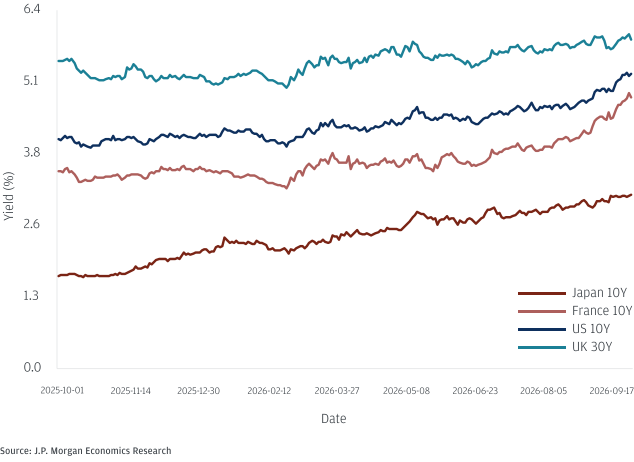
A line chart shows yield percentage from Oct 2025 to Oct 2026 for Japan 10Y, France 10Y, US 10Y, and UK 30Y. UK 30Y yields are highest throughout, rising from about 5.4% to about 6.1%. US 10Y yields increase from roughly 3.9% to about 5.3%, and France 10Y yields rise from around 3.4% to about 4.7%. Japan 10Y yields are lowest, climbing steadily from about 1.6% to about 2.9%. All four series trend upward overall, with the sharpest increases occurring late in the period.
Why are bond yields spiking?
In the U.S., the shifting path of Fed rates explains the spike in bond yields. “The repricing higher of Fed expectations explains nearly all of the rise in 10-year yields and the flattening of the Treasury curve over the month of September,” Barry said. “Current pricing looks appropriate here and does not appear to have overrun fundamentals.”
The U.S. economy’s growth trajectory, which has remained resilient throughout a challenging year of geopolitical tension, sticky inflation, firming labor markets and rising energy costs, is ultimately what’s driving the Fed to make those shifts.
Recently, however, the Treasury Department has taken the initiative to intervene, announcing that it would at least double the maximum amount of long-dated U.S. government debt it can buy back from $2 billion to at least $4 billion per operation in an effort to tamp down bond yields. Some market participants believe that Treasury could cut long-end auction sizes in an effort to reduce supply of Treasuries and thus potentially reduce long-end yields.
Barry expressed doubt around the efficacy of such moves, citing similar attempts to intervene in other international bond markets. “While cutting long-end auction sizes would likely have a short-term impact on the shape of the curve, other similar actions undertaken in the U.K. and Japan have had only temporary impacts,” Barry said. “Accordingly, we do not think this would have a lasting effect on the term structure, and in fact could contribute to higher term premium and yields over time should the Treasury become more opportunistic in its approach to debt management and move further away from its ‘regular and predictable’ tenet.”
“The repricing higher of Fed expectations explains nearly all of the rise in 10-year yields and the flattening of the Treasury curve over the month of September.”

Jay Barry
Head of Global Rates Strategy, J.P. Morgan
Similarly, in Europe, the spike in yields seems to be tracking uncertainty over the European Central Bank (ECB) terminal rate. J.P. Morgan Global Research forecasts the ECB to raise rates once more this year to 2.75%, and then hike once more in the first quarter of 2027.
“In Europe, the recent repricing in intermediate Euro and UK yields in our view partly reflects increased monetary policy tightening expectations, and partly reflects more global and technical factors, including higher neutral rate expectations on AI-driven productivity gains,” said Francis Diamond, head of European Rate Strategy at J.P. Morgan. “The front-end sell-off, particularly in the euro and British pound, also partly reflects higher energy prices and increased energy risk premium, as hopes of a durable Middle East de-escalation have faded amid ongoing U.S. and Iran strikes.”
AI debt issuance is putting additional pressure on the bond market, though J.P. Morgan Global Research believes the effect to be more marginal than major.
“While there has been an increase in the duration impulse of corporate issuance, in the context of overall net issuance of bonds globally, the $260 billion increase in net bond issuance by tech companies for 2026 looks manageable,” said Nikolaos Panigirtzoglou, a senior Global Markets strategist at J.P. Morgan. “Based on our calculations, it would put perhaps 10-15 bps of upward pressure on global aggregate bond index yields.”
The effects of high bond yields: Higher borrowing costs, equity headwinds and more
The danger of spikes in yields is that they risk becoming self-reinforcing, a so-called “vicious circle.” Higher yields push benchmark rates higher, feeding into higher borrowing costs for governments, companies and consumers and creating wider deficits. This in turn erodes the attractiveness of government debt, thus pushing yields higher as investors demand more compensation for holding debt.
“High Treasury yields could more than double U.S. net interest costs from around $1 trillion today to $2.1 trillion by 2035, nearly 5% of GDP,” said Joyce Chang, chair of Global Research at J.P. Morgan. “Under a scenario where interest rates run just 1 percentage point above projections, bringing the 10-year Treasury note from an average 4.3% over the decade to 5.3%, the Committee for a Responsible Federal Budget notes that it would add an additional $3.5 trillion to the debt above projections.”
High bond yields could also affect equities. In a historical study of the S&P 500, J.P. Morgan Global Research found that while rising yields initially support higher multiples on equities, there is an “inflection point” after which high yields become a headwind for both growth and multiples, as higher discount rates and higher inflation begin to compress valuations.
According to Mislav Matejka, head of European and International Equity Strategy at J.P. Morgan, the current equity market can absorb higher yields up to a certain level, but the picture becomes less clear the higher yields run.
“We believe that the positive equities-yields correlation can stay in effect. In other words, that one could have, in six months, higher yields and higher equity prices from current [levels], but the margin of error is getting smaller,” said Matejka. “We have always maintained that around 5%--5.5% 10-year U.S. yield, the correlations are at an increasing risk of flipping. The key will be whether the drivers of rising yields change, and whether their levels are already prohibitive for the economy.”
For the average consumer, higher bond yields could impact those looking for financing options, from car loans to mortgages, as the 10-year Treasury yield acts as a primary benchmark for 30-year fixed mortgages and other fixed-rate financing. “The immediate impact of higher rates is a higher all-in cost on new issues,” said Amy Sze, head of J.P. Morgan’s Asset-Backed Securities Research team. “Higher funding costs usually get passed on to consumers in the form of higher annual percentage rates (APR), albeit with some lag, particularly on fixed-rate consumer credit products.”
How a consumer already strained by higher energy costs and sticky inflation will respond to a spike in borrowing costs remains to be seen.
“We believe that the positive equities-yields correlation can stay in effect — in other words, that one could have, in six months, higher yields and higher equity prices from current [levels], but the margin of error is getting smaller.”

Mislav Matejka
Head of European and International Equity Strategy, J.P. Morgan
Related insights
-

Global Research
With $100/bbl crude, commodities markets are repricing risk in real time — with some surprising results.
-

Global Research
What’s the Fed’s next move?
September 25, 2026
The Fed raised rates in September, marking the first hike in three years. Is this the start of a longer hiking cycle?
-

Global Research
Is India’s equity market the best AI hedge?
September 15, 2026
As global investors trim or diversify away from crowded AI trades, India’s equity market is emerging as the world's largest, liquid AI hedge. What is the outlook for stocks as earnings rebound?
This communication is provided for information purposes only. JPMorgan Chase & Co. or its affiliates and/or subsidiaries (collectively, J.P. Morgan) normally make a market and trade as principal in securities, other financial products and other asset classes that may be discussed in this communication. This communication has been prepared based upon information, including market prices, data and other information, from sources believed to be reliable, but J.P. Morgan does not warrant its completeness or accuracy. Any opinions and estimates constitute our judgment as of the date of this material and are subject to change without notice. Past performance is not indicative of future results. This communication is not intended as an offer or solicitation for the purchase or sale of any financial instrument. J.P. Morgan Research does not provide individually tailored investment advice. Any opinions and recommendations herein do not take into account individual client circumstances, objectives, or needs and are not intended as recommendations of particular securities, financial instruments or strategies to particular clients. You must make your own independent decisions regarding any securities, financial instruments or strategies mentioned or related to the information herein. Periodic updates may be provided on companies, issuers or industries based on specific developments or announcements, market conditions or any other publicly available information. However, J.P. Morgan may be restricted from updating information contained in this communication for regulatory or other reasons. This communication may not be redistributed or retransmitted, in whole or in part, or in any form or manner, without the express written consent of J.P. Morgan. Any unauthorized use or disclosure is prohibited. Receipt and review of this information constitutes your agreement not to redistribute or retransmit the contents and information contained in this communication without first obtaining express permission from an authorized officer of J.P. Morgan.