

- Markets are expecting a slowdown in interest rate hikes as recessionary risks mount. This is bolstering demand for bonds, which are seen as safe-haven assets.
- However, most central banks in developed markets (DMs) are expected to continue delivering further interest rate hikes in the first half of 2023 before pausing.
- This ongoing tug-of-war between hawkish central bank messaging and slowing economic growth will likely create choppy conditions for bond markets in 2023, with yields expected to trade within a range-bound environment.

After a decade of near-zero interest — in which consumers and corporations alike enjoyed lenient financing conditions — rates around the world have risen as central banks battle to curb inflation, hammering markets as a result. However, amid signs that inflation is cooling and that interest rate hikes might be slowing, the bond market stands to become a major beneficiary. Global bond markets surged 4.1% to start the year, their best performance since 1999.
As a result of this outperformance, high-quality fixed-income assets are looking increasingly attractive. But the tightening cycle is not over yet; so, is the bond market rebound here to stay?
Why are bonds rallying?
Companies and governments globally issued nearly $600 billion worth of bonds in January alone. In light of slowing economic growth, markets are betting central banks will pull back on interest rate hikes as recessionary risks mount. This direction is bolstering demand for bonds, which are seen as safe-haven assets.
“The sell-off we saw in late December was precipitated by hawkish moves by central banks. But now, we see a moderation in Fed tightening expectations to start the year,” said Jay Barry, Co-Head of U.S. Rates Strategy at J.P. Morgan. The Fed moved from 75 bp hikes to 50 bp hikes in December 2022 and downshifted further to 25 bp in February 2023. “This is certainly a reason for the recent bond rally, particularly as it is accompanied by a moderation in inflation. With that, investors are more comfortable that we are getting closer to the end of the tightening cycle,” said Barry.
DM bond yields are falling
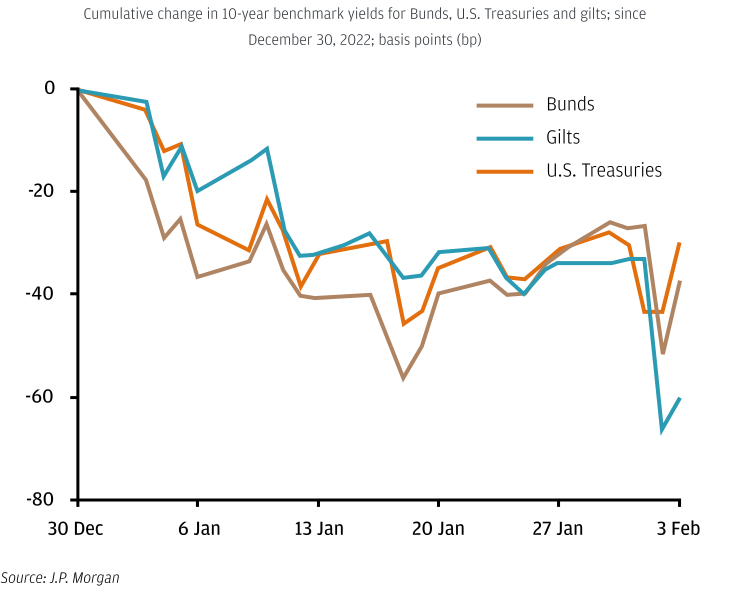
The 10-year benchmark yields for Bunds, U.S. Treasuries and gilts have trended downward since the beginning of 2023.
On one hand, investors are seeking to lock in the current high yields before inflation starts to moderate. “Even though yields are declining, they are close to their highest levels in the last 10 to 15 years,” said Barry. This is making recently issued bonds more attractive thanks to their sizeable coupon payments, which offer meaningful returns.
On the other hand, when interest rates fall, bond prices go up and yields (which move inversely to prices) decrease — a boon for investors seeking stable, low-risk assets. In the U.S., Treasury yields have declined on the back of dovish global policy developments, weakening economic data, rising recession risks and strong demand for duration.
Overall, the prospect of slowing interest rate hikes could spell good news for DM bond markets, where further positive returns are projected for 2023. “The broad expectation of a pause over the next few months is fully priced across various DMs,” noted Fabio Bassi, Head of European Rates Strategy at J.P. Morgan. “However, the job on the tightening cycle is not done yet and it is far too early to declare victory in the fight against inflation.”
Will interest rate hikes slow down?
Despite broader market expectations, DM central banks will likely continue delivering further interest rate hikes before pausing. “DM central banks are taking stock of what’s been delivered so far and indicate additional but limited tightening, with a pause expected between the first and second quarter of 2023,” said Bassi.
The Fed is expected to hike by 25 bp in March and by another 25 bp in May before pausing, while the European Central Bank (ECB) has committed to another 50 bp hike in March and will likely continue tightening into the second quarter of the year (J.P. Morgan Research calls for a further 25 bp hike in May). In the U.K., the Bank of England (BoE) will likely carry out an additional 25 bp hike in March and a further one of the same size in May. While the Bank of Japan (BoJ) did not tweak its yield curve control (YCC) policy in January 2023, which markets interpreted as a dovish move, J.P. Morgan Research expects it to make another adjustment sometime in mid-2023.
“As the market prices the peak in late spring and early summer, there has been a decent amount of repricing further out the curve. Easing is now priced in for all DM central banks between the peak and the rest of 2023, with even more aggressive easing expected in 2024,” said Bassi. “We are biased to fade the early easing in 2023 as we believe central banks will be reluctant to give a message that the tightening job is done ahead of a pause that is still a few months away. But at the same time, we acknowledge that tighter monetary policy for longer will increase the chances of a slowdown and recession at a later stage.”
DM bond markets remain in a tug-of-war between central banks that continue to deliver a broadly hawkish message of ‘tightening cycle not over yet’ while dismissing early expectations of rate cuts, and inflation prints that have started their decline with some downside surprise relative to consensus.
Fabio Bassi
Head of European Rates Research, J.P. Morgan
What about bond demand and supply?
The consensus is that softening growth and slowing interest rate hikes will contribute to declining bond yields, a view consistent with J.P. Morgan Research’s bond demand and supply estimates.
Back in November 2022, J.P. Morgan Research forecasted an improvement of close to $1 trillion in the bond demand and supply balance for 2023. Based on the historical relationship between annual changes in excess supply and the Bloomberg Global Aggregate Bond Index, which measures the performance of the global investment-grade, fixed-rate bond markets, a $1 trillion improvement would imply a downward pressure of around 40 bp on global aggregate yields.
“However, it’s important to note that we currently see significant upside to the aforementioned $1 trillion improvement between bond demand and supply for 2023. This is because the year-to-date demand from retail investors, U.S. commercial banks and FX reserve managers is tracking a pace that is significantly stronger than what we were expecting for the whole of 2023,” said Nikolaos Panigirtzoglou, who covers Global Markets Strategy at J.P. Morgan. This should add further downward pressure on global aggregate yields, which should prove supportive for the overall bond market.
What’s next for bond markets?
Despite the recent rally and improved demand/supply balance, J.P. Morgan Research expects bond markets to be more volatile in the near term, with yields trading within a choppy range. This is as markets brace for the next big policy shift from central banks, which are still maintaining a hawkish outlook.
“DM bond markets remain in a tug-of-war between central banks that continue to deliver a broadly hawkish message of ‘tightening cycle not over yet’ while dismissing early expectations of rate cuts, and inflation prints that have started their decline with some downside surprise relative to consensus,” said Bassi. “The decline of inflation on base effect, combined with the large and sharp amount of rate hikes delivered so far, will warrant DM central banks pausing and taking stock of the impact of the tightening on the growth and inflation outlook. But at the same time, DM central banks will be quite reluctant in declaring an early victory against inflation.”
Overall, while demand for credit will remain elevated, particularly given positive year-to-date returns and attractive yields, the scope for a further bond market rally is limited. “The tug-of-war will probably be ongoing, so we expect conditions to be choppier. But as we are close to the end of the tightening cycle and because growth is weakening, we don’t envision yields to revisit the highs we saw last fall,” noted Barry. “Overall, we think we’ll see a range-bound environment persisting, with yields 15 bp to 20 bp lower at the end of the year than they are right now.”
This communication is provided for information purposes only. Please read J.P. Morgan research reports related to its contents for more information, including important disclosures. JPMorgan Chase & Co. or its affiliates and/or subsidiaries (collectively, J.P. Morgan) normally make a market and trade as principal in securities, other financial products and other asset classes that may be discussed in this communication.This communication has been prepared based upon information, including market prices, data and other information, from sources believed to be reliable, but J.P. Morgan does not warrant its completeness or accuracy except with respect to any disclosures relative to J.P. Morgan and/or its affiliates and an analyst's involvement with any company (or security, other financial product or other asset class) that may be the subject of this communication.
Any opinions and estimates constitute our judgment as of the date of this material and are subject to change without notice. Past performance is not indicative of future results. This communication is not intended as an offer or solicitation for the purchase or sale of any financial instrument. J.P. Morgan Research does not provide individually tailored investment advice. Any opinions and recommendations herein do not take into account individual client circumstances, objectives, or needs and are not intended as recommendations of particular securities, financial instruments or strategies to particular clients. You must make your own independent decisions regarding any securities, financial instruments or strategies mentioned or related to the information herein. Periodic updates may be provided on companies, issuers or industries based on specific developments or announcements, market conditions or any other publicly available information. However, J.P. Morgan may be restricted from updating information contained in this communication for regulatory or other reasons. Clients should contact analysts and execute transactions through a J.P. Morgan subsidiary or affiliate in their home jurisdiction unless governing law permits otherwise.
This communication may not be redistributed or retransmitted, in whole or in part, or in any form or manner, without the express written consent of J.P. Morgan. Any unauthorized use or disclosure is prohibited. Receipt and review of this information constitutes your agreement not to redistribute or retransmit the contents and information contained in this communication without first obtaining express permission from an authorized officer of J.P. Morgan.