
Key takeaways
- AI investment is driving operational efficiency and innovation across industries, with recent deals underscoring its strategic importance.
- Rising defense budgets and private investment are accelerating technological development.
- A robust IPO pipeline, corporate separation initiatives and strategic consolidation are reshaping the sector and facilitating growth.
Rapid advances in artificial intelligence, rising global defense budgets and shifting international investment patterns are redefining industrial innovation. Leaders are responding to these changes by pursuing technology-driven growth, navigating asset competition and preparing for a wave of IPOs and corporate restructuring. Understanding these themes is essential for charting a course through today’s complex market landscape.
Private capital flows and IPOs lead to consolidation and innovation in defense and aerospace
Global defense spending is set to rise, with the European Union (EU) moving from 1.5% to 3.5% of GDP on defense. Countries around the world are increasing allocations, and significant growth is expected across Europe. Defense budgets are being directed toward personnel, operations, equipment procurement, and research and development, with an implied budget of ~$1.1 trillion for the U.S. and ~$0.7 trillion for the EU at the 3.5% target.
“As defense spending accelerates and technology advances, we’re seeing continued interest from investors in public offerings across the sector,” said Mark Marengo, global head of Diversified Industries Investment Banking at J.P. Morgan. “Market appetite and capital flows are fueling innovation and consolidation, positioning defense companies for long-term growth.”
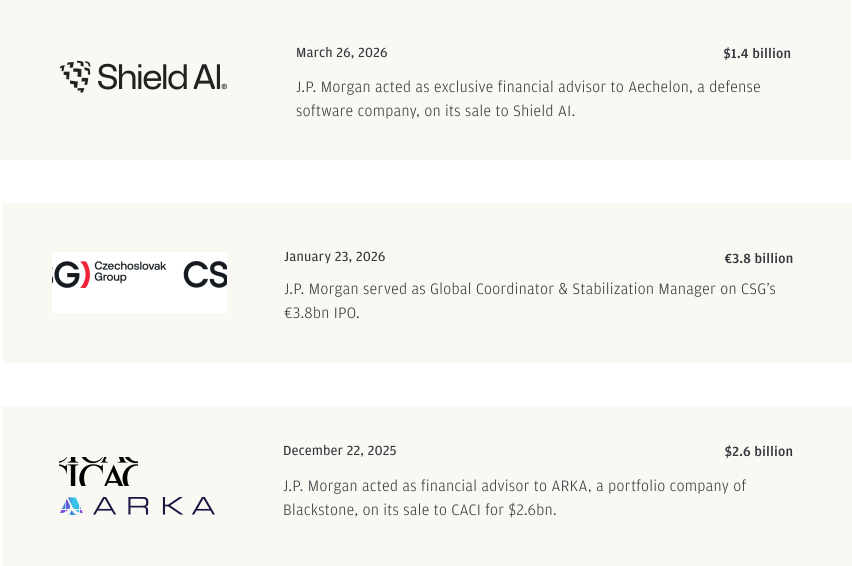
Recent deal activity highlights the sector’s increased consolidation. The sale of ARKA Group L.P., a provider of intelligence and warfighter solutions, to CACI International Inc. for $2.6 billion shows the importance of fast delivery of actionable intelligence to customers.
“Bringing together ARKA and CACI unites mission-focused cultures and deep engineering expertise,” said Jason Spindel, global head of Aerospace, Defense, Space and Government Services for J.P. Morgan.
Meanwhile IPO activity remains robust, with the €3.8 billion IPO of Czechoslovak Group (CSG) on Euronext Amsterdam marking the largest ever defense IPO globally. CSG operates two main divisions — Defense Systems and Ammo+ — serving customers in over 70 countries. The IPO was multiple times oversubscribed, underscoring investor appetite for defense assets.
“Market appetite and capital flows are fueling innovation and consolidation, positioning defense companies for long-term growth.”

Mark Marengo
Head of Diversified Industries Investment Banking, J.P. Morgan
AI investment enables operational efficiency across industries
AI adoption is accelerating, fundamentally changing the industrial landscape. Companies are investing in advanced technologies including robotics, sensor proliferation and simulation platforms to build resilience and maintain competitive positions.
One industry where AI is making a measurable impact is in defense and aerospace. “Defense clients are prioritizing innovation and supply chain security,” noted Spindel. “The need for advanced technologies and resilient platforms has never been greater.”
The acquisition of Aechelon Technology Inc. by Shield AI Inc. exemplifies the convergence of autonomy and simulation in the sector, supporting pilot training and testing of advanced aircraft for the U.S. military and allies. Shield AI’s concurrent $2 billion Series G funding round, part of the Security and Resiliency Initiative, more than doubled the company’s valuation to $12.7 billion. The transaction is expected to close in the second quarter of 2026, pending regulatory approval.
“Defense clients are prioritizing innovation and supply chain security. The need for advanced technologies and resilient platforms has never been greater.”

Jason Spindel
Global head of Aerospace, Defense, Space and Government Services, J.P. Morgan
Investments in US increase, but face challenges from elevated valuations and asset competition
The U.S. remains a major focus for international investors, particularly in the transportation and infrastructure industries. Cross-border deals, such as the American Axle and Dowlais combination, advised by J.P. Morgan, illustrate growth opportunities. The transaction delivered approximately $300 million in synergies and expanded the customer base and geographic presence.
International clients are encountering challenges in asset competition, as valuation multiples remain favorable and execution is strong. “Strategic M&A is a powerful lever for growth, but competition for U.S. assets is intense,” said Marengo. “Clients are looking for disciplined portfolio management and targeted investments in the current environment.”
A robust environment for public market activity
Across industries, J.P. Morgan observes a surge in public markets activity, with a record backlog of IPOs, financial sponsors exploring public equity exits in addition to cash sales and larger corporates considering spin-offs to reshape and refocus their portfolios.
“We’re seeing companies pursue divestitures — including spin-offs — of non-core businesses to sharpen corporate focus and drive greater strategic clarity,” Marengo noted. “Separately, we’re also seeing increased activity in public equity offerings.”
Sponsor M&A activity is evolving as financing conditions and public market alternatives improve. “We’re seeing sponsors become more active in industrials,” said Michael Murphy, head of diversified industries M&A at J.P. Morgan. “If these trends continue, we expect volumes to increase.”
Looking to the future
Looking ahead, the industrial sector faces both significant opportunity and meaningful complexity. Defense budgets are expanding, AI is reshaping operational models, and public markets are primed for a new wave of activity. Yet elevated valuations, financing constraints and intensifying asset competition demand careful strategic judgment.
Geopolitical shifts and evolving regulatory landscapes will further influence how capital is deployed, making it critical for organizations to build agility and resilience into their long-term strategic planning. As consolidation accelerates and new entrants emerge through IPOs and spin-offs, the competitive landscape will continue to reward those who combine operational excellence with a clear-eyed view of where the next wave of value creation lies. Leaders who embrace technology-driven innovation, capitalize on robust capital markets and pursue targeted portfolio optimization will be well-equipped to navigate complexity and deliver sustainable growth.
Related insights
-
Our Aerospace, Defense and Government Services (ADG) group delivers tailored financial solutions to help support and accelerate your company’s growth.
-

Investment Banking
Providing investment banking solutions, including M&A, capital raising and risk management, for a broad range of corporations, institutions and governments.
-

Banking
Global Dealmaking Trends in Q3 2026 | J.P. Morgan
October 20, 2026
Despite continued market volatility, global dealmaking activity remained elevated through the third quarter of 2026. Explore how AI investment, financing dynamics and economic security priorities are shaping dealmaking heading into year-end.