Key takeaways
- The defense sector has entered a more capital-intensive phase with longer program cycles, steeper production ramps and extended lead times. Inventory is rising across the value chain, intensifying balance sheet pressure upstream for Tier 1 and Tier 2 suppliers across US, European and allied defense ecosystems.
- Strategic working capital optimization spanning inventory finance and complemented by government receivables finance, export credit agency (ECA) financing and performance standby letters of credit (SBLC) converts critical inventory and contractual exposures into deployable liquidity without increasing leverage or altering existing commercial terms.
- Primes and suppliers gain flexibility to meet delivery commitments, self-fund internal research and development (IRAD) and preserve capital allocation discipline, while SBLCs and ECA backed structures support execution, contract awards, and supplier participation as part of an integrated liquidity framework, while strengthening overall supply chain resilience.
EXECUTIVE SUMMARY
The defense industrial base is operating in a more capital‑intensive environment characterized by longer program cycles, accelerated production ramps and higher resilience requirements across NATO and allied defense markets. Inventory is rising by design, reflecting long‑lead procurement and supplier prebuilds rather than operational inefficiency. At the same time, margin pressure and elevated rates—with the federal funds target range at 3.50%–3.75% as of late January 20261—increase the importance of cash generation independent of earnings growth. Working capital efficiency is now a critical source of internally generated liquidity, supporting IRAD investment, bridging sovereign and government payment timing across jurisdictions and preserving execution certainty across the supply chain. Efficient inventory financing is emerging as a core determinant of resilience across the sector for defense primes and suppliers globally.
A structurally different operating environment
Demand signals remain robust with sustained increases in defense spending across the US, Europe and allied nations, underscoring sustained focus on readiness, modernization and capacity. Programs are longer in duration; production ramps are steeper, and end customers including the Department of War (DoW) and NATO allies are scrutinizing delivery timelines and capacity expansion. Technological advances have concentrated supply chains around specialized components and single‑source suppliers, extending lead times and narrowing margins for error across transatlantic and intra-European supply chains.
Production continuity increasingly requires early sourcing and staging of long‑lead materials. These dynamics have fundamentally altered program working capital profiles, heightening the dependence of cash generation on inventory levels and the timing of milestone payments.
Recent U.S. policy signals have urged defense primes to prioritize research and development while maintaining delivery performance and expanding capacity commitments. The result is a capital allocation tension: companies must fund innovation, meet increased production demand and satisfy investor expectations while managing elevated working capital requirements.
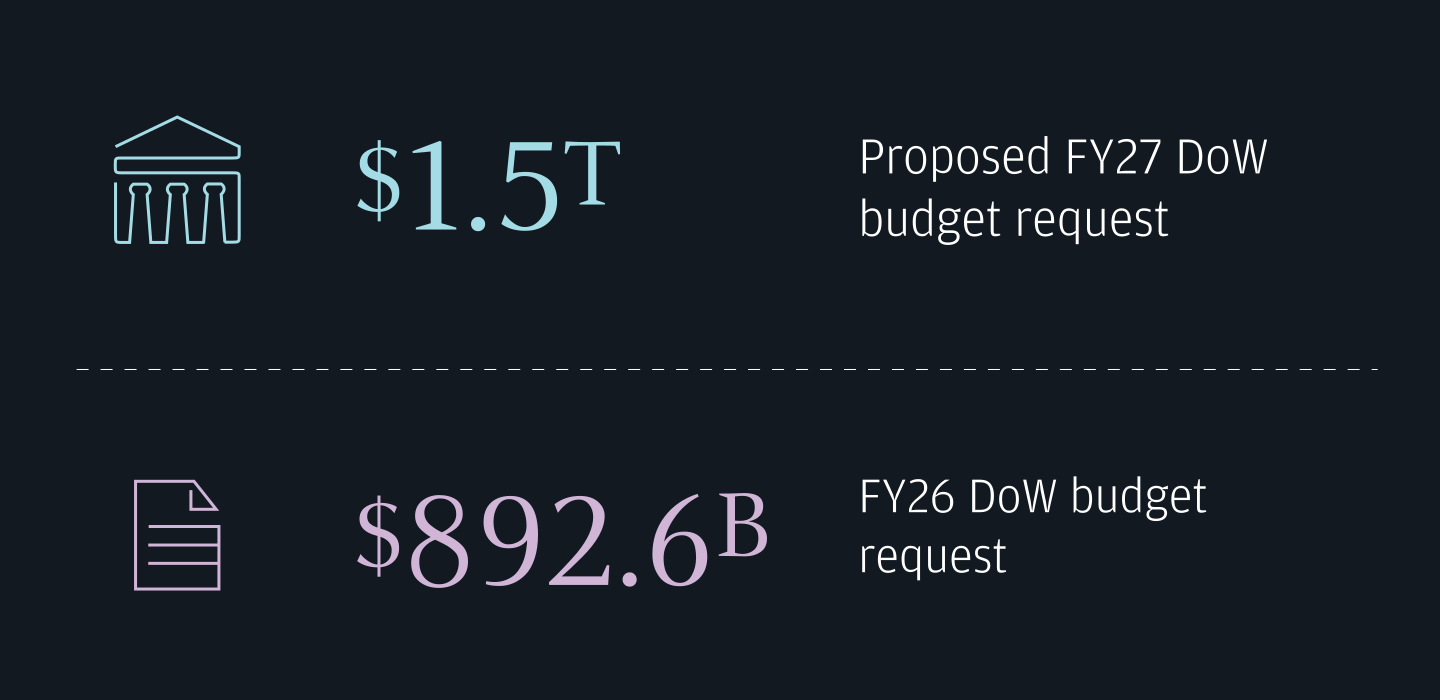
$1.5 trillion - proposed FY27 DoW budget request
$892.6 billion - FY26 DoW budget request
Why this program cycle is different
Long program cycles are familiar in defense. What distinguishes this cycle is the combination of two forces that materially change the working capital equation.
First, inventory is rising concurrently among primes and suppliers, rather than being absorbed downstream. The burden is distributed across the value chain and often concentrated upstream among Tier 1 and Tier 2 suppliers who must build inventory and invest in capacity ahead of funding.
Second, a persistently elevated rate environment across major economies increases the cost of carrying inventory. With the federal funds target range at 3.50%–3.75%1, what was a manageable drag on working capital now amplifies cash sensitivity. Inefficiently financed inventory has become a strategic concern.
Together, these dynamics increase working capital intensity across the value chain and elevate execution risk if not addressed.
Inventory growth is execution driven, not inefficiency
Inventory accumulation is primarily a function of program timing and delivery requirements. It supports long lead procurement, supplier prebuilds and planned capacity expansion. This growth is nondiscretionary and closely tied to rising delivery commitments. Recognizing this distinction is critical to designing financing solutions that align liquidity directly with program execution rather than treating inventory as a symptom of operational inefficiency.
Working capital as internally generated liquidity
Working capital performance is a source of internally generated liquidity that advances strategic objectives: self‑funded IRAD, improved cash flow predictability through payment‑timing bridges and preserved capital allocation discipline.
In today’s rate environment, the opportunity cost of inefficiently financed inventory is significant. Converting critical inventory into liquidity without increasing leverage or disrupting commercial arrangements helps enable companies to meet delivery commitments and fund innovation.
Balance sheet pressure is concentrated upstream
Working capital requirements are unevenly distributed. Tier 1 and Tier 2 suppliers often build inventory and expand capacity prior to funding while navigating receivables cycles shaped by government contracting structures. This creates free cash flow variability precisely where the supply chain is most vulnerable to disruption.
For primes, supplier fragility introduces downstream execution risk. Proactive working capital strategies that relieve upstream pressure can help strengthen supply chain resilience and reduce program risk.
The risk of inaction
Without a targeted working capital strategy, defense companies face compounding risks:
-

Increased free cash flow volatility driven by milestone payment timing and inventory cycles
-

Heightened supplier fragility that elevates program execution risk
-

Reduced ability to self‑fund IRAD during peak production periods
-

Greater reliance on balance sheet leverage to finance production spikes
Under heightened scrutiny of delivery performance and innovation from customers and the DoW, these risks translate directly into program credibility, contract competitiveness and long‑term positioning within the defense industrial base.
Case study: Inventory finance enabling strategic capacity expansion
Challenge
A leading original equipment manufacturer (OEM) accelerated production to support a strategic program ramp, materially increasing near term demand across a concentrated group of Tier 2 suppliers. While demand visibility was strong, the pace of the ramp exposed upstream constraints particularly where a mission-critical Tier 1 supplier needed to procure long lead materials and build inventory ahead of funded demand. Limited access to affordable capital created a risk that execution bottlenecks would emerge from balance sheet constraints at a critical point in the OEM’s expansion.
OEM objectives
-

Fortify the supply chain against disruption and production bottlenecks
-

Inject liquidity to ensure continuity for a mission-critical Tier 1 supplier
-

Support an accelerated production ramp without increasing balance sheet stress upstream
Solution
In collaboration with an inventory management provider, J.P. Morgan structured a comprehensive inventory finance program that aligned liquidity directly with production requirements. A dedicated operating entity held inventory in support of the OEM, enabling the Tier 1 supplier to procure and stage long lead materials without expanding its own balance sheet. This converted structurally higher inventory into a source of execution resilience while preserving balance sheet discipline.
Outcome for the OEM
-

Enhanced stability and predictability of supply flows during a critical production ramp
-

Created a resilient bridge between supplier production and OEM assembly, supporting consistent throughput
-

Reduced vulnerability to disruption by decoupling execution risk from supplier balance sheet capacity
-

Improved alignment across Tier 2, Tier 1 and OEM through just-in-time delivery and upstream inventory visibility
Outcome for the Tier 1 supplier
-

Fortify the supply chain against disruption and Provided access to affordable liquidity without on-balance sheet leverage
-

Reduced working capital strain during peak production periods
-

Enabled sustainable capacity expansion aligned with long-term demand
Aligning working capital solutions with defense program economics
Inventory finance sits at the center of the current cycle, addressing structural increases in inventory across the value chain. By converting critical inventory into internally generated liquidity, primes and Tier 1 suppliers can meet delivery commitments and fund IRAD while preserving balance sheet capacity.
Complementary solutions help manage liquidity volatility, support contractual requirements and address payment-timing mismatches:
-

Government receivables finance (defense-specific complement): Unlocks liquidity tied to highly secured sovereign receivables when payment timing is the constraint; complements inventory finance without increasing leverage or altering existing contractual arrangements.
-

Export credit agency (ECA) Financing: Supports long dated defense exports by enabling tier 1/2 suppliers and primes to finance production and delivery under ECA backed frameworks, improving liquidity predictability, reducing buyer risk and supporting cross border program execution
-

Receivables finance (cashflow smoothing): Accelerates cash conversion on billed receivables to reduce quarter-to-quarter free cash flow volatility and improve collection timing, which can be especially valuable during production spikes.
-

Performance standby letters of credit (execution enabler): Supports bid, advance payment and performance obligations without requiring funded collateral. While not a direct source of liquidity, SBLCs preserve capital, enable contract awards and safeguard execution continuity.
A new calculus for defense working capital
The current cycle elevates the strategic importance of working capital across global defense supply chains. Structural inventory growth combined with margin compression and rate pressures heightens cash sensitivity. Upstream balance sheet stress is intensifying among Tier 1 and Tier 2 suppliers. Efficient inventory financing is now a strategic necessity for funding innovation, strengthening supply chain resilience and maintaining continuous production.
For defense primes and their suppliers, the imperative has shifted: Working capital strategy is integral to defense readiness. The question is no longer whether to optimize working capital but how to strategically deploy it.
Contact us to discuss how inventory finance and working capital solutions can help your organization navigate global supply chain complexity while maintaining financial agility.