- U.S. equities: 47%
- European equities: 7%
- U.S. Treasuries: 7%
- Oil: 16%
- EM equities: 24%

Key takeaways
- Despite ongoing conflicts and inflationary pressures, global markets in 2026 are demonstrating resilience, with the U.S. and emerging markets (EM) leading in growth and investor confidence.
- Geopolitical tensions are directly influencing market pricing, energy supply, trade policy and investment strategies.
- AI has moved from a market theme to a core driver of earnings, capital spending and risk management, prompting investors to reassess opportunities and evaluate concentration risks.
Global markets outlook 2026: Navigating uncertainty, opportunity and innovation
In the second half of 2026, markets are balancing resilient growth against persistent inflation pressures and ongoing global conflict. “Clients are navigating a genuinely complex world across volatility, geopolitical uncertainty and new AI paradigms. It’s not just about your rate view anymore. It’s about how everything connects,” said Claudia Jury, global co-head of Sales & Research at J.P. Morgan.
As investors strategize for the remainder of the year, J.P. Morgan brought together industry and market experts at the Global Markets Conference in Paris to explore market outlooks and trending topics. “We’ve always featured markets and geopolitics at this event, but this year we’ve expanded into AI, governance, cyber security and the evolving private credit landscape,” said Scott Hamilton, global co-head of Sales & Research at J.P. Morgan. “The conversation evolves because the markets evolve.”
Polling data and perspectives from nearly 600 clients across 400 companies in attendance point to a continued preference for U.S. equities, a wide range of rate outcomes and a heightened focus on energy and security. Here are the most important takeaways.
Revised growth and inflation forecasts for 2026
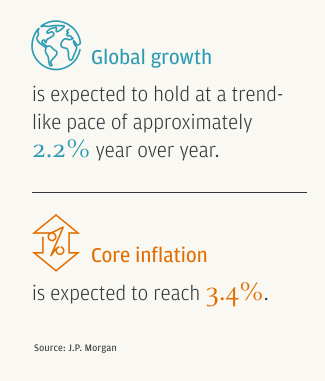
The global economy has shown remarkable resilience, with the U.S. leading the way. “U.S. consumer spending trends have remained firm and discretionary spending is steady. Tax refunds are helping to offset higher oil prices,” said Stephen Dulake, co-head of Global Fundamental Research at J.P. Morgan. This strength is reflected in J.P. Morgan’s baseline forecast, which sees global growth holding at a trend-like pace of approximately 2.2% year over year — a slight markdown from earlier expectations, but still robust. The U.S. economy’s resilience is further underscored by strong job creation and steady consumer fundamentals.
The polling data from the conference supports this outlook, with 47% of respondents identifying U.S. equities as the best performing asset class for the remainder of 2026, followed by EM equities at 24% and oil at 16%. This sentiment reflects confidence in the U.S. and EM, even as Europe faces challenges around consumer spending and stagflation risks. Yet, the interplay between inflation and growth is nuanced; global inflation remains a central concern, with core inflation rates revised higher to 3.4%.
Navigating global tensions, trade implications and other risks
Base case predictions are being tested by geopolitical shocks that increasingly show up in pricing as well as headlines. For investors, geopolitics is no longer a background variable; it is influencing portfolios through energy, trade policy, supply chains and security-related fiscal decisions. Amid this landscape, the Middle East conflict U.S.–China dynamics and Europe’s defense agenda are shaping both the macro outlook and the relative attractiveness of asset classes.
Trade policy is also a key channel through which geopolitics is influencing market expectations. In polling, 78% of respondents expected the average effective U.S. tariff rate on imports to settle in the 10–20% range by year-end. This matters not only for growth and inflation assumptions, but also for corporate margins, capex prioritization and cross-border investment confidence — especially in an environment where investors are already sensitive to rate uncertainty.
There are other factors to consider too. “In the very near term, May will be interesting from a Chase card spending perspective as the pace of tax refunds to consumers will moderate,” Dulake said. “Secondly, a medium-term risk is a disorderly move up in bond yields; that’s when credit-rates correlations go to one and this impacts risk markets more broadly. Lastly — somewhat long-term and not unrelated to crowding in the tech sector — is the shape of the AI monetization curve, given all the dependency on hyperscaler cash flows.”
Where will average effective U.S. tariff rates settle by year-end?
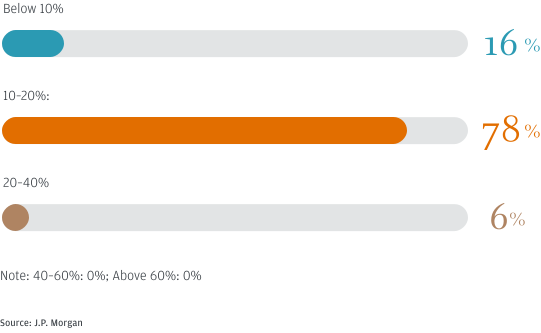
78% of poll respondents believe that the average effective U.S. tariff rates will settle between 10% and 20% by the end of 2026.
Commodities outlook: Oil, gold and supply chain disruption
Operational challenges in the oil market are shaping price dynamics and upending supply chains. “There has been significant supply disruption since March; however, inventories have helped absorb a large part of the shock so far. While it may appear we have a large buffer, having entered this conflict with ~8.4 billion barrels in global inventory, the backdrop is a lot more complex,” said Dubravko Lakos-Bujas, head of Global Markets Strategy at J.P. Morgan. “There are numerous operational constraints — we estimate the true and more effective buffer is closer to 800 million barrels, and as of today, we have depleted roughly 350 million barrels. So, almost half of the buffer has been taken out.”
Brent crude is forecast to remain just below $100 per barrel for the remainder of the year, with oil prices expected to remain sticky until year-end as restocking takes time. “If the Strait is not opened by June, operational stress may begin to kick in,” Lakos-Bujas said.
“There has been significant supply disruption since March. If the Strait of Hormuz is not opened by June, operational stress may begin to kick in.”

Dubravko Lakos-Bujas
Head of Global Markets Strategy, J.P. Morgan
Gold and silver markets are also experiencing shifts, with central bank purchasing of gold similar to levels seen in the first quarter of 2025 and Chinese buyers entrenched in the gold trade. “ETF inflows in gold were very large last year, but lower this year. Demand is fairly similar to last year but has moved from ETFs to China buying more gold and more physical buying by retail,” said Pranav Thakur, head of Global Markets at J.P. Morgan. In this environment, precious metals are increasingly being treated as both a diversification tool and a barometer of geopolitical and inflation uncertainty.
Trading floor insights: Rate hikes expected in the second half of 2026
Market volatility and central bank dynamics are top of mind for traders and investors. All eyes are on the Fed, with J.P. Morgan Global Research anticipating rates to hold steady for the rest of the year. This may change if the labor market weakens, the economic fallout from high energy prices becomes more severe or as Kevin Warsh steps into his new role as Fed chair. “The bar for the Fed to cut rates is going to be very high. For now, the best case for markets is that the Fed keeps rates unchanged,” said Thakur.
“The bar for the Fed to cut rates is going to be very high. For now, the best for markets is that the Fed keeps rates unchanged.”

Pranav Thakur
Co-Head of Global Markets, J.P. Morgan
The Fed’s cautious stance is mirrored by the European Central Bank (ECB) and Bank of England (BoE), with markets pricing multiple hikes and additional challenges in the U.K. due to inflation and political shifts. “With the BoE and ECB , there are three hikes priced. For now, we will not fade the third hike, but this could change depending on oil prices,” Thakur said.
The Bank of Japan (BoJ) faces its own challenges, with the yen under severe stress and interest rate differentials driving currency weakness. “Until the BoJ materially reduces the interest rate differential, it will be hard to get the currency under control. We expect at least two hikes,” Thakur said.
FX trends reflect the stability of the dollar, with real carry driving outperformance across currencies. “The U.S. is a large energy exporter. The opening of the Strait of Hormuz could take some time, which could back the dollar,” Thakur said. The dollar’s stability is further supported by capital flows into liquid dollar assets when alternatives look less compelling.
Risks and returns in private credit markets
Credit markets are at a crossroads, with both public and private credit lines converging and new risks emerging. “We are seeing a rare mix of elevated yields, strong corporate fundamentals and very strong earnings, and in the public markets, very high credit quality,” said Sanjay Jhamna, global head of credit trading at J.P. Morgan.
The commoditization of private credit has narrowed the performance gap between top- and bottom-quartile managers, creating an unusually tight dispersion that is likely to correct. In this environment, managers focused primarily on growing assets under management are expected to face the greatest challenges over the next two to three years.
Regional dynamics underscore how diverse the private credit opportunity set has become. In Europe, infrastructure is viewed as relatively less exposed to AI disruption risk, while digital and energy dependence remains a strategic constraint given the scale of corporate spending by European investors on U.S. hyperscalers. In Australia, real estate represents a significant share of private credit activity, supported by population growth and a preference for hard-asset collateral, alongside insolvency regimes that tend to prioritize secured creditors.
Against this backdrop, sector selection and underwriting discipline are increasingly critical. In software and other AI-exposed areas, shorter visibility into business models raises the bar for assessing the durability of cash flows and understanding end-customer willingness to pay. Overall, the private credit outlook remains cautiously constructive: while stress and disruption are building, conditions are still viewed as manageable, with capital markets offering a roughly two-year window for issuers to pursue refinancing and structural solutions. High all-in yields, particularly in investment grade, continue to support demand even as investors become more selective.
AI drives global market activity
AI is now a dominant driver of market activity and investment, reshaping earnings trajectories, capital spending and competitive dynamics across sectors. Since late 2022, the AI complex has contributed 80% of cumulative earnings growth and driven 75% of both capex and R&D growth. AI-linked earnings growth is running ahead of non-AI growth (41% AI-related versus 12% ex-AI). “AI is not a theme — AI is the driver. Not just for equity markets, but much broader,” Lakos-Bujas said.
AI-enabled tools are already expanding from R&D into day-to-day decision-making and execution across organizations, including risk, fraud, marketing, documentation, customer service, hedging, prospecting and AML/BSA compliance. As adoption accelerates, the challenge for investors is to separate durable monetization pathways from hype, and to understand second-order effects including disruption risk in downstream software and the potential for job displacement to become a macro variable in the next downturn. In that context, AI is both a growth driver and a key lens for assessing concentration risk, crowded positioning and the resilience of business models under faster-than-historical technology cycles.
The AI cycle is also increasingly inseparable from cybersecurity and operational resilience. Security and cyber resiliency gaps are driving close to $1.5 trillion in incremental tech spending over the coming quarters, reinforcing investment momentum beyond compute. Jamie Dimon, chairman and chief executive officer of JPMorganChase, framed tech security clearly: “Cybersecurity should be taken as seriously as anything in our lives.”
“AI is not a theme — AI is the driver. Not just for equity markets, but much broader.”
Dubravko Lakos-Bujas
Head of Global Markets Strategy, J.P. Morgan
Polling results: Market sentiment and expectations for 2026
Polling data from attendees of the Global Markets Conference provides valuable insights into market sentiment and expectations:
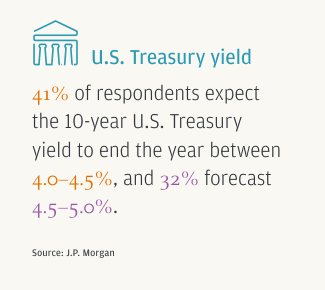
- Below 3.5%: 2%
- 3.5–4.0%: 18%
- 4.0–4.5%: 41%
- 4.5–5.0%: 32%
- Above 5%: 7%
- Execution is key — the direction is right, but the pace will determine the right payoff: 54%
- Positive for equities — but bond markets will need to digest the fiscal expansion: 27%
- A broader catalyst — this accelerates EU integration: 10%
- A generational opportunity — European defense and industrials are the trade of the decade: 4%
- A rising tide — benefits extend well beyond defense: 4%
- Below 10%: 16%
- 10–20%: 78%
- 20–40%: 6%
- 40–60%: 0%
- Above 60%: 0%
Looking forward: Global markets outlook
The outlook for global markets in 2026 is shaped by resilience and strategic decision-making. Investors are responding to shifting geopolitical tensions and evolving risks, with a focus on preparation, diversification and innovation.
In the face of fast-changing conditions, Dimon’s advice resonates: “When it comes to risk management, roll your sleeves up and focus, stay calm and logical. There may be challenges ahead but what we can do is prepare and put ourselves in the best possible position.”
Related insights
-

Securities Services
Private market secondaries are booming amid an IPO slowdown
April 13, 2026
Transaction volumes for private market secondaries have hit fresh highs. What’s driving their appeal, and will this trend continue?
-

Markets and Economy
From attractive EM valuations to a new commodities supercycle, discover the opportunities investors are focusing on in 2026 and beyond.
-

Markets and Economy
Direct access to market leading liquidity harnessed through world-class research, tools, data and analytics.
FOR INSTITUTIONAL & PROFESSIONAL CLIENTS ONLY – NOT INTENDED FOR RETAIL CUSTOMER USE
This material has been prepared by J.P. Morgan Sales and Trading personnel and is not the product of J.P. Morgan’s Research Department. It is not a research report and is not intended as such. This material is provided for informational purposes only and is subject to change without notice. It is not intended as research, a recommendation, advice, offer or solicitation to buy or sell any financial product or service, or to be used in any way for evaluating the merits of participating in any transaction. Please consult your own advisors regarding legal, tax, accounting or any other aspects including suitability implications, for your particular circumstances or transactions. J.P. Morgan and its third-party suppliers disclaim any responsibility or liability whatsoever for the quality, fitness for a particular purpose, non-infringement, accuracy, currency or completeness of the information herein, and for any reliance on, or use of this material in any way. Any information or analysis in this material purporting to convey, summarize, or otherwise rely on data may be based on a sample or normalized set thereof. This material is provided on a confidential basis and may not be reproduced, redistributed or transmitted, in whole or in part, without the prior written consent of J.P. Morgan. Any unauthorized use is strictly prohibited. Product names, company names and logos mentioned herein are trademarks or registered trademarks of their respective owners. The products and/or services mentioned herein may not be suitable for your particular circumstances and may not be available in all jurisdictions or to all clients. Clients should contact their salespersons at, and execute transactions through, a J.P. Morgan entity appropriately licensed in the client’s home jurisdiction unless governing law permits otherwise. Past performance is not indicative of future results. All services are subject to applicable laws, regulations and service terms. This material is a “solicitation” of derivatives business only as that term is used within CFTC Rule 1.71 and 23.605. Where this material is an “investment recommendation” as that term is defined in MAR visit: www.jpmm.com/#mardisclosures. This material is subject to terms at: www.jpmorgan.com/salesandtradingdisclaimer.
© 2026 JPMorgan Chase & Co. All rights reserved.
J.P. Morgan is a marketing name for investment banking businesses of JPMorgan Chase & Co. and its subsidiaries and affiliates worldwide. Bank products and services, including certain lending, derivative and other commercial banking activities, are offered by JPMorgan Chase Bank N.A. (JPMCB), including through its authorized branches and other global affiliates registered with local authorities as appropriate. Securities products and services, including execution services, are offered in the United States and in other jurisdictions worldwide by J.P. Morgan Securities LLC (JPMS LLC), in EMEA by J.P. Morgan Securities plc (JPMS plc) and J.P. Morgan SE (JPM SE) and in other regions by other appropriately licensed global affiliates. JPMCB, JPMS LLC, JPMS plc and JPM SE are principal subsidiaries of JPMorgan Chase & Co. For information on which legal entities offer investment banking and securities products and services in each jurisdiction, please consult: https://www.jpmorgan.com/disclosures/investment-bank-legal-entity-disclosures#securities-transactions
For additional regulatory disclosures, please consult: www.jpmorgan.com/disclosures.