
Key takeaways
- E-trading’s becoming increasingly central to liquidity, execution, and risk management across institutional markets.
- ETFs, algorithms, and portfolio trading are giving investors a broader, more transparent trading toolkit.
- Human expertise still matters, but modern systems are now essential in increasingly electronic markets.
Trading has come a long way in a relatively short space of time. While the equity markets were the early adopters in the noughties, it’s a little over a decade since the credit markets were still largely human-driven and executed over the phone.
Back then, institutional traders would trade a small number of tickets of a large size each day, whereas the growth in systematic trading in both North America and EMEA across algorithmic, portfolio, and ETF venues, has seen broad growth in the offerings available to clients.
The credit market, in particular, is much broader than it was a decade ago, with more issuers, larger capital structures, and increased market depth. This has allowed banks to become more sophisticated and make better use of data. As a result, they better understand correlations and can provide very broad liquidity through a growing number of axes.
Technology, technology, technology
The most rapid growth in technology happened between 2015 and 2019, says Peter Grant, Co-Head of Systematic Credit Trading at J.P. Morgan.
“COVID-19 came at a time when credit was at an inflection point, and as a result, it highlighted where the systematic ecosystem could step in to buy better liquidity,” says Grant. “Ever since then, it’s been on a steep upward trajectory.”
Integrating data from algo trading, the “mid certainty” provided by ETFs, and the execution certainty from portfolio trading (PT) offers investors a powerful platform that simply wasn’t possible with portfolio trading before the pandemic. E-trading has not only delivered new products to clients, or helped in the sourcing of alpha and managing risk, says Grant—it has also provided new opportunities.
What traders want
The evolution of e-trading is not simply about doing things better, but the market rewarding results. This leads to a snowball effect in the pace of change, not least at times of great volatility.
The J.P. Morgan Markets 2026 e-Trading Survey shows that volatile markets remain the key concern of traders this year (43%), far ahead of factors like workflow, liquidity, data costs and availability, and data leakage. In the equivalent 2021 survey, traders expected inflation to have the biggest impact on markets over the subsequent year (48%). Equity volatility was only cited as a concern by 8% of the survey respondents.
However, in the 2026 survey, it is depth of liquidity and market access that is considered the most important factor (29%) when selecting a sell-side platform during market volatility, ahead of reliability and execution quality (27%), and relationship/trust (18%).
Global traders are seeking actionable insights to shape execution decisions and the 2026 survey shows that real time data and analytics consistently emerge as the most valued tools for almost a quarter (24%) of respondents.
Respondents consider ease of access and experience, along with advanced analytics/tools, to be the most valuable features in a trading platform, with these being prioritized across all products, regions and trader types.
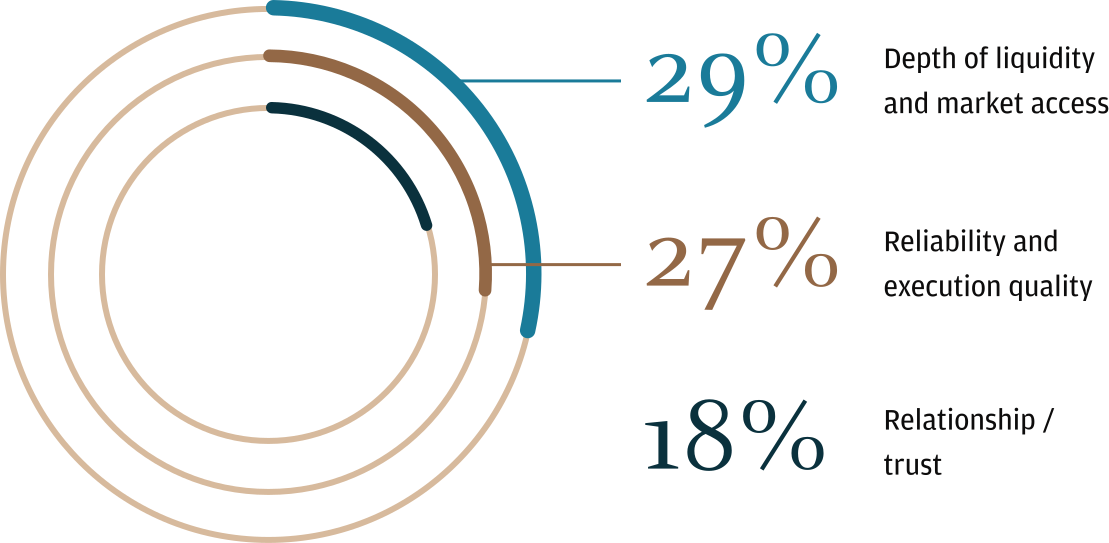
Concentric ring infographic highlighting three factors with percentages: Depth of liquidity and market access 29%, Reliability and execution quality 27%, and Relationship/trust 18%, each shown with a colored arc on the rings and labeled on the right.
Managing risk and greater transparency
E-trading has accelerated the pace of change, while driving innovation. One such evolution has been algorithmic liquidity provision and pricing, which is typically more efficient than anything a human can do, or agency algorithmic execution, says Andrew Morgan, President and Chief Revenue Officer at trading software provider TS Imagine.
“Ultimately, these super sophisticated machines are interacting with one another, and competing with each other for client business and optimal outcomes in markets every single day,”
he says.
“There’s a huge optimization exercise that goes on, and over time it’s improving outcomes for market participants as we migrate from analog to electronic trading techniques.”
“Technology doesn’t simply mean more efficient pricing and execution. It provides data, the lifeblood of the next wave of the technological revolution: the application of AI. Better data means better understanding and that necessarily extends to risk management and mitigation.”
Algorithms manage risk by looking at it holistically and optimizing what’s driving growth, particularly in the ETF market, says Morgan. This makes for far more effective risk management, because it provides optionality which is available at scale because of automation. Such an outcome wouldn’t be possible if someone was managing risk with a spreadsheet or a pen and paper.
“If anybody is still running their business off a spreadsheet, or still using core banking technologies while telling themselves they don’t need an execution management system in 2026, they’re kidding themselves,” adds Morgan.

Gaining better control
The operation of algorithms, with pre-determined and imposed regulatory obligations, is providing greater transparency and enabling more effective risk management. Electronic market making becomes easier to facilitate, as better access to data and control of the operational risk won’t be compromised by someone having a bad day at the office, systems not talking to one another, or data being poorly integrated.
“If a machine can respond to an opportunity in milliseconds, this is a very different way of operating,” says Morgan. “From a productivity standpoint, a modern toolkit, integrated data, FIX connectivity, access to liquidity, analytics, etc, give you the ability to automate a lot of the flow that really is a cognitive load on a trader, and a drag on productivity and the ability to add true value.”
One asset class that would probably not exist without the rise of e-trading, and whose development is inextricably linked with it, is ETFs. Developed from an effort to democratize finance for the retail investor, ETFs have slashed the cost of trading from hundreds of basis points to almost nothing today. But, to succeed, there was a need for greater transparency and the ability to transact simply and easily.
“This meant the sell side had to develop more and better tools to offer this efficiency and quality of execution,” says Olivier Cajfinger, Global Investment Grade, Short Duration & Public Finance Sales & Global Solutions at J.P. Morgan.
“This is how it has evolved over the past few years, and now the toolkit includes bonds, credit default swaps (CDS), total return swaps (TRS), ETFs, portfolio trading, repacks and corporate bond forwards. This means the toolkit is much richer than it used to be, which allows investors to have multiple weapons in their arsenal.”

More liquidity, please
Clients are increasingly demanding quicker, more transparent access to liquidity, as both retail and institutional investors make more use of ETFs for varied strategic and tactical purposes, says Jason Warr, Global Head of ETF Capital Markets at BlackRock.
“ETFs have now become an incredibly complementary risk transfer vehicle to manage risk at a firm, with more demand from liquidity providers who want to use ETFs for this purpose,” he says, adding that this is particularly the case in fixed income.
“That’s why, if we move back to periods like March 2020 and other times of high volatility, you’re seeing a greater increase in ETF volume relative to underlying bond volume. That isn’t pure client demand, but liquidity providers using it as a risk transfer vehicle because they can’t get the liquidity as quickly or as efficiently in the underlying bonds.”
ETFs are predicted to see the most developments in electronification in 2026, according to the 2026 J.P. Morgan Markets e-Trading Survey. Almost a fifth (18%) of respondents said ETFs will see the most developments in electronic trading, followed by equity derivatives and corporate bonds, which both polled at 15%.
These developments are now “morphing” into other asset classes, says Cajfinger, with portfolio trading in the municipal bonds (muni) business growing from less than 1% to over 3% of flows in a single year. Algorithms are also moving into the high yield (HY) space, and electrification is being discussed for SPG (securitized products group) assets and collateralized loan obligations.
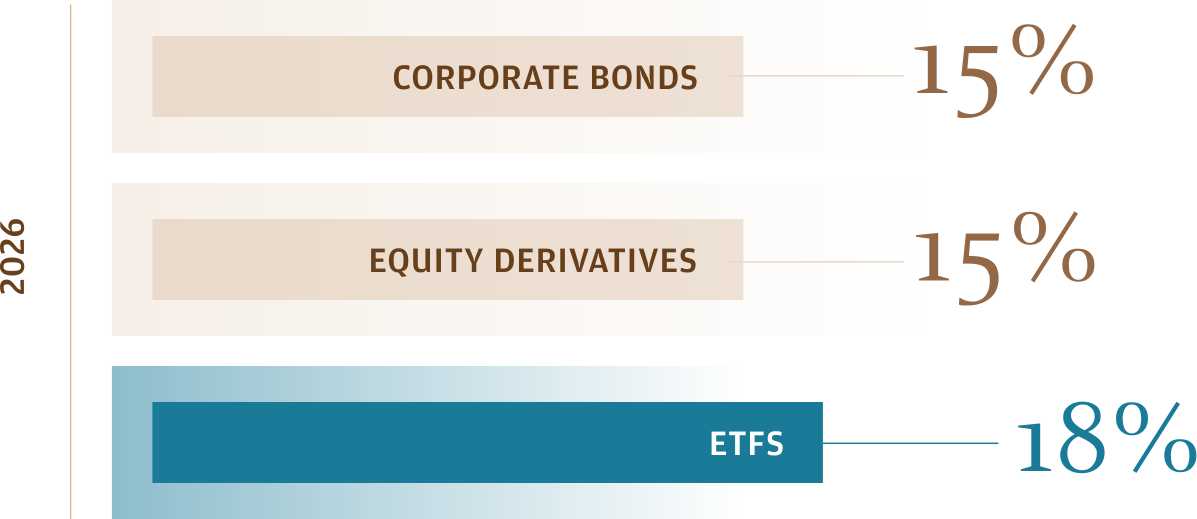
Horizontal bar chart for 2026 showing three product categories and their percentages: Corporate bonds 15%, Equity derivatives 15%, and ETFs 18% (ETFs shown with the longest, teal bar).
E-trading is a fact of life
While humans will still have a role to play in trades, e-trading is not only here to stay, but is going to dominate all asset classes in time.
“People might still pick up the phone to place an order because they prefer to do things that way, but by the time the order gets to the market, it’s gone through a machine—probably several—and definitely multiple AI agents,”
says Andrew Morgan, President and Chief Revenue Officer at trading software provider TS Imagine.
The reason for lost competitiveness on the buy side is because it couldn’t demonstrate that it did a better job than ETFs and other lower cost alternatives. It’s very hard to get repeatable sources of alpha individually, and do it in a way that means that you’re able to attract persistent inflows.
You’re leaving yourself in a vulnerable position if you’re not embracing these tools today, adds Morgan. “With everything that’s going on around artificial intelligence, and that level of awareness now outside of the technology function, there’s an expectation that modernization is going to happen at a faster pace.”
“You don’t want to be the person explaining to your board why you’re still using Excel to manage risk and make trading decisions.”

The future is e-trading
The vast majority of the volume across markets today is almost all machine driven, says Morgan, even if the original alpha and the idea to put the trade on isn’t. “By the time it gets to the cash equities desk, if it’s not going straight into a machine or an algorithm, it’s going to a sales trader who puts it into a machine,” he adds.
But that doesn’t mean the end of the human touch, says Grant: “The goal is to marry ‘low touch’ automated, and ‘high touch’ human, systems so the client receives the better price and risk is routed efficiently.”
“There are times when one of these approaches will provide the optimal price and the objective is to integrate them so the client always sees the better option, then allow us to route the risk to the one that will manage and exit it most efficiently, to ensure the client gets the best possible liquidity.”
While opportunities, not least with ETFs, have proliferated, concerns about data leakage and the impact this has on liquidity may result in more investor clients shifting to more direct relationships. Grant says there are legitimate worries about data leakage from using dealer platforms, as this effectively worsens liquidity in the system, and reduces their amount of trading.
“As bonds are quite a transparent market now in North America, and they’re going to be in Europe with some of the regulatory changes due,” he says, “clients are looking at options including reducing the number of dealers and pushing towards this direct connectivity to mitigate the concerns.”
One thing is for certain. While e-trading will continue to assert its dominance, opportunities will remain for institutional traders who seek to add value to the service they provide their clients.
ETFs: The catalyst for change
ETFs are very much the poster child of e-trading and most would probably accept that, without them, the pace of electronification and increased transparency would have taken far longer.
Jason Warr, Global Head of ETF Capital Markets at BlackRock, says fixed income is the perfect example of that. He points to some very strong examples of how ETFs have influenced the development of e-trading in High Yield and dollar credit, while even extending into other aspects of the fixed income market, such as mortgages and loans.
“These may not get the same kind of liquidity dynamics we’re seeing in other products, but by definition and by construct, they are adding more transparency,” says Warr.
A major benefit of the spread of ETFs is the real time transparency on the price of underlying assets, be they credit, high yield, or commodities, where access to accurate real time pricing is less available.
“I could manage my risk much better as a trader, as an investor, if I know what the value of that asset is at any time,”
says Warr. This, he adds, is why ETFs are growing—and in directions perhaps not anticipated a decade ago, such as active ETFs.
“ETFs are bringing more transparency into the value of my underlying active strategies and security holdings, and that’s part of the reason why in the US—and often in other regions, too—both retail and institutional investors are choosing to move their exposure to ETFs, because of that ability to manage risk, and meet any regulatory obligations they have.”
Do. More.
on J.P. Morgan Markets
Direct access to market leading liquidity harnessed through world-class research, tools, data and analytics.
Explore more themes
No results found
Adjust your filter selections to find what you’re looking for
FOR INSTITUTIONAL & PROFESSIONAL CLIENTS ONLY – NOT INTENDED FOR RETAIL CUSTOMER USE
This material has been prepared by J.P. Morgan Sales and Trading personnel and is not the product of J.P. Morgan’s Research Department. It is not a research report and is not intended as such. This material is provided for informational purposes only and is subject to change without notice. It is not intended as research, a recommendation, advice, offer or solicitation to buy or sell any financial product or service, or to be used in any way for evaluating the merits of participating in any transaction. Please consult your own advisors regarding legal, tax, accounting or any other aspects including suitability implications, for your particular circumstances or transactions. J.P. Morgan and its third-party suppliers disclaim any responsibility or liability whatsoever for the quality, fitness for a particular purpose, non-infringement, accuracy, currency or completeness of the information herein, and for any reliance on, or use of this material in any way. Any information or analysis in this material purporting to convey, summarize, or otherwise rely on data may be based on a sample or normalized set thereof. This material is provided on a confidential basis and may not be reproduced, redistributed or transmitted, in whole or in part, without the prior written consent of J.P. Morgan. Any unauthorized use is strictly prohibited. Product names, company names and logos mentioned herein are trademarks or registered trademarks of their respective owners. The products and/or services mentioned herein may not be suitable for your particular circumstances and may not be available in all jurisdictions or to all clients. Clients should contact their salespersons at, and execute transactions through, a J.P. Morgan entity appropriately licensed in the client’s home jurisdiction unless governing law permits otherwise. Past performance is not indicative of future results. All services are subject to applicable laws, regulations and service terms. This material is a “solicitation” of derivatives business only as that term is used within CFTC Rule 1.71 and 23.605. Where this material is an “investment recommendation” as that term is defined in MAR visit: www.jpmm.com/#mardisclosures. This material is subject to terms at: www.jpmorgan.com/salesandtradingdisclaimer.
© 2026 JPMorgan Chase & Co. All rights reserved.
J.P. Morgan is a marketing name for investment banking businesses of JPMorgan Chase & Co. and its subsidiaries and affiliates worldwide. Bank products and services, including certain lending, derivative and other commercial banking activities, are offered by JPMorgan Chase Bank N.A. (JPMCB), including through its authorized branches and other global affiliates registered with local authorities as appropriate. Securities products and services, including execution services, are offered in the United States and in other jurisdictions worldwide by J.P. Morgan Securities LLC (JPMS LLC), in EMEA by J.P. Morgan Securities plc (JPMS plc) and J.P. Morgan SE (JPM SE) and in other regions by other appropriately licensed global affiliates. JPMCB, JPMS LLC, JPMS plc and JPM SE are principal subsidiaries of JPMorgan Chase & Co. For information on which legal entities offer investment banking and securities products and services in each jurisdiction, please consult: https://www.jpmorgan.com/disclosures/investment-bank-legal-entity-disclosures#securities-transactions
For additional regulatory disclosures, please consult: www.jpmorgan.com/disclosures.