
Key takeaways
- J.P. Morgan Global Research sees U.S. house prices stalling at 0% in 2026, with a slight improvement in demand likely offsetting any increased supply.
- U.S. home sales held firm at the tail-end of 2025 following a sluggish year, and are projected to further improve in the coming months.
- While the Trump administration has announced two new housing reforms, their impact on the housing market is likely to be limited.
The U.S. housing market has been characterized by a persistent imbalance in recent months. Demand has been muted due to stubbornly high house prices, while supply has slowly but surely increased as new construction picks up. Could the market regain equilibrium in 2026, and are house prices expected to fall?
What’s the forecast for US house prices in 2026?
After nearly doubling in the last decade, J.P. Morgan Global Research sees U.S. house prices stalling at 0% in 2026, with a slight improvement in demand likely offsetting any increased supply.
While fixed-rate mortgage rates are projected to stay elevated at 6+%, adjustable-rate mortgage (ARM) rates could tick downward if the Fed decides to ease, thereby making homes more affordable. In addition, homebuilders are continuing to offer rate buydowns — in which they pay a sum upfront to help lower the buyer’s mortgage rate — in a bid to clear their inventory. “We think this could be enough, along with a rising wealth effect, to shift demand higher while supply increases subside. Consequently, we expect home prices to stall at 0% nationally in 2026,” observed John Sim, head of Securitized Products Research at J.P. Morgan.
There are, of course, regional variations. House prices are falling the most along the West Coast and Sun Belt, where there remains a glut of new homes following the pandemic-era construction boom. “It should not be a surprise that supply is a key factor in areas where we see home prices decline,” Sim said.
Indeed, the size of the housing shortage in the U.S. has been overemphasized, with J.P. Morgan Global Research putting the figure at around 1.2 million homes — significantly below other market estimates. Looking back over the past 30 years, new household formations and housing completions net out to nearly zero. In addition, housing supply has climbed in recent months. “Overbuilding is a sure path to home price declines, and builders have been navigating an increasing supply of new homes,” Sim added.
The supply of single-family homes has increased
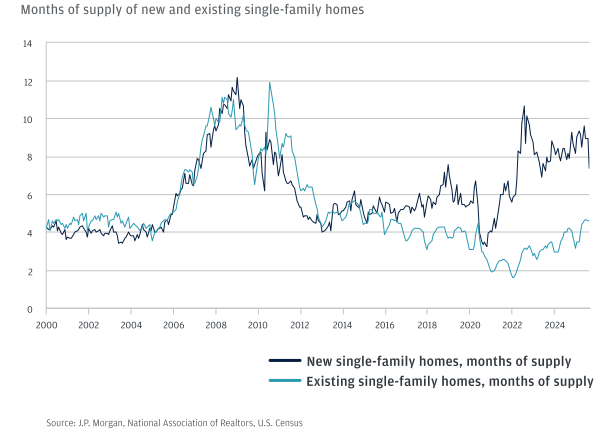
The supply of new and existing single-family homes has climbed in recent months.
Why have house prices been so high?
The house price-to-income ratio in the U.S. has remained near historic highs for the last three years. Even though house price inflation has decelerated, the U.S. is the only developed market (DM) outside of Japan that did not see house prices fall during the recent tightening cycle.
This is in part due to the prevalence of 30-year fixed-rate mortgages among American homeowners. “Higher policy rates weighed on not just demand but also supply, as current homeowners were reluctant to move and sacrifice lower mortgage rates. Prices were thus kept high despite a fall in demand,” said Joseph Lupton, a global economist at J.P. Morgan.
More recently, the impact of higher mortgage rates has been exacerbated by a labor market hiring rate that has slowed to near recession lows. “This has restricted an important channel that typically spurs both supply and demand in the housing market, as people with jobs and low mortgage rates are now further disincentivized from moving,” Lupton added.
“Lower adjustable-rate mortgage rates and builder buydowns could be enough, along with a rising wealth effect, to shift demand higher while supply increases subside. Consequently, we expect home prices to stall at 0% nationally in 2026.”

John Sim
Head of Securitized Products Research, J.P. Morgan
Are home sales improving?
U.S. home sales held firm at the tail-end of 2025 following a sluggish year. Sales of existing homes in December grew by 5.1% (seasonally adjusted) to reach a nearly three-year high, while sales of new homes in September and October also exceeded expectations.
“Mortgage rates fell nearly 75 basis points (bp) from late-May to mid-September and look to have finally translated into an improving trend for sales, though residual seasonality in existing sales could be overstating things,” said Michael Feroli, chief U.S. economist at J.P. Morgan.
Looking ahead, home sales are expected to further improve gradually, with mortgage purchase applications ticking up in early January. That said, housing affordability remains a challenge: the National Association of Realtors’ affordability index was still 35% below its pre-COVID level in November. “We will be closely watching upcoming pending home sales data, which lead existing home sales by one to two months, to gauge whether positive momentum will be sustained in the months ahead,” Feroli added.
How might new policies impact the US housing market?
In response to the affordability crisis, the Trump administration recently announced two new housing reforms. The first is a ban on institutional investors purchasing single-family homes, which is aimed at easing competition for first-time buyers. “However, institutional investors make up only about 1–3% of the market, so the policy is unlikely to be a game-changer,” Lupton noted.
What’s more, many institutional investors have in recent years pivoted to building their own build-to-rent communities as opposed to buying homes on the open market. “If the proposed ban also prevents these large operators from building their own homes or communities, we believe this could potentially have the opposite effect and theoretically tighten overall supply, as it would prevent more rental homes from entering the market,” said Michael Rehaut, head of U.S. Homebuilding and Building Products Research at J.P. Morgan.
There could also be other implications for the rental market if the policy successfully drives a meaningful increase in for-sale housing activity. “Our early thought is that the impact on landlords is small — perhaps less than a 1% annual headwind to net operating income (NOI) for a couple of years, in isolation,” observed Anthony Paolone, co-head of U.S. Real Estate Stock Research at J.P. Morgan. “While a headwind of this magnitude is not nothing, especially given the very low market rent growth for landlords over the past few years, it also seems less impactful than the normal range of outcomes.”
Under the second reform, the Trump administration has instructed the Federal Home Loan Mortgage Corporation (Freddie Mac) and the Federal National Mortgage Association (Fannie Mae) to buy up to $200 billion in mortgage-backed securities (MBS) in order to drive down mortgage rates and reduce borrowing costs.
However, this policy might once again have limited impact on the housing market. According to J.P. Morgan Global Research, the $200 billion purchase accounts for just ~1.4% of the approximately $14.5 trillion mortgage market, and will likely reduce 30-year mortgage yields by only 10–15 bp at most. “Secondly, most homebuilders already offer potential buyers mortgage rate buydowns of 100 bp to as much as 200 bp below the prevailing mortgage rate,” Rehaut said. “As a result, we do not believe a modest lowering of the market mortgage rate will have a material impact on demand.”
Related insights
-
Global Research
What’s the Fed’s next move?
April 17, 2026
Following the latest jobs report numbers and the nomination of Kevin Warsh as new Fed chair, what’s the outlook for interest rates for the rest of the year?
-

Global Research
2026 market outlook: A multidimensional polarization
December 09, 2025
Against a backdrop of uneven monetary policy, relentless AI expansion and intensifying market polarization, what’s the outlook for equities, commodities, currencies and more?
-

Global Research
AI and geopolitics reshape the 2026 labor market
December 10, 2025
Standfirst: The U.S. labor market in early 2026 stands at a crossroads. How will shocks from military conflicts and rapid AI adoption influence the market in the second half of the year?
This material (Material) is provided for your information only and does not constitute: (i) an offer to sell, a solicitation of an offer to buy, or a recommendation for any investment product or strategy, or (ii) any investment, legal or tax advice. The information contained herein is as of the date and time referenced in the Material and J.P. Morgan does not undertake any obligation to update such information. J.P. Morgan disclaims any responsibility or liability, whether in contract, tort (including, without limitation, negligence), equity or otherwise, for the quality, accuracy or completeness of the information contained in this Material, and for any reliance on, or uses to which, this Material, is put, and you are solely responsible for any use to which you put such information. Without limiting any of the foregoing, to the fullest extent permitted by applicable law, in no event shall J.P. Morgan have any liability for any special, punitive, indirect, or consequential damages (including lost profits or lost opportunity), in connection with the information contained in this Material, even if notified of the possibility of such damages. Any comments or statements made herein do not necessarily reflect those of J.P. Morgan, its subsidiaries or its affiliates.
All materials and information shared with you are, unless otherwise indicated to you, proprietary and confidential to J.P. Morgan. You are hereby notified that any disclosure, dissemination, copying, distribution, or use of the information provided to you, in whole or in part, other than as expressly permitted by J.P. Morgan, is STRICTLY PROHIBITED. You are permitted to disclose the materials and information to your officers and employees on a need to know basis. Should you have any questions regarding this, please contact your usual J.P. Morgan contact. For further information please visit:https://www.jpmorgan.com/pages/disclosures/materialdisclaimer.
© 2025 JPMorgan Chase & Co. All rights reserved. J.P. Morgan is a marketing name for businesses of JPMorgan Chase & Co. and its subsidiaries and affiliates worldwide. JPMorgan Chase Bank N.A. (member of FDIC), J.P. Morgan Securities LLC (member of FINRA, NYSE and SIPC), J.P. Morgan Securities plc (member of the London Stock Exchange and authorized by the Prudential Regulation Authority (PRA) and regulated by the Financial Conduct Authority and the PRA) and J.P. Morgan SE (authorised by the BaFin and regulated by the BaFin, the German Central Bank and the European Central Bank) are principal subsidiaries of JPMorgan Chase & Co. For legal entity and regulatory disclosures, visit: www.jpmorgan.com/disclosures. For additional regulatory disclosures, please consult: www.jpmorgan.com/disclosures.