For Companies and Institutions
-
Commercial Banking
We provide tailored credit, financing, treasury and payment solutions for businesses of all sizes and commercial real estate. Backed by the strength and stability of J.P. Morgan, our dedicated experts deliver industry-specific guidance and services, empowering you to manage cash flow, seize growth opportunities and achieve your strategic goals. -
Global Corporate Banking
We help clients achieve their long-term strategic goals through financing, liquidity, payments, risk management and investment banking solutions. -
Investment Banking
Providing investment banking solutions, including M&A, capital raising and risk management, for a broad range of corporations, institutions and governments. -
Payments
Your partner for commerce, receivables, cross-currency, working capital, blockchain, liquidity and more.
Key Links
For Institutional Investors
-
Asset Management
Putting our long-tenured investment teams on the line to earn the trust of institutional investors.
-
Markets
Direct access to market leading liquidity harnessed through world-class research, tools, data, and analytics.
-
Securities Services
Helping institutional investors, traditional and alternative asset and fund managers, broker dealers and equity issuers meet the demands of a rapidly evolving market.
-
Global Research
Leveraging cutting-edge technology and innovative tools to bring clients industry-leading analysis and investment advice.
-
Prime Services
Helping hedge funds, asset managers and institutional investors meet the demands of a rapidly evolving market.
-
Global Liquidity Solutions
Global short-term fixed income strategies designed to help clients manage liquidity through the cycle.
Key Links
For Individuals
-
Wealth Management
With J.P. Morgan Wealth Management, you can invest on your own or work with an advisor to design a personalized investment strategy. We have opportunities for every investor.
-
Private Bank
A uniquely elevated private banking experience shaped around you.
-
Personal Investing (UK only)
Invest with J.P. Morgan Personal Investing, a platform for UK-based clients with the human expertise, intuitive app and tools to help you work towards your long-term goals.
For Employers
-
Workplace Solutions
Enhance your equity compensation offering with solutions designed to empower your employees and bring your reward strategy to life.
Key Links
Who We Serve
Key Links
All Insights
Explore a variety of insights.
Key Links
Insights by Topic
Explore a variety of insights organized by different topics.
Key Links
Insights by Type
Explore a variety of insights organized by different types of content and media.
Key Links
About Us
We aim to be the most respected financial services firm in the world, serving corporations and individuals in more than 100 countries.
Key Links

From: Making Sense
Making Sense brings you insights across our Investment Banking, Markets and Research businesses. In each episode, J.P. Morgan leaders discuss the latest market trends and key developments that impact our complex global economy. Learn more about the series, by accessing the episodes below.
Subscribe
.svg)


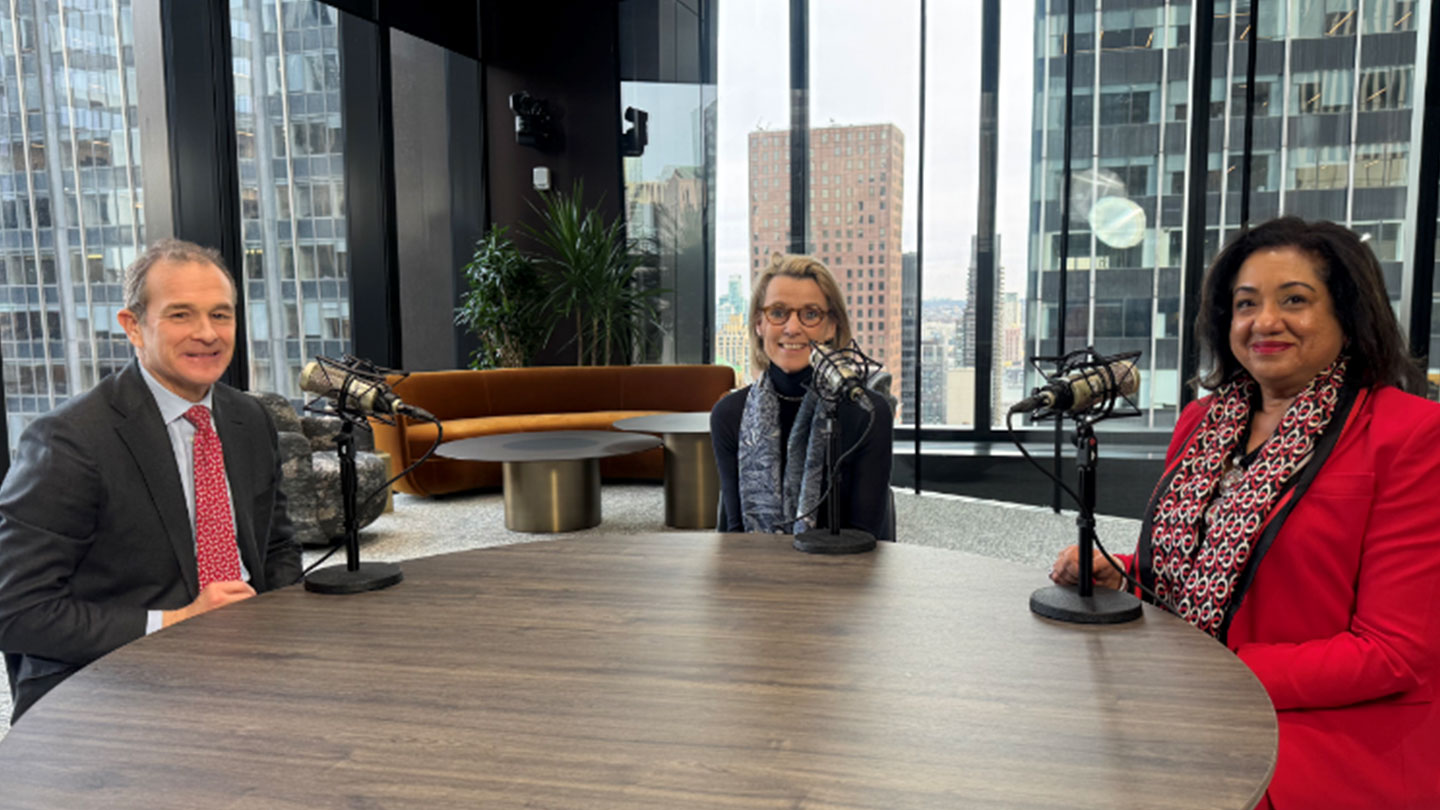
Mega deals and market shifts: 2025 investment banking recap and 2026 outlook
[Music]
Dorothee Blessing: Welcome to J.P. Morgan's Making Sense, where we break down the forces shaping global markets. I'm Dorothee Blessing, global head of Investment Banking Coverage, and I'm joined today by my two colleagues, Anu Aiyengar, global head of Advisory and M&A, and Kevin Foley, global head of Capital Markets. Together, we'll reflect on what defined in our mind 2025, share our perspectives, and the themes that could matter most for all of you in 2026. Thank you for being here, Kevin and Anu.
Kevin Foley: Thank you, Dorothee.
Anu Aiyengar: Happy to be here.
Dorothee Blessing: So let's start with a recap on 2025, and take a look back. This year really had two major themes that stood out with our clients and then the markets. Cautious optimism and adaptability. Clients began the year with cautious optimism, quickly adapting to persistent tariff, macroeconomic, and geopolitical uncertainties. But as the year progressed, uncertainty became more part of the business as usual environments, and clients recalibrated operations and supply chains to manage external risks. Clients had strategic caution and focused on fundamentals. Throughout 2025, they consistently prioritized cost management, liquidity, but also financial flexibility. Despite caution, many actively sought strategic growth opportunities across a number of sectors, and that was across technology, fintech, energy, and healthcare. And since the summer, we've seen an uptick in deal activity and broad optimism, largely supported by strong equity markets, driven by AI investments, and positive earnings, and with expectation for healthy activity and market stability. So Anu and Kevin, what has your take been? And maybe Anu, we start with you. As we look back at your mid-year M&A outlook, it really showed deal value up substantially this year, and it was driven by mega deals in tech, healthcare, and financial services. Why do we see so many mega deals this year?
Anu Aiyengar: Look, I think, as you said, Dorothee, the year began with optimism and then turned very negative post-Liberation Day. And then the summer saw the green shoots of activity. We saw dialogue pick up in May and real deals starting printed July onwards. But I would not have expected at that time that we're already at 4.5 trillion of volume, 38% year-over-year increase. That's way better than what anybody would have forecasted in the middle of the year. And what has really driven this is mega deals. We define that as more than 10 billion. And this has been a decade-high level of mega deals, double the number of deals from last year. When you look at the importance of scale, it's been an all-time record in terms of the premium that the market has given to scale. Whether to get included in the index, the PE multiples and EBITDA multiples that companies trade at, S&P 500, S&P 600 globally, scale has become a real important driver of value, not just reflected in multiples and index inclusion, but also in your ability to access capital. More larger companies are investment grade versus smaller companies, and the cost of borrowing has also been more attractive with the focused scale in particular. Having said that, Kevin, it's been a bit of a rollercoaster on the capital market side as well, times when we felt that the markets are wide open, and times when we've just been sitting and waiting for the market to come back. How do you think investor sentiment has evolved?
Kevin Foley: Well, I, I would echo that has felt like a bit of a rollercoaster ride, but I think fortunately, as you noted with the M&A environment, similar to the financing environment, in terms of whether you're both the equity or debt markets, we went through that six-week pause post-Liberation Day. And then after that, the level of uncertainty, at least the perception of it started to fade, the sentiment became more positive, benefiting from the fact that you've got the secular tailwinds of what's happening with AI investments, the anticipation of the Fed being more supportive, along with a pro-business physical policy out of this administration, all of that had a very positive impact on sentiment in both the equity and debt markets. The other thing I note to it is that the amount of liquidity in both markets. There was a lot of capital in the system looking to find a home. Borrowers in the debt markets have benefited from the fact that it has been heavily refinancing act driven, because to your theme around big cap M&A, that has been on very big companies that have healthy balance sheets that haven't necessarily needed financing from it. So a lot of the financing activity has been recycling of money, and we've seen a steady upward increase in IPO activity, but it was still building as the year progressed, and it was more prevalent in the last four or five months of the year.
Anu Aiyengar: Thank you for that, Kevin.
Kevin Foley: So Dorothee, let's talk a bit about one of the key themes of the year, which is AI and the corporate transformation. With it rapidly becoming a key player in so many fields, AI investment's at an all-time high. How is this influencing priorities for businesses across industries, and are we still in the early innings of this investment cycle?
Dorothee Blessing: I actually think there is no conversation these days without AI coming up, and it's almost omnipresent across organizations in all sectors, and not just the technology sector. As a matter of fact, I think 90% of organizations report regular AI use. But a lot of companies, to your point, Kevin, are really in the early stage experimenting in terms of how to best use AI. But we're seeing a third of organizations really starting to scale up AI programs and citing the key cost benefits. AI spend within organizations that have adopted AI is really accelerating. More than one-third of organizations are committing more than 20% of their digital budgets to AI technologies. And as demand for AI keeps rising across different industries, we are working with our clients that are AI-related clients to help them stay ahead of the demand curve, and that's not just to support them meeting today's needs, but really to help them think strategically about the future as AI is becoming even a bigger part of how businesses operate and innovate. And then, there is the high capital spending in AI and data center-supporting infrastructure. But even with all of this momentum, I'd say there's still early stages of that AI investment lifecycle. We see valuations of key public AI players remaining in line as AI demand is far exceeding supply, which is a very different dynamic than what we've seen in what people refer to as previous bubbles. So the real point is, I think we're in the early inning. Enhancement to the foundational models are happening more regularly and the capabilities from intelligence to autonomy are improving rapidly. And I think the systems are really going to drive massive efficiencies at every business and fundamentally changing the way we work. One of the things we shouldn't forget, it's only been three years that ChatGPT was released, so we're all still very much in the early innings of that evolution. So maybe, Anu, I can turn to you. I mean, if we look at all of that momentum on AI, what have we seen on the M&A side? How has AI impacted M&A?
Anu Aiyengar: So I'd split it into three pieces, fundraising, investments, and valuation. From a fundraising perspective, we've seen a proliferation of infrastructure funds come up, and these infrastructure funds raising significant amount of capital. Then we see investments across different areas, CapEx investment, investment in data centers, energy transition, as well as minority investments, because people don't know exactly which AI technology will succeed and what will not. So a lot of times, strategics want a seat at the table at multiple different companies to try and see which particular company is going to be successful. Combination of the level of fundraising that has happened and the level of investments that we've seen is valuations have really gone up. And there's been all these questions about are we in a bubble, are we not? And like you said, if we are very early in the game, we're only three years from when ChatGPT started, which is actually astounding to think about. These valuations, there will be some end game winners where the valuation will make sense, and there will be some which will not be successful. And right now, people are trying to figure out who the end game winners would be. Most companies don't have the option to wait. You need to have an AI strategy whether you're gonna disrupt yourself or whether you're gonna get disrupted, and that is what most people have been focused on.
Dorothee Blessing: So Anu, financial sponsors entered the capital cycling phase this year. With more exits and the comeback of taking privates, rise of sovereign private capitalist co-investors, what do you see from the private equity community in 2025 as we talk about activity levels?
Anu Aiyengar: If we just take stock of the sponsor M&A activity this year, sponsor M&A volumes have been up, but again, similar to what we said earlier on, it has been largely driven by mega deals. The majority of the activity has been sponsors selling their assets to a strategic. The sponsor-to-sponsor trade has been a lesser amount of the volumes than it has been historical, and overall, sponsor's contribution to M&A has been less than it has been in the past.
Dorothee Blessing: Let's take a look forward as we look at sponsors dry powder, deployment, and let's look at how they're looking at monetizations.
Anu Aiyengar: So that has been really the story for the past three years. After a robust timing of deployment and monetization where the cycle of ownership kept compressing, in both '23 and '24, what we saw is that sponsors were not monetizing as many assets. So we began this year with a huge backlog, and there is still a meaningful amount of backlog that is left. The level of monetizations that have happened has been mixed, and more away from the traditional channels that we have seen of either 100% sale or an IPO market. What would you say, Kevin, was the IPO market share of kind of the monetizations that we've seen?
Kevin Foley: So in 2025, we expect the year to end up around 20% of all of IPOs in the U.S. sponsor-related. Interestingly, those have performed very well. When you look at IPOs as a whole, year-to-date, they've on average returned 15%. When you look at the sponsor-related IPOs, they performed at closer to 20% return, so outperformed on average, the rest of IPOs and creating good momentum to go into 2026. As we think about 2026, we believe 30 to 35% of all IPO activity could be related to sponsors in the forthcoming year. But, Anu, IPOs are just one alternative for exiting. We've seen good activity in secondaries and continuation vehicles, and pursuit of other exit strategies. Can you talk about those trends and how we think about them going into next year?
Anu Aiyengar: Yeah, indeed. As you say, Kevin, the secondary market has been booming with just this year, volumes up 60% year-over-year, and the forecast even for 2026 is that there will be meaningful amount of secondary activity, not just between the LP funds, but also several GPs now raising a secondary fund to participate in this robust market. Continuation vehicle or some version of partially monetizing and partially continuing to own the asset has been a big trend as the private capital markets have continued to increase and companies can stay private for longer. Part of it has been LPs asking for their money back and wanting to refresh it with new investments. There continues to be a lot of mispricing in the public markets and opportunities to take companies private, and in '26, we are more optimistic about both trends, more deployment, as well as more monetizations. This year, we've already seen a beginning of this trend. So Kevin, there was meaningful take private activity this year as well, of course, with the blockbuster electronic arts take private, but there are many others as well. What is your view on the art of the possible of an LBO deal that can happen in the market?
Kevin Foley: Well, we've had the privilege to support many of the most significant M&A financings in the market this year. What I'm particularly proud of is our ability to deliver truly product-agnostic advice up and down the capital structure across both public and private markets, but always with a focus on quality of execution. A number of these have been take privates with global operations, which we've been able to leverage our global franchise across markets and currencies. Notably, 3G's acquisition of Sketchers, Sycamore's purchase of Walgreens Boots, and as you note, the take private of EA Sports by Silver Lake and PIF. That financing's yet to come, and that will be done in early '26. But they've all had complexity to them, and our teams have been able to work with the clients to structure the best possible outcome by leveraging the breadth of both the traditional, broadly syndicated, as well as the direct lending markets. One other highlight for the year was the continued growth of our direct lending initiative. We provided almost 10 billion in capital to support both large cap and middle market sponsors in 2025, and expect that to continue to grow in 2026. As we think about next year, we expect the robustness that we're seeing in appetite to continue. Importantly, as we noted earlier, the activity in the debt market's been largely driven by refinancing activity. 75% of leverage finance activity has been related to refinancing, so we've been recycling that demand, as I mentioned earlier. That creates a very positive backdrop for bringing more paper to the market, and so the market is actually clamoring for more M&A-related financings. We think, looking at a single B LBO, we could raise up to $25 billion, if not more, for the right credit and situation. I frankly think the equity check will probably be more of a constraint than the debt markets will be. When you look at it from a double B rated and looking at a corporate acquisition, we think it could be over $40 billion. So you see the extent of the appetite that's out there, the depth of the markets. It also benefits from the fact that when you have the growth in both the broadly syndicated market and the private credit markets is creating a very deep market, what is going to be a very supportive environment for getting M&A deals done. So bottom line, for anyone who's wondering if there's appetite out there to do big deals, there absolutely is. There's an ability to do complex deals as well. So we feel very good about going into the year given the technical backdrop, as well as the way we've seen the sentiment out there.
Anu Aiyengar: That's great, Kevin. Seems like the markets are there. We just need to find opportunities to deploy and create larger and larger deals.
Kevin Foley: We're ready, willing, and able.
Anu Aiyengar: Excellent.
Dorothee Blessing: (laughs) So with that, let's pivot to 2026 outlook. We're about to head into 2026, and all of our clients are getting ready for the new year, a changing market environment, but we anticipate continued momentum really across various sectors, sub-sectors. And Anu, let's start with you as we'll look on the M&A side. What are we anticipating in terms of M&A activity, whether from corporates, sponsors, and the broader community?
Anu Aiyengar: I'll give you my top three themes. Scale will continue to be important, but focused scale, because oftentimes people ask, how can we both be focused on corporate clarity as well as size? And the answer is focused scale. Market is rewarding companies who are larger, have the capacity to withstand a volatile market, and are able to make the investments necessary in order to be tech-enabled and supply chain resilient, and that theme we expect will continue. A second theme is U.S. exceptionalism and the valuation in the U.S. market being an attraction for companies globally, U.S. as a target, as well as mergers and spin-split transactions with a merger with US as the eventual domicile as a theme that continues. And sponsor activity, which we talked about a little bit. Unlocking sponsor assets that require monetization and the deployment that comes on the back of that. So those three themes will see a bit of a continuation of and an enhancement of going into '26.
Dorothee Blessing: Anything you wanna comment on cross-border activity in particular?
Anu Aiyengar: We've seen that with the corporate governance changes that we've seen in Japan as well as now Korea and the robust equity markets that we see in Australia as well as India, the valuation differential in the U.S. continues to make the U.S. an attractive space to invest, and many companies seeking to do that. There is, of course, national interest considerations and regulatory considerations and geopolitical considerations. But despite that, we've seen a meaningful amount of cross-border activity this year and continued expectation for 2026 that we'll see pockets of it, not across every jurisdiction, but mostly outbound from Asia, inbound into the U.S., as well as meaningful activity in the Middle East.
Dorothee Blessing: So we just looked at the M&A part of the equation, Kevin. Let's pivot and look at the capital m arkets, and in particular, the IPO markets in 2026. What are some of the most important trends that will affect the market, and are there any regional or other dynamics that you see playing out?
Kevin Foley: Well, it's interesting, Dorothee. I was reading the economist over the weekend and they had their word of the year was slop. Uh, I think we could sit there and talk about capital markets and maybe for a six-week period, the word was slop, but for the rest of the year, it's been resiliency. So these markets have continued to be really resilient. We've seen that get increasingly resilient throughout the year, right? If you had looked at the beginning of the year and we talked about whether it's Liberation Day to government shutdowns to other things that have been hanging on the markets, we would not have expected the markets to perform as well as they have. So, we carry that momentum into 2026. We've seen a number of high profile IPOs come here in December. We're still gonna be doing things as we sit here on December 8th with more to come. We feel like we've got a very positive backdrop for the reasons that we've talked about earlier, right? You have a secular tailwind from the AI investment theme. You continue to have supportive policy out of both the Fed and physical policy. You look at central banks around the world, they continue to be supportive, and you've had a economy that has remained resilient, and in some cases, starting to see some improvements in different parts of the world. So we feel optimistic about going into the year, and we expect IPO issuance levels could be up 25% globally in 2026. That would be back in line with pre-COVID averages, and we expect we'll be continuing to be driven by TMT and healthcare, which have been making up close to 60% of IPO activity, but we're also expecting an increase in volumes in consumer, diversified industries, and the fig spaces. I won't go as far as saying 2026 is going to be the ultimate tipping point for private equity and coming into the IPO market, but as you noted earlier, we expect it to pick up significantly and be as much as 30 to 35% of the activity in the coming year. But the environment continues to be very favorable. Valuations are attractive. We've seen good trading in the secondary on IPOs, so we're hopeful that activity will continue. What could be a risk at that? If AI, the efficiencies and growth that is expected from AI doesn't come to fruition or as quickly as we all would expect, that's a risk. If inflation is stickier and that has a negative impact on central bank policy, as well as geopolitical concerns, yes, we've seen progress on that front, but we're not fully through it. And then what I always like to note is the known unknowns. What is it that we don't know that's gonna happen that could surprise us?
Dorothee Blessing: So just to wrap up on the conversation we've been having, Kevin and Anu, there is a lot that we discussed from cautious optimism and adaptability through 2025, the positive momentum developing throughout the year, the resilience across the market, despite the volatility, and really despite the continuous geopolitical or macroeconomic risk we're seeing. So maybe Kevin, you wanna start, what do you think our clients should be thinking about as they head into 2026?
Kevin Foley: Don't be complacent. As optimistic as we all are and believers in a bullish environment and very favorable backdrop for getting deals done, we don't think we can take it for granted. There are risks in the balance that could have a negative impact and would say, if the money's there today, whether that's the debt or equity markets, we'd take advantage of it.
Dorothee Blessing: Anu, what will you say?
Anu Aiyengar: Building on that theme, be comfortable with uncertainty and be nimble. Think big. The financing markets can support it and the investors will reward you for it.
Dorothee Blessing: I'd really say continue to focus on what I call scenario-based planning, resilience strategies, build for that volatility and opportunity at the same time, and focus on AI and data, and not just from a digital transformation perspective, but really as a value driver, as we heard in the conversation today. Maintain the capital allocation to be able to respond to market opportunities, whether for growth or capability-driven acquisitions, and be prepared for that acceleration of M&A that Anu talked about. Thanks, Anu and Kevin for the great discussion and joining me for the podcast. We really, all three of us, wanna thank all of our clients for the trust and the business you do with J.P. Morgan. We'll be back soon with more insights from across J.P. Morgan's investment banking franchise.
[Music]
Voiceover: Thanks for listening to ‘What's the Deal?’ If you've enjoyed this conversation, we hope you'll review, rate, and subscribe to J.P. Morgan's Making Sense to stay on top of the latest industry news and trends, available on Apple Podcasts, Spotify, and YouTube.
To stay ahead of the curve, sign up for J.P. Morgan's In Context newsletter, packed full of market views and expert insights straight to you. To subscribe, just visit jpmorgan.com/in-context.
This material was prepared by the investment banking group of J.P. Morgan Securities LLC and not the firm's research department. It is for informational purposes only, and is not intended as an offer or solicitation for the purchase, sale, or tender of any financial instrument.
© 2025 JPMorgan Chase & Company. All rights reserved.
[End of episode]
In this episode, Dorothee Blessing, Global Head of Investment Banking Coverage, is joined by Anu Aiyengar, Global Head of Advisory and M&A, and Kevin Foley, Global Head of Capital Markets. Together, they break down the forces that shaped 2025—from cautious optimism and strategic adaptation to the surge in mega deals and the transformative impact of AI. Looking ahead, they share actionable insights on M&A, IPOs, private capital, and global market trends that will define opportunities and risks in 2026.
This podcast was recorded on December 8, 2025.
This material was prepared by certain personnel of JPMorgan Chase & Co. and its affiliates and subsidiaries worldwide and not the firm’s research department. It is for informational purposes only, is not intended as an offer or solicitation for the purchase, sale or tender of any financial instrument and does not constitute a commitment, undertaking, offer or solicitation by any JPMorgan Chase entity to extend or arrange credit or provide any other products or services to any person or entity.
© 2026 JPMorgan Chase & Company. All rights reserved.
You're now leaving J.P. Morgan
J.P. Morgan’s website and/or mobile terms, privacy and security policies don’t apply to the site or app you're about to visit. Please review its terms, privacy and security policies to see how they apply to you. J.P. Morgan isn’t responsible for (and doesn’t provide) any products, services or content at this third-party site or app, except for products and services that explicitly carry the J.P. Morgan name.