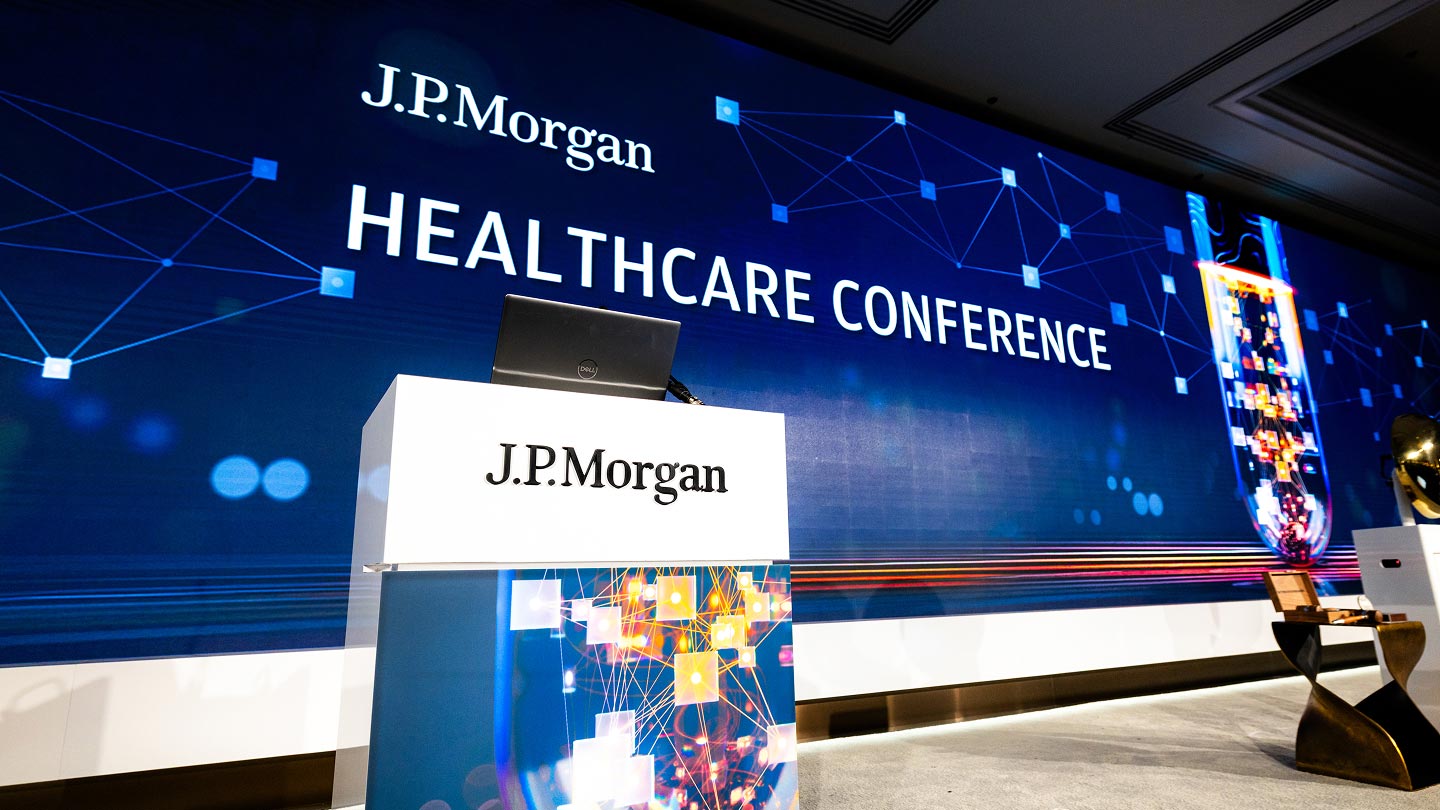
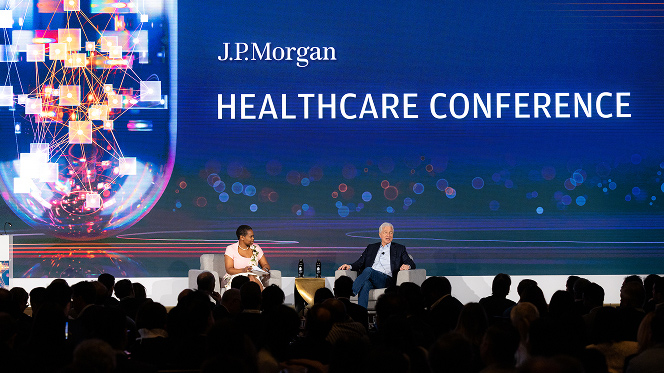
J.P. Morgan’s 44th annual Healthcare Conference, the industry’s largest and most informative healthcare event, recently wrapped up in San Francisco. Connecting global investors, industry leaders, high-growth companies, innovative technology creators and senior government officials, the conference provides crucial insight into what lies ahead for the industry.
What does 2026 hold for healthcare? Here are five key takeaways from the conference.
“We’re set for an active year ahead—biopharma innovation, medtech and life science breakthroughs, and AI transforming healthcare services. With last year’s headwinds continuing to dissipate, we anticipate strong 4Q25 momentum to carry through to 2026 for both M&A and the capital markets across the entire healthcare landscape.”

Jeremy Meilman
Global head of Healthcare Investment Banking, J.P. Morgan
The expanding role of technology in healthcare
AI and automation tools continue to roll out across the healthcare sector, with the goal of relieving administrative burdens, fortifying balance sheets and freeing up provider time for better patient care. AI stands to accelerate drug development, inspiring deeper collaboration between technology and pharmaceutical companies. At the conference, Nvidia and Eli Lilly announced a landmark partnership to build an AI drug discovery lab intended to unite top talent in the fields of pharmaceutical research and computer science.
Keynote addresses from senior government officials made the case for greater data integration in the public sector, as well as the launch of a “health tech ecosystem” that can provide Medicare enrollees easier access to innovative health technologies. Technology-enabled care continues to be a priority, with virtual care growing in fields like chronic care management. Government organizations aim to move faster in 2026, focusing on digital-first solutions across drug development, data management and diagnostics. All serve to set up 2026 as the year that technological achievements in healthcare take a visible leap forward.
“This year's conference was characterized by extensive discussion regarding new AI entrants and the evolving competitive landscape,” said Alexei Gogolev, senior analyst covering mid & small-cap vertical software and internet infrastructure at J.P. Morgan. “While recent headlines have highlighted the potential for disruption, companies in our coverage flag that their models are trained on billions of proprietary clinical and administrative data, enabling more accurate, context-aware AI solutions that are deeply embedded in the healthcare workflows.”
M&A activity could ramp up in biotech and pharma
In a regulatory environment generally considered more favorable to M&A than in years past, the health care, medical and biotech spaces are being closely watched for dealmaking activity after 2025 saw a return to relative highs for these sectors. One factor driving urgency may be the “patent cliff,” a term for the numerous brand-name drugs where key patents are set to expire in the coming years. As the brand-name drugs become available as generics, large pharmaceutical companies are bracing for potential loss of revenue by bolstering pipelines through M&A.
2025 saw deals struck between the Trump administration and nine pharmaceutical companies that are intended to lower the amount Medicaid pays for certain drugs. Given renewed momentum and favorable valuations, companies will likely seek out deals that pave the way for long-term stability and growth.
“The optimism around biotech was really felt in and around the conference,” said Tess Romero, senior analyst covering the small- and mid-cap biotechnology sector at J.P. Morgan. “In particular, the resurgence of M&A that we have seen is encouraging investors to take a closer look at high quality biotech names with assets with clear value propositions. As we look to the balance of 2026, it's ripe with binary events that could be interesting opportunities to see upside.”
Reconstituting GLP-1s as strategic investments
Researchers continue to discover benefits for GLP-1s that go beyond weight loss, with data showing their ability to help prevent diabetes and reduce cardiovascular risks. Various industry and government leaders called GLP-1s a “strategic investment” in the fight against health risks associated with obesity. Developing and expanding access to GLP-1s could decrease the prevalence of chronic noncommunicable diseases in obese populations, and as a result, lower healthcare utilization. And with the Trump administration announcing it had brokered a deal for lower GLP-1 prices for Medicare and Medicaid recipients , usage is likely to expand, particularly as a GLP-1 pill comes to market. All this suggests GLP-1 demand will grow, and competition between manufacturers will intensify.
IPO and M&A activity should continue to roar in APAC
Healthcare IPOs are all the rage in the Asia-Pacific region; 25 new sector IPOs debuted on the Hong Kong index in 2025, raising more than $30 billion collectively. Additionally, biotech and digital health are trends seen as converging, with capital flowing to companies that integrate advanced therapeutics with data-driven platforms. “Many of the new healthcare startups funded globally had an AI or digital health component,” said David Lau, Co-head of China Investment Banking and head of Asia Healthcare Investment Banking at J.P. Morgan. “Investors are prioritizing scalable, tech-enabled solutions that can deliver both clinical and economic value.”
Lau noted that global pharma will guide the way on dealmaking, and that markets with predictable regulation and stable interest rates will see the most activity. “The future will reward those who can execute efficiently and build trust-based, long-term relationships, especially as global competition for innovative assets intensifies,” he said.
The shifting sands of healthcare coverage
The political battle over expiring ACA subsidies, the Trump administration’s proposed outline for healthcare and the ongoing political question of what Medicaid and Medicare will (and will not) cover all make 2026 a year of potential upheaval. In response, health systems report prioritizing resilience and adaptability to weather any upcoming changes. Meanwhile, the U.S. system faces long-term challenges like nursing and provider shortages, high turnover, unreliable care for rural populations and an aging population. Time will tell how these acute and chronic pressures influence policy and practice in the year ahead.
“The future will reward those who can execute efficiently and build trust-based, long-term relationships, especially as global competition for innovative assets intensifies.”

David Lau
Co-head of China Investment Banking and head of Asia Healthcare Investment Banking, J.P.Morgan
Related insights
-

18:17 - Banking
-

Adapt to the fast-paced health care landscape to deliver quality care. Whether you’re a provider, researcher, manufacturer or startup, J.P. Morgan powers health care organizations with solutions to build financial strength, resiliency and growth.
-

In-Person Conference
Highlights from the J.P. Morgan healthcare conference
This material (including market commentary, market data, observations or the like) has been prepared by personnel in the Investment Banking Group of JPMorgan Chase & Co. and/or its affiliates and subsidiaries worldwide (“J.P. Morgan”). It has not been reviewed, endorsed or otherwise approved by, and is not a work product of, any research department of J.P. Morgan.
Any views or opinions expressed herein are solely those of the individual authors and may differ from the views and opinions expressed by other departments or divisions of J.P. Morgan. This material is for the general information of our clients only and is a “solicitation” only as that term is used within CFTC Rule 1.71 and 23.605 promulgated under the U.S. Commodity Exchange Act.
RESTRICTED DISTRIBUTION: This material is distributed by the relevant J.P. Morgan entities that possess the necessary licenses to distribute the material in the respective countries. This material is proprietary and confidential to J.P. Morgan and is for your personal use only. Any distribution, copy, reprints and/or forward to others is strictly prohibited.
This material is intended merely to highlight market developments and is not intended to be comprehensive and does not constitute investment, legal or tax advice, nor does it constitute an offer or solicitation for the purchase or sale of any financial instrument or a recommendation for any investment product or strategy.
Information contained in this material has been obtained from sources believed to be reliable but no representation or warranty is made by J.P. Morgan as to the quality, completeness, accuracy, fitness for a particular purpose or noninfringement of such information. In no event shall J.P. Morgan be liable (whether in contract, tort, equity or otherwise) for any use by any party of, for any decision made or action taken by any party in reliance upon, or for any inaccuracies or errors in, or omissions from, the information contained herein and such information may not be relied upon by you in evaluating the merits of participating in any transaction. All information contained herein is as of the date referenced and is subject to change without notice. All market statistics are based on announced transactions. Numbers in various tables may not sum due to rounding.
J.P. Morgan may have positions (long or short), effect transactions, or make markets in securities or financial instruments mentioned herein (or options with respect thereto), or provide advice or loans to, or participate in the underwriting or restructuring of the obligations of, issuers mentioned herein. Any transactions presented herein are for illustration purposes only. J.P. Morgan does not make representations or warranties as to the legal, tax, credit, or accounting
treatment of any such transactions, or any other effects similar transactions may have on you or your affiliates. You should consult with your own advisors as to such matters.
The use of any third-party trademarks or brand names is for informational purposes only and does not imply an endorsement by J.P. Morgan or that such trademark owner has authorized J.P. Morgan to promote its products or services.
J.P. Morgan is the marketing name for the investment banking activities of JPMorgan Chase Bank, N.A., J.P. Morgan Securities LLC (member, NYSE), J.P. Morgan Securities plc (authorized by the Prudential Regulation Authority and regulated by the Financial Conduct Authority and the Prudential Regulation Authority), J.P. Morgan SE (Authorised as a credit institution by the Federal Financial Supervisory Authority (Bundesanstalt für Finanzdienstleistungsaufsicht, BaFin) and jointly supervised by the BaFin, the German Central Bank (Deutsche Bundesbank) and the European Central Bank (ECB)), J.P. Morgan Securities Australia Limited (ABN 61 003 245 234/AFS Licence No: 238066 and regulated by Australian Securities and Investments Commission) and their investment banking affiliates. J.P. Morgan Securities plc is exempt from the licensing provisions of the Financial and Intermediary Services Act, 2002 (South Africa).
For Brazil: Ombudsman J.P. Morgan: 0800-7700847 / ouvidoria.jp.morgan@jpmorgan.com
For Australia: This material is issued and distributed by J.P. Morgan Securities Australia Limited (ABN 61 003 245 234/ AFS Licence No: 238066) (regulated by ASIC) for the benefit of “wholesale clients” only. This material does not take into account the specific investment objectives, financial situation or particular needs of the recipient. The recipient of this
material must not distribute it to any third party or outside Australia without the prior written consent of J.P. Morgan Securities Australia Limited.
© 2026 JPMorgan Chase & Co. All rights reserved.