
Contributors

Kriti Gupta

Executive Director, Global Investment Strategist, J.P. Morgan Private Bank

Federico Cuevas

Global Investment Strategist


Markets are pricing in a familiar fear: With volatile oil prices hinging on developments around the conflict in Iran and the uncertainty weighing on equity bulls, investors are instinctively falling back on the inflation playbook – buy energy and consumer staples.

It’s a script investors know well as geopolitical risk rattles the markets. But this cycle looks different than previous iterations, especially if the conflict deescalates. Earnings growth expectations and limited exposure to energy price volatility point to a quieter, and more compelling, defensive trade: utilities and healthcare. With relatively low valuations, the sectors offer investors a more defensive posture for a stock market bottom.

The tried and tested path

It’s conventional wisdom: When oil prices rise, energy stocks rally. When growth fears mount, consumer staples companies provide shelter. They’re the things consumers need regardless of economic conditions – the basics. That framework is deeply ingrained, but perhaps becoming increasingly outdated.

For most of 2022, energy was the only positive sector in the S&P 500. But after the market bottomed, investors rotated out of energy and embraced every other sector. Fast forward to 2026 and the same familiar market reflex is kicking in. Worries around being late-cycle, facing sticky inflation and the potential for higher rates are driving a bid for energy stocks yet again. The sector has already seen a 36% rally in the first quarter of the year and an almost 10% rally just since the conflict in Iran began.

Whereas energy and consumer staples stocks benefit from the perceived risk of inflation, they are also directly exposed to the conflict in Iran through commodity prices or input costs, respectively. That distinction matters if tensions with Iran escalate or remain unresolved.

Why lean into energy shock exposure when you can be insulated instead?

There are other sectors that offer defensive characteristics with long-term growth prospects. Healthcare demand, by contrast, is largely insensitive to fuel prices altogether and remains mostly non‑cyclical. Innovation pipelines remain robust. And earnings growth is supported by demographics rather than discretionary spending. Now add on pricing power, and the sector’s long‑term earnings power has proven resilient across cycles.

Meanwhile, utilities have been benefitting from grid investment, electrification and data‑center demand. The energy needs of the tech sector haven’t gone away – perhaps that’s why the utilities sector, despite depreciating year-to-date, is selling off by less than half of the move seen in the consumer staples sector. Plus, with higher oil prices, utilities retain the flexibility to substitute natural gas for oil when economically advantageous.

And yet, the classically defensive sectors of healthcare and utilities continue to trade with broader risk sentiment – even as their earnings growth estimates top those of their “inflation playbook” counterparts.

The chart displays year-over-year earnings per share growth rates (%) for five sectors, comparing historical averages (1996–2025) and current estimates for calendar year 2027. For the S&P 500, the historical average is about 7% and the current estimate is roughly 16%.


On sale

It’s not enough to have a compelling earnings story. Stock valuations must be attractive relative to that growth. And if there is a catalyst not embedded in the valuation, all the better.

Valuations across oil and gas companies sit well above long‑term averages, supported by years of capital discipline and shareholder return policies. With the Strait of Hormuz effectively closed, and oil supply therefore trapped, demand is disproportionately higher. Naturally, earnings expectations will reflect the resulting higher global price.

But it works in the other direction too. A de-escalation and the consequent oil price reduction yields the possibility of earnings revisions. Note, the crude futures curve continues to price oil below $80 per barrel in the back half of the year.

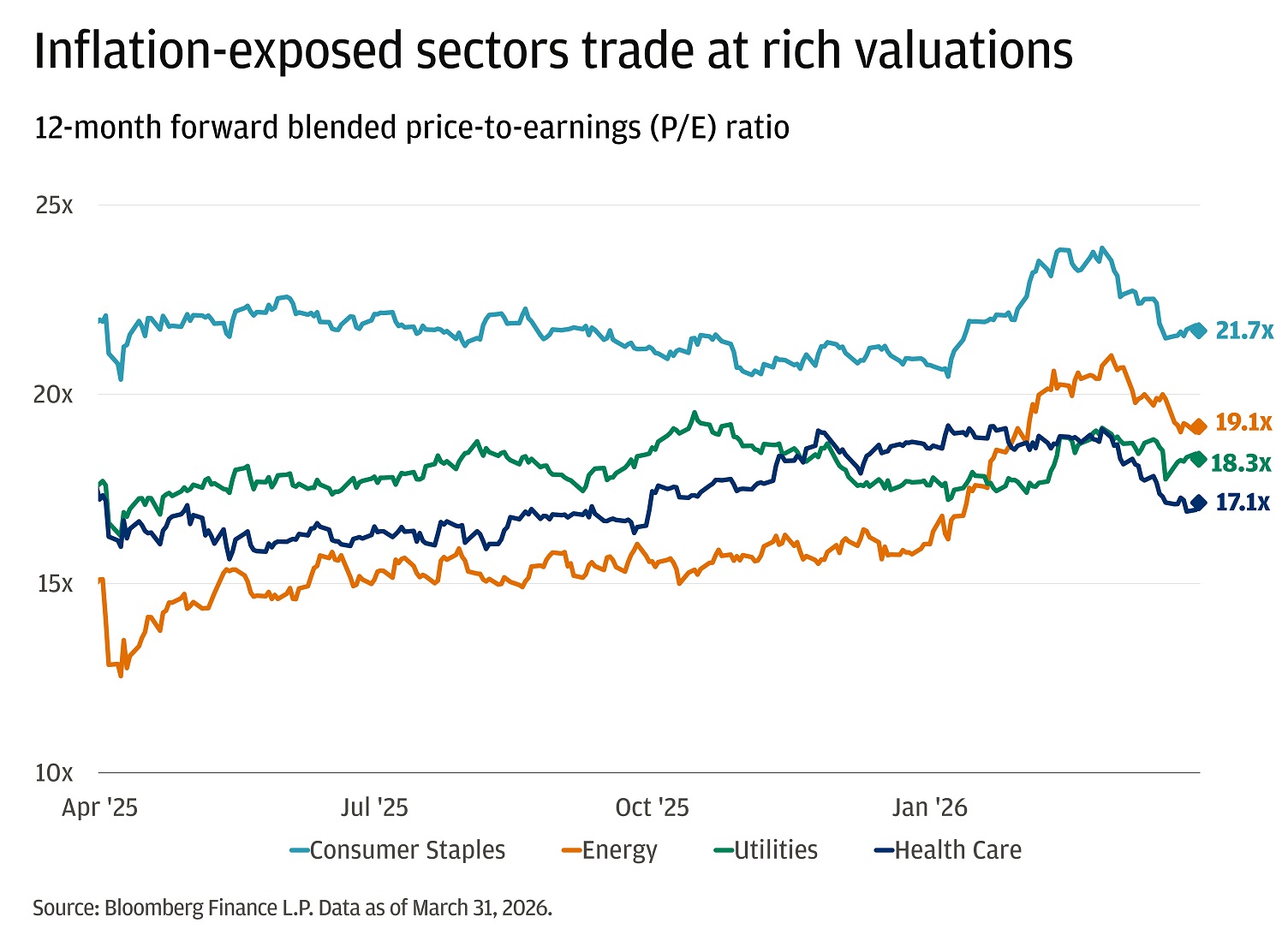
Consumer staples tell a similar story. Once the quintessential safety trade, the sector now faces margin pressure from lingering input costs, waning pricing power and a consumer that is increasingly value‑conscious. Now add on earnings growth expectations sitting below the market average and elevated valuations (relative to history).

The chart shows the 12-month forward Price-to-Earnings (P/E) ratio from 2025 to March 31, 2026 for five groups: The S&P 500, Consumer Staples, Energy, Utilities, and Health Care. S&P 500, Consumer Staples, and Health Care all fluctuate mostly between 17x and 22x, with Consumer Staples often leading slightly higher and Health Care slightly lower.


The bigger valuation gap is overseas

In times of geopolitical crisis, it’s common to see sentiment overshoot fundamentals. And it’s not just an S&P 500 story. When it comes to what regions may be poised for a recovery, take a look at Latin America.

Despite posting macroeconomic resilience, stable inflation, fiscal consolidation, nearshoring and energy independence, the MSCI Emerging Markets Latin America Index has dropped over 12% since the conflict in Iran began. Latin America’s valuation discount is less about deteriorating fundamentals and more about a higher risk and currency discount being applied to the region. But even as earnings are being revised upward, the region has faced a similar sentiment-driven drop primed to bounce back upon conflict resolution.

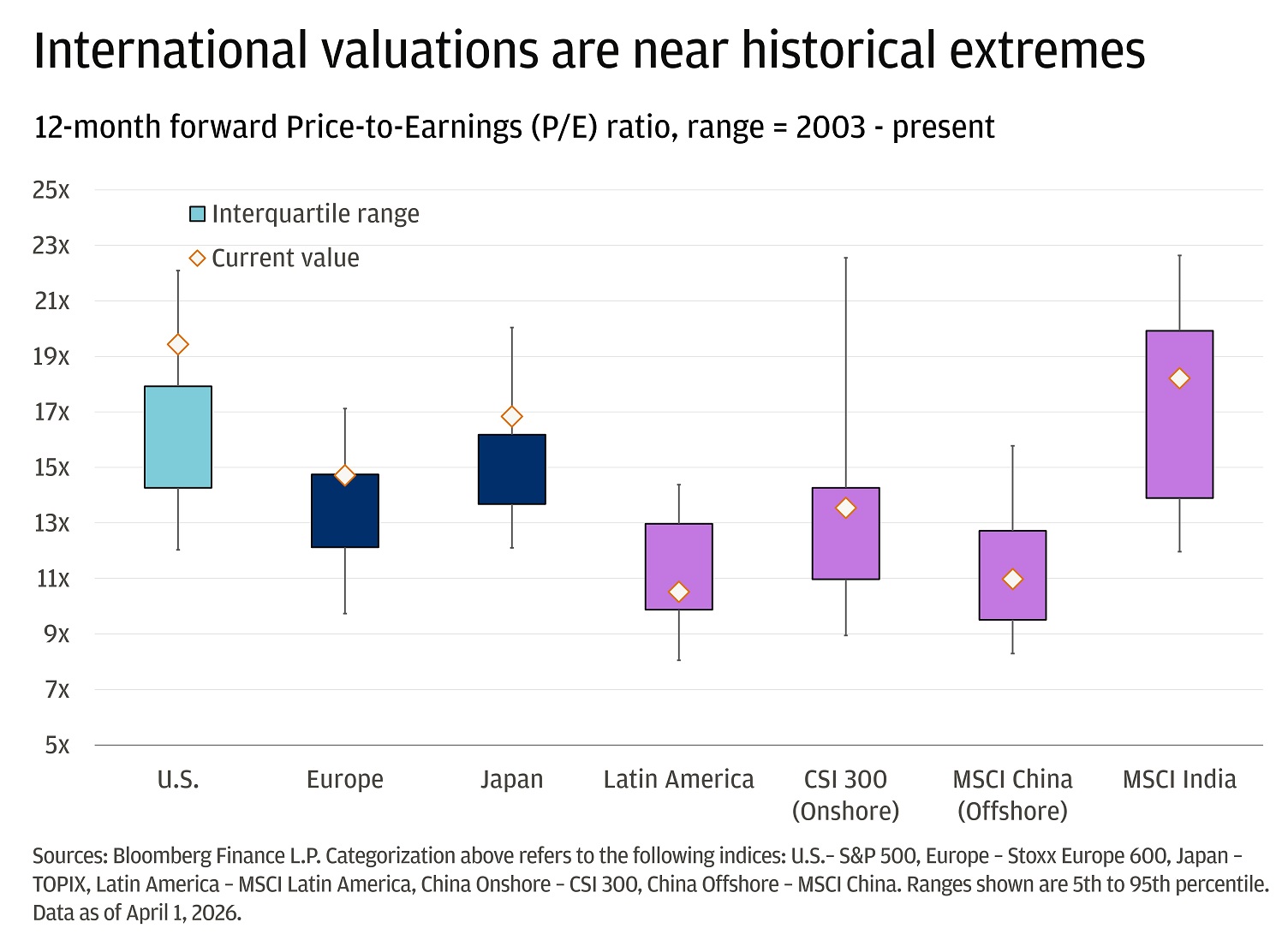
Now add in valuations. The index is trading at a roughly 10.2 forward multiple, which not only screens cheap against major peers, but also compared to its own historical average of about 11.5. Compared to the broader emerging market group, it’s trading at a 51% discount. That’s the largest valuation gap in 20 years. Even Europe, which is far more vulnerable to the fallout of higher energy prices and will need a longer recovery time, trades at a higher premium.

The chart displays 12-month forward Price-to-Earnings (P/E) ratios for eight equity categories, showing both the interquartile range and the current value as of March 31, 2026. U.S. has an interquartile range from about 15x to 20x, with a current value near 20x. Europe ranges from about 11x to 16x, with a current value near 15x.


All market and economic data as of 04/02/2026 are sourced from Bloomberg Finance L.P. and FactSet unless otherwise stated.

Connect with a Wealth Advisor

Reach out to your Wealth Advisor to discuss any considerations for your current portfolio. If you don’t have a Wealth Advisor, click here to tell us about your needs and we’ll reach out to you.

Connect now


DISCLOSURES

Investments in commodities may have greater volatility than investments in traditional securities, particularly if the instruments involve leverage.

Index definitions:

Standard and Poor’s 500 Index is a capitalization-weighted index of 500 stocks. The index is designed to measure performance of the broad domestic economy through changes in the aggregate market value of 500 stocks representing all major industries. The index was developed with a base level of 10 for the 1941–43 base period.

The Bloomberg Eco Surprise Index shows the degree to which economic analysts under- or over-estimate the trends in the business cycle. The surprise element is defined as the percentage difference between analyst forecasts and the published value of economic data releases.

The MSCI World Index is a free float-adjusted market capitalization index that is designed to measure global developed market equity performance.

The NASDAQ 100 Index is a basket of the 100 largest, most actively traded U.S companies listed on the NASDAQ stock exchange. The index includes companies from various industries except for the financial industry, like commercial and investment banks. These non-financial sectors include retail, biotechnology, industrial, technology, health care, and others.

The Russell 2000 Index measures small company stock market performance. The index does not include fees or expenses.

We believe the information contained in this material to be reliable but do not warrant its accuracy or completeness. Opinions, estimates, and investment strategies and views expressed in this document constitute our judgment based on current market conditions and are subject to change without notice.

The views, opinions, estimates and strategies expressed herein constitutes the author's judgment based on current market conditions and are subject to change without notice, and may differ from those expressed by other areas of J.P. Morgan. This information in no way constitutes J.P. Morgan Research and should not be treated as such. You should carefully consider your needs and objectives before making any decisions. For additional guidance on how this information should be applied to your situation, you should consult your advisor.

Any companies referenced are shown for illustrative purposes only, and are not intended as a recommendation or endorsement by J.P. Morgan in this context.

JPMorgan Chase & Co., its affiliates, and employees do not provide tax, legal or accounting advice. Information presented on these webpages is not intended to provide, and should not be relied on for tax, legal and accounting advice. You should consult your own tax, legal and accounting advisors before engaging in any financial transaction.

RISK CONSIDERATIONS (REMOVE THE DISCLOSURES THAT ARE NOT APPLICABLE BEFORE PUBLICATION.)

  • Past performance is not indicative of future results. You may not invest directly in an index.
  • The price of equity securities may rise or fall due to the changes in the broad market or changes in a company's financial condition, sometimes rapidly or unpredictably. Equity securities are subject to 'stock market risk' meaning that stock prices in general may decline over short or extended periods of time.
  • Investing in fixed income products is subject to certain risks, including interest rate, credit, inflation, call, prepayment and reinvestment risk. Any fixed income security sold or redeemed prior to maturity may be subject to substantial gain or loss.
  • In general, the bond market is volatile and bond prices rise when interest rates fall and vice versa. Longer-term securities are more prone to price fluctuation than shorter term securities. Any fixed income security sold or redeemed prior to maturity may be subject to substantial gain or loss. Dependable income is subject to the credit risk of the issuer of the bond. If an issuer defaults no future income payments will be made.
  • When investing in mutual funds or exchange-traded and index funds, please consider the investment objectives, risks, charges, and expenses associated with the funds before investing. You may obtain a fund’s prospectus by contacting your investment professional. The prospectus contains information, which should be carefully read before investing.
  • Investors should understand the potential tax liabilities surrounding a municipal bond purchase. Certain municipal bonds are federally taxed if the holder is subject to alternative minimum tax. Capital gains, if any, are federally taxable. The investor should note that the income from tax-free municipal bond funds may be subject to state and local taxation and the alternative minimum tax (amt).
  • International investments may not be suitable for all investors. International investing involves a greater degree of risk and increased volatility. Changes in currency exchange rates and differences in accounting and taxation policies outside the U.S. can raise or lower returns. Some overseas markets may not be as politically and economically stable as the United States and other nations. Investments in international markets can be more volatile.
  • Investments in emerging markets may not be suitable for all investors. Emerging markets involve a greater degree of risk and increased volatility. Changes in currency exchange rates and differences in accounting and taxation policies outside the U.S. can raise or lower returns. Some overseas markets may not be as politically and economically stable as the United States and other nations. Investments in emerging markets can be more volatile.
  • Investments in commodities may have greater volatility than investments in traditional securities, particularly if the instruments involve leverage. The value of commodity-linked derivative instruments may be affected by changes in overall market movements, commodity index volatility, changes in interest rates, or factors affecting a particular industry or commodity, such as drought, floods, weather, livestock disease, embargoes, tariffs and international economic, political and regulatory developments. Use of leveraged commodity-linked derivatives creates an opportunity for increased return but, at the same time, creates the possibility for greater loss.
  • Real estate investments trusts may be subject to a high degree of market risk because of concentration in a specific industry, sector or geographical sector. Real estate investments may be subject to risks including, but not limited to, declines in the value of real estate, risks related to general and economic conditions, changes in the value of the underlying property owned by the trust and defaults by borrower.
  • Investment in alternative investment strategies is speculative, often involves a greater degree of risk than traditional investments including limited liquidity and limited transparency, among other factors and should only be considered by sophisticated investors with the financial capability to accept the loss of all or part of the assets devoted to such strategies.
  • Structured products involve derivatives and risks that may not be suitable for all investors. The most common risks include, but are not limited to, risk of adverse or unanticipated market developments, issuer credit quality risk, risk of lack of uniform standard pricing, risk of adverse events involving any underlying reference obligations, risk of high volatility, risk of illiquidity/little to no secondary market, and conflicts of interest. Before investing in a structured product, investors should review the accompanying offering document, prospectus or prospectus supplement to understand the actual terms and key risks associated with the each individual structured product. Any payments on a structured product are subject to the credit risk of the issuer and/or guarantor. Investors may lose their entire investment, i.e., incur an unlimited loss. The risks listed above are not complete. For a more comprehensive list of the risks involved with this particular product, please speak to your J.P. Morgan team.
  • As a reminder, hedge funds (or funds of hedge funds) often engage in leveraging and other speculative investment practices that may increase the risk of investment loss. These investments can be highly illiquid, and are not required to provide periodic pricing or valuation information to investors, and may involve complex tax structures and delays in distributing important tax information. These investments are not subject to the same regulatory requirements as mutual funds; and often charge high fees. Further, any number of conflicts of interest may exist in the context of the management and/or operation of any such fund. For complete information, please refer to the applicable offering memorandum.
  • For informational purposes only -- J.P. Morgan Securities LLC does not endorse, advise on, transmit, sell or transact in any type of virtual currency. Please note: J.P. Morgan Securities LLC does not intermediate, mine, transmit, custody, store, sell, exchange, control, administer, or issue any type of virtual currency, which includes any type of digital unit used as a medium of exchange or a form of digitally stored value.
  • The prices and rates of return are indicative, as they may vary over time based on market conditions.
  • Additional risk considerations exist for all strategies.
  • The information provided herein is not intended as a recommendation of or an offer or solicitation to purchase or sell any investment product or service.
  • Opinions expressed herein may differ from the opinions expressed by other areas of J.P. Morgan. This material should not be regarded as investment research or a J.P. Morgan investment research report.


GENERAL RISKS & CONSIDERATIONS
Any views, strategies or products discussed in this material may not be appropriate for all individuals and are subject to risks. Investors may get back less than they invested, and past performance is not a reliable indicator of future results. Asset allocation/diversification does not guarantee a profit or protect against loss. Nothing in this material should be relied upon in isolation for the purpose of making an investment decision. You are urged to consider carefully whether the services, products, asset classes (e.g. equities, fixed income, alternative investments, commodities, etc.) or strategies discussed are suitable to your needs. You must also consider the objectives, risks, charges, and expenses associated with an investment service, product or strategy prior to making an investment decision. For this and more complete information, including discussion of your goals/situation, contact your J.P. Morgan representative.

NON-RELIANCECertain information contained in this material is believed to be reliable; however, JPM does not represent or warrant its accuracy, reliability or completeness, or accept any liability for any loss or damage (whether direct or indirect) arising out of the use of all or any part of this material. No representation or warranty should be made with regard to any computations, graphs, tables, diagrams or commentary in this material, which are provided for illustration/reference purposes only. The views, opinions, estimates and strategies expressed in this material constitute our judgment based on current market conditions and are subject to change without notice. JPM assumes no duty to update any information in this material in the event that such information changes. Views, opinions, estimates and strategies expressed herein may differ from those expressed by other areas of JPM, views expressed for other purposes or in other contexts, and this material should not be regarded as a research report. Any projected results and risks are based solely on hypothetical examples cited, and actual results and risks will vary depending on specific circumstances. Forward-looking statements should not be considered as guarantees or predictions of future events.

Nothing in this document shall be construed as giving rise to any duty of care owed to, or advisory relationship with, you or any third party. Nothing in this document shall be regarded as an offer, solicitation, recommendation or advice (whether financial, accounting, legal, tax or other) given by J.P. Morgan and/or its officers or employees, irrespective of whether or not such communication was given at your request. J.P. Morgan and its affiliates and employees do not provide tax, legal or accounting advice. You should consult your own tax, legal and accounting advisors before engaging in any financial transactions.

Legal Entity and Regulatory Information.

J.P. Morgan Wealth Management is a business of JPMorgan Chase & Co., which offers investment products and services through J.P. Morgan Securities LLC (JPMS), a registered broker-dealer and investment adviser, member FINRA and SIPC. Insurance products are made available through Chase Insurance Agency, Inc. (CIA), a licensed insurance agency, doing business as Chase Insurance Agency Services, Inc. in Florida. Certain custody and other services are provided by JPMorgan Chase Bank, N.A. (JPMCB). JPMS, CIA and JPMCB are affiliated companies under the common control of JPMorgan Chase & Co. Products not available in all states.

Bank deposit accounts and related services, such as checking, savings and bank lending, are offered by JPMorgan Chase Bank, N.A. Member FDIC.

This document may provide information about the brokerage and investment advisory services provided by J.P. Morgan Securities LLC (“JPMS”). The agreements entered into with JPMS, and corresponding disclosures provided with respect to the different products and services provided by JPMS (including our Form ADV disclosure brochure, if and when applicable), contain important information about the capacity in which we will be acting. You should read them all carefully. We encourage clients to speak to their JPMS representative regarding the nature of the products and services and to ask any questions they may have about the difference between brokerage and investment advisory services, including the obligation to disclose conflicts of interests and to act in the best interests of our clients.

J.P. Morgan may hold a position for itself or our other clients which may not be consistent with the information, opinions, estimates, investment strategies or views expressed in this document. JPMorgan Chase & Co. or its affiliates may hold a position or act as market maker in the financial instruments of any issuer discussed herein or act as an underwriter, placement agent, advisor or lender to such issuer.