

Contributors

Kriti Gupta

Executive Director, Global Investment Strategist, J.P. Morgan Private Bank

The conflict in Iran, an ongoing war in Ukraine, counter-narcotics operations across Latin America and the question of Taiwan – these are just a few of the reasons that have led investors to view the global defense sector as an obvious beneficiary of an uncertain world.

Escalating conflicts and rising geopolitical fragmentation have spurred ambitious spending proposals. After all, it’s the structural spend that supports a multiyear uptrend. Unless, of course, it doesn’t come to fruition.

That’s the fear across advanced economies already burdened with elevated debt levels and supply chains that extend around the world. The idea of a sustained, multiyear rearmament cycle naturally invites skepticism. It’s that tension that sits at the heart of today’s defense investment debate.

Big promises

The debate is most visible in the United States, where proposals for a materially higher defense budget have prompted a simple question: How do you pay for it?

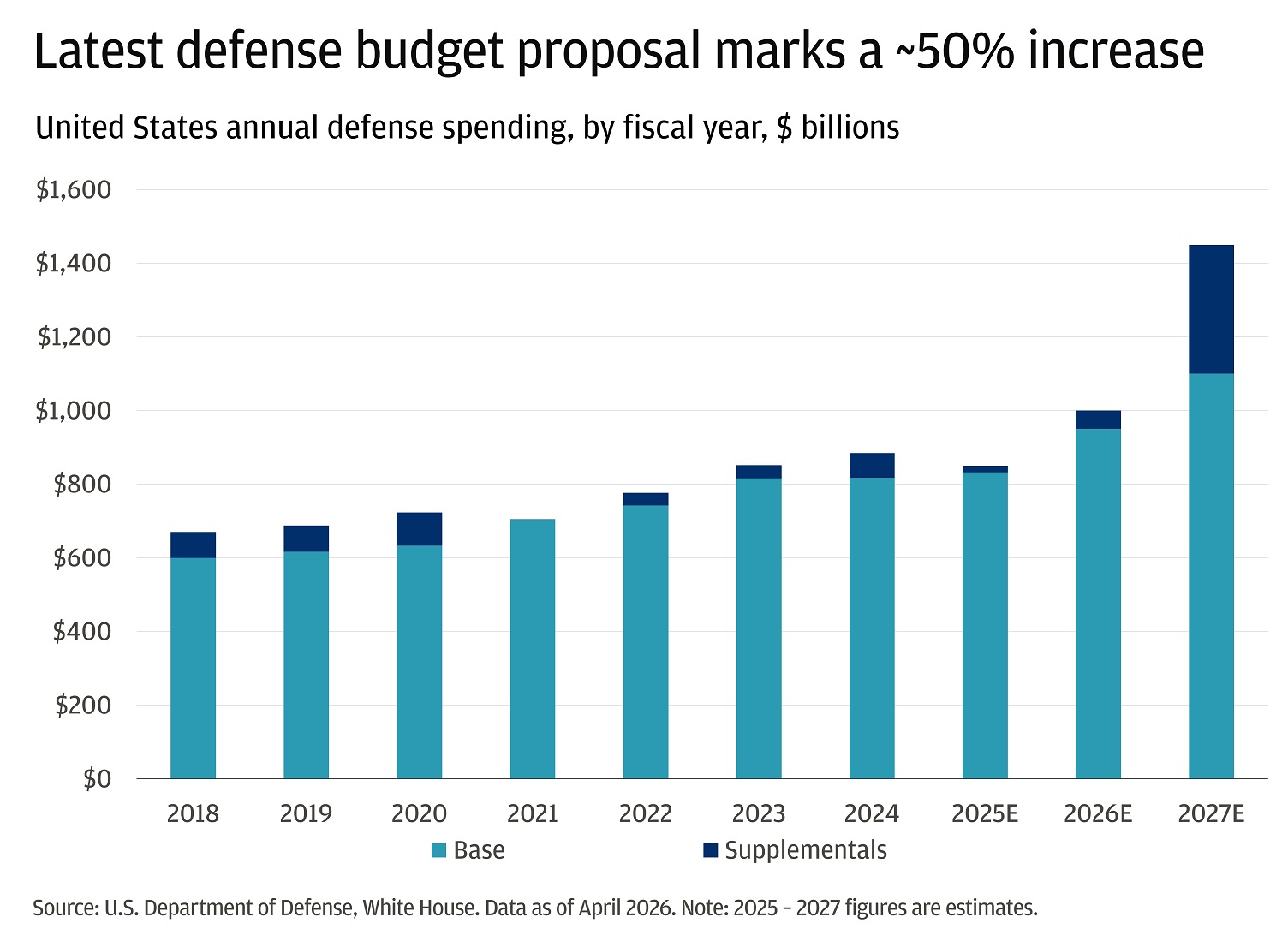
It’s no secret that the United States spends the most on defense in the world, allocating approximately $1 trillion in fiscal year 2026 alone – already a record amount. That amount could increase by almost 50% in 2027 as a $1.5 trillion budget proposal is presented to Congress.1 And that doesn’t account for expected supplemental funding requests expected around financing the operations in the Middle East.

The chart shows United States annual defense spending by fiscal year from 2018 to 2027, broken down into base spending and supplementals, in billions of dollars.

On sale

This defense proposal is unlike its predecessors in both scale and priorities. In prior years, supplemental funding, which traditionally adds on to funds allocated to defense in the national budget, has been focused on conflicts abroad, aiding allies like Ukraine and Israel. The $1.5 trillion budget proposal, however, leans further into the domestic agenda. It’s looking to fund modernization priorities such as multilayered missile defense systems like the Golden Dome for America to protect from aerial threats, space capabilities, shipbuilding, a 5%–7% pay raise for troops, artificial intelligence (AI) technology and nuclear funding, among other goals. But passage of the full request remains far from assured.

With a Republican majority in both the U.S. House of Representatives and Senate, it’s natural to assume an increase in defense spending would not only be welcome, but encouraged given the party has generally advocated for a stronger national defense. But this time, the scale of the spend competes with the fiscal priority of bringing down the national debt.

With the U.S. debt-to-GDP ratio at over 120% and a global market that has proven more sensitive to balanced budgets (or the lack thereof), increasing the defense budget by such a margin could face pushback by Congressional policymakers, especially during a midterm election year. That said, even a scaled-down compromise would still represent an acceleration in procurement, investment and research spending.

Ramp-ups and backlogs

Across the Atlantic, the investment case looks somewhat different. Europe’s shift toward higher defense spending reflects a more strategic reassessment after decades of underinvestment. Unlike in the United States, where defense infrastructure is already mature, Europe’s challenge lies in capacity rebuilding – from munitions and maintenance to logistics and integration.

The onset of the war in Ukraine and a push to increase contributions to the North Atlantic Treaty Organization (NATO) has created a crisis-driven urgency. But uneven industrial readiness in the region has slowed execution. As a result, the European rearmament story may be more gradual, but potentially more durable, especially with Germany’s fiscal pledge.

The German government boosted military spend in 2025 by 20%–25%, using both its traditional budget and special funds for the Bundeswehr, its armed forces.2 In doing so, Germany – a country renowned for its budget discipline – left its largest public-sector deficit since reunification. For some, the trade-off between debt and defense is worth it. After all, even with the investment, Germany’s debt-to-GDP ratio only sits at 64% – a far cry from the global average of G7 economies of 128%.3

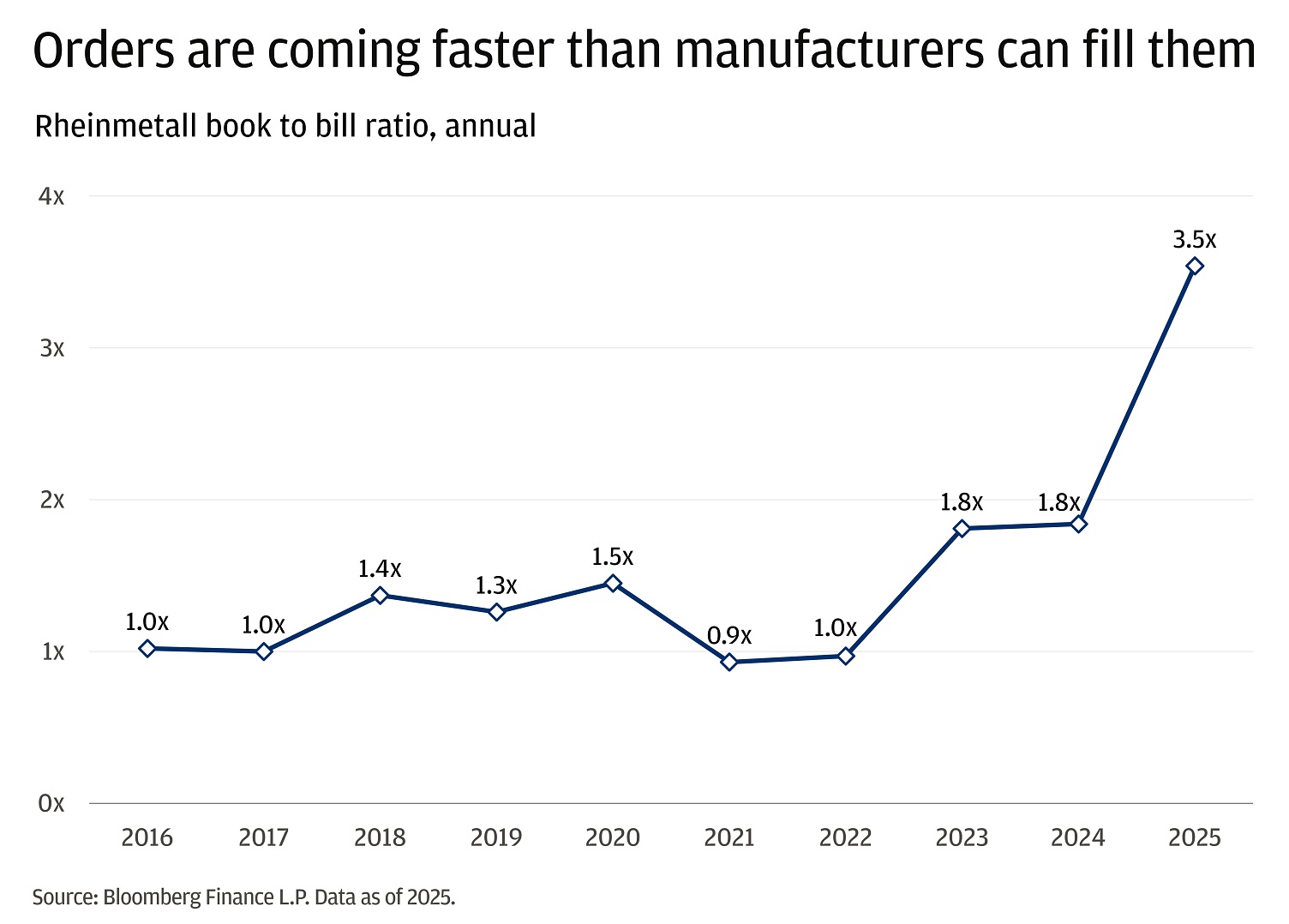
Even as the nation and broader European continent mobilizes, slower implementation and long-term investment plans breed capacity restraints. Take a look at the book-to-bill ratio of Rheinmetall, one of the world’s largest defense manufacturers, as one example of the broader trend. It’s the measure to show how quickly new orders are accumulating relative to current production, which has spiked since German spending priorities zeroed in on defense.

The line chart shows the annual Rheinmetall book to bill ratio from 2016 to 2025.

The backlogs are so large, ensuring future contracted revenue, that the sector’s stock market value has surged. As an illustrative valuation datapoint only (not a recommendation), it’s worth noting Rheinmetall has been trading at a higher valuation than even Nvidia – the largest company in the world by market capitalization – for the last 12 months.4

Balancing ambition & affordability

And it's not alone. Even Japan has changed its tune. Grappling with a debt burden, low purchasing power, reliance on foreign energy and aging demographics, Japan is ramping up its defense spending with a 2026 budget at a record 9 trillion yen (around $58 billion), marking a 10% annual increase. Even with political consensus to invest in maritime security and strengthening deterrence against China and North Korea, its economic constraints prove to be the biggest hurdle. Japan has to balance its 2% of GDP goal with its 237% of debt-to-GDP.

Japan is just the latest example of a fragmenting world that’s prioritizing defense. Japan is just the latest example of a fragmenting world that’s prioritizing defense. Global spend is expected to rise at a 5% compound annual growth rate by 2030 with earnings expected to grow in double digits after posting an average of 8% annual growth over the past decade. And that doesn’t yet take into account the latest $1.5 trillion defense proposal from the White House.

Even with these global increases, it's still the United States that tops the list of defense spending as it places an emphasis on security across the Western hemisphere, maritime and counter-narcotics operations, encouraging NATO contributions and a broad rearmament cycle around the world. And the market is not only pricing that in, but awaiting the green light on additional funding that could take the sector even higher.

All market and economic data as of 04/10/2026 are sourced from Bloomberg Finance L.P. and FactSet unless otherwise stated.

References

1.

The White House, 2026.

2.

NATO, 2026

3.

IMF, 2024.

4.

12-month blended forward P/E ratio. The information within this document is being provided for informational and is not intended to provide specific advice or recommendations. 

Connect with a Wealth Advisor

Reach out to your Wealth Advisor to discuss any considerations for your current portfolio. If you don’t have a Wealth Advisor, click here to tell us about your needs and we’ll reach out to you.

Connect now

DISCLOSURES

Investments in commodities may have greater volatility than investments in traditional securities, particularly if the instruments involve leverage.

Index definitions:

Standard and Poor’s 500 Index is a capitalization-weighted index of 500 stocks. The index is designed to measure performance of the broad domestic economy through changes in the aggregate market value of 500 stocks representing all major industries. The index was developed with a base level of 10 for the 1941–43 base period.

The Bloomberg Eco Surprise Index shows the degree to which economic analysts under- or over-estimate the trends in the business cycle. The surprise element is defined as the percentage difference between analyst forecasts and the published value of economic data releases.

The MSCI World Index is a free float-adjusted market capitalization index that is designed to measure global developed market equity performance.

The NASDAQ 100 Index is a basket of the 100 largest, most actively traded U.S companies listed on the NASDAQ stock exchange. The index includes companies from various industries except for the financial industry, like commercial and investment banks. These non-financial sectors include retail, biotechnology, industrial, technology, health care, and others.

The Russell 2000 Index measures small company stock market performance. The index does not include fees or expenses.

We believe the information contained in this material to be reliable but do not warrant its accuracy or completeness. Opinions, estimates, and investment strategies and views expressed in this document constitute our judgment based on current market conditions and are subject to change without notice.

The views, opinions, estimates and strategies expressed herein constitutes the author's judgment based on current market conditions and are subject to change without notice, and may differ from those expressed by other areas of J.P. Morgan. This information in no way constitutes J.P. Morgan Research and should not be treated as such. You should carefully consider your needs and objectives before making any decisions. For additional guidance on how this information should be applied to your situation, you should consult your advisor.

Any companies referenced are shown for illustrative purposes only, and are not intended as a recommendation or endorsement by J.P. Morgan in this context.

JPMorgan Chase & Co., its affiliates, and employees do not provide tax, legal or accounting advice. Information presented on these webpages is not intended to provide, and should not be relied on for tax, legal and accounting advice. You should consult your own tax, legal and accounting advisors before engaging in any financial transaction.

RISK CONSIDERATIONS 

  • Past performance is not indicative of future results. You may not invest directly in an index.
  • The price of equity securities may rise or fall due to the changes in the broad market or changes in a company's financial condition, sometimes rapidly or unpredictably. Equity securities are subject to 'stock market risk' meaning that stock prices in general may decline over short or extended periods of time.
  • Investing in fixed income products is subject to certain risks, including interest rate, credit, inflation, call, prepayment and reinvestment risk. Any fixed income security sold or redeemed prior to maturity may be subject to substantial gain or loss.
  • In general, the bond market is volatile and bond prices rise when interest rates fall and vice versa. Longer-term securities are more prone to price fluctuation than shorter term securities. Any fixed income security sold or redeemed prior to maturity may be subject to substantial gain or loss. Dependable income is subject to the credit risk of the issuer of the bond. If an issuer defaults no future income payments will be made.
  • When investing in mutual funds or exchange-traded and index funds, please consider the investment objectives, risks, charges, and expenses associated with the funds before investing. You may obtain a fund’s prospectus by contacting your investment professional. The prospectus contains information, which should be carefully read before investing.
  • Investors should understand the potential tax liabilities surrounding a municipal bond purchase. Certain municipal bonds are federally taxed if the holder is subject to alternative minimum tax. Capital gains, if any, are federally taxable. The investor should note that the income from tax-free municipal bond funds may be subject to state and local taxation and the alternative minimum tax (amt).
  • International investments may not be suitable for all investors. International investing involves a greater degree of risk and increased volatility. Changes in currency exchange rates and differences in accounting and taxation policies outside the U.S. can raise or lower returns. Some overseas markets may not be as politically and economically stable as the United States and other nations. Investments in international markets can be more volatile.
  • Investments in emerging markets may not be suitable for all investors. Emerging markets involve a greater degree of risk and increased volatility. Changes in currency exchange rates and differences in accounting and taxation policies outside the U.S. can raise or lower returns. Some overseas markets may not be as politically and economically stable as the United States and other nations. Investments in emerging markets can be more volatile.
  • Investments in commodities may have greater volatility than investments in traditional securities, particularly if the instruments involve leverage. The value of commodity-linked derivative instruments may be affected by changes in overall market movements, commodity index volatility, changes in interest rates, or factors affecting a particular industry or commodity, such as drought, floods, weather, livestock disease, embargoes, tariffs and international economic, political and regulatory developments. Use of leveraged commodity-linked derivatives creates an opportunity for increased return but, at the same time, creates the possibility for greater loss.
  • Real estate investments trusts may be subject to a high degree of market risk because of concentration in a specific industry, sector or geographical sector. Real estate investments may be subject to risks including, but not limited to, declines in the value of real estate, risks related to general and economic conditions, changes in the value of the underlying property owned by the trust and defaults by borrower.
  • Investment in alternative investment strategies is speculative, often involves a greater degree of risk than traditional investments including limited liquidity and limited transparency, among other factors and should only be considered by sophisticated investors with the financial capability to accept the loss of all or part of the assets devoted to such strategies.
  • Structured products involve derivatives and risks that may not be suitable for all investors. The most common risks include, but are not limited to, risk of adverse or unanticipated market developments, issuer credit quality risk, risk of lack of uniform standard pricing, risk of adverse events involving any underlying reference obligations, risk of high volatility, risk of illiquidity/little to no secondary market, and conflicts of interest. Before investing in a structured product, investors should review the accompanying offering document, prospectus or prospectus supplement to understand the actual terms and key risks associated with the each individual structured product. Any payments on a structured product are subject to the credit risk of the issuer and/or guarantor. Investors may lose their entire investment, i.e., incur an unlimited loss. The risks listed above are not complete. For a more comprehensive list of the risks involved with this particular product, please speak to your J.P. Morgan team.
  • As a reminder, hedge funds (or funds of hedge funds) often engage in leveraging and other speculative investment practices that may increase the risk of investment loss. These investments can be highly illiquid, and are not required to provide periodic pricing or valuation information to investors, and may involve complex tax structures and delays in distributing important tax information. These investments are not subject to the same regulatory requirements as mutual funds; and often charge high fees. Further, any number of conflicts of interest may exist in the context of the management and/or operation of any such fund. For complete information, please refer to the applicable offering memorandum.
  • For informational purposes only -- J.P. Morgan Securities LLC does not endorse, advise on, transmit, sell or transact in any type of virtual currency. Please note: J.P. Morgan Securities LLC does not intermediate, mine, transmit, custody, store, sell, exchange, control, administer, or issue any type of virtual currency, which includes any type of digital unit used as a medium of exchange or a form of digitally stored value.
  • The prices and rates of return are indicative, as they may vary over time based on market conditions.
  • Additional risk considerations exist for all strategies.
  • The information provided herein is not intended as a recommendation of or an offer or solicitation to purchase or sell any investment product or service.
  • Opinions expressed herein may differ from the opinions expressed by other areas of J.P. Morgan. This material should not be regarded as investment research or a J.P. Morgan investment research report.

This material is for information purposes only, and may inform you of certain products and services offered by J.P. Morgan’s wealth management businesses, part of JPMorgan Chase & Co. (“JPM”). The views and strategies described in the material may not be suitable for all investors and are subject to investment risks. Please read all Important Information. 

GENERAL RISKS & CONSIDERATIONS. Any views, strategies or products discussed in this material may not be appropriate for all individuals and are subject to risks. Investors may get back less than they invested, and past performance is not a reliable indicator of future results. Asset allocation/diversification does not guarantee a profit or protect against loss. Nothing in this material should be relied upon in isolation for the purpose of making an investment decision. You are urged to consider carefully whether the services, products, asset classes (e.g. equities, fixed income, alternative investments, commodities, etc.) or strategies discussed are suitable to your needs. You must also consider the objectives, risks, charges, and expenses associated with an investment service, product or strategy prior to making an investment decision. For this and more complete information, including discussion of your goals/situation, contact your J.P. Morgan representative.

NON-RELIANCE. Certain information contained in this material is believed to be reliable; however, JPM does not represent or warrant its accuracy, reliability or completeness, or accept any liability for any loss or damage (whether direct or indirect) arising out of the use of all or any part of this material. No representation or warranty should be made with regard to any computations, graphs, tables, diagrams or commentary in this material, which are provided for illustration/reference purposes only. The views, opinions, estimates and strategies expressed in this material constitute our judgment based on current market conditions and are subject to change without notice. JPM assumes no duty to update any information in this material in the event that such information changes. Views, opinions, estimates and strategies expressed herein may differ from those expressed by other areas of JPM, views expressed for other purposes or in other contexts, and this material should not be regarded as a research report. Any projected results and risks are based solely on hypothetical examples cited, and actual results and risks will vary depending on specific circumstances. Forward-looking statements should not be considered as guarantees or predictions of future events.

Nothing in this document shall be construed as giving rise to any duty of care owed to, or advisory relationship with, you or any third party. Nothing in this document shall be regarded as an offer, solicitation, recommendation or advice (whether financial, accounting, legal, tax or other) given by J.P. Morgan and/or its officers or employees, irrespective of whether or not such communication was given at your request. J.P. Morgan and its affiliates and employees do not provide tax, legal or accounting advice. You should consult your own tax, legal and accounting advisors before engaging in any financial transactions.

Legal Entity and Regulatory Information.

J.P. Morgan Wealth Management is a business of JPMorgan Chase & Co., which offers investment products and services through J.P. Morgan Securities LLC (JPMS), a registered broker-dealer and investment adviser, member FINRA and SIPC. Insurance products are made available through Chase Insurance Agency, Inc. (CIA), a licensed insurance agency, doing business as Chase Insurance Agency Services, Inc. in Florida. Certain custody and other services are provided by JPMorgan Chase Bank, N.A. (JPMCB). JPMS, CIA and JPMCB are affiliated companies under the common control of JPMorgan Chase & Co. Products not available in all states.

Bank deposit accounts and related services, such as checking, savings and bank lending, are offered by JPMorgan Chase Bank, N.A. Member FDIC.

This document may provide information about the brokerage and investment advisory services provided by J.P. Morgan Securities LLC (“JPMS”). The agreements entered into with JPMS, and corresponding disclosures provided with respect to the different products and services provided by JPMS (including our Form ADV disclosure brochure, if and when applicable), contain important information about the capacity in which we will be acting. You should read them all carefully. We encourage clients to speak to their JPMS representative regarding the nature of the products and services and to ask any questions they may have about the difference between brokerage and investment advisory services, including the obligation to disclose conflicts of interests and to act in the best interests of our clients.

J.P. Morgan may hold a position for itself or our other clients which may not be consistent with the information, opinions, estimates, investment strategies or views expressed in this document.  JPMorgan Chase & Co. or its affiliates may hold a position or act as market maker in the financial instruments of any issuer discussed herein or act as an underwriter, placement agent, advisor or lender to such issuer.