

Key takeaways

  • The incremental Canada tariff measures announced so far look too small, in isolation, to materially move the needle on U.S. growth or inflation; near-term economic impacts appear limited.
  • Autos are the first escalation risk. If trade measures expand into North American supply chains, then disruptions and cost pass-throughs could become more visible in prices and activity.
  • Energy may impact inflation faster. Any move that meaningfully affects Canadian crude flows (or materially tightens energy supply) has greater potential to complicate the inflation backdrop than the initial tariff basket.

Contributors

Sergei Klebnikov

Editorial Staff, J.P. Morgan Wealth Management

The renewed trade tensions between the U.S. and Canada have naturally raised a familiar question: Could tariffs re-accelerate inflation or materially change the economic outlook?

Both countries have levied tariffs on each other, spanning a wide range of goods as trade tensions escalate. Even so, J.P. Morgan Wealth Management strategists think the macroeconomic impact from these tariffs remains limited, at least for now. In other words, the current tariff scope isn’t yet the kind of broad shock that typically moves national inflation trends or meaningfully alters the trajectory of economic growth.

There are two areas where our strategists believe escalation would be more consequential, however: autos and energy.

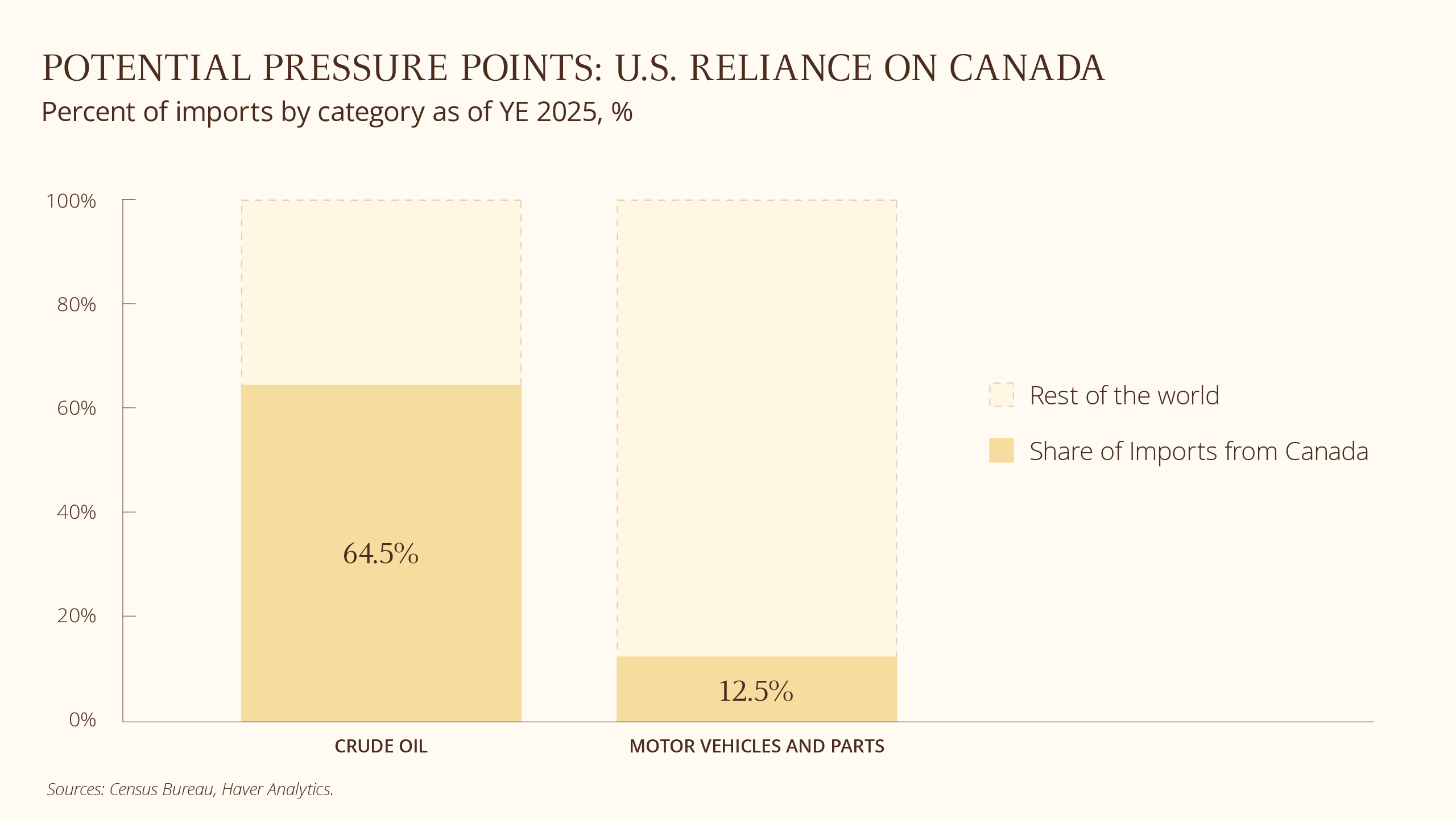
North American auto supply chains are tightly integrated, with 12.5% of total U.S. auto imports coming from Canada last year. Meanwhile, Canada accounted for 64.5% of U.S. crude oil imports in 2025. Thus, any tariff impact in these areas could have a more direct effect on headline inflation.

“The tariffs as they stand are a Canadian regional manufacturing story – hitting Quebec and Ontario hardest – not a U.S. macro story," Senior Markets Economist at J.P. Morgan Private Bank Joe Seydl said. "But watch the auto tariffs and Canadian oil as the two channels that could flip this benign picture quickly."

Why the first-round tariff impact looks limited – for now

Tensions escalated sharply after bilateral talks broke down, prompting the U.S. to announce a new round of 50% tariffs on $20 billion worth of Canadian goods – including wine, cement and hockey sticks – effective August 22, 2026.1 The implementation had been briefly paused amid negotiations, underscoring how fluid the policy path remains. President Donald Trump also threatened to raise tariffs on Canadian autos and auto parts to 50%, effective January 1, 2027.2

Canada responded by announcing “dollar for dollar” retaliatory tariffs on roughly $20 billion of U.S. goods – from steel and dairy to paper and appliances – that will go into effect on September 8, 2026. Tariff rates range from 15% to 50% on roughly 700 products.3

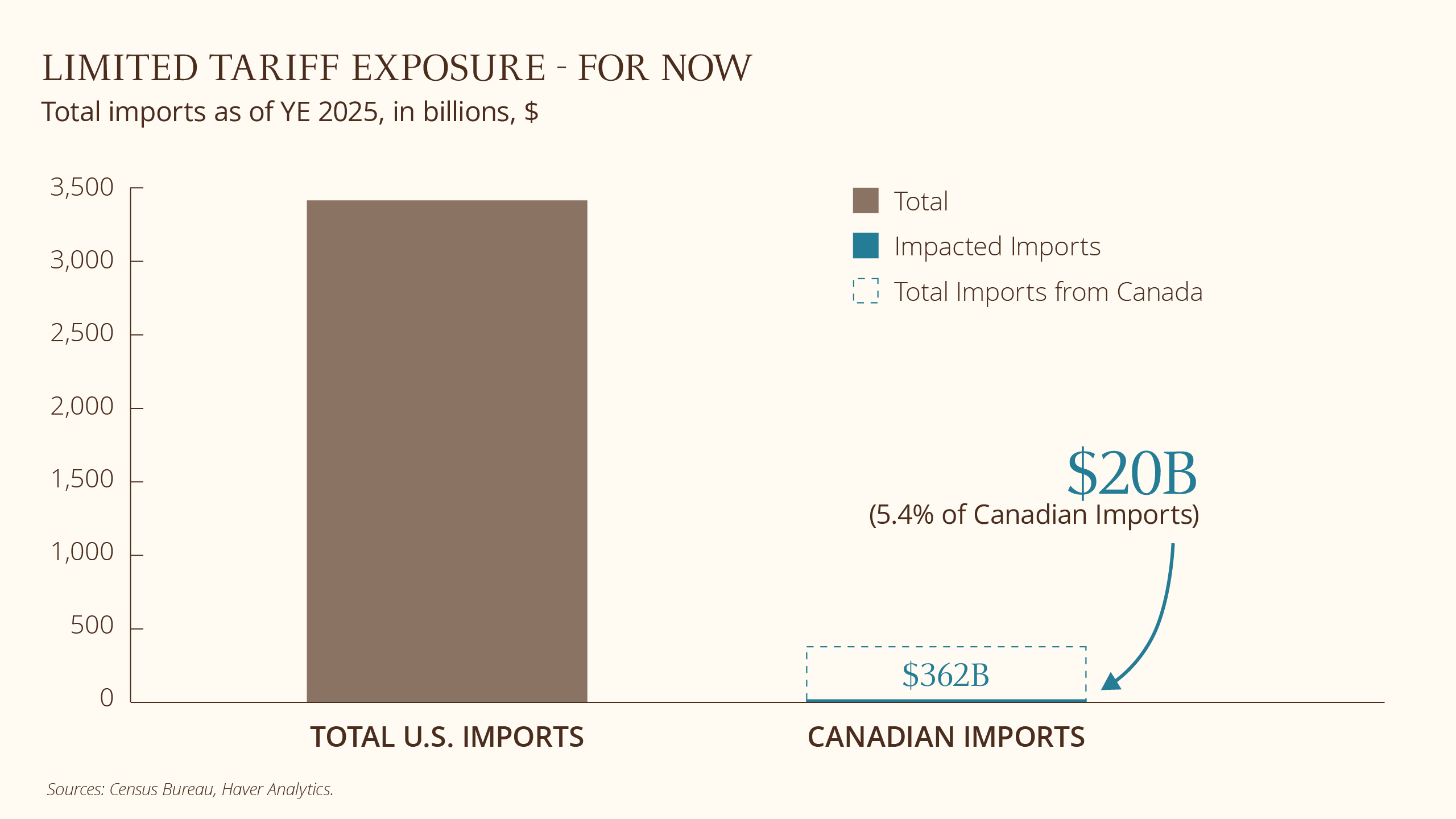
While the headline tariff numbers may seem daunting, they’re still small relative to the larger U.S. import base, as well as to the much broader basket of prices that drives inflation. As a result, these tariffs are more likely to raise prices in a few specific areas, rather than a meaningful shift in overall inflation.

This bar chart compares total United States imports with total imports from Canada as of year-end 2025.

The asymmetry of the trade relationship is another reason why strategists see limits to the potential tariff impact: Canada accounts for roughly 10% of U.S. total imports, while the U.S. takes roughly 70% of Canada’s total exports.4 While the U.S. relies heavily on specific Canadian imports like oil, Canada counts on the U.S. as its largest trading partner – and that interdependence could potentially limit broad-based escalation.

Finally, it can help to separate prices from inflation when considering the potential tariff impact. Tariffs can lift some prices without necessarily creating sustained, broad-based inflation pressure. For the U.S.–Canada tariffs to become a macro inflation issue, you’d typically see a much wider set of goods affected, meaningful spillovers into services and expectations, or a supply-side disruption large enough to ripple through multiple categories.

Autos: Where supply chains can turn trade policy into broader price pressure

The bigger risk, according to our strategists, is Trump’s threat of a 50% tariff on Canadian autos and related components. North American auto production is built on highly integrated cross-border processes, with parts and components crossing the U.S.-Canada border multiple times before a finished vehicle is assembled and sold. When trade measures influence that complex network, the risk shifts from isolated price effects to real operational friction – delays, rerouting, higher working capital needs and difficult sourcing decisions – that could ultimately impact both pricing behavior and production plans.5

The bar chart shows the percentage of United States imports from Canada in two categories: crude oil, and motor vehicles and parts

If auto tariffs broaden, investors may want to watch for where the impact shows up first: not only in prices for new and used vehicles, but also in the cost and timeline of repairs, maintenance and related services. Even without dramatic price changes, constrained supply or longer repair cycles can lead to pricing pressures on their own, thereby increasing the chance that manufacturers and dealers have to pass higher costs to consumers.

What would make autos meaningfully more concerning for the economic and inflation outlook is less the headline tariff rate and more the story behind it: whether the scope of tariffs expands beyond finished vehicles into parts and components; whether implementation timelines are tight with limited exemptions; and whether there’s clear evidence of companies raising prices broadly rather than absorbing costs through margins.

Energy: The faster pathway to an inflation complication

Our strategists view energy as the faster route from trade friction to inflation complication. Energy prices can move quickly, are highly visible to consumers and can influence inflation expectations more directly than many other channels. Canada’s role as the United States’ largest source of crude oil – with the former supplying nearly two-thirds of total U.S. imports – makes this channel different. Indeed, anything that meaningfully alters effective energy supply or introduces uncertainty around it can have an outsized impact on the overall U.S. economy.

“The key retaliatory lever is energy. … Any Canadian move to curb or cut off crude exports would be a genuine shock, and this is where a contained trade spat could turn into a macro event for U.S. energy prices,” Seydl said. “The U.S. energy situation is already stressed from the conflict in Iran, which has driven inventory depletion and maxed out refinery utilization.”

In plain terms, if trade tensions begin to affect energy flows, logistics or even the perceived reliability of supply, oil prices can become more sensitive. That can translate into higher gasoline and energy costs, which feed into headline inflation and, in turn, broader market sentiment. It can also spill into transportation-intensive costs across the economy, including freight, distribution, and select goods and services where energy is a meaningful input.

Here, too, the distinction is in the details. Our strategists would be more concerned if retaliation moves beyond symbolic tariff lists and into measures that touch energy flows or logistics, if energy price impacts appear persistent rather than brief and if higher fuel costs begin to show up repeatedly in transport-sensitive categories. That’s the threshold where a trade dispute is more likely to shift from headline noise to something that might plausibly complicate the inflation outlook.

The bottom line

In short, the recent round of U.S.–Canada tariffs look macro-light for the U.S. – more likely to create isolated price changes than a broad shift in the inflation trend. The bigger question is what comes next: Autos and energy are two areas directly affected by trade policy that could meaningfully complicate the inflation and growth outlook. Whether this turns into a broader macro issue will depend on how far tariff policy extends from here – and whether it begins to affect supply chains or energy in a sustained way. The clearest signal would be persistent cost pass-through, not a one-time price bump.

References

1.

The Wall Street Journal, “U.S. Imposes 50% Tariffs on Some Canadian Goods After Last-Ditch Talks Fail.” (August 22, 2026)

2.

CNBC, “Trump Says U.S. Will Hike Canada Auto Tariffs to 50% as Trade War Escalates.” (August 24, 2026)

3.

Department of Finance Canada, “Complete List of U.S. Products Subject to Counter Tariffs.” (August 26, 2026)

4.

U.S. Census Bureau, “Trade in Goods With Canada.” (Accessed August 27, 2026); Government of Canada Office of the Chief Economist, “Monthly Trade Report: December 2025.” (Accessed August 27, 2026)

5.

Council on Foreign Relations, “The Real Cost of the U.S.-Canada Trade Breakdown.” (August 27, 2026)

Connect with a Wealth Advisor

Reach out to your Wealth Advisor to discuss any considerations for your current portfolio. If you don’t have a Wealth Advisor, click here to tell us about your needs and we’ll reach out to you.

Connect now

IMPORTANT INFORMATION

This material is for informational purposes only, and may inform you of certain products and services offered by J.P. Morgan’s wealth management businesses, part of JPMorgan Chase & Co. (“JPM”). Products and services described, as well as associated fees, charges and interest rates, are subject to change in accordance with the applicable account agreements and may differ among geographic locations. Not all products and services are offered at all locations. If you are a person with a disability and need additional support accessing this material, please contact your J.P. Morgan team or email us at accessibility.support@jpmorgan.com for assistance. Please read all Important Information.

The price of equity securities may rise or fall due to the changes in the broad market or changes in a company's financial condition, sometimes rapidly or unpredictably. Equity securities are subject to 'stock market risk' meaning that stock prices in general may decline over short or extended periods of time. 

Changes in economic and market conditions, interest rate risk, and lack of liquidity may affect equity performance. Investments in equity structures entail certain risk factors and investments in commodities may have greater volatility than investments in traditional securities. The value of commodities may be affected by changes in overall market movements, commodity index volatility, changes in interest rates, or factors affecting a particular industry or commodity, such as drought, floods, weather, livestock disease, embargoes, tariffs and international economic, political and regulatory developments. Investing in commodities creates an opportunity for increased return but, at the same time, creates the possibility for greater loss. 

Diversification does not ensure a profit or protect against loss.  


GENERAL RISKS & CONSIDERATIONS
Any views, strategies or products discussed in this material may not be appropriate for all individuals and are subject to risks. Investors may get back less than they invested, and past performance is not a reliable indicator of future results. Asset allocation/diversification does not guarantee a profit or protect against loss. Nothing in this material should be relied upon in isolation for the purpose of making an investment decision. You are urged to consider carefully whether the services, products, asset classes (e.g. equities, fixed income, alternative investments, commodities, etc.) or strategies discussed are suitable to your needs. You must also consider the objectives, risks, charges, and expenses associated with an investment service, product or strategy prior to making an investment decision. For this and more complete information, including discussion of your goals/situation, contact your J.P. Morgan representative.

NON-RELIANCECertain information contained in this material is believed to be reliable; however, JPM does not represent or warrant its accuracy, reliability or completeness, or accept any liability for any loss or damage (whether direct or indirect) arising out of the use of all or any part of this material. No representation or warranty should be made with regard to any computations, graphs, tables, diagrams or commentary in this material, which are provided for illustration/reference purposes only. The views, opinions, estimates and strategies expressed in this material constitute our judgment based on current market conditions and are subject to change without notice. JPM assumes no duty to update any information in this material in the event that such information changes. Views, opinions, estimates and strategies expressed herein may differ from those expressed by other areas of JPM, views expressed for other purposes or in other contexts, and this material should not be regarded as a research report. Any projected results and risks are based solely on hypothetical examples cited, and actual results and risks will vary depending on specific circumstances. Forward-looking statements should not be considered as guarantees or predictions of future events.

Nothing in this document shall be construed as giving rise to any duty of care owed to, or advisory relationship with, you or any third party. Nothing in this document shall be regarded as an offer, solicitation, recommendation or advice (whether financial, accounting, legal, tax or other) given by J.P. Morgan and/or its officers or employees, irrespective of whether or not such communication was given at your request. J.P. Morgan and its affiliates and employees do not provide tax, legal or accounting advice. You should consult your own tax, legal and accounting advisors before engaging in any financial transactions.

Legal Entity and Regulatory Information.

J.P. Morgan Wealth Management is a business of JPMorgan Chase & Co., which offers investment products and services through J.P. Morgan Securities LLC (JPMS), a registered broker-dealer and investment adviser, member FINRA and SIPC. Insurance products are made available through Chase Insurance Agency, Inc. (CIA), a licensed insurance agency, doing business as Chase Insurance Agency Services, Inc. in Florida. Certain custody and other services are provided by JPMorgan Chase Bank, N.A. (JPMCB). JPMS, CIA and JPMCB are affiliated companies under the common control of JPMorgan Chase & Co. Products not available in all states.

Bank deposit accounts and related services, such as checking, savings and bank lending, are offered by JPMorgan Chase Bank, N.A. Member FDIC.

This document may provide information about the brokerage and investment advisory services provided by J.P. Morgan Securities LLC (“JPMS”). The agreements entered into with JPMS, and corresponding disclosures provided with respect to the different products and services provided by JPMS (including our Form ADV disclosure brochure, if and when applicable), contain important information about the capacity in which we will be acting. You should read them all carefully. We encourage clients to speak to their JPMS representative regarding the nature of the products and services and to ask any questions they may have about the difference between brokerage and investment advisory services, including the obligation to disclose conflicts of interests and to act in the best interests of our clients.

J.P. Morgan may hold a position for itself or our other clients which may not be consistent with the information, opinions, estimates, investment strategies or views expressed in this document.  JPMorgan Chase & Co. or its affiliates may hold a position or act as market maker in the financial instruments of any issuer discussed herein or act as an underwriter, placement agent, advisor or lender to such issuer.