

Version 1 - Primary Nav Search

Key takeaways

  • Oil prices have spiked in 2026: WTI crude is up about 68% and Brent crude is up about 84% from the start of the year through the end of September.
  • For investors, oil prices matter because they can feed into headline inflation – and that can influence bond yields, rate expectations and overall risk appetite.
  • Oil swings can change what’s leading in the stock market: When prices rise, the energy sector can benefit, while oil-sensitive industries can face cost pressures and volatility can increase.

Contributors

Sergei Klebnikov

Editorial Staff, J.P. Morgan Wealth Management

Oil prices so far in 2026 have risen sharply. West Texas Intermediate, or WTI crude (the U.S. benchmark), and Brent crude (the global benchmark) have moved higher this year as markets have weighed a familiar push and pull: concerns about supply versus questions about demand.1

On the supply side, oil has been especially sensitive to the ongoing conflict involving Iran and related disruption risks – from shipping and trade flows to sanctions and broader regional instability as energy facilities were targeted – which can quickly change how investors think about near-term supply. Decisions by OPEC+, comprising the Organization of the Petroleum Exporting Countries and its nonmember allies, have also mattered, since even small changes in expected production can shift the balance between a well-supplied market and a tighter one.2

On the demand side, the story has been about how fast the world economy is growing and whether higher interest rates are making it harder and more expensive to borrow. Those factors influence expectations for how much oil the world will use.

And while crude oil isn’t the same thing as gas at the pump, higher oil prices can contribute to higher gasoline and diesel costs over time, which can squeeze household budgets and affect spending.

“Oil doesn’t just affect what you pay at the pump; it can shape inflation and interest rates, which is why it often shows up in stock and bond markets at the same time,” J.P. Morgan Wealth Management Global Investment Strategist Mohammad Maaz Rehan said. “For most investors, the goal isn’t to trade every oil headline; it’s to stay diversified, understand where energy costs can pressure parts of your portfolio, and make sure your plan can hold up if inflation stays higher for longer.”

Oil prices in 2026 so far – a quick snapshot

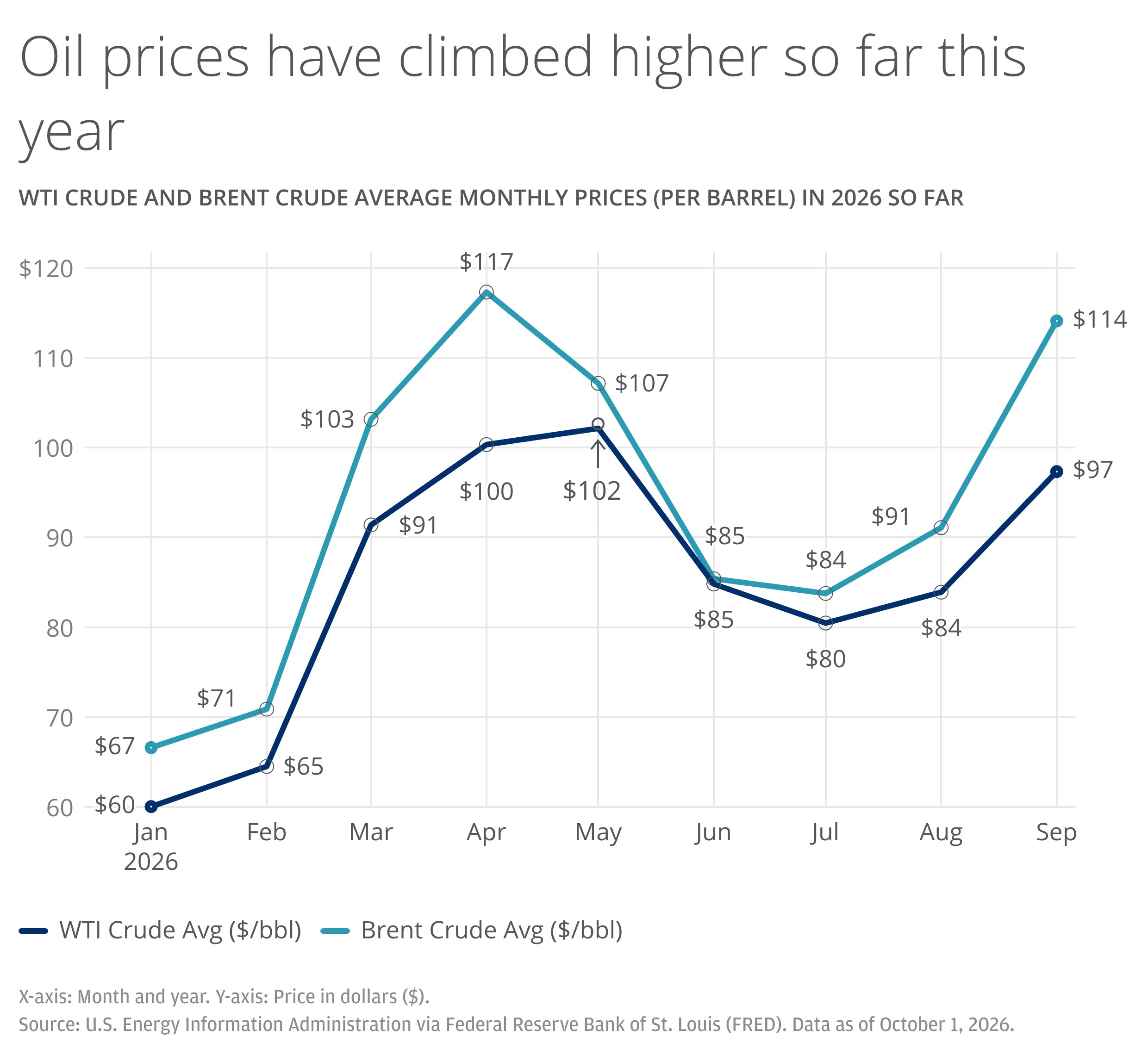
Oil has had a big year so far. From early-January lows to early-April highs, both benchmarks increased sharply – then pulled back in early summer before climbing again into September. Both WTI and Brent crude have had several months this year where prices averaged over $100 per barrel.

The line graph shows average monthly prices per barrel, stated in U.S. dollars, for two crude oil benchmarks – WTI crude and Brent crude – from January 2026 through September 2026, using a price scale from $60 per barrel to $120 per barrel.

While monthly averages smooth out day-to-day noise and make the broader trend easier to see, the table below captures the year-to-date (YTD) changes along with the highs and lows for each benchmark. According to daily prices between January and September, WTI ranged from about $56 to $115 per barrel, while Brent ranged from about $61 to $138 per barrel.3

WTI crude and Brent crude oil prices in 2026

Benchmark

WTI crude

Brent crude

Start of year

$57.21

$61.98

End of September

$96.16

$113.96

$ change in 2026

$38.95

$51.98

% change in 2026

68.08%

83.87%

YTD high

$114.58

$138.21

YTD low

$56.01

$61.08

Source: U.S. Energy Information Administration via Federal Reserve Bank of St. Louis (FRED). Data as of October 1, 2026.

What moved oil prices in 2026

Geopolitics and supply risk (Iran and key shipping routes)

Oil’s biggest moves in 2026 were shaped by the ongoing conflict with Iran and the risk of disruptions in critical Middle East shipping lanes – particularly the Strait of Hormuz, a chokepoint for a large portion of the world’s oil and liquefied natural gas (LNG) trade – because even the threat of interrupted flows can push prices higher quickly.4

OPEC+ policy

OPEC+ influenced prices in 2026 less through target announcements and more through what the market believed would actually reach buyers. The group signaled a path of modest monthly increases in output targets (an adjustment of about 188,000 barrels per day) through the summer, but real-world disruptions tied to the ongoing conflict with Iran meant production and exports were often well below quota.5

US supply and inventories

U.S. crude production trends and weekly inventory data can move prices as well, as they’re a frequent reality check on whether the market is tightening or loosening. When inventories draw down unexpectedly, that can support prices; when inventories build up, it can signal softer demand or rising supply.6

Global demand expectations, the US dollar and borrowing costs

Oil demand rises and falls with the global economic growth outlook, so signs of slower activity can cool prices after rallies. In early summer, softer global oil demand – especially tied to China and Europe – played a role as prices eased from earlier highs.7 A stronger dollar and higher borrowing costs have also weighed on demand expectations.

Why oil matters for investors

Energy is a direct input into everyday costs – including fuel, shipping and manufacturing – so when oil prices rise sharply, it can push headline inflation higher. That matters because markets don’t look at inflation in isolation; they translate it into expectations for interest rates and bond yields, which influence borrowing costs and valuations across the larger economy.

In 2026, for example, headline Consumer Price Index (CPI) inflation (measured year over year) rose from 2.4% in January to 3.4% in August.8 Investors have also seen a meaningful rise in longer-term yields this year, with the 10-year Treasury yield rising from 4.19% at the start of 2026 to 5.29% by the end of September.9 When oil is moving quickly, markets often reassess where inflation and rates could go next – and that can ripple across stocks, bonds and credit.

Higher oil prices can affect the market in different ways. When crude rises, energy producers and oil field services firms may benefit, because revenues can improve with higher prices. At the same time, higher fuel costs can squeeze margins for industries like airlines, transportation, chemicals and parts of the consumer discretionary sector.

The key nuance for investors is that the impact often isn’t uniform: Companies with stronger pricing power may be able to pass some costs through to consumers, while others may absorb them. Some firms also hedge fuel or commodity exposure.

Big moves in oil prices can increase market volatility, especially when driven by geopolitical risk or tied to global supply concerns. That’s in part because oil can impact both sides of the macro equation at once: It not only can add to inflation concerns but also can lead to uncertainty around economic growth. When that happens, oil spikes can temporarily change how different assets move together, including stocks and bonds.

Oil is global but priced in U.S. dollars, so changes can affect regions differently. Oil-importing economies can face more inflation pressure when prices rise, while oil-exporting economies may benefit from stronger energy revenues. Currency moves can also amplify those differences, since a stronger dollar can make oil more expensive for non-U.S. buyers as well as influence demand at the margin.

How to think about oil – without trying to trade it

Most investors don’t need to predict short-term oil moves to manage oil-related risk. Instead, a more practical approach is to treat oil prices as a useful signal for inflation, rates and certain parts of the market, without letting headlines drive big portfolio changes.

Start by checking sector concentration: You may be more exposed to energy, or to oil-sensitive industries, than you realize. Next, consider pressure-testing your financial plan, especially if you’re near or in retirement. If energy costs were to stay elevated for a stretch, would that change your spending assumptions or your need for short-term liquidity? Finally, it can be helpful to focus on diversification and discipline. Oil headlines can be dramatic, but portfolios often do best when changes are measured and aligned to a long-term plan rather than short-term forecasts.

For investors who want to understand where oil exposure can show up, common high-level exposures include energy sector funds, broad commodity funds and inflation-linked bonds. If you are unsure about your portfolio’s exposure to oil, consider speaking with a qualified financial professional.

The bottom line: What to watch for in the rest of 2026

Several signals are likely to matter most for where WTI and Brent crude prices go next – and how markets respond to those changes.

First, watch OPEC+ meetings and compliance. Announcements can move prices, but follow-through matters more, especially if actual exports don’t match what’s been signaled. Second, keep an eye on inventory trends and demand signals. Inventory drawdowns or buildups can act as a near-term reality check on whether the market is tightening or loosening, while demand indicators help clarify whether prices are moving on stronger consumption or on supply fears. Third, geopolitical developments and shipping constraints remain central – particularly any shifts that affect the reliability of flows through major routes.10

It can also be worth paying attention to refining constraints and product-market stress – not as a separate gas prices story, but because tightness in refined products can sometimes feed back into crude demand and pricing. It helps to remember that oil doesn’t trade in a vacuum: Inflation data and rate expectations can influence overall risk appetite, and that can either reinforce or dampen price moves.

Here’s a checklist of things to track as oil prices move:

  • Inflation implications: Is energy pushing headline inflation up or down in recent data?
  • Rate and yield implications: Are bond yields and rate expectations reacting to inflation pressure?
  • Likely sector leadership: Are energy-related areas leading, or are oil-sensitive industries showing signs of margin pressure?

Oil prices through the end of 2026 are likely to hinge on the balance between supply risk (geopolitics, shipping, OPEC+) and demand (growth, inventories), with inflation and rates shaping how markets digest each move.

References

1.

EIA via Federal Reserve Bank of St. Louis (FRED). Data as of September 30, 2026.

2.

U.S. Energy Information Administration (EIA), “Short-Term Energy Outlook – Global Oil Markets.” (September 9, 2026)

3.

EIA via Federal Reserve Bank of St. Louis (FRED). Data as of September 30, 2026.

4.

EIA, “Short-Term Energy Outlook – Global Oil Markets.” (September 9, 2026)

5.

CNBC, “OPEC+ Announces 188,000 Barrels-Per-Day Output Increase in First Meeting Without UAE.” (May 3, 2026); Reuters, “OPEC+ Oil Producers Set to Keep Output Targets Steady at Sunday Meeting, Sources Say.” (September 30, 2026)

6.

EIA, “What Drives Crude Oil Prices?” (Accessed October 1, 2026)

7.

Business Insider, “The Oil Market Has Moved From Fearing Shortages to Pricing in a Very Different Future.” (June 30, 2026)

8.

U.S. Bureau of Labor Statistics, “12-Month Percentage Change, Consumer Price Index, Selected Categories.” (Accessed October 1, 2026)

9.

Board of Governors of the Federal Reserve System via FRED, “Market Yield on U.S. Treasury Securities at 10-Year Constant Maturity, Quoted on an Investment Basis.” (Accessed October 1, 2026)

10.

EIA, “Short-Term Energy Outlook – Global Oil Markets.” (September 9, 2026)

Connect with a Wealth Advisor

Reach out to your Wealth Advisor to discuss any considerations for your current portfolio. If you don’t have a Wealth Advisor, click here to tell us about your needs and we’ll reach out to you.

Connect now

IMPORTANT INFORMATION

This material is for informational purposes only, and may inform you of certain products and services offered by J.P. Morgan’s wealth management businesses, part of JPMorgan Chase & Co. (“JPM”). Products and services described, as well as associated fees, charges and interest rates, are subject to change in accordance with the applicable account agreements and may differ among geographic locations. Not all products and services are offered at all locations. If you are a person with a disability and need additional support accessing this material, please contact your J.P. Morgan team or email us at accessibility.support@jpmorgan.com for assistance. Please read all Important Information.


GENERAL RISKS & CONSIDERATIONS
. 
Any views, strategies or products discussed in this material may not be appropriate for all individuals and are subject to risks. Investors may get back less than they invested, and past performance is not a reliable indicator of future results. Asset allocation/diversification does not guarantee a profit or protect against loss. Nothing in this material should be relied upon in isolation for the purpose of making an investment decision. You are urged to consider carefully whether the services, products, asset classes (e.g. equities, fixed income, alternative investments, commodities, etc.) or strategies discussed are suitable to your needs. You must also consider the objectives, risks, charges, and expenses associated with an investment service, product or strategy prior to making an investment decision. For this and more complete information, including discussion of your goals/situation, contact your J.P. Morgan representative.

NON-RELIANCE. Certain information contained in this material is believed to be reliable; however, JPM does not represent or warrant its accuracy, reliability or completeness, or accept any liability for any loss or damage (whether direct or indirect) arising out of the use of all or any part of this material. No representation or warranty should be made with regard to any computations, graphs, tables, diagrams or commentary in this material, which are provided for illustration/reference purposes only. The views, opinions, estimates and strategies expressed in this material constitute our judgment based on current market conditions and are subject to change without notice. JPM assumes no duty to update any information in this material in the event that such information changes. Views, opinions, estimates and strategies expressed herein may differ from those expressed by other areas of JPM, views expressed for other purposes or in other contexts, and this material should not be regarded as a research report. Any projected results and risks are based solely on hypothetical examples cited, and actual results and risks will vary depending on specific circumstances. Forward-looking statements should not be considered as guarantees or predictions of future events.

Nothing in this document shall be construed as giving rise to any duty of care owed to, or advisory relationship with, you or any third party. Nothing in this document shall be regarded as an offer, solicitation, recommendation or advice (whether financial, accounting, legal, tax or other) given by J.P. Morgan and/or its officers or employees, irrespective of whether or not such communication was given at your request. J.P. Morgan and its affiliates and employees do not provide tax, legal or accounting advice. You should consult your own tax, legal and accounting advisors before engaging in any financial transactions.

Legal Entity and Regulatory Information.

J.P. Morgan Wealth Management is a business of JPMorgan Chase & Co., which offers investment products and services through J.P. Morgan Securities LLC (JPMS), a registered broker-dealer and investment adviser, member FINRA and SIPC. Insurance products are made available through Chase Insurance Agency, Inc. (CIA), a licensed insurance agency, doing business as Chase Insurance Agency Services, Inc. in Florida. Certain custody and other services are provided by JPMorgan Chase Bank, N.A. (JPMCB). JPMS, CIA and JPMCB are affiliated companies under the common control of JPMorgan Chase & Co. Products not available in all states.

Bank deposit accounts and related services, such as checking, savings and bank lending, are offered by JPMorgan Chase Bank, N.A. Member FDIC.

This document may provide information about the brokerage and investment advisory services provided by J.P. Morgan Securities LLC (“JPMS”). The agreements entered into with JPMS, and corresponding disclosures provided with respect to the different products and services provided by JPMS (including our Form ADV disclosure brochure, if and when applicable), contain important information about the capacity in which we will be acting. You should read them all carefully. We encourage clients to speak to their JPMS representative regarding the nature of the products and services and to ask any questions they may have about the difference between brokerage and investment advisory services, including the obligation to disclose conflicts of interests and to act in the best interests of our clients.

J.P. Morgan may hold a position for itself or our other clients which may not be consistent with the information, opinions, estimates, investment strategies or views expressed in this document.  JPMorgan Chase & Co. or its affiliates may hold a position or act as market maker in the financial instruments of any issuer discussed herein or act as an underwriter, placement agent, advisor or lender to such issuer.


Check the background of our firm and investment professionals on FINRA's BrokerCheck

To learn more about J.P. Morgan Wealth Management’s investment business, including our accounts, products and services, as well as our relationship with you, please review our J.P. Morgan Securities LLC Form CRS and Guide to Investment Services and Brokerage Products.

This website is for informational purposes only, and not an offer, recommendation or solicitation of any product, strategy service or transaction. Any views, strategies or products discussed on this site may not be appropriate or suitable for all individuals and are subject to risks. Prior to making any investment or financial decisions, an investor should seek individualized advice from a personal financial, legal, tax and other professional advisors that take into account all of the particular facts and circumstances of an investor's own situation. 

This website may provide information about the brokerage and investment advisory services provided by J.P. Morgan Securities LLC ("JPMS"). When JPMS acts as a broker-dealer, a client's relationship with us and our duties to the client will be different in some important ways than a client's relationship with us and our duties to the client when we are acting as an investment advisor. A client should carefully read the agreements and disclosures received (including our Form ADV disclosure brochure, if and when applicable) in connection with our provision of services for important information about the capacity in which we will be acting.

INVESTMENT AND INSURANCE PRODUCTS ARE:
• NOT FDIC INSURED • NOT INSURED BY ANY FEDERAL GOVERNMENT AGENCY • NOT A DEPOSIT OR OTHER OBLIGATION OF, OR GUARANTEED BY, JPMORGAN CHASE BANK, N.A. OR ANY OF ITS AFFILIATES • SUBJECT TO INVESTMENT RISKS, INCLUDING POSSIBLE LOSS OF THE PRINCIPAL AMOUNT INVESTED

J.P. Morgan Wealth Management is a business of JPMorgan Chase & Co., which offers investment products and services through J.P. Morgan Securities LLC (JPMS), a registered broker-dealer and investment adviser, member FINRA and SIPC Insurance products are made available through Chase Insurance Agency, Inc. (CIA), a licensed insurance agency, doing business as Chase Insurance Agency Services, Inc. in Florida. Certain custody and other services are provided by JPMorgan Chase Bank, N.A. (JPMCB). JPMS, CIA and JPMCB are affiliated companies under the common control of JPMorgan Chase & Co. Products not available in all states.

Please read additional Important Information in conjunction with these pages.