
Key takeaways

  • Due to the recent government shutdown, the Labor Department delayed the release of November’s jobs data and incorporated employment figures from October despite not releasing a full report for the month.
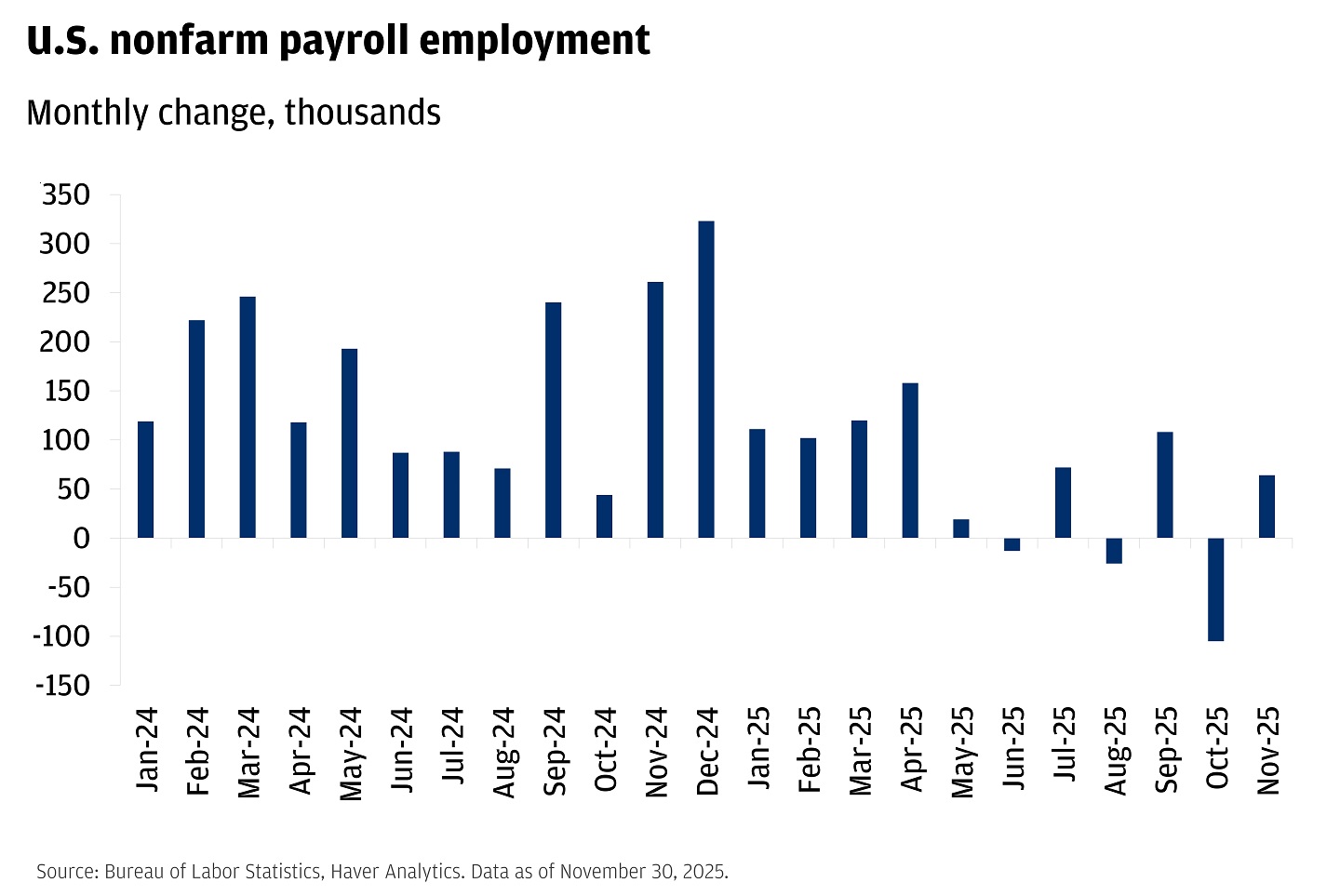
  • While the newly released October data revealed a decline of 105,000 jobs in the month, hiring resumed at a moderate pace in November with 64,000 jobs added, driven in part by the health care and construction industries.
  • The unemployment rate inched higher to 4.6% in November, up from 4.4% in September, while average hourly earnings growth slowed to 3.5% year-over-year.

Contributors

Seth Carlson

Editorial staff, J.P. Morgan Wealth Management

The release of the November jobs report marks another step in the gradual return of official government data measuring the health of the U.S. labor market after September’s report was delayed following a prolonged government shutdown. The shutdown scrambled the calendar and forced the Bureau of Labor Statistics (BLS) to stitch some employer data from October into the November package.1 Since this isn’t a standard report, the numbers require a closer look to understand what is really happening in the economy.

What’s different about the November jobs report?

Normally, the jobs report comes from two separate surveys. The establishment survey asks businesses about their payrolls to calculate the number of new jobs. The household survey asks individuals about their work status to calculate metrics like the unemployment rate. Both usually happen midmonth and give a snapshot of the labor market.

The prolonged government shutdown broke that rhythm, meaning a full October jobs report will never be published. The BLS skipped the household survey for October entirely. However, the agency managed to collect some retrospective data from businesses, which is why November’s report includes a look back at what employers did in October, alongside the new November numbers. It’s a double dose of data after a drought, but the gap in the household survey means there will always be a blind spot for October’s unemployment rate.

What did the November jobs report say?

Employers are hanging onto their workers but being cautious with hiring. The latest employment report showed a moderate pace of hiring in November as employers added 64,000 new jobs,2 only a fraction of the hiring in September (though that data largely surprised given the overall state of the labor market). The gains in November marked a turnaround from the October figures also included in the release, which showed a decline of 105,000 total nonfarm jobs,3 demonstrating continued pressure on the labor market following September’s stronger-than-expected gains.

Bar chart showing monthly change in U.S. nonfarm payroll employment from January 2024 to November 2025.

The unemployment rate ticked up slightly to 4.6% in November, up from 4.4% in September.4 The share of people working or looking for work, known as the overall participation rate, also ticked up from 62.4% to 62.5%.5

October’s Job Openings and Labor Turnover Summary (JOLTS) report, which sheds light on job openings, hirings and separations in the nonfarm sectors, showed employers hiring at a rate consistent with the period after the Great Financial Crisis, when the unemployment rate was roughly twice as high as it is today.6

The relative lack of hiring demand has slowed salary gains slightly, with average hourly earnings rising only 3.5% over the past year.7 Workers may be losing negotiating power for higher pay after years of staff shortages.

Which sectors hired the most in November?

The hiring picture remains split between industries that are accelerating and those that are pulling back. Health care and social assistance services led the way, adding 46,000 and 18,000 jobs respectively, as demand for health care workers continues to grow. The construction industry also showed strength, adding 28,000 positions.8

Which sectors were slowing down hiring in November?

Employment was most noticeably down in transportation and warehousing (-18,000 jobs) and has declined by 78,000 since achieving a peak in February. Federal government employment also extended its declines in November (-6,000), following a steep drop in October of 162,000 positions. However, it’s important to caveat that some federal employees opted for a deferred resignation.9

Elyse Ausenbaugh, Head of Investment Strategy at J.P. Morgan Wealth Management, explained how the decline in federal government employment is starting to catch up to overall payroll data.

“The October payrolls figure is jarring, but under the surface you can see how the impact of Department of Government Efficiency (DOGE)-related resignations in the Federal government employment category dragged the overall figure in a big way.” Ausenbaugh said. “Even if none of the other sectors showed robust growth throughout the fall, a three-month moving average figure of 75,000 [private-sector employment] is a solid pickup from the sluggish 15,000 pace we saw in the summer.”

What could November's jobs report mean for interest rates?

The Federal Reserve (Fed) lowered its policy rate last week and kept the message simple: Policy does not need big swings right now. The Fed cut interest rates by 25 basis points to incrementally bring down borrowing costs to increase business spending and hiring as unemployment picks up.

Ausenbaugh views the November jobs report as a potential indication of the Fed’s path forward.

“This report bolsters the way we have been thinking about the Fed’s current policy approach,” Ausenbaugh said. “The delivery of ‘insurance’ cuts over the past few months was prudent and brought rates to a more neutral level. One additional cut may be appropriate in the first quarter of 2026, but the economy looks stable enough to heed patience in taking additional action.”

In addition to the health of the labor market, the next few inflation reports will be critical in helping to determine future Fed policy.

What could the November jobs report mean for investors?

While some investors may be concerned about the volatility in the labor market, especially the revelation of a sharp decline in payrolls in October, the stock market reaction was initially muted.

The 2026 Outlook from J.P. Morgan Wealth Management’s Global Investment Strategy team flags three forces doing the heavy lifting in portfolios next year: artificial intelligence, a more fragmented global system and more volatile inflation. In that setting, broad diversification remains the practical choice.

Investors could benefit from keeping portfolios spread across asset classes and regions, rather than making big shifts on partial information. Volatile prices and a gentler Fed can pull markets in different directions at different times, which argues for balance and patience over bets on a single outcome.

The bottom line

The November jobs report helps give markets a more complete depiction of the labor market in the aftermath of the government shutdown, with the hope that job growth can continue improving modestly and in line with current trends. Investors can treat this release as a direction check, keeping an eye on the next inflation updates and jobs data for confirmation of the path forward for growth and inflation.

As always, consult a J.P. Morgan advisor to learn how these developments could affect your investing portfolio.

References

1.

Bureau of Labor Statistics. “Revised news release dates following the 2025 lapse in appropriations.” (Modified December 15, 2025)

2.

Bureau of Labor Statistics. “Employment Situation Summary” (December 16, 2025).

3.

Ibid.

4.

Ibid.

5.

Ibid.

6.

Bureau of Labor Statistics. “Job Openings and Labor Turnover Summary.” December 9, 2025

7.

Bureau of Labor Statistics, “Employment Situation Summary” (December 16, 2025)

8.

Ibid.

9.

Ibid.

Connect with a Wealth Advisor

Reach out to your Wealth Advisor to discuss any considerations for your current portfolio. If you don’t have a Wealth Advisor, click here to tell us about your needs and we’ll reach out to you.

Connect now

IMPORTANT INFORMATION

This material is for informational purposes only, and may inform you of certain products and services offered by J.P. Morgan’s wealth management businesses, part of JPMorgan Chase & Co. (“JPM”). Products and services described, as well as associated fees, charges and interest rates, are subject to change in accordance with the applicable account agreements and may differ among geographic locations. Not all products and services are offered at all locations. If you are a person with a disability and need additional support accessing this material, please contact your J.P. Morgan team or email us at accessibility.support@jpmorgan.com for assistance. Please read all Important Information.

GENERAL RISKS & CONSIDERATIONSAny views, strategies or products discussed in this material may not be appropriate for all individuals and are subject to risks. Investors may get back less than they invested, and past performance is not a reliable indicator of future results. Asset allocation/diversification does not guarantee a profit or protect against loss. Nothing in this material should be relied upon in isolation for the purpose of making an investment decision. You are urged to consider carefully whether the services, products, asset classes (e.g. equities, fixed income, alternative investments, commodities, etc.) or strategies discussed are suitable to your needs. You must also consider the objectives, risks, charges, and expenses associated with an investment service, product or strategy prior to making an investment decision. For this and more complete information, including discussion of your goals/situation, contact your J.P. Morgan representative.

NON-RELIANCECertain information contained in this material is believed to be reliable; however, JPM does not represent or warrant its accuracy, reliability or completeness, or accept any liability for any loss or damage (whether direct or indirect) arising out of the use of all or any part of this material. No representation or warranty should be made with regard to any computations, graphs, tables, diagrams or commentary in this material, which are provided for illustration/reference purposes only. The views, opinions, estimates and strategies expressed in this material constitute our judgment based on current market conditions and are subject to change without notice. JPM assumes no duty to update any information in this material in the event that such information changes. Views, opinions, estimates and strategies expressed herein may differ from those expressed by other areas of JPM, views expressed for other purposes or in other contexts, and this material should not be regarded as a research report. Any projected results and risks are based solely on hypothetical examples cited, and actual results and risks will vary depending on specific circumstances. Forward-looking statements should not be considered as guarantees or predictions of future events.

Nothing in this document shall be construed as giving rise to any duty of care owed to, or advisory relationship with, you or any third party. Nothing in this document shall be regarded as an offer, solicitation, recommendation or advice (whether financial, accounting, legal, tax or other) given by J.P. Morgan and/or its officers or employees, irrespective of whether or not such communication was given at your request. J.P. Morgan and its affiliates and employees do not provide tax, legal or accounting advice. You should consult your own tax, legal and accounting advisors before engaging in any financial transactions.

Legal Entity and Regulatory Information.

J.P. Morgan Wealth Management is a business of JPMorgan Chase & Co., which offers investment products and services through J.P. Morgan Securities LLC (JPMS), a registered broker-dealer and investment adviser, member FINRA and SIPC. Insurance products are made available through Chase Insurance Agency, Inc. (CIA), a licensed insurance agency, doing business as Chase Insurance Agency Services, Inc. in Florida. Certain custody and other services are provided by JPMorgan Chase Bank, N.A. (JPMCB). JPMS, CIA and JPMCB are affiliated companies under the common control of JPMorgan Chase & Co. Products not available in all states.

Bank deposit accounts and related services, such as checking, savings and bank lending, are offered by JPMorgan Chase Bank, N.A. Member FDIC.

This document may provide information about the brokerage and investment advisory services provided by J.P. Morgan Securities LLC (“JPMS”). The agreements entered into with JPMS, and corresponding disclosures provided with respect to the different products and services provided by JPMS (including our Form ADV disclosure brochure, if and when applicable), contain important information about the capacity in which we will be acting. You should read them all carefully. We encourage clients to speak to their JPMS representative regarding the nature of the products and services and to ask any questions they may have about the difference between brokerage and investment advisory services, including the obligation to disclose conflicts of interests and to act in the best interests of our clients.

J.P. Morgan may hold a position for itself or our other clients which may not be consistent with the information, opinions, estimates, investment strategies or views expressed in this document.  JPMorgan Chase & Co. or its affiliates may hold a position or act as market maker in the financial instruments of any issuer discussed herein or act as an underwriter, placement agent, advisor or lender to such issuer.