
Key takeaways

  • The U.S. added 50,000 jobs in December 2025, slightly below expectations. However, the unemployment rate ticked down slightly to 4.4%, a positive development amidst economic uncertainty.
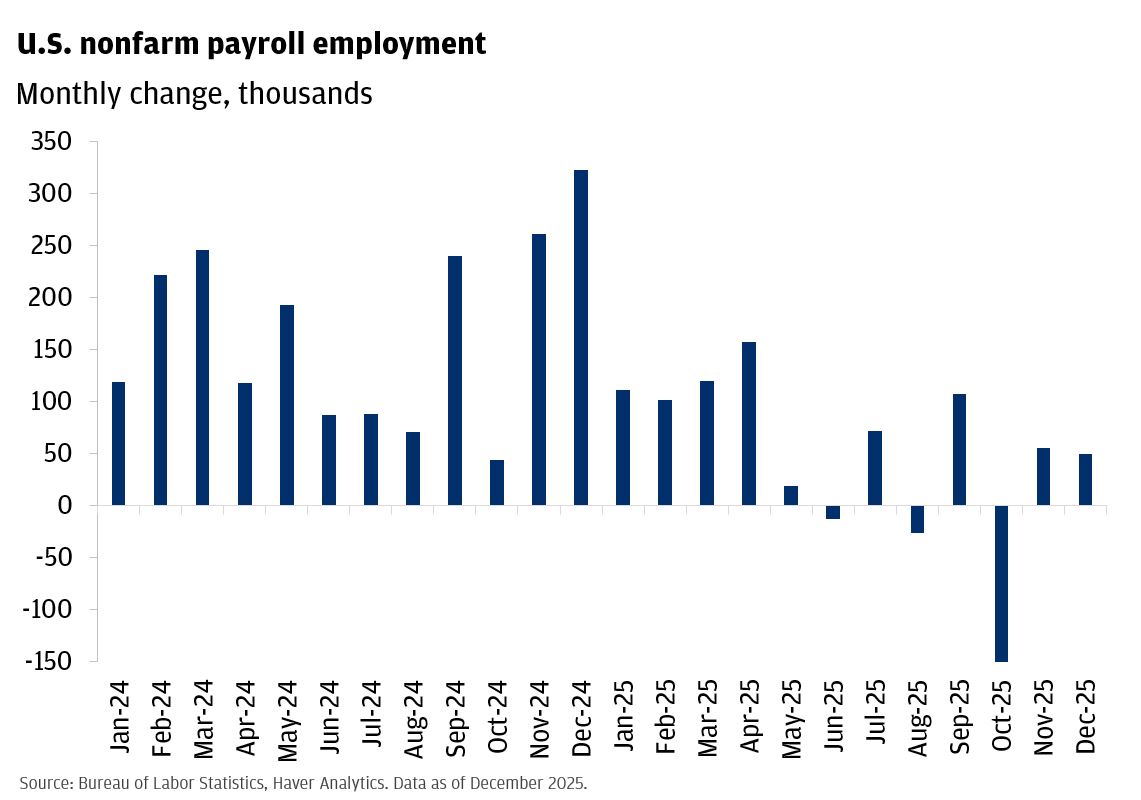
  • 2025 was the weakest year of employment growth in a non-recessionary year since 2003, according to the Bureau of Labor Statistics, but it likely won’t be enough to trigger another Federal Reserve rate cut in January.
  • Investors may want to focus less on the headline numbers and more on whether payroll growth, unemployment and wages are telling a consistent story about the economy’s direction.

Contributors

Seth Carlson

Editorial staff, J.P. Morgan Wealth Management


The U.S. labor market showed mixed signs in December, as investors and policymakers are paying attention to the last jobs data release of 2025.

The monthly jobs report carries added significance after a prolonged government shutdown caused a data blackout, limiting the availability of labor market indicators in recent months. Now that reporting has resumed, December 2025’s release provides an opportunity to assess whether the recent patterns of slowed hiring and moderating wage growth will continue into 2026.

What the US labor market showed at the end of 2025

Recent labor market data points to a job market that shows signs of stabilizing but is expanding more slowly than before. Indeed, the average monthly gain in private payrolls over the past six months has been just 43,000 jobs – well below the average pace experienced in 2024. At the same time, wage growth has continued to ease, with average hourly earnings up 3.8% over the past year.1

Importantly, the recent slowdown appears to indicate companies are pulling back on hiring rather than resorting to widespread layoffs. Employers seem to be holding onto their existing workers while waiting to see what happens with inflation and borrowing costs. That dynamic has helped prevent a sharp rise in unemployment, even as job creation has softened.

What did December 2025’s jobs numbers tell us?

The labor market finished the year on a sluggish note from a hiring perspective, as the U.S. added 50,000 jobs in December, down slightly from the revised 56,000 the month prior.2 Employment increased in the health care, food and services and social assistance sectors, while retail jobs declined.

The chart shows the monthly change in U.S. nonfarm payroll employment, measured in thousands, from January 2024 through December 2025.


That said, the slightly lower unemployment rate of 4.4% (down from 4.6% in November 2025) was a welcome development amidst lingering economic uncertainty.3

In addition, the December report offered insight into several areas that matter for markets and monetary policy. Here are three signals we’re watching.

Payroll growth

In his most recent press conference, Federal Reserve (Fed) Chair Jerome Powell said recent indicators suggest that “both layoffs and hiring remain low,”4 and he pointed to payroll growth that has slowed notably since earlier in the year. December’s jobs report seems to continue this trend, which could nudge the Fed toward staying on the sidelines in January.

The unemployment rate

After rising gradually since the summer, the unemployment rate ticked down in December, which was welcome. The trajectory of the unemployment rate will be key going forward. For the time being, the labor market has been defined as one of low hiring and low firing, which has resulted in slowing payroll gains but also a contained rise in the unemployment rate. J.P. Morgan Wealth Management’s Global Investment Strategy team believes that the unemployment rate should remain near current levels in 2026, but they will be watching closely for any signs of layoffs picking up pace.

Wage growth

Wage growth remains an important factor for inflation and Fed policy. Powell has indicated that moderating wage growth is one reason the economy does not appear to be growing too fast. If wage growth continues to ease, it would support the view that inflation pressures are cooling. However, a renewed acceleration could complicate the inflation outlook.

What the December jobs report could mean for the Federal Reserve

The December jobs data arrives as the Fed weighs still-elevated inflation against rising risks to employment. Recent rate cuts were intended to reduce the risk that slower growth and hiring turn into something more severe. This report shows softer, yet somewhat resilient labor conditions, which will likely give the Fed room to pause rate cuts at its first meeting in January. Furthermore, a pause would allow policymakers to evaluate how those earlier cuts are affecting the economy.

As Powell and other officials have emphasized, future policy decisions will depend on how incoming data evolves, with labor market trends playing a central role alongside inflation and consumer spending. Keep an eye on the next Consumer Price Index (CPI) release on January 13 to contextualize the snapshot of the U.S. economy’s overall health at the start of 2026.

The bottom line

While this month’s data may shape expectations for future employment trends and Fed policy, it's unlikely to provide any definitive answers on its own.

For investors, the key takeaway is context. Understanding how this report fits into broader labor and inflation trends matters more than the headline numbers themselves. As 2026 begins, it’s more important to focus on long-term trends rather than short-term fluctuations.

In this environment, diversification is often a good response to uncertainty. With slower growth, easing inflation and a cautious Fed pulling markets in different directions, maintaining balance across asset classes may help investors navigate short-term volatility without losing sight of longer-term goals.

To learn how economic developments may affect your investing strategy, consult with a J.P. Morgan advisor.

References

1.

Bureau of Labor Statistics, “Employment Situation Summary.” (January 9, 2026)

2.

Bureau of Labor Statistics, “Employment Situation Summary.” (January 9, 2026)

3.

Bureau of Labor Statistics, “Employment Situation Summary.” (January 9, 2026)

4.

Federal Reserve, “Transcript of Chair Powell’s Press Conference.” (December 10, 2025)

Connect with a Wealth Advisor

Reach out to your Wealth Advisor to discuss any considerations for your current portfolio. If you don’t have a Wealth Advisor, click here to tell us about your needs and we’ll reach out to you.

Connect now

IMPORTANT INFORMATION

This material is for informational purposes only, and may inform you of certain products and services offered by J.P. Morgan’s wealth management businesses, part of JPMorgan Chase & Co. (“JPM”). Products and services described, as well as associated fees, charges and interest rates, are subject to change in accordance with the applicable account agreements and may differ among geographic locations. Not all products and services are offered at all locations. If you are a person with a disability and need additional support accessing this material, please contact your J.P. Morgan team or email us at accessibility.support@jpmorgan.com for assistance. Please read all Important Information.


GENERAL RISKS & CONSIDERATIONS
Any views, strategies or products discussed in this material may not be appropriate for all individuals and are subject to risks. Investors may get back less than they invested, and past performance is not a reliable indicator of future results. Asset allocation/diversification does not guarantee a profit or protect against loss. Nothing in this material should be relied upon in isolation for the purpose of making an investment decision. You are urged to consider carefully whether the services, products, asset classes (e.g. equities, fixed income, alternative investments, commodities, etc.) or strategies discussed are suitable to your needs. You must also consider the objectives, risks, charges, and expenses associated with an investment service, product or strategy prior to making an investment decision. For this and more complete information, including discussion of your goals/situation, contact your J.P. Morgan representative.

NON-RELIANCECertain information contained in this material is believed to be reliable; however, JPM does not represent or warrant its accuracy, reliability or completeness, or accept any liability for any loss or damage (whether direct or indirect) arising out of the use of all or any part of this material. No representation or warranty should be made with regard to any computations, graphs, tables, diagrams or commentary in this material, which are provided for illustration/reference purposes only. The views, opinions, estimates and strategies expressed in this material constitute our judgment based on current market conditions and are subject to change without notice. JPM assumes no duty to update any information in this material in the event that such information changes. Views, opinions, estimates and strategies expressed herein may differ from those expressed by other areas of JPM, views expressed for other purposes or in other contexts, and this material should not be regarded as a research report. Any projected results and risks are based solely on hypothetical examples cited, and actual results and risks will vary depending on specific circumstances. Forward-looking statements should not be considered as guarantees or predictions of future events.

Nothing in this document shall be construed as giving rise to any duty of care owed to, or advisory relationship with, you or any third party. Nothing in this document shall be regarded as an offer, solicitation, recommendation or advice (whether financial, accounting, legal, tax or other) given by J.P. Morgan and/or its officers or employees, irrespective of whether or not such communication was given at your request. J.P. Morgan and its affiliates and employees do not provide tax, legal or accounting advice. You should consult your own tax, legal and accounting advisors before engaging in any financial transactions.

Legal Entity and Regulatory Information.

J.P. Morgan Wealth Management is a business of JPMorgan Chase & Co., which offers investment products and services through J.P. Morgan Securities LLC (JPMS), a registered broker-dealer and investment adviser, member FINRA and SIPC. Insurance products are made available through Chase Insurance Agency, Inc. (CIA), a licensed insurance agency, doing business as Chase Insurance Agency Services, Inc. in Florida. Certain custody and other services are provided by JPMorgan Chase Bank, N.A. (JPMCB). JPMS, CIA and JPMCB are affiliated companies under the common control of JPMorgan Chase & Co. Products not available in all states.

Bank deposit accounts and related services, such as checking, savings and bank lending, are offered by JPMorgan Chase Bank, N.A. Member FDIC.

This document may provide information about the brokerage and investment advisory services provided by J.P. Morgan Securities LLC (“JPMS”). The agreements entered into with JPMS, and corresponding disclosures provided with respect to the different products and services provided by JPMS (including our Form ADV disclosure brochure, if and when applicable), contain important information about the capacity in which we will be acting. You should read them all carefully. We encourage clients to speak to their JPMS representative regarding the nature of the products and services and to ask any questions they may have about the difference between brokerage and investment advisory services, including the obligation to disclose conflicts of interests and to act in the best interests of our clients.

J.P. Morgan may hold a position for itself or our other clients which may not be consistent with the information, opinions, estimates, investment strategies or views expressed in this document. JPMorgan Chase & Co. or its affiliates may hold a position or act as market maker in the financial instruments of any issuer discussed herein or act as an underwriter, placement agent, advisor or lender to such issuer.